Saturday, 19 August 2023

Other media can have Tubridy, but they can't have RTÉ

@wwaycorrigan

A bit of a parochial post this — Ireland is parochial. It's a link to my latest letter in the Irish Examiner about a payment scandal at the national broadcaster, RTÉ, largely, but not exclusively, revolving around one of its now former top presenters, Ryan Tubridy.

The letter was originally published online on 19 August 2023 at https://www.irishexaminer.com/opinion/yourview/arid-41208160.html.

RTÉ, I am open to offers to work as a radio presenter. And I'll do it for far less than 200,000 euros!
Other media can have Tubridy, but they can't have RTÉ: Wrong Way Corrigan's letter in the Irish Examiner about Ryan Tubridy and the RTÉ payment scandal.
Corrigan calls it.
__________________________________________________________
Listen to The Corrigan Cast podcast here.

Facebook: Wrong Way Corrigan — The Blog & IQuiz "The Bogotá Pub Quiz".

Tuesday, 15 August 2023

Cartagena: A costly Colombian Caribbean city but more relaxed than I'd remembered

@wwaycorrigan

[For an audio/vlog version of this blog story, click here.]

If you're looking for the definitive visitor's guide to Cartagena, this isn't it.

Cartagena: A costly Colombian Caribbean city but more relaxed than I'd remembered
Cartagena's tourist-heavy nature is a turn-off for some. It has its charms, though.
As one of Colombia's most popular tourist spots, much has been written about it. And because this popularity with Colombians and foreigners alike has seen it become one of the most expensive places in the country to visit, I hadn't been in a rush to go back. The last time I'd been there was in 2011, with my first visit in 2009.

Safe shores

That 2009 trip, accompanied by a Colombian friend who did most of the planning, saw me take in many of the tourist attractions, including a recommended day trip to one of the picturesque Islas del Rosario, Rosario Islands.

The beaches there are — or at least were — more pleasing to the eye than those around the city. This isn't to say the beaches in Cartagena, specifically the Bocagrande sector, are unpleasant. They're fine, no more, no less.

What had bugged me the most in Cartagena was the intensity of the beach vendors — they were far worse than the mid-30 degrees Celsius heat.

Alongside the selling of refreshments and tattoos of questionable quality, one would be offered a massage a minute. These masseuses were as annoying as mosquitoes buzzing around your ear in the middle of the night.

On this latest visit, such vendor force was, thankfully, nowhere near as powerful. Maybe I just got lucky with my timing. Or maybe I was unlucky in 2009 and 2011.

The fact that there was much more of a relaxed vibe for the three consecutive mornings/early afternoons I spent on Bocagrande's western beach, does suggest it has become a little more tranquil. It could be said the ambience is like the surrounding waters, rather calm with only the occasional wild-ish wave.

Indeed, much to my pleasant surprise, I discovered that it was fine to leave my belongings on the beach while I went for a refreshing dip in the sea.

Initially, not only had I asked neighbouring loungers to keep an eye on my stuff but I also gathered it up and left it beside them. No dar papaya and all that.

Yet, I soon noticed that hardly anyone else was being as cautious. Considering how important this sun, sea and sand tourism is to Cartagena, especially in the upmarket Bocagrande, it seems opportunistic thievery has been largely eradicated.

However, in Bocagrande one gets robbed in another, officially sanctioned way: the high prices. For example, a beer on the beach costs around 10,000 COP for a 330-ml bottle of the working-man's Aguila brew. That's four times more than the standard price.
'I found it rather curious that El Guerrero's TV gave us live pictures of the toilet. What would one be up to on the loo besides relieving oneself?'
As mentioned, though, Bocagrande is upmarket in what is a Caribbean tourist hotspot. So there's nothing too shocking about the higher prices.

Those on a tighter budget will most likely opt to stay in Cartagena's historic centre or in the chilled-out Manga neighbourhood.

(Regular readers might be surprised to discover that I stayed in Bocagrande, in the four-star Hotel Cartagena Plaza. Don't worry, it's not that I lost my mind and went on a mad spending spree. At a press conference in Bogotá earlier this year, I won a three-night stay there. As fancy hotels go, it was fine. I certainly made the most of the decent spread of food at the buffet breakfasts.)

When my three nights were up at the Cartagena Plaza, it was to Manga I went and the quaint San Jacinto hostel. A dorm bed at 40,000 COP per night, light breakfast included, is about the best value one will get in the city.

The Guerrero of Getsemani

My evening socialising throughout my stay was reserved for the historic centre, inside the old walled city, around Plaza de la Trinidad in the Getsemani barrio to be precise. Well, there and a couple of brief visits to the more unkempt Mercado de Bazurto, the working class's shopping district.

Outside of the centre's liveliness come sunset, there I found a tienda, El Guerrero, that sold litres of my preferred Poker beer for 6,000 COP. That's an acceptable price anywhere in Colombia — except in my local watering holes in my Bogotá barrio — never mind Cartagena. (Do note, even though my bed and breakfast was free for my first three nights, I was still in Cartagena on a tight budget.)

While El Guerrero is popular with revellers — not surprising considering the booze prices — most buy their tipple to drink outside. As is my wont, I positioned myself in a corner at the counter, allowing me to chat with the employees/owners.

I did find it rather curious that the TV in the tienda, via the security camera, gave us live pictures of the toilet. What would one be up to on the loo besides relieving oneself? It did, nonetheless, give another, um, solid reason not to be glued to the box.

WC watching aside, El Guerrero was certainly an interesting place to observe the comings and goings of the diverse folk traipsing around Cartagena's colonial quarter.

Just outside the centre is Castillo de San Felipe de Barajas, a castle constructed by African slaves under Spanish supervision in the 16th century.
'It was nice to view and enter the sea for the first time since 2018.'
I'm fairly sure that I visited this tourist site for free in 2009, although perhaps my memory is failing me on that one. These days, there's what I consider a fairly hefty entrance fee, 30,000 COP. I gave it a miss this time; the long queues waiting to get in were off-putting, too.

Now, that I enjoyed my stay in the city may be because I went there with low enough expectations. That and the fact that I generally look forward to any escape from Bogotá these days.

As this story has explained, though, there's more to it than that. And in a more basic sense, it was simply nice to view and enter the sea for the first time since 2018.

Sticky stopover

The biggest drawback is getting there from Bogotá, as I detailed in Colombia's plebeian transport: A riveting ride.

As mentioned in that piece, I broke up the marathon return journey with a night-and-day stay in Aguachica in the Cesar department, about halfway between Cartagena and Bogotá.

Well inland at a low altitude, temperatures reach the mid-30s in degrees Celsius.

With hardly a breeze about and no nearby refreshing waters to cool off in, it's one of those places where you could take a shower every hour to stay feeling fresh. I don't particularly mind that, it's just that the town seems to have little going for it. Again, this generally isn't a drawback for me, I can create my own fun.

It must get plenty of visitors all the same, for whatever reason. There are hotels on pretty much every street. It also has an abundance of barbershops and hairdressers.

What annoyed me the most during my brief stay there were the motorbike taxis. They won't leave a wanderer in peace.

I probably need a second, longer visit to give a more rounded review of the place. Like my Cartagena experiences, my opinion of Aguachica might get better with subsequent stays. Return visits are unlikely, all the same.

However, if Hotel Cartagena Plaza wants to gift me more free nights on the Caribbean shores, I could include another stay in Aguachica en route. It certainly does its job as a fairly cheap stopover town.
__________________________________________________________
Listen to The Corrigan Cast podcast here.

Facebook: Wrong Way Corrigan — The Blog & IQuiz "The Bogotá Pub Quiz".

Tuesday, 8 August 2023

Colombia's plebeian transport: A riveting ride

@wwaycorrigan

[For an audio/vlog version of this blog story, click here.]

'Why are you going by bus when flights are cheap?'

That's how some Bogotá acquaintances reacted when they heard I was taking the land route for my grand return after a 12-year absence to the Caribbean coast city of Cartagena, over 1,000 kilometres away from the capital

Fare deal

Considering the bus journey takes about 26 hours while the flight time is an hour or so, flying certainly has its advantages. Price, though, is not one of them.
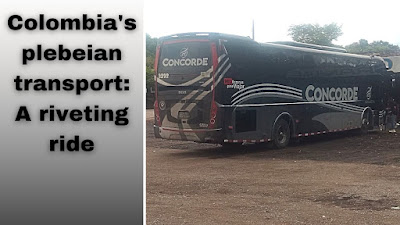
Colombia's plebeian transport: A riveting ride
There's rarely a dull moment when bussing it in Colombia.
Domestic airfares were similar to, even occasionally cheaper than, bus fares during Colombia's low-cost carrier heydey, from 2016 to 2020, roughly speaking. However, with the rather curious departure of Viva Air, closely followed by Ultra Air, bus travel is once again a lot cheaper; generally less than half the price of flight tickets.*

For sure, if it is a time-is-money case at the origin or at the destination — or at both — then the financial savings made by taking the bus would most likely be wiped out in a matter of hours.

In a year of scant paid work, this hasn't been a concern for me. Indeed, taking a little bit more time to get to and from the destination, and thus being out of Bogotá for longer, is a minor bonus.

Land travel also allows for more flexibility and last-minute decisions. Simply turn up at the bus terminal at the moment you want to travel, pay in cash and go. It's often more hectic during religious/school/state holidays, times I tend to avoid in any case.

Another advantage is that you can view the scenery and get a flavour of the towns along the way, fleetingly as this is. (Although, some food/toilet breaks are taken in towns rather than at isolated and expensive service stations and restaurants well outside urban centres. Stopping in a town means one has a bit of choice when it comes to snacking.)
'I had a mildly drunk middle-aged man for company for, mercifully, a short period. What he lacked in stature he made up for in fidgetiness.'
As has often happened with me, one bus journey to a certain destination, um, paves the way for the next trip, in a that-place-I've-just-passed-through-looks-interesting sense.

On this escape to Cartagena, the town of Aguachica in the Cesar department made it onto my to-visit list. I duly did just that, spending a night and day there to break up the return journey to Bogotá. I plan to write more about hot and sticky Aguachica in a later post.

Road reading

Coming back to the benefits of long-haul land travel, it appears that even a mammoth bus trip of 26 hours still leaves one with a smaller carbon footprint than a flight of one hour.

Of course, many of those shouting the loudest about the impending doom due to climate change are too busy saving us all to have time to focus on their own environmentally harmful practices. They are, after all, statistically safer in the air, too. We can't risk further endangering humanity by putting the lives of these heroes at greater risk, can we?

Notwithstanding all the above, as somebody who can be quite restless, I don't exactly look forward with great joy to spending hours locked up in a metal box.

This is offset by the fact that I am travelling, I am going somewhere — when not stuck in traffic, that is — while the dead time gives ample opportunity for reading and pondering.

What one can't really plan for is the aforementioned traffic.

In Colombia, alongside standard causes of congestion such as the sheer volume of vehicles and roadworks, there's also the potential road blockages. These can be natural, i.e. landslides, or human-made in the form of disgruntled workers, social groups or rebel fighters. The latter is not as common as it once was but can still cause disturbances in certain regions.

Noisy neighbours

Another uncontrollable is fellow passengers. Previously, I had a mother with a couple of young kids seated next to me, kids who at one moment would roam over me, the next bawl out, then they'd spew out; sometimes it was all three at once. Rent-a-dad, eh?

On this latest trip, I had a mildly drunk middle-aged man for company for, mercifully, a short period. What he lacked in stature he made up for in fidgetiness. I did contemplate trying to put him to sleep with a knock-out blow. His stop came just in time.

The near neighbours aren't always a pain, though.

Again, on this most recent journey, it was because of Barranquilla-bound student Pleasant Paola and her talking up of Aguachica, her hometown where she boarded the bus, that led me to visit the place on my return from Cartagena. Her gifting me of a piece of torta de tres quesos, 'three cheeses cake', from the pastry shop La Tortería where she works during college holidays left an impression.

Now, while it's a lottery as to who sits next to you when travelling solo, it's not a complete free for all. On most long-haul/overnight trips, each passenger is assigned a seat. Yet, there's nearly always some dispute and subsequent musical chairs mid-journey.

The seemingly simple solution of insisting people take the seat number stipulated on their ticket doesn't always work. Double bookings appear to be a frequent occurrence. Nonetheless, a lot of the time it's purely because passengers, knowingly or ignorantly, take a different seat.
'Our competitor bus, firmly focused on the duel, unperturbed by pedestrians, managed to squeeze ahead and stop in front of us, blocking our way.'
On-board entertainment had been another contentious issue — anyone for another ire-raising Fast & Furious movie? — but it seems many bus operators are now leaving that, literally, in the hands of the passengers and their smartphones.

Newer buses with some companies now also come with seat-back screens with various entertainment options so the individual can choose what to watch, listen to or play. Or silently opt-out. I've experienced these screens with Berlinas and Expreso Brasilia.

Knight driving

Now, even if you get the perfect fellow passengers and non-invasive entertainment, the bus drivers will invariably take you on an emotional — and physical — rollercoaster.

In keeping with the Colombian motorist standard, the bus drivers' overall aim is to push the boundaries of land travel. Passengers, if thought of at all, are merely pawns.

I was privileged to have front-row seats to the duel between my bus, from the Concorde company, and bitter rival Copetran; a modern take on the medieval game of jousting.

It took place on the rather narrow road between Barranquilla and Cartagena. One of the notable feats was a daring act of undertaking by our Concorde driver.

In fact, I thought it was the clincher. Concorde, true to its name, sped away. You can't, though, keep a good Copetran down.

In a busy town en route, our competitor bus, firmly focused on the duel, unperturbed by pedestrians, managed to squeeze ahead and stop in front of us, blocking our way.

In a highly controversial move, the rival driver alighted his charge and approached the window of our Concorde conductor. Not only did he fire angry words at our driver but he also dealt him a slap in the jaw, mild as it was. I believe that left it in a tie. Dates for the rematch have yet to be announced.

The things one misses out on when flying, eh?

Train of thought

Outside of happenings on the bus and between rival buses, Colombia's road infrastructure is another challenge.

For sure, the Andes present their own unique problems, such as the aforementioned landslides.

Yet, on the journey from Bogotá to the Caribbean, after entering the Cesar department at the town of San Alberto, the mountains give way to low-lying plains. Here you get the first significant stretch of dual carriageway since Bogotá-Tunja.

The frustrating part is that this dual carriageway is intermittent. What makes this frustration worse is that all along the way are unfinished works.

They are all part of the Ruta del Sol, Route to the Sun project, mired in controversy and corruption as it has been for years. So all along one is given reminders of how much shorter the journey could be if only the works were finished.

If it takes me another 12 years to return to Cartagena, the route might be fully ready by then.

Or maybe Colombia will come to embrace the joys of modern, efficient train transport. Let's resurrect the railways!

*A note on prices: I paid 130,000 COP for a one-way direct trip from Bogotá's northern bus terminal (Calle 192) to Cartagena with Concorde. The return trip was more expensive as I did it in two legs. It was 80,000 COP from Cartagena to Aguachica with Copetran and another 80,000 COP with Brasilia from Aguachica to Bogotá.
__________________________________________________________
Listen to The Corrigan Cast podcast here.

Facebook: Wrong Way Corrigan — The Blog & IQuiz "The Bogotá Pub Quiz".

Wednesday, 26 July 2023

Tight times with no respite in sight

@wwaycorrigan

[For an audio version of this blog story, click here.]

To a man, woman and non-binary individual, practically all Colombians I talk to echo my sentiments that it's been a difficult year income-wise.

Tight times with no respite in sight: But deals on the staples in Bogotá can always be found.
Thankfully, there are always a few deals to be found in Bogotá's ubiquitous local fruit and veg shops.
Of course, many people say that their financial situation is tight even if the reality is different. It's usually best not to give the impression that one has a cash cushion to fall back on, especially in Colombia.

Where the stats lie

Zooming out to the national level for a moment and looking at the chief indicators, Colombia's economy, in layperson's terms, can be described as 'doing OK but could do better.' (See https://issuu.com/oecd.publishing/docs/colombia-oecd-economic-outlook-june-2023?fr=sY2U1ZTUwNTY2MTA.)

The official unemployment rate, at just over 10 per cent, is comparable to the average figure in the years immediately before the pandemic. Do note, high informal labour levels have to be factored in when discussing the numbers that are truly unemployed in Colombia.

Whatever the case, such headline figures only give a very rough idea of how things are for the individual. A country's overall economic performance, be it good, bad or mediocre, doesn't mean the entire population is in the same situation.

For sure, high interest and/or inflation rates have a real-life impact. They can alter consumer behaviour in both negative and positive ways.

However, it can be argued that these are less crucial factors in low- to middle-income nations such as Colombia. What I mean by this is that times are almost always tight for the typical working-class barrio resident, particularly in the cities, with rainy-day funds almost non-existent.

Recession proof?

As a single, childless foreigner with a fairly minimalist lifestyle, I am perhaps not the best sample case to study for an idea of how Colombia's current economic performance is affecting the average working-class person.

For one, the high inflation rates that Colombia has been experiencing haven't had a noticeable impact on my cost of living.
'In Bogotá, in my circles in any case, it appears to be a tough time to be an independent worker. Is it ever any other way?'
In the last 18 months, my rent has increased by less than two per cent. What's more, I am actually paying less in rent today than I was in 2020 and 2021. I did, though, change accommodation quite a bit. Also, if I felt a little more financially secure I'd be seeking my own place — I just can't justify the additional cost of such a luxury right now.

As for expenditure on the staples, while some things have got notably more expensive, my weekly spend hasn't shot up in line with inflation. There's always a deal or three to be got at the local fruit and veg shop. One just needs to be flexible with one's diet

Scare necessities

It's my earning power, as mentioned in the opening lines, that has waned considerably of late. In this, I may make common cause with my barrio buddies who work independently, mostly in the construction sector. Patiencepaciencia, has been our word of the year.

In Bogotá, in my circles in any case, it appears to be a tough time to be an independent worker. Is it ever any other way? Unlike most of my barrio acquaintances, however, one obstacle for me is that I'm a bit too picky about what I want to work at.

My reluctance, nay refusal, to return to English teaching is a major reason why the number of pesos refilling my pocket has plummeted. I've spent more than I've earned in each month of 2023 thus far. This looks unlikely to change in the foreseeable, particularly with a trip to my birthplace in the offing.

Thankfully, I have some savings that are generating a little bit of interest, partially offsetting my monthly losses. However, such financial management, to state the obvious, is unsustainable unless I decide to live rent-free on the street or suchlike.

That yet-to-be-booked journey back to Ireland is an opportunity to reset; it should allow for a thorough reappraisal of my situation.

For various reasons, as I recently explained, such a re-evaluation has been difficult to undertake in my current Bogotá beat. It hasn't been infusing me with energy and enthusiasm — although the city itself can't take all the flak for that.

On the other hand, a return to Ireland scares me somewhat. In my, um, rare angry moments, watching from afar, I see an overpriced, illiberal-liberal, smug state (I thought the English were meant to be the smug ones?). Ireland Inc. is unlikely to be perturbed by such proclamations all the same.

Be that as it may, regardless of where I am in the world I face the same rather disconcerting question: What do I do to not only make ends meet but feel somewhat fulfilled as well? (Feel free to leave your answers to that one in the comments section!)

Leaving behind what has been life on Mediocre Lane in Colombia might just lead me to Awful Alley. Then again, it could be the way to that lesser-spotted Easy Street. Time to set forth and find out while I still can.
__________________________________________________________
Listen to The Corrigan Cast podcast here.

Facebook: Wrong Way Corrigan — The Blog & IQuiz "The Bogotá Pub Quiz".

Tuesday, 18 July 2023

Exacting revenge

@wwaycorrigan

[For an audio version of this blog story, click here.]

In a memorable episode — few were forgettable, in fairness — of the hit 1990s TV sitcom, Father Ted, the no-nonsense, hot-tempered Bishop Brennan gets a kick up the posterior from the comedy classic's title character.

Exacting revenge: Constantly thinking of revenge can be fatiguing.
Revenge: It's often best put on the long finger.

Dazed and enraged

Ted was forced into this almost-suicidal shoe of strength after being exposed as a cheat while managing a football team against his arch-rival priest, Dick Byrne. Kicking Bishop Brennan up the arse was the forfeit.

When a near-perfect scenario arises where the deed can be carried out, Ted duly delivers the hit.

Considering the fear he instils in his inferiors, Bishop Brennan can't believe what's happened.

The next few scenes show His Grace in a stupor as he makes his way to Rome for an audience with the Pope. It's only at the Vatican, facing Pope John Paul II, that Bishop Brennan snaps out of this stupor and realises that he did indeed get kicked up the arse.

Cue a rush back to Ireland to confront Father Ted.

A slapstick comedy this show may have been, yet I often find myself referring to it for solace, of sorts. That and the fact that many of its silly scenes accurately reflect real life.

While I haven't been in a stupor to the extent Bishop Brennan was, I have been regularly distracted by thoughts of an episode that has, or at least had, left me disillusioned. (See both The fiendish frenemy and Bogged down in Bogotá for more on that.)
'What had made the rage so acute was the belief that outside of, unwisely, taking matters more firmly into my own hands, I felt rather powerless.'
That the borrower in my previously documented money-lending saga has started to re-engage in the repayment process is helping to lessen the disillusionment.

I did also, à la Bishop Brennan, have my snap-out-of-it moment, the result of which was a verbal attack — or two — on my loanee friend/frenemy. It appears to have cleared the heavy air that had, understandably enough, existed between us, although at the time it seemed like it had finally put an end to any pretence of friendship.

Power struggle

Nonetheless, this whole loan affair has left a sour taste. It's likely to linger for quite a while. What's more, as alluded to, there is still money to be repaid.

Yet, those feelings of rage with an accompanying desire to exact revenge of some sort have dissipated.

What had made such feelings so acute was the belief that outside of, unwisely, taking matters more firmly into my own hands, I felt rather powerless. An omnipotent Bishop Brennan dealing with an unruly understudy I was not.

Sure, the borrower and I had signed a legally binding document but going the legal route to get this money repaid would most likely result in more pain rather than any pay, particularly in Colombia.

The only viable approach I've had throughout, without potentially creating more problems, has been to play the waiting game.

A couple of verbal shots fired in frustration aside, this is largely how I've played it. I have been fairly patient and understanding, if I do say so myself.

However it finally plays out, enough has happened thus far to ensure this money-lending episode will live long in the memory. It's been a kick in the posterior one has to learn from.
__________________________________________________________
Listen to The Corrigan Cast podcast here.

Facebook: Wrong Way Corrigan — The Blog & IQuiz "The Bogotá Pub Quiz".

Tuesday, 11 July 2023

Fattening up our future health problems

@wwaycorrigan

[For an audio version of this blog story, click here.]

Fattening up our future health problems with ultra-processed foods.
What exactly are we putting into our bodies?
Of all the subjects I may be deemed unqualified to comment on, parenting is surely one of them.

It's easy for me, a childless man, to be idealistic, to condemn what I believe to be poor parenting practices and be convinced that I would do things differently, for the better, if I were a father. Let's see how I'd fare if I were, quite literally, left holding my own baby (previous bouts of babysitting don't really count).

Intoxicating toddlers

Nonetheless, these days only the ignorant, indifferent or negligent would let their defenceless newborns regularly consume ultra-processed and/or sugar-laden, unnaturally sweetened foods. Numerous studies highlight the potential harm to our health in such eating.

If the parents want to indulge in unwholesome fare, that's their choice — I am, like many, far from squeaky clean when it comes to what is considered healthy eating. But actively encouraging toddlers to down soft drinks or some candy with an ingredient list the length of a children's book, is both sad and worrying to see.

Why not hand them a cigarette and a bottle of beer while at it? Both are generally less processed in any case.

In a Colombian context, it can be argued that, in some sectors of society, there is a lack of knowledge as to what makes up a good diet. 'Food is food, just get it into ya.'

What's more, even for a well-read individual, there isn't full consensus in the medical/scientific community as to what a healthy diet is. The information available can be quite confusing and, at times, contradictory.

Fake food

Where there is widespread consensus, though, is on the harms of ultra-processed foods. It's generally agreed that whatever we eat, try to eat it as close to its most natural form as possible.

The ideal would be to cultivate your own food, where you control how it's grown or reared. Modern life makes such a scenario next to impossible for most of us.

So we have to try to make the best of a far-from-optimal situation.

I've written before about the abundance of relatively cheap fresh fruit and veg in Colombia. For those of a more carnivorous persuasion, the country is not lacking in that department either. (How pumped full of potentially nasty chemicals all these are is another matter.)
'While fat-shaming is seen as a hate crime by many social justice warrior types, some obese folk, it seems, don't care about themselves.'
Thus, avoiding prettily packaged convenience food shouldn't be a difficult task here. Yet, from what I frequently see in the barrio, the opposite is the case. And if it's good for Mammy and Daddy (if he's present), then it's good for little Juan or Juanita.

One mother, who is surely in the morbid obesity category, seems keen on seeing her youngest become a sugar/sweet/candy addict before he can barely walk.

This is the same mother who I witnessed devouring an 80-gram packet of crisps (or chips, for our North American friends) by pouring — yes, pouring — them into her mouth. Gone, in about twenty seconds. This was within minutes of her having had a substantial meal.

While fat-shaming is seen as a hate crime by many social justice warrior types, some obese folk, it seems, don't care about themselves. OK, maybe there are mental issues at play and I can be accused of making light — or, um, not making light as the case is — of a disease but some people appear to be utterly lazy.

Self-control

Now, as referred to earlier, what adults decide to do or not to do is their business as far as I'm concerned. I'm certainly not advocating for a nanny state to control every aspect of our lives.

People should be responsible for their own actions. In a far-from-free world, eschewing responsibility tends to push one further under the control of other actors. For greater safety and security, misplaced as this often is, it's a case of, 'Into thy hands I commend my spirit.' 

For sure, if whatever one does is illegal, we have mechanisms — questionable or flawed as some are — in place to deal with transgressors.

In this regard, fattening up dependent, impressionable young children with food of little-to-no real nutritional value can be seen as a form of abuse.

It could set in motion dangerous addictions and associated health complications in the years to come. These are problems that will affect society as a whole in the form of additional healthcare costs and a reduction in overall productivity.

So a backseat, point-the-finger parent I maybe, but we all have skin in the game when it comes to humanity's future prosperity. One is simply showing concern and trying to help. Don't devour the messenger.
__________________________________________________________
Listen to The Corrigan Cast podcast here.

Facebook: Wrong Way Corrigan — The Blog & IQuiz "The Bogotá Pub Quiz".

Tuesday, 4 July 2023

In need of some peace and quiet? Sleepy Somondoco is the place to go to

@wwaycorrigan

[For an audio/video version of this blog story, click here.]

Bucolic bliss. The rural idyll. Like anything that refers to perfection, the reality is different. Nothing in this world is perfect.

What we strive for is to have as many positives as possible in whatever it is we're doing or wherever we're going (both mentally and physically).
In need of some peace and quiet? Sleepy Somondoco is the place to go to. This town in Colombia's Boyacá department is as quiet as they come in these parts.
Peaceful: Somondoco is as quiet as they come.
What these positives are depend on the individual. When it comes to a break from the routine, a getaway, what works wonders for one may be a bore for another.

Church-hill views

My needs for any escape from Bogotá are minimal. A lot of the time I simply have a desire to leave; the destination is almost of secondary importance.

As long as there's a fairly cheap hotel room and quiet-ish countryside to wander about, I'm usually content. If it's a warm-weather location, having a clean-ish watercourse of some description nearby in which one can bathe in peace whilst taking in some sun is a nice bonus.

To varying degrees, most towns within a 200-kilometre radius of Bogotá meet these rather undemanding requirements.

Of course, no matter how cosy and quiet your setting may be, at some stage loud music will trump the tranquillity. It's practically a rule that where there's a human settlement in Colombia, there are oversized speakers. And there's almost always a crazy canine or two to contend with when out and about, saying nothing of the crazy human folk.

Such drawbacks were, mercifully, in short supply in the town of Somondoco, in the south-east of Colombia's Boyacá department — my default go-to department over the last few years.

OK, it could be said that it has few pull factors, that it hasn't anything particularly appealing to make it stand out from the many other similar Andean towns. That's not fully true.
'Surely the townsfolk will look to bloom big again in the coming years to win back their flower power?'
For one, it has the impressive Santuario del Santo Cristo del Cerro de Somondoco. This ornate, in-renovation chapel sits at an altitude of 2,300 metres, offering views of the neighbouring towns of Guayatá, Guateque, Sutatenza, La Capilla, Macanal and Almeida.

The landscape somewhat obscures the view of Somondoco itself, some 600 metres below. The trek up from the town to the hilltop chapel takes about two hours, a nice way to sweat out any bodily impurities.

Massive mango town

A swift walk down into the Somondao River valley and back up to the town of Guayatá, 10 kilometres west of Somondoco, also gets the body working, as well as allowing one to take in the scenic Andean countryside in relative serenity.
Guayatá, Boyacá, Colombia.
Record town: Guayatá.
While I only stayed a couple of hours in Guayatá, it seemed a little livelier, in a fun way that is, than Somondoco.

More importantly, it has at least one café that makes decent coffee. Somondoco is unfortunately still stuck in the greca era; the brews available there are ordinary at best.

On a quirkier note, Guayatá has been home to two Guinness World Records: It still holds the title for the world's heaviest mango and in 2014 it was registered as having the longest line of flowers ever recorded, a spectacle that can be seen each year in celebration of Corpus Christi. This latter record has since been beaten. Surely the townsfolk will look to bloom big again in the coming years to win back their flower power?

Back in Somondoco, while it won't win any world record for this, the well-kept, modern Hotel Real Simindoco (no, I'm not writing that wrong, it is Simindoco, not Somondoco) is a winner with me with spacious rooms from 25,000 COP per night.

So for a small town within a few hours' drive of Bogotá, Somondoco and its surrounds have many plus points for me.

Quiet, affordable and with a few tranquil treks to traipse. If someone in the town would only ditch those grecas and learn how to make decent coffee. Nothing, though, is perfect after all.
__________________________________________________________
Listen to The Corrigan Cast podcast here.

Facebook: Wrong Way Corrigan — The Blog & IQuiz "The Bogotá Pub Quiz".