Sunday, 5 November 2023

Calling out the illiberal "liberals"

@wwaycorrigan

Sharing here my latest letter in the Sunday Independent.

It's shocking to think that Declan Lynch gets paid for his column and I don't get remunerated for my musings!

Outside of the photo of the letter below, it can also be found by scrolling down on the following link, https://www.independent.ie/opinion/letters/letters-time-for-bishops-to-be-humble-and-ask-for-priests-from-afar/a1461060798.html.

Calling out the illiberal "liberals": My Sunday Independent letter in response to Declan Lynch's column about US Speaker of the House Mike Johnson.
Tackling the Lynch mob.

__________________________________________________________
Listen to The Corrigan Cast podcast here.

Facebook: Wrong Way Corrigan — The Blog & IQuiz "The Bogotá Pub Quiz".

Tuesday, 17 October 2023

Seventh heaven: Seven benefits of living in Colombia

@wwaycorrigan

[For an audio/vlog version of this story, click here.]

I've let it be known many times before how Colombia can be bad for one's health and well-being — or my own, at least.

Seventh heaven: Seven benefits of living in Colombia
The high life: Wrong Way is a fan of Colombia's highlands.
For one, there are the ubiquitous panaderías with their constant supply of fresh-but-of-dubious-quality bread that can be hard to resist, especially when it's just out of the oven.

Then there's cheap barrio-tienda beer. Its affordability often encourages those of a certain disposition to imbibe more than is advisable. (In mitigation, it does promote socialising. If one is going to drink, isn't it better to do so in a public house rather than at home? There's surely a mental health benefit to be had.)

We've also got apartment complexes and their complexes i.e. their many ridiculous rules. The mentally and physically damaging playing of loud music often goes unpunished yet prepare yourself for the firing squad if you dare to air clothes at the only window you have that the sun reaches. Well, if not quite the firing squad certainly a fine will be forthcoming.

And let's not forget the largely non-existent customer service, although this isn't exclusive to Colombia.
'You don't have to go out of your way to eat healthily here.'
I was going to include the difficult damas, the complicated chicas, but thanks to my frigidity these days, such stresses are a thing of the past.

However, in recent months the antics of some frenemies have taken their place. My ability, nay willingness, to trust people has taken a hit in these lands. I do, though, still tend to take folk at their word until proven otherwise.

Now, in light of the previous, one might think that I actively seek out negatives, that I'm a fan of self-flagellation so to put it. Not at all. It's not that I'm a sucker for punishment that I've stayed in Colombia this long. Honestly, it's not.

The following, in no particular order, are some of the main reasons why I've been captured, in a good sense, by Colombia. (Yes, I could have used captivated instead of captured but captivated is a bit too quixotic for me!) These seven benefits have played their part in my reluctance to let Colombia go.

Fresh fare sourced locally

When it comes to the bare necessities, Colombia has an abundance of relatively cheap fruit and vegetables available all year round, most of which are grown in the country. So you don't have to go out of your way to eat healthily here. And the grub doesn't have to travel too far to get to you either.

One significant snag, though, is that we can't be sure about the safety of any pesticides these natural goodies may be dosed in during cultivation. Unless we grow our own from scratch — impracticable for many — we just have to hope that the chemical balance is tipped in our favour health-wise.

Independent living

Now, there's no point in having access to a range of fresh produce if you rarely have the time to cook. For the average working-class, city-dwelling Colombian, this can be a challenge.

However, some foreigners from higher-income nations who come to settle here are often engaged in work that comes with generous me-time, more so than they would most likely enjoy in their birth country anyway.

Fresh fruit and vegetables in Bogotá, most of which is sourced locally.
Fresh fare: The food looks good. Hopefully it's not riddled with harmful chemicals.
The likes of native English speakers who teach the language can usually expect to earn a decent hourly rate. So they can do fairly well without having to work the long hours forced upon many locals.

It's even better for those who are paid in one of the world's stronger currencies whilst based in Colombia.

Alas, having grown tired of English teaching and not having a foreign-currency income to rely on, I haven't exactly been rolling in it of late.

Nonetheless, with my rather minimalist lifestyle — it comes naturally — I have been able to maintain my independent living to a greater or lesser extent, replete with regular, refreshing bouts of travel around Colombia.

While the fallow periods can be worrying, I'm happier to ride them out than return to work as a wage slave. One is open to all serious offers all the same!

Rentafácil

Those fallow periods just mentioned, of which there have been many of late, have been offset somewhat by, whisper it, a rather generous savings scheme.

Banco Caja Social's Rentafácil, literally easy income, has been at inflation-busting interest rates for some time, offering much better returns than the CDTs I wrote about in 2020. My cautious, doubting nature is waiting for the catch but so far, so good, it seems.

Shrewder investors will most likely find fault with the Rentafácil or view it as an amateur investment. All I can say is that if the interest it's accruing is all mine to enjoy then I'll be quite content (it is, by the way, an instant-access scheme but I haven't withdrawn any funds yet).

Active at altitude

Whatever about the future of the returns on my Rentafácil, they're unlikely to take me to the high life socially speaking. Colombia's topography, on the other hand, offers plenty of natural highs.
'In Bogotá, only the very sensitive to cold might want home heating at night.'
And while it's far from certain that living at lofty altitudes is better for one's overall health than life around sea level, I at least think that the high-ish life has been good for me. And if I think it hard enough, I can make it the truth, can't I?!

In fact, at times I feel that Bogotá, at 2,600 metres above sea level, isn't high enough. So I'm considering setting up a new base camp in Colombia — if, that is, I can make it financially sustainable and the country continues to be my home.

One option, um, high on the list is Güicán, a town I recently visited and enjoyed, perched about 400 metres closer to the stars than the capital.

Fun in the sun

Speaking of being closer to the stars, Colombia's location in the tropics ensures that the sun's strength provides sufficient vitamin D throughout the year.

Even during Bogotá's rainiest days the sun usually shines sufficiently for the average person to soak up enough of this immune system booster.

This can't be said of my native Ireland and other similar places.

Goldilocks zone

Mentioning Ireland, for large parts of the year a heat source is usually needed to keep people warm inside.

In Bogotá, only the very sensitive to cold might want home heating at night. Those aside, if one feels cold, an extra item of clothing and/or some physical movement should warm one up sufficiently. The same goes for most Andean locations at an altitude of roughly 1,500 to 3,000 metres above sea level: a Goldilocks temperature all year round.

For places at the lower end of that range, finding ways to cool down is the main issue. Well above 3,000 metres, one can expect to prepare for occasional night frosts. And because many of Colombia's buildings are poorly insulated, it can often be colder inside than outside.

Inside outsider

As for inside and outside, in my beloved working-class barrios and pueblos, I usually feel like an inside outsider.

That is, with the local people who know me, I'm not just another random foreigner. I'm viewed more as a part of the community. Yet, I can still maintain my distance and play the foreigner card (not the gringo one!) when needs be.

Now, this is the least one might expect after almost 12 years based in a country. However, settled immigrants don't always become accepted, be they in Colombia — in certain places more so than others — or around the world. This can be due to an immigrant's own behaviour, the locals' attitude or a mixture of both.

During my time in Colombia, I feel I've found the right inside/outside balance.

Some, though, argue that I've become too cosy with working-class Colombia to the detriment of my career and financial development. There's merit to that.

Yet, taking all the above into account, Colombia has been a more positive experience than a negative one. Maybe other places offer all these benefits but have fewer negatives. If so, do let us know about them!
__________________________________________________________
Listen to The Corrigan Cast podcast here.

Facebook: Wrong Way Corrigan — The Blog & IQuiz "The Bogotá Pub Quiz".

Wednesday, 4 October 2023

Free love and sexual fluidity: Queer today, gay tomorrow

@wwaycorrigan

[For an audio/vlog version of this story, click here.]

A guy I was recently working with told me that he is in a polyamorous relationship with a woman.

His partner had been in a lesbian romance, but she left that to start this open arrangement with him. Obviously, both of them are comfortable with the idea. It simply couldn't work otherwise.

Free love and sexual fluidity: Queer today, gay tomorrow. Sexuality may be more fluid than some like to think it is.
For some, any hole is a goal.

Pride (in the name of love)

One thing this guy didn't mention — and I wasn't really bothered to ask considering I'm not that prurient — is whether or not he, like his prime partner, enjoys same-sex intimacy. My inkling is that he doesn't.

While I've never been in such a relationship — not by consent/my being aware of it anyway — it did get me thinking about the whole concept and how I'd feel about playing a part in it.

I would be more accepting of the idea if my partner were doing her sleeping around with other women. I wouldn't be at all comfortable with the thought of her having sex with men.

I wager — and some academic studies on the subject back this up — that most heterosexual men share such sentiments.

My male mind had thus led me to hypothesise that most heterosexual women in an open relationship would prefer their man's additional partners to be men. However, anecdotal evidence and a number of research papers suggest this is not so.

A case of, it could be argued, women wanting their male lovers to be manly. Men having gay sex tends to go against this notion.

The, um, pride of many men, meanwhile, would take a significant hit if they were to discover their female lover was sleeping with rival males. Yet, a lesbian transgression may in some instances excite the dominant male.

Defenders of the unfaithful

All this does beg the question — particularly in a time when sexual fluidity for all genders appears to be flowing more freely than ever — are we, those of us from a Judeo-Christian tradition in any case, too tied to monogamy?

As many strive to live a life as close as possible to 'as nature intended', is having just one partner for the majority of our lives somewhat unnatural?
'How much this anchoring to monogamy is nature and how much is nurture is difficult to know.'
In a 2012 blog story that looked at the influence of Catholicism in both Colombia and Ireland, I explained how Vatican policy regarding sexual intercourse has had a longer history of being ignored in Colombia than in my birth country.

Back then, I surmised that the seemingly more liberal Colombian approach as regards sex might indeed be more natural but not the best when it comes to raising a family. That is, not the best when just one parent is, quite literally, left holding the baby.

Even though Ireland is far less conservative in this area than it was when I came into the world in the mid-1980s, monogamy is still generally seen as virtuous, in word at least.

Of course, infidelity is often a reason for the breakup of a relationship or marriage. So if polygamy were viewed less grievously, if it were more accepted, infidelity would lose much weight as grounds for separation.

For many of us, however, such a change of mindset wouldn't come simply. How much this anchoring to monogamy is nature and how much is nurture is difficult to know. It is, of course, the current standard for most of humanity, with an estimated two per cent of the global population in polygamous households.

That being so, those in what is meant to be a monogamous relationship who end up two-timing often do so impulsively. They don't set out to be unfaithful.

Thus, the injured partner can be more accepting of and forgive a transgression if the desire to do so exists.

For as much as monogamy is seen as desirable, most realise that it has to be worked at all the same. At times it requires willpower. And sometimes, some fail.

Roman rule: Anything goes

There is much less wriggle room and understanding when it comes to sexuality.

As already referenced, there is usually little to no leniency shown by a female partner to a once-perceived heterosexual man who is found to have been unfaithful homosexually.
'In Ancient Rome, it seems that bisexuality was standard, at least for those with citizen status. An any-hole-is-a-goal approach.'
This is chiefly because most people today still view sexuality as fixed, innate, not fluid. One can't be queer today, bi tomorrow and heterosexual the day after.

Yet, a glance at history suggests it hasn't always been thus.

In Ancient Rome, for example, it appears sexual fluidity was the norm, as the British historian Tom Holland pointed out in a recent interview:

'There’s a description in Suetonius’s imperial biography of Claudius: "He only ever slept with women." And this is seen as an interesting foible in the way that you might say of someone, he only ever slept with blondes. I mean, it’s kind of interesting, but it doesn’t define him sexually. Similarly, he says of Galba, an upright embodiment of ancient republican values: "He only ever slept with males." And again, this is seen as an eccentricity, but it doesn’t absolutely define him.'

'What does define a Roman in the opinion of Roman moralists is basically whether you are — and I apologise for the language I’m now going to use — using your penis as a kind of sword, to dominate, penetrate and subdue. And the people who were there to receive your terrifying, thrusting, Roman penis were, of course, women and slaves: anyone who is not a citizen, essentially. So the binary is between Roman citizens, who are all by definition men, and everybody else.'


So going by this, in Ancient Rome, it seems that bisexuality was standard, at least for those with citizen status. An any-hole-is-a-goal approach.

OK, as Holland's insight implies, some Romans were heterosexual and some homosexual, but these are seen as outliers.

Like other traits, one's sexuality is most likely on a spectrum, as the Kinsey scale, for one, measures. (For more on that and other scales see https://www.webmd.com/sex/what-is-sexuality-spectrum.)

What's more, there is a belief among some scholars that one's position on the spectrum can change over time. That may be so. Or it might be that some people are more of the anything-goes variety when it comes to sexual pleasure.

Right now, I can say I'm in a healthy asexual relationship. And I'm certainly not in the free-love brigade. It would take somebody special to, um, knock me off these pillars.
__________________________________________________________
Listen to The Corrigan Cast podcast here.

Facebook: Wrong Way Corrigan — The Blog & IQuiz "The Bogotá Pub Quiz".

Thursday, 28 September 2023

Yes Güicán! But you just can't touch the snow-capped mountains

@wwaycorrigan

[For an audio/vlog version of this story, click here.]

There are times when, contrary to the lyrics in the popular 1977 Fleetwood Mac song, you can't go your own way.
Yes Güicán! But you just can't touch the snow-capped mountains
Snow go! This is as close as one can get to the Ritacuba glacier.
Well, you can't if the place you want to go to is inside a national park with various entry requirements, including the prohibition of unguided treks, forcing one to fork out for a certified guide.

Normally, I find such conditions a turn-off. 'No thanks, I'll do my own thing.'

Reaching Ritacuba

However, some sites are protected in such a manner for the very fact that they are special and thus need to be shielded from over-tourism.

And a number of these are places that are on my imaginary priority-visit list, among them being treks up to Colombia's highest peaks.

This is what brought me to the chilled-out town of Güicán in the Boyacá department.

At an altitude of about 3,000 metres, it serves as a point of departure for the Sierra Nevada de El Cocuy, Güicán and Chita. Generally, the first of these municipalities, El Cocuy, tends to dominate the naming rights, but all of the snow-capped peaks in this mountain range are actually in Güicán.
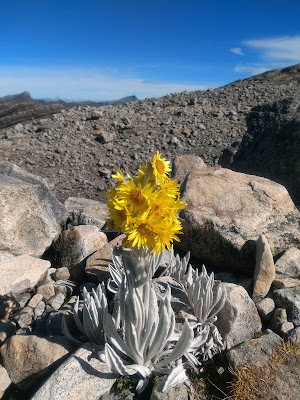
A lone frailejón: A little further down the mountain, there are thousands of them.
It was one such peak, Ritacuba Blanco at somewhere between 5,300 and 5,410 metres above sea level — I've seen various figures in that range given — that was on my radar.

A cursory internet check before leaving Bogotá did at least forewarn me that it wouldn't be a case of simply rocking up to Güicán and from there finding my own way to the snowcaps. Wishful, nay naïve thinking.

Even that rocking up to the town proved more taxing than it should have been.

Instead of the estimated journey time of nine hours, it took 15. This was due to an on-off mechanical failure with the bus, which eventually resulted in a wait for a replacement vehicle halfway through the trip. When taking overland transport in Colombia, it's best not to pack punctuality.

As it was a night-time departure, the longer-than-expected journey wasn't a big setback, arriving as we did at Güicán in the early afternoon. (I don't like to get to places I don't know after dusk.)

Being an impromptu trip — it's generally how I travel — the first mission on arrival was to find cheap accommodation.

That, I successfully did in the shape of Hospedaje Casa Grande — one can't go too wrong with a room for 25,000 pesos per night.
Twenty years ago, the Ritacuba glacier was a good number of metres further down the mountain.
Retreating: The glacier is gradually disappearing.
Its owner, the helpful Wosvaldo, quickly got the necessary planning in motion for my trip to Ritacuba.

Wosvaldo also offers his taxi services to and from the control/entrance point, some 17 km from Güicán via unpaved roads and 1,000 metres higher up. So he, like most accommodation providers in the town, has skin in the treks-to-the-Sierra Nevada game.*
'The trek up itself, from 4,000 to 4,800 metres through kilometres of frailejón-filled land, is mild enough.'
First on that planning list was the need to source a guide. Wosvaldo, unsurprisingly, had one to hand: the rather genteel Luis Emilio.**

Once Luis Emilio confirmed his ability for the next day, the next step was to pay the entrance fee to the national park. For me, as a foreigner with a Colombian-issued ID, it was 41,500 pesos. For non-resident foreigners, it's about double that, for Colombians it's half that.
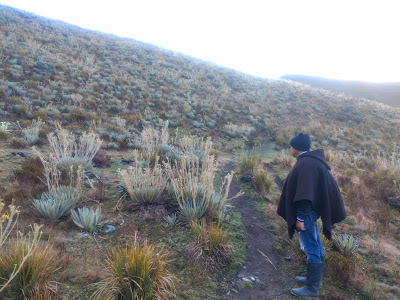
Ruana-clad guide Luis Emilio examines the frailejones on the trek up to Ritacuba Blanco in the Sierra Nevada de El Cocuy, Güicán and Chita.
Ruana-clad guide Luis Emilio examines the frailejones. 
This payment is made at an office in the town, next to which is the company providing the compulsory insurance. For two people, the guide and me, that cost 15,200 pesos.

The final requirement was to connect to a roughly 30-minute online induction chat provided live by a National Natural Parks of Colombia (PNN) employee. That takes place at 4 pm each evening and covers the three permitted treks inside the Sierra Nevada de El Cocuy, Güicán and Chita National Natural Park.

Do note, the entrance fee is valid for three days so if one has the desire — and more limiting in my case, the dinero, the money — the three treks can be done over three days.

When going it alone, as in not through an agency, the guide and the insurance are daily expenses. There are various accommodation options closer to the park entrance, so one could save on travel costs to and from Güicán by staying in one of those.

Photos show that the other two treks are equally as impressive as Ritacuba but my focus was on getting as close as possible to the highest peak with the most extensive glacier. It is, by the way, prohibited to actually walk on or even touch the glacier and snow.

Snow show

The trek up itself, from 4,000 to 4,800 metres through kilometres of frailejón-filled land, is mild enough. Some may have issues with the oxygen-light air but thankfully that wasn't a problem for me.

We started our ascent at dawn, just before 6 am, and arrived at the glacier shortly after 8.30 am, with a short snack stop included along the way. As guides go, Luis Emilio and I were pretty much in sync pace-wise.
The view from Peñón de los Muertos, Güicán, Boyacá, Colombia.
The view from Peñón de los Muertos, with Güicán in the right middle-ground. 
While I may be accused of taking a very easy out here, particularly as a blogger, I feel describing the glacier and the sights all around with words is insufficient. To address this shortcoming, I recorded a few YouTube Shorts videos which you can find at https://youtube.com/shorts/ZHGESHxM0no and https://youtube.com/shorts/JhaN7B4D4x4.
'Güicán is up there as the ruana-wearing capital of Colombia. It's easier to keep track of those not donning this traditional garb than those with it.'
Having soaked in the splendour for half an hour or so, we started our descent to the entrance point just as the clouds began to roll in. Yes, luckily Mother Nature shone on us that morning. No doubt dark skies and precipitation would have dampened the wonderland experience somewhat — although a snow shower would have been nice.

My visit was during a tourist-light period, so Luis Emilio and I had the glacier viewing point to ourselves. I'm guessing it's different during high season. The Ritacuba trek, though, is limited to fewer than 80 tourists per day.

Güicán itself doesn't give off an obvious tourist vibe, whether one views that as good, bad or indifferent. There's certainly no international flair to it. It maintains its basic Boyacá market-town flavour.

It's also certainly up there as the ruana-wearing capital of Colombia. It's easier to keep track of those not donning this traditional garb than those with it.

Respected traditions notwithstanding, one might expect Güicán to have at least one establishment that prepared coffee to more cosmopolitan standards i.e. not greca-brewed fare that at best merely gives a hint as to what good coffee can taste like.

Offering quality, machine-brewed fare wouldn't exactly be a portent of pernicious change, would it? Other similar towns have seen the light. Both Luis Emilio and Wosvaldo were receptive to my suggestion in any case; it seemed to spark a business idea in them. I hope they don't forget me when the pesos come pouring in.

Death valley

Coming back to natural attractions, outside of the Sierra Nevada treks, there are plenty of walks to other sites that one can wander cost-free and unguided.

One of particular interest is Peñón de los Muertos, Rock of the Dead, seven kilometres to the east of Güicán and a few hundred metres higher.

Here, so the story goes, many U'wa indigenous took the roughly 400-metre suicidal plunge to the River Cóncavo below rather than be taken captive by the Spanish conquistadores. The ultimate flight reaction to a threatening situation.
The glacial waters of the River Cóncavo, Güicán, Boyacá, Colombia.
Fancy a cool dip?! The glacial waters of the River Cóncavo.
Mentioning the River Cóncavo, but not at all in a macabre sense, relaxing by its fast-flowing glacial waters is a nice way to waste away an afternoon, particularly when the sun shines, as it regularly did during my four-day stay.

Indeed, with nobody about, it's perfect for a chilly skinny dip, if it can be braved. It works wonders to clear away any cobwebs.

So you see, you can go your own way in Güicán and have plenty of innocent enjoyment in the process.

Going to see the Sierra Nevada snow show is another matter. It's well worth the extra effort, though.

*Wosvaldo, the owner of the cheap and cheerful Hospedaje Casa Grande and offerer of chauffeur services to the national park, can be contacted by WhatsApp on +57 313 8682814.

**The certified guide Luis Emilio's WhatsApp number is +57 314 2904721. One guide can take up to five people, so going with others is one way to keep costs down, in terms of both paying for the guide and transport to the National Park control point.
__________________________________________________________
Listen to The Corrigan Cast podcast here.

Facebook: Wrong Way Corrigan — The Blog & IQuiz "The Bogotá Pub Quiz".

Thursday, 14 September 2023

'An alcoholic?! Me?! No way!'

@wwaycorrigan

[For an audio/vlog version of this story, click here.]

A barrio acquaintance, one who is not only very fond of marijuana and the hip psychedelic tusi but has also been a petty peddler of same, called me an alcoholic the other day.

A case of, an outside observer might say, one addict knowing another.

'An alcoholic?! Me?! No way!'
One man's alcoholic is another's merely mild drinker, right?
However, seeing how this acquaintance, in her early 20s, has barely worked a day in her life — outside of her minor drug dealing — and usually appears more out of it than with it, I initially shrugged off her labelling me an alcoholic.

Yet, as an Irishman who likes the occasional beer that often leads to a questioning of my relationship with alcohol, her remark did end up bugging me a little.

'Am I an alcoholic?'

Habit addict

To answer that, we must define what an alcoholic is.

One dictionary definition describes an alcoholic as 'a person addicted to intoxicating drinks.' Another definition is 'somebody who drinks alcohol to excess habitually.'

Those definitions, however, in using words such as 'addicted', 'excess' and 'habitually', are open to much interpretation.

Some commentators and scholars on the subject dismiss the concept of addiction outright. They see it as a mere cover for one's failure to take responsibility.

According to this school of thought, it's not an innate, incurable addiction that's at play but rather a very fixable fixation. It's a harmful habit that can be replaced with a more beneficial — or at least less-bad — one. What's lacking is willpower, as well as any real desire to change in many instances.
'That four-day booze-free stint coincided with an annoying head cold. Was my body telling me something? A case of a beer a day keeps colds at bay?'
In other words, people know they're doing something that's not good for their overall well-being but they do it anyway. (Of course, few of us live vice-free — even exercise can become a problem if one overdoes it regularly. Some vices, though, are more damaging than others.)

Mild imbiber

Returning to our definitions of alcoholic, it's easier, at least officially, to find consensus for what excess and habitually mean.

In Ireland, a standard drink is defined as one which contains 10 grams of pure alcohol. The advice is that a man should drink no more than 17 such servings a week, a woman no more than 11.

If one drinks alcohol more days in a week than not, few would argue that this is habitual.

On that last one, despite publishing a few months ago a hopeful post, Abandoning the beer standard, I've been quite the habitual drinker of late.

The longest run I've had without a beer in 2023 has been four days, and that was on one occasion only. Frustratingly, that four-day booze-free stint coincided with an annoying head cold. Was my body telling me something? A case of a beer a day keeps colds at bay?

Plenty of downtime this year and not wanting to be in my shared accommodation for too long at any one time are two big reasons for this regular revelling, tame as it normally is.

What's more, as a pastime, sipping on a Barrio Santandercito tienda beer is a fairly economical activity compared to some other pursuits one could get up to in Bogotá.

As alluded to, in terms of excess, my consumption levels each time I drink are nothing like they were in the past.

Where previously when I would go at it, as we Irish say, I'd have at least four litres of Poker beer or the equivalent, these days I'm usually looking for the exit door after two or at most three. (Do note, Poker's alcohol by volume [ABV] is four per cent.)

So my binge-drinking days do appear to be largely behind me. Compared to other regular drinkers, I think it's fair to put me in the mild category. I'm certainly no Brendan Behan — no sniggering — who described himself as 'a drinker with a writing problem.' Some might say writing is my main problem and I should give that up!

Constant craving

Whatever the case, there is another factor to be considered: cravings.

This ties in with addiction, whether one believes addiction to be a genuine disease or not.

I surmise that people who I consider to be alcoholics crave alcohol, it's constantly in their thoughts. When they get up in the morning, if a beer or whatever was put in front of them, they'd have no issue downing it. What usually prevents such types from doing so is a job commitment or suchlike.

I, on the other hand, rarely if ever desire an alcoholic drink first thing. For me, imbibing has a time and a place — the time is normally late in the evening, the place is a tienda/public house, certainly not my own dwelling.

And as I've already pointed out, I'm more than content to retire to my bed after a couple of litres. Where perhaps in my earlier drinking days I suffered from fomo, fear of missing out, these days I'm more in the jomo, joy of missing out, camp.

So, yes, I do like beer and I may regularly drink more units of alcohol per week than most health experts recommend.

Nonetheless, life in my late 30s doesn't revolve around the next alcohol-fuelled session like it did to some extent in my 20s and early 30s.

Of course, how I feel and what I believe is one thing. How others view me is another. Perception is reality in this regard. Yet, it's only the perceptions and opinions of certain people in my life that I should really value. Others are best ignored.
__________________________________________________________
Listen to The Corrigan Cast podcast here.

Facebook: Wrong Way Corrigan — The Blog & IQuiz "The Bogotá Pub Quiz".

Monday, 4 September 2023

Colombia's credit contradiction

@wwaycorrigan

[For an audio/vlog version of this story, click here.]

'We only give credit to those older than 90 and who bring one of their grandparents as a guarantor.'
Colombia's credit contradiction: Many beer-serving tiendas in Colombia say they don't give credit. In reality, with the payment systems in operation, they often do.
Bottle-cap accounting: Foolproof?
That's the English translation of one version of the various we-don't-give-credit signs you'll see displayed in many Colombian tiendas, convenience stores that sell products ranging from beer to brushes and much else besides. (Although some tiendas' chief business line is beverages and sweet and savoury snacks.)

What such signs really mean, of course, is that credit is not given whatsoever. (Perhaps, in a few generations, a 90-year-old might expect his/her grandparents to still be alive. Then again, in a few generations, humanity might be extinct.)

The reality is, however, that in many beer-serving tiendas, no-credit signs on display or not, the payment model in operation leaves the establishment at risk of being what effectively amounts to a moneylender.

Drink now, pay later

This is because the tab system dominates in such environments in Colombia; you pay your bill when you've finished imbibing. Rarely will you be asked for payment upfront, as is generally demanded in pubs in Ireland and the UK.

In theory, paying at the end makes more sense than doing so each time you order, particularly when we're talking about the consumption of multiple beverages.

This is even more so the case in places where cash is still king (working-class Colombia is, thankfully, in that category). It can be cumbersome having to deal with change for each order.

Nonetheless, the tab model can be easily abused, by both the customer and the owner/staff.

The former can do this by simply saying, be it true or not, that he/she doesn't have enough money to pay the bill.

In a country where the financial situation for many is far from stable, this I-don't-have-the-cash-right-now defence is commonplace. I've seen it cause plenty of beer-fuelled, heated discussions.

That much of working-class Colombia falls into the low-income bracket makes the popular use of the tab system even more of a head-scratcher.

That it persists suggests that businesses feel it's the best way to operate. They'll get the money at some stage — as long as the debtor doesn't die with the bill still outstanding. Or it could be one of those just-how-it-is scenarios that I wrote about before.

Bottle battles

As for tienda owners or staff, they can game the system by adding more products to your tab than were actually ordered.

This abuse is, unsurprisingly, far easier to carry out when the product in question is alcohol and the customer is drinking on-site, getting merry in the process.

I'm not the only one who has questioned the amount owed at the end of a session. It can lead to a tetchy tienda environment, if not to something more untoward.

Linked to all this is the method some tiendas use to keep, um, tabs of the tab.

Counting the bottles consumed is one way, something I see less often these days.
'If you happen to have a less-than-attentive tienda keeper, bottle-cap counting could work to your advantage.'
This may seem sound — and it explains why bottles are left on a customer's table until the session has finished — yet a couple of other foreigners and I were the victims of its flaws a few years ago in Bogotá. I wrote about that incident at the time in a blog piece titled, 'You've been had, Bogotá style'.

Summarising that episode, a guy who we'd befriended and who we thought had bought us a few beers actually pulled a fast one on us, or so it seemed.

As he left before us, we ended up being charged for all the beers he'd drunk, even those he'd had before joining our company.

Of course, he could have been — indeed, probably was — in cahoots with the tienda owner. Or the tienda owner might have seen an opportunity to charge for the same beers twice.

As we were in an unfamiliar place, after airing our displeasure we took the financial hit and promptly left, never to return.

Top cap

An alternative accounting approach with tiendas is the bottle cap. For each beer opened, the cap is placed on what we'll call the payment counter.

This is open to some of the same abuses as outlined with bottle-counting, minus the problem of another customer adding to your bill.

One particular flaw it has is with bottle size and associated price differences.

For example, to use my tipple of choice, Poker, very often the cap on a litre bottle is decorated the same as the 330 ml presentation.

So, if you're in a round consisting of bigger and smaller bottles of the same brew, you could be deemed to have had more bigger ones than smaller ones when the reality was the reverse.

Now, if you happen to have a less-than-attentive tienda keeper, bottle-cap counting could work to your advantage. 'Oh no, of those five bottle caps, only two belong to litre bottles, the rest were 330 ml.' One can plead ignorance if caught out.

Pen power

Slightly more watertight than the aforementioned methods is the radical pen-and-paper approach to tab-keeping.

Yes, some tienda workers write down your name — or some title that identifies you, such as gringo or mono — in a copybook and note your orders as they come. Revolutionary.

Again, it's not abuse-proof. If you lose track of what you've had, a few additional beers might be added to your tab. (And yes, this isn't exclusive to rudimentary tiendas. It can happen in fancy establishments using a digital system.)

Also, particularly in a lively tienda, a crafty fellow carouser could get his beers added to your account. Those behind the counter don't always check if a beer has been invited or not, as long as it goes on some customer's tab.

So, like many things in these parts, the no-credit policy is something of a contradiction with these tab systems in operation.

Yet, contradiction aside — and again like many things around here — tienda transactions normally pass off without much ado.

For sure, there will always be those who try to abuse it. They would do well not to, though.

A move to more advanced methods in this digital age may see them easily locked out of the market altogether. So scorn not the simplicity of the tienda's status quo.
__________________________________________________________
Listen to The Corrigan Cast podcast here.

Facebook: Wrong Way Corrigan — The Blog & IQuiz "The Bogotá Pub Quiz".

Thursday, 24 August 2023

Less stress, less success in these idle times

@wwaycorrigan

[For an audio/vlog version of this story, click here.]

Stress, especially of the mental variety, is seen as something to be avoided for our overall well-being.

At chronic levels, it can lead to anxiety, depression or other difficult-to-overcome afflictions of the mind.

Less stress, less success in these idle times
Having less stress is a good thing in general. This doesn't mean we shouldn't push ourselves, though.
One proven way to reduce mental stress is to counter it with a bit of physical stress on the body i.e. exercise.

This doesn't need to be of an elite-athlete variety. It can be a case of just being active enough to get the heartbeat up a few notches — a brisk walk, some floor exercises at home, even energetically cleaning the house.

Incorporating such physical movements into one's daily routine doesn't appear too complicated, in theory.

However, with all the technological advancements over the decades leading to an increase in sedentary yet no less demanding and time-consuming forms of employment, some people find it hard to fit in physical activity to get that endorphin, feel-good boost. (OK, some are simply lazy, too.)

Indeed, it's a double negative that doesn't produce a positive (mathematics isn't always helpful in real life). The sedentary but demanding employment, stressful in its own right, can leave one with little time and desire for exercise, thereby compounding the stress.

I can only assume that trying to raise a young family alongside all this makes the situation even more problematic. On the flip side, it might provide some welcome comfort, focus and strength.

Otherwise engaged

Whatever the case, for all of the above, I can't say I'm really having to deal with them right now.

As a single, childless man, the raising of a family is not a factor. (Although, one has had complications of late with the odd mentally straining frenemy.)

As for work, while this year has been particularly troubling in terms of a steady income, the positive is that I don't have the time-consuming, stress-inducing, sedentary employment as a concern. (Do note, with my current skill set, the careers in which I could earn the most are those where one spends a lot of time at a computer.)

This lack of paid employment that would see me tied to one place for hours on end means that I have plenty of time to get out and about. OK, I'm not running marathons but I'm usually on my feet moving more than I'm sitting still.
'It's like I'm in early-midlife retirement, minus any pension.'
The generous me-time also allows for what I feel is a cathartic, relaxing mealtime, in that I get to cook my own meal — I generally just need one — almost every day.

In one sense, it's like I'm in early-midlife retirement, minus any pension of course. Thus, it must be temporary, unless I come into a lot of money soon.

And this is the crucial issue here. The consequences of being economically inactive mean it's not a carefree time. While I'm managing my financial affairs for now, it is, to state the obvious, unsustainable in the mid to long term.

It's one of those scenarios where my back isn't completely against the wall yet. It's why I'm still quite picky about the work I'm willing to do.

As for returning to full-time employment, I would have to be well-remunerated to give up my independence. For whatever I may gain in financial recompense, previous working-for experiences tell me that it comes at a significant stress cost.

Stress test

However, not all mental anguish is inherently bad. Stress leading to anxiety or depression is one thing, challenging oneself to expand knowledge or learn a new skill is quite another.

It's like physical activity. When we push ourselves hard, it's taxing on both body and mind. We can even overdo it to the point of burnout and injury. Yet, not doing it will most likely result in a myriad of far worse health complications sooner or later.

So, with both physical activity and workouts for the mind, it's about finding the balance.

Now, I must say that I feel that my mental health is fairly sound.

Yes, this fallow paid-employment period leaves me with much thinking time. And overthinking can be dangerous for the mind. However, when I'm not distracted by technology or barrio temptations — socialising is important — it also offers plenty of beneficial reading time.

And even with all my free time, I still wish I had more hours in the day to read — I am a slow enough reader — and acquire new knowledge. One can never know enough. And one can never know it all.

While all this is, on the whole, keeping stress at bay, it's not like I have no preoccupations. We all do, of course.

Also, right now, it's not a case of, to borrow from the title of a school book I once used, less stress, more success; success measured in monetary terms this is. It could be said it's more like less stress, less success.

Nonetheless, I'm certainly not searching for ways to unnecessarily increase my stress levels.

I want to be excited about and stimulated by my next challenge, not stressed out about it. Ever the idealist.
__________________________________________________________
Listen to The Corrigan Cast podcast here.

Facebook: Wrong Way Corrigan — The Blog & IQuiz "The Bogotá Pub Quiz".