Showing posts with label USA. Show all posts

Sunday, 10 November 2024

Ready to do my bit for Ireland — as ambassador to the US

@wwaycorrigan

I couldn't let Donald J. Trump's return as US president pass without making a comment about it.

Below is a screenshot of the online version of my letter on that theme, published in the Sunday Independent of 10 November 2024. It can be found buried in this webpage, https://www.independent.ie/opinion/letters/letters-john-boyne-takes-a-novel-approach-in-face-of-literary-pretension/a777243096.html.

Able ambassador

With Ireland currently in its own general election campaign — the country goes to the polls on 29 November — I don't expect to receive a call about my credentials to be the next Irish ambassador in Washington DC until a new taoiseach (prime minister) is in place. But I do expect a call nonetheless. 

Now, I would be willing to accept a more minor role as consul. It doesn't have to be the top gig immediately. I'm somewhat flexible.

Letter to the editor: Brendan 'Wrong Way' Corrigan outlines his case to become the next Irish ambassador to Washington DC. Why not?
Washington DC: The right way for Wrong Way.


Saturday, 27 July 2024

US democracy drags on. But decorum is dead

@wwaycorrigan

[For an audio/vlog version of this story, click here.]

Hubris. Melodrama. Scheming and screaming. Refusal to accept one's errors. Refusal to accept defeat.

US democracy drags on. But decorum is dead: Kamala Harris takes on Donald Trump in the battle for the Oval Office.
Kamala Harris or Donald Trump: Which one is the greater threat to democracy? (Photos from X and Instagram.)
No, I'm not referring to South American football teams — although, all the above do apply to them. I'm referring to US presidential elections; those of recent vintage at least.

Fat chance

Watching the Democrats and Republicans battle it out is akin to two schoolyard bullies facing off. 'Yo momma's so fat' sort of stuff. OK, you're right, that might be a bit unfair to the inventiveness of some of those fat-momma quips.

It can make for compelling viewing for sure. Yet, it doesn't inspire confidence that the world's most powerful country has competent leadership.

The June debate between the now-retired candidate, President Joe Biden, and the Republican presidential nominee, Donald Trump, was unedifying. Hey, a real axis of evil — China, Russia, Iran and North Korea — may be threatening the West but how well would their leaders do facing into a par five in inclement conditions? It's pointless having a good shot on the battlefield if you can't shoot your way around a golf course, you know?

At least Biden can focus more on his golf game — or simply just try to focus — now that he's no longer in the race to prolong his stay in the White House. Trump, though, will — or should, anyway — be spending less time on the tee and more time on the campaign trail.
'Whatever Harris decides to discuss, her big problem is that she's not an orator.'
His fiery rhetoric is, um, par for the course. He had promised a toned-down, more unifying style in the immediate aftermath of the assassination attempt on him. Trump saying this is one thing. Delivering it, quite another. A slightly milder speech than normal at the Republican National Convention aside, his tone remains more bellicose than benign.

Calm-ala Harris?

In such an atmosphere, adopting a less hostile approach when trying to win over those crucial swing voters makes more sense, one would think. It remains to be seen if Trump's new opponent, the presumptive Democratic Party candidate, Vice President Kamala Harris, goes for such a strategy i.e. focusing on policies and plans rather than ad hominem attacks. The early signs are that she'll play the man more so than the ball.

One area where she might offer something different to both Biden and Trump is in the god talk, as in having less of it. At times I wonder what's the point in having these elections if it's all in the hands of the Almighty. Many of the USA's political heavyweights reference their Christian god more than the average Islamic fundamentalist mentions Allah.

This isn't necessarily a problem, particularly if it is accompanied by concrete proposals. However, the god talk rings hollow in the toxic political climate of today's USA.

Nonetheless, Harris is going to be on safer ground talking about gun control rather than god control. Jesus is still a big vote-winner in American politics.

Whatever she does decide to discuss, her big problem is that she's not a talented orator. Well, she's not an orator full stop. (Or period, as our US friends say.)

A dying democracy

Thus, the Harris handlers will most likely advise her to stick to the well-tried but not altogether trusted line that 'Trump is a threat to our democracy'. Keep it simple, stupid.

A fresher, smarter approach would pay greater dividends, but that's probably beyond Harris's ken. Or maybe she'll show us in the coming weeks some political acumen that has heretofore remained hidden. It has been a crazy election cycle after all.

Yet, the constant over these last few years has been the vitriolic nature of US politics. This isn't going to change anytime soon.

Some argue about just how democratic the USA is, but it's certainly no dictatorship. Its version of democracy is still alive. What is dead, or dying in any case, is decorum in political discourse.

And with the death of decorum, decline or dictatorship is not far behind. Or both.
__________________________________________________________
Listen to The Corrigan Cast podcast here.

Facebook: Wrong Way Corrigan — The Blog & IQuiz "The Bogotá Pub Quiz".

Friday, 26 April 2024

On comma ground: Where the US English team stands firm

@wwaycorrigan

[For an audio/vlog version of this story, click here.]

For native English speakers of the Old World, namely inhabitants of Britain and (whisper it) Ireland, it can be hard to accept that our New World ancestors have better language conventions than us. For some things, that is.

On comma ground: Where the US English team stands firm
USA: Home of the brave. And home of the useful Oxford comma, too.
It comes down to providing consistency and clarity and there are at least two areas where US/American English trumps British.

Team of us

In terms of consistency, the British English tendency to use plurals when referring to a team is difficult if not impossible to defend grammatically.

Taking the current English Premier League champions as an example, Manchester City is a team. Yet, we English speakers in Britain and Ireland almost always refer to the team using are, as in 'Manchester City are the champions of Europe.' It sounds weird to us to say 'Manchester City is the champion of Europe.' (I am aware that for those who favour the red half of Manchester, neither form is acceptable. What's more, as I write this blog, City's Champions League defence has come a cropper.)

I recall reading US newspapers, particularly the sports sections, during my first visit to the States, aged 15, and feeling that there was something amiss. The use of the singular for a team didn't seem right for somebody brought up on plural constructions for such an entity. It felt a bit cold and impersonal. A team is made up of people, after all.

It is, however, the Yanks who are on firmer ground if one strictly adheres to grammar rules. The team-is-made-up-of-people defence is understandable yet the idea of a team is that it works as a unit. (As the rather goody-two-shoes remark goes, 'There's no 'I' in team'. The equally inane retort is, 'But there is a me.')

Were 'Is a team' to go up against 'Are a team' in a grammar court, the former would surely win out. But hey, one doesn't tend to have much fun in court.

Clarity contest

In a clarity context, nay contest, US English tends to favour the use of the Oxford/serial comma.

In my school days, I was repeatedly told that it was wrong to place a comma before the 'and' in a sentence containing a list of items of three or more things. England, Ireland, Scotland and Wales — correct. England, Ireland, Scotland, and Wales — incorrect.

One could say such a rule is rather insignificant. It matters little whether the comma is there or not. And for the minimalists amongst us, as I am, excluding it makes more sense. Fewer commas means less ink required in printing. Every little helps.
'Rather than being doctrinaire against the use of the Oxford comma, those of us brought up to obediently omit it should be open to its vital value.'
However, the Oxford comma is not a case of Yankee extravagance. It does serve an important purpose. Its omission can lead to much confusion.

To take from Steven Pinker's impressive and witty The Sense of Style: The Thinking Person's Guide to Writing in the 21st Century, consider the following:
'This book is dedicated to my parents, Ayn Rand and God.'
'Highlights of Peter Ustinov’s global tour include encounters with Nelson Mandela, an 800-year-old demigod and a dildo collector.'

The lack of a comma before the 'and' in those sentences can lead to confusion (even in speech, with that absent comma, one may be inclined to leave out a helpful pause between the last two items). Thus, Nelson Mandela had a more colourful, far-reaching past, than most of us had realised. And the author of the book referred to has some powerful parents — or at least one of them is omnipotent.

So rather than being doctrinaire against the use of the Oxford comma, those of us brought up to obediently omit it should be open to its vital value.

Period pain

While we're on comma ground, one US convention — in academia in any case — that doesn't seem to have much logic behind it is the inclusion of a comma after 'i.e.'. What clarity does it provide? (I find some of American English's quotation-mark punctuation guidelines rather illogical, too.)

It's the same for Americans' use of full stops, or periods as they say, after each letter in an initialism. Why not USA rather than U.S.A.? It's superfluous punctuation, particularly when the actual words must be said together to make proper sense.

Sticking with period punctuation, I prefer the style choice more common in British English where there's no full stop placed after an abbreviation that starts with the abbreviated word's first letter and ends with its last. So it's Mr and Mrs for me, full-stop free.

However, abbreviations that don't end with the final letter of the word get a full stop. For example, co. for company (or county) and inc. for incorporation.

Most of these differences are matters of style. My general approach is if a certain rule serves no obvious, helpful purpose, then there's no need to use it, particularly when there's a viable, comprehensible alternative.

As we've seen with the Oxford comma, though, opting for less punctuation isn't always the best strategy. Nonetheless, old habits die hard. I still feel like I'm committing a violation if I use it.

When it comes to using plural forms for a team, its everyday use in British English has led to its acceptance. Through dedication and repetition, Team GB have won the right to say it makes sense.
__________________________________________________________
Listen to The Corrigan Cast podcast here.

Facebook: Wrong Way Corrigan — The Blog & IQuiz "The Bogotá Pub Quiz".

Sunday, 5 November 2023

Calling out the illiberal "liberals"

@wwaycorrigan

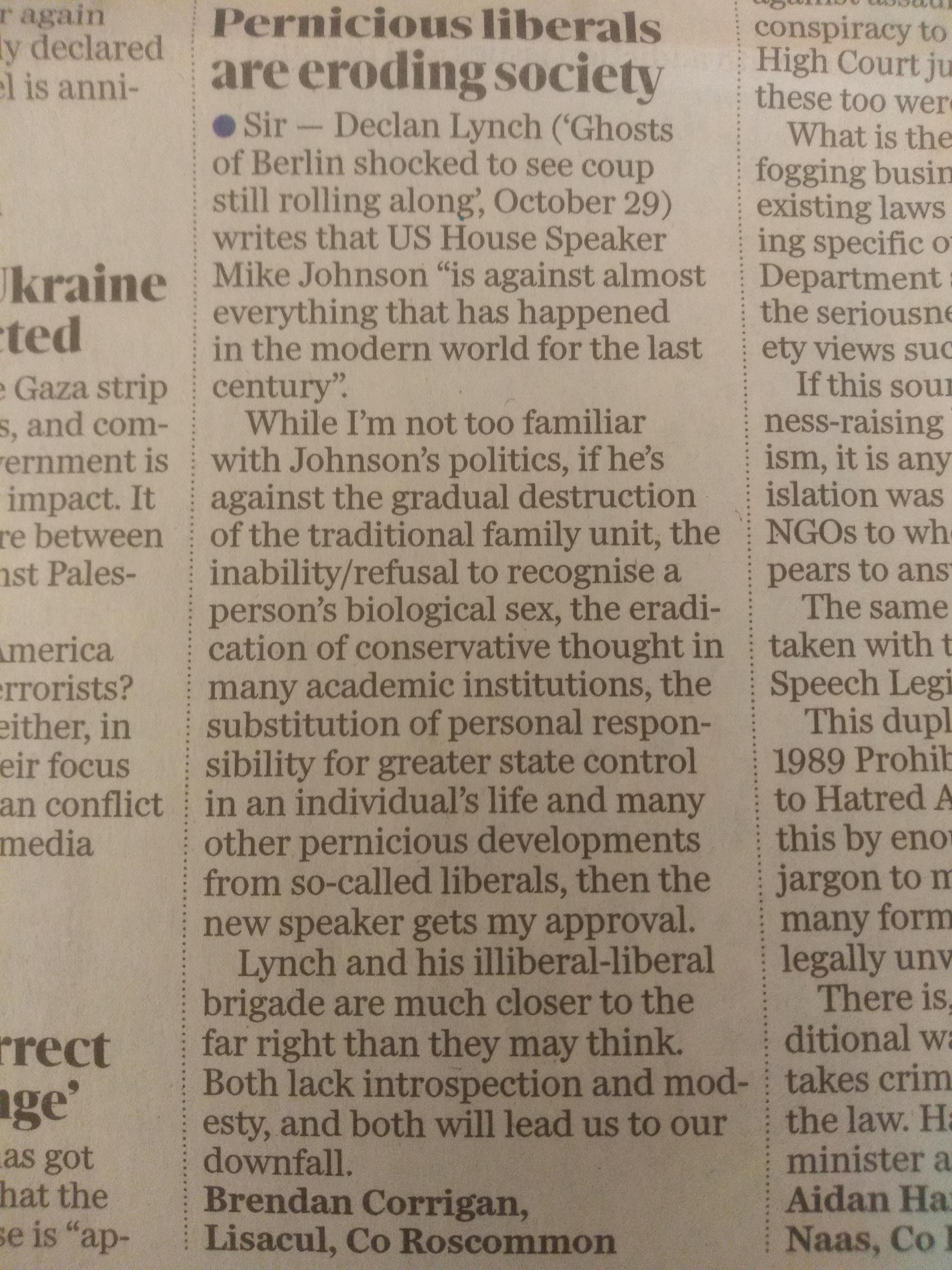
Sharing here my latest letter in the Sunday Independent.

It's shocking to think that Declan Lynch gets paid for his column and I don't get remunerated for my musings!

Outside of the photo of the letter below, it can also be found by scrolling down on the following link, https://www.independent.ie/opinion/letters/letters-time-for-bishops-to-be-humble-and-ask-for-priests-from-afar/a1461060798.html.

Calling out the illiberal "liberals": My Sunday Independent letter in response to Declan Lynch's column about US Speaker of the House Mike Johnson.
Tackling the Lynch mob.

__________________________________________________________
Listen to The Corrigan Cast podcast here.

Facebook: Wrong Way Corrigan — The Blog & IQuiz "The Bogotá Pub Quiz".

Friday, 5 February 2021

'Colombia's done OK, but prepare for a half-shut, half-open world for 2021' — Dr Bhattacharya

@wwaycorrigan

Dr Jay Bhattacharya, co-author of the controversial Great Barrington Declaration which called for 'focused protection' instead of widespread lockdowns in dealing with coronavirus, says we're in store for a 'half-and-half world' for most of this year.

Dr Jay Bhattacharya says Dr Anthony Fauci's neglect of other public health issues during the pandemic has been an 'abdication of responsibility'.
Controversial: Dr Jay Bhattacharya, co-author of the Great Barrington Declaration.

The Professor of Medicine at Stanford University made the comments in relation to the probability that many of the high-income nations will have vaccinated the majority of their populations against covid-19 by August while low-income countries will be lagging behind.

Colombia's 'done better'
Speaking to Wrong Way's Colombia Cast, Dr Bhattacharya, who is director of Stanford's Center for Demography and Economics of Health and Aging, said 'Colombia has done better (in getting access to vaccines) but (for) much of South America that's not going to be the case. I think It's going to take much longer than August to get the vaccines out to the older populations.'

'A lot of the world will still not be vaccinated in August. Places that are vaccinated will still want to close borders to those who aren't vaccinated ... I think there's going to be this half-and-half world where half are still going to have lockdowns and half are not.'

When asked for his thoughts on the Great Barrington Declaration, four months on from its publication, Dr Bhattacharya maintains that 'focused protection' is the least-worst option for containing coronavirus.

He said that lockdown advocates 'have not respected the most important scientific fact about this disease which is the age gradient, mortality and risk. For people who are younger, it is not particularly dangerous. The flu is more dangerous ... That fact is incredibly important.'

As for Dr Anthony Fauci, the popular director of the USA's National Institute of Allergy and Infectious Diseases and now also President Joe Biden's Chief Medical Advisor, Dr Bhattacharya claims Fauci's neglect of other public health issues during the pandemic has been an 'abdication of responsibility'.

Watch the interview in full at https://youtu.be/ZSb8VnG4nPs or download a podcast version at https://anchor.fm/brendan-corrigan/episodes/Dr-Jay-Bhattacharya-on-covid-controls--vaccine-priority--failing-our-elderly--Tony-Faucis-myopia-epuh4v.
_______________________________________________________________
Listen to Wrong Way's Colombia Cast podcast here.

Facebook: Wrong Way Corrigan — The Blog & IQuiz "The Bogotá Pub Quiz".


Friday, 22 January 2021

Trumpism: Why it won't go gentle into that good night

 @wwaycorrigan

[Listen to an audio version of this blog entry here.]
M
uch of the world appeared to breathe a collective sigh of relief when Joe Biden was inaugurated as the 46th president of the United States of America.

Trumpism: Why it won't go gentle into that good night. Donald Trump promised to drain the Washington swamp. Joe Biden's inauguration could be seen as representing a return to that kind of politics.
Swamp men? Barack Obama & Joe Biden. (Photo from Facebook.)
After four crazy years of Donald J. Trump, calm has been restored. A comforting normality has returned to the self-proclaimed greatest democracy on the planet. Certainly, Biden will conform to many people's view of what it means to be "presidential".

Long live Trump

However, while Trump's presidency may be dead, Trumpism lives on. To ignore it, to hope it will just peter out as a force would be foolish in the extreme.

To this end, President Biden has talked the language of reconciliation, of unity. Therefore, we must assume that his administration isn't about to completely discard the almost 75 million US citizens who voted for Trump.

Biden only needs to look at his own inauguration day to be reminded of why Trump won the 2016 election. While the outgoing commander-in-chief decided, as has been his wont, to go against 150 years of tradition and not attend the peaceful handover of power, three former establishment presidents were present: namely Clinton, Bush and Obama.
"Untruths can be forgiven as long as one is acting in good faith, saying what one thinks. 'Trump may be a liar, but he's an honest liar.'"
The bonhomie on display, especially the banter between Republican George W. Bush and Democrat Michelle Obama, will lead some to believe that common ground between two deeply divided factions can be found in the years to come. There is room for bipartisanship.

However, another way to look at it is as the personification of what Trump referred to as the 'swamp', a swamp he promised to drain which, depending on who you ask, he either made a decent fist of doing so or failed miserably.

Where lies truth?

This Washington swamp is a political elite out of touch with the needs and wants of America. It's an enemy that needs to be dismantled for those who espouse Trumpism.

Then there's language, what's said and what isn't said. The BBC's Washington correspondent, Jon Sopel, when asked of Trump's positives, referred to his transparency.

Now, while we all know of the many untruths Trump spouted and tweeted during his term in office, what Sopel refers to is the idea that you knew how he was feeling at any given time. To use the old expression, Trump wears his heart on his sleeve — or at least he constantly posted it on Twitter when he had access to that medium.

This is another important element of Trumpism. Untruths can be forgiven as long as one is acting in good faith, saying what one thinks. 'Trump may be a liar, but he's an honest liar.'

Contrast this with the politically correct language of Biden and his ilk. Experience leads Trumpists to view with great suspicion all these carefully worded speeches. They've heard it all before.

What's more, in such language they tend to hear not the equality of opportunity they associate with their USA but rather an equality of outcome. What they believe made the US great — the individualism, the freedom, a "non-interfering" government — is being eroded before their very eyes under the guise of progressive politics.

President Biden is only settling in at the White House. He may indeed turn out to be a president who can build bridges rather than walls. Convincing some in his own ranks to rein in their more ambitious ideas will surely prove key to that.
_______________________________________________________________
Listen to Wrong Way's Colombia Cast podcast here.

Facebook: Wrong Way Corrigan — The Blog & IQuiz "The Bogotá Pub Quiz".
 

Tuesday, 8 September 2020

Democrats' Biden time strengthens Trump's card

[Listen to an audio version of this blog entry here.]
In January of this strangest of years, unaware of what was coming down the line, I made a couple of what could be seen as rash decisions.
Democrats' Biden time strengthens Trump's card: President Donald J. Trump on the reelection campaign trail.
Four more years of President Trump? It looks quite possible now. (Image from Facebook.)
One was to resign from my full-time, relatively well-paid marketing job. I'd had enough and I wanted to focus on some personal, yet financially impotent projects.

Along came corona

The other was to write a piece suggesting that a Donald Trump re-election might be the least-bad option for the United States of America. 

Despite what some doomsayers had predicted when he won his first term in 2016, the world didn't descend into complete chaos. There was no apocalypse, much to the disappointment of some radical leftists. 

What's more, at the time of writing, there appeared to be a real possibility that the Democrats would select a candidate too leftist for the majority of the electorate, thereby playing into Trump's hands.

Then, along came coronavirus and the Black Lives Matter protests. Things certainly did get quite chaotic, apocalyptic even, the world over and particularly so in the Land of Opportunity. 

The mishandling of both was levelled firmly — and understandably if exaggeratedly — at the feet of President Trump. 

It was looking so grim for the incumbent that it seemed the Democrats could put forward Nicolás Maduro — replete in a US tracksuit to entice some jingoistic Republicans to the cause — and still expect to comfortably win November's election.

That fascinating prospect aside, up until recently, the biggest challenge for the challengers had been to ensure that their actual candidate, Joe Biden, stayed alive. The rest would take care of itself.

However, with the conventions of the Big Two now done and dusted, what were considered advantages for the Democrats just a few short weeks ago now appear to be working against them.

Whilst receiving widespread support initially, many US citizens are growing increasingly tired, angered even, by the ongoing Black Lives Matter protests. The Democrats, having fully supported the movement, are struggling to distance themselves from the rioting.
'While the thoughts of a Trump victory are anathema to many, it could be the saving grace for the Democrats, a realisation that lunging left is politically suicidal.'
Trump's playing of the law-and-order-president card appears to be hitting a sweet spot, despite the opposition pointing out, correctly, that the violence is happening under his watch. The thing is, while he is commander-in-chief, he can easily and effectively shift the blame. 

Radical leftists, who are pulling the Democrats' strings, are behind it all. Images of the burning of his effigy by protesters serve to reinforce the point. 

With time and a November endorsement, he will restore calm. A Biden presidency, on the other hand, will do anything but.

The right calls?

The current pandemic will, of course, play a big role in the outcome of the election. 

Yet, despite the relatively high death toll in the US, should employment figures continue to improve ahead of election day, Trump has another positive to play with. 'I had the economy roaring BC (Before Coronavirus), and the signs are it will bounce back quickly under my watch. All you'll get with Sleepy Joe are higher taxes and rising unemployment.' This is sure to resonate with many undecided, centrist voters.

The one, really only, bipartisan issue is the need to deal with a menacing China. 

Again, Trump can point to the hard line he has already taken in this regard. Can a soft-centred Democrat Party with its radical leftist undercurrent really be trusted to play tough with Beijing? It's a pitch that the many doubters may just find too worrying to let slide.

Also, while the thoughts of a Trump victory are anathema to many, it could actually be the saving grace for the Democrats, a realisation that lunging left is politically suicidal. 

By veering back towards the centre, the party would become a far more formidable force for a Republican Party that will have its own soul-searching to do post Trump.

So, as we move into the final quarter of a year that many of us wish we could wipe from memory, my January rashness, despite all that's happened, might actually prove to be rather prudent. 

Getting out of my job when I did may have been the right move. I don't feel worse off mentally in any case. And the US might just decide that it is better to go with 'the devil you know'.

Whatever happens, the closing chapters of 2020 are set to be intriguing.
__________________________________________________
Listen to Wrong Way's Colombia Cast podcast here.

Facebook: Wrong Way Corrigan — The Blog & IQuiz "The Bogotá Pub Quiz".

Saturday, 18 April 2020

A world in disunion

Those idealistic at heart may have thought that in a world connected as never before, the arrival of a common enemy of humankind would unite us as never before.

You know, like in the Independence Day movie when the aliens attack, we rally together, led, of course, by the USA, to smash those pesky extraterrestrials.

A world in disunion: Women, on "women-only day" form a queue, spaced apart in line with recommendations due to coronavirus, to enter a supermarket in Bogotá, Colombia.
The new normal: Maintaining our distance, on a micro and macro level.
The real-life "enemy" we currently face, covid-19, isn't actually a living thing by most definitions but it attacks indiscriminately, albeit it's far more lethal on certain members of society than others.

Nonetheless, the collateral damage it is causing us, pretty much all of which is self-inflicted in a bid to check the virus' spread, is resulting in widespread harm across the globe. So if ever we should work together as a species, it would appear now is the time.

Self-isolating Uncle Sam

What is actually happening, though, is more of a retreat into our tribe.

OK, some of this is down to what are seen as necessary "wartime" measures. The free movement of people will only spread the virus and as the majority of our decision-makers are unwilling to contemplate herd immunity — there are experts who believe it to be the quickest way to defeat our fiend — it was inevitable that old borders would be re-erected, both between countries and inside national territories.

The question is, will we smoothly return to the kind of free movement we had before? If we do, it's sure to take some time. 
'The immediate fallout from this pandemic will be a facemask-wearing population in a more divided world.'
Other current manifestations of this inward retreat were obvious before coronavirus reared its crowned head.

The United States of America, for example, the country that Hollywood has been telling us for decades will lead us to salvation in the event of an existential threat, has been anything but united of late. Its internal divisions appear to have only deepened during this crisis.

What's more, and unsurprisingly considering what President Donald J. Trump has been telling us ever since he announced his attention to run for the White House, it's very much America first. Global leadership isn't a priority.

It is, to state the obvious, the USA's prerogative to pursue this course of action. I, for one, have no qualms in this regard. The problem is, its leaders don't always stick to it.

Chitaly

Then there's the European "Union". The Italians, not for the first time, have decried the lack of solidarity from EU member states. It would seem they have fair grounds for complaint. Of course, in recent years they've been getting quite cosy with the Chinese (we're terming this courting Chitaly), much to the chagrin of Europe's powerhouses France and Germany.

Speaking of the Chinese, from the outside (trying) to look in, it's a case of following the accepted script. Are they deliberately pursuing a divide-and-conquer strategy? Or are we overestimating them?

Regardless, considering this coronavirus emerged from within its territory together with the general mistrust of the information emanating from there, the suspicion with which China and many of its citizens are viewed by some in the West is only going to deepen.

Thus, the immediate fallout from this pandemic looks set to be a facemask-wearing population in a more divided world coupled with greater state control and curtailment of previous "freedoms" we once enjoyed.

Government-controlled utilitarianism one could call it. We'll be told what the greatest good for the greatest number is. Exciting times lie in store.
____________________________________
Listen to Wrong Way's Colombia Cast here.

Facebook: Wrong Way Corrigan — The Blog & IQuiz "The Bogotá Pub Quiz".

Friday, 7 September 2018

Flying the flag for political incorrectness

Many people still don't seem to get it. Or they wish it wasn't so in any case.

Basically, a significant reason US President Donald Trump proved to be — and still proves — popular across Middle America, away from the east- and west-coast echo chambers that is, is that he speaks a straightforward language.

Flying the flag for political incorrectness: Donald Trump — tells it as he sees it.
Trump: Middle America's president. (Photo from Twitter.)
He tells/tweets it as he sees it — for better or for worse. Unlike mainstream, establishment politicians, not everything, nay nothing in terms of tweets anyway, is precisely planned, framed in must-not-offend diplomatic speak.

In the politically correct West, where the leftist discourse has taken a strong hold in the universities, shaping in such a way many of our current and future key opinion leaders, somebody deviating from the accepted script is bound to find favour with those not in the club.

This is not to say that all Trump supporters are dumb hillbilly racists, the standard charge levelled at them.

Indeed, many Trumpists I know find his controversial, excessive tweeting irritating. Neither do they agree with all his utterances — in fairness it can be hard to keep up with them in any case.

Yet, it's the feeling that despite his many flaws, he is about as honest as they come. He doesn't hide behind political advisers. What you see is what you get.

In this day of carefully groomed, mannequin-esque politicians, this resonates. (That the US economy is performing well under Trump's watch is another important plus point.) 

It's a question of, 'Who do you really trust: Somebody who comes across as "holier than thou" or a guy seemingly showing us his warts and all?'
"Now name calling does hurt us."
Trump's presidency and other similar eschewing of the standard political system elsewhere have been the inevitable backlash against the over-the-top political correctness we've had to stomach for the last couple of decades.

Where did our childhood act of defiance towards hurtful words go? You know, the old schoolyard rhyme, 'Sticks and stones may break my bones but names will never hurt me.'

We realised back then that acts of real violence could be lethal, but name-calling? Whatever. We could rise above it.

Now, however, many of our law-framers and influencers have become too cool for school. 'You can have your free speech but you can't say this and you sure as hell (OMG, did I just say "hell"?) can't use that word.'

We're in the process of creating an impotent, sterile bunch of human beings. Like the announcer at the bumping cars — do they still exist or have they become too unsafe, imparting evil habits in our young? — at a funfair used to say 'one way round only', now it's 'one discourse only', even if it goes against biology, to name but one area of contention. (How many genders do we have now? It's difficult to stay, um, abreast of the accepted pronouns these days.)

The British intellectual, amongst many other things, Stephen Fry has a refreshing approach to all this craziness. At a debate on political correctness earlier this year he said that if somebody wants to call him a 'fagot' — he is gay — then so be it. It's not the end of the world. There are far greater things we should be crusading against.

It's not the case where we want things to become overly verbally abusive — radicals or fundamentalists on all sides are adept at that already — but we don't want people having to consult a lawyer every time they want to speak lest they offend some unsuspecting bystander.

Fry's common sense view is nothing more than we'd expect from a man of his standing. Yet, worryingly, he doesn't seem to be in the majority in the intellectual world.

In Colombia, one of the refreshing things about life here is how it's normal to call somebody by their outward appearance. So you have people being affectionately called 'fatty', 'blacky', 'thinny' and so on.

Imagine how that would go down these days in most "First World" countries. The courts would be on the go 24-7.

With all that in mind, we're now just over two years away from the next US presidential election. The big question is, if he survives all the scandals and potential impeachment, can Trump get re-elected?

A lot, of course, will depend on who he's up against. 

The danger for the Democrats is that in their desperate bid to win back the White House they'll opt for an everything-for-everybody candidate. A product of our one-size-fits-all globalised world. 'Tell us what we want to hear, regardless of the reality.' Ah yeah, that makes it all better.

The Democrats would be doing us all a favour, everywhere, if they look more towards the centre-ground.

Alas, the radical left will do their bit to make sure that doesn't happen. Trump will happily toot to that.
_____________________________________

Thursday, 26 January 2017

A welcoming Ireland (but not for Colombians)

As we looked at in our last post, Colombia is, from a tourism perspective anyway, 'the country of the moment'. In the coming months and years it may be about to see unprecedented numbers visiting its shores as word has finally got out of the many natural beauties the place has to offer.

A welcoming Ireland (but not for Colombians): The beautiful Glanmore Lake & surrounds, County Kerry, Ireland.
Hidden beauty (or just pretty much off limits for some people). (Photo from Facebook.)
What's more, for now in any case, it's rather simple for Western tourists to come here should they so wish. 

That is to say, there's no tedious visa application needed if the purpose is solely tourism. Up to 90 days are granted on arrival, which can be extended by a further 90 if you feel the need (many just leave the country and come back in again in order to get that extension, something that is generally the case throughout Latin America).

Yet, this relatively relaxed approach is not reciprocated by all the countries that benefit from it here. 

The obvious one (and most popular for Colombians) is the United States of America. There's nothing surprising in that, however. US immigration makes it difficult for citizens of most nations to enter its territory. And this is only set to get worse with President Donald J. Trump at the helm. ('But Señor Trump, aren't we all immigrants in a sense?' For more on that topic, see Phantom freedom.)

Those insular, loopy Yanks aside, we Irish, for the nation of migrants that we are, don't always return a country's friendly gesture made towards us. 

Colombians, as well as Ecuadorians, Peruvians and Venezuelans to name just the Latin South American countries, need to apply in advance for a tourist visa to allow them visit our rain-sodden little island. 

This is in contrast to the Schengen Area of countries on the European mainland which allows Colombians, Peruvians and Venezuelans (but not Ecuadorians and Bolivians for some reason) visa-free access for a minimum of 90 days.

Now assuming, as it seems safe to do so, that visiting 'the Emerald Isle' isn't exactly top priority for most citizens of these countries -- the costs involved largely see to that -- why do we make it difficult for the few who actually are willing to come? 

Talk about double standards. (It must be noted here that Ireland did submit a request to participate in Schengen in 2002. This was approved by the Council of the European Union but it has not yet, obviously enough, been put into effect; and the political desire to do so seems lacking right now.)

In such straitened times, you think we'd happily welcome anyone who's willing to spend their hard-earned money visiting us, giving the economy a little boost in the process. Why be selective on where the paying tourists come from?

Selective, however, is what we are. We have our favourites, to hell with the rest. 'The land of a thousand welcomes', for those who fit the bill that is.
___________________________________
Facebook: Wrong Way Corrigan - The Blog & IQuiz "The Bogotá Pub Quiz".

Thursday, 26 May 2016

Crazy Copa América

It's fair enough to assume that most of us like at least a little stability in our lives. The comfort of knowing, barring absolute disasters, that you can rely on certain things.

Crazy Copa América: The stars expected to light up Copa América Centenario USA 2016 ...
Copa América: Embracing its unpredictability. (Image from Facebook.)
Even in the world of sport where stability, nay predictability, might not be what we always want, we do have certain bankers. 

You know, like in rugby where the All Blacks always win and in football where you can never write off the Germans. Sticking with the round-ball game — but something that is pretty much true of most sport — you also have the regularity of its main tournaments. The World Cup comes every four years, the same with the European Championships, on the even-numbered years between the global contest, as in this year.

Yet, as tends to be the wont in South America for many things, the Copa América arrives at any old time. It doesn't appear, or at least hasn't heretofore, to follow any plan. Well, if it does, it's not a straightforward one. (Maybe they're right on this one?)

Fair enough, this year's renewal, hot on the heels of Chile 2015, is marking the competition's centenary. Yet, it's not even being played on South American soil. No, it's taking place in the grand old US of A. 

At least it means that none of the Conmebol teams will have home advantage; but the USA will. It wouldn't exactly be the best of etiquette to throw a party in somebody else's gaff without inviting them, now would it?

Indeed, the venue choice has raised eyebrows among some of the participants, with Uruguay manager Óscar Washington Tabárez questioning the United States' suitability on this occasion, especially as games are going to be played all over the vast nation. His side, for example, will be travelling from west (Glendale) to east (Philadelphia) and back west (Santa Clara) again for their three group matches.

Whatever about the merits of this edition — the inclusion of six invitees, namely Costa Rica, Haiti, Jamaica, Mexico, Panama and hosts US, could be seen as weakening its credibility further — there is still a 'copa' to be won.

Looking at it from adopted-Colombian eyes, the competition gives José Pékerman's selection the opportunity to continue their unbeaten ways in competitive matches, having won two on the bounce in the World Cup qualifiers. It also represents a chance to erase the memories of a rather mediocre showing 12 months ago.

La Selección Colombia: How far can they go at Copa América Centenario USA 2016?
How far can Colombia go in the Copa this year? (Picture from Facebook.)
Their game with the United States on 03 June gets the tournament under way. Home advantage is usually a big help in the Copa América, but considering it is not the States' 'baby' so to speak, Colombia might be just that little more up for it (although the bookmakers, perhaps tellingly, see it differently).

A result in that one could set them up for a bit of a run, as Paraguay should be dispatched and Costa Rica, as one of the invited nations, mightn't be overly pushed. Yet making positive predictions about Colombia, as last year showed, is risky business.

That aside, it's likely the winner will come from one of South America's heavyweights. Take your pick from Argentina, Brazil, Chile or Uruguay (yep, we're going all out there). We'll be, um, 'patriotic' and include Colombia as well, but with a semi-final against Argentina, Chile or Uruguay on the cards should they get that far, making the decider might be just beyond them.

But hey, whatever the outcome, at least the Colombian team will have a few weeks in what is a second home for most of their fellow countrymen. Plus, there's always another Copa not too far away.
_________________________________________
Facebook: Wrong Way Corrigan - The Blog & IQuiz "The Bogotá Pub Quiz".

Tuesday, 30 September 2014

Green light for 'Rape' in Colombia ... oops!

Well, it may have seemed like a good idea at the time. In fact, considering the pretty poor level of English in Colombia in general, most people probably have no issue with it, insofar as the meaning is lost on them. Plus, what it represents is something largely positive, or at least that’s the hope.

Green light for 'Rape' in Colombia ... oops! The Rape men; oh dear.
Politicians supporting Rape, including Bogotá mayor Gustavo Petro (centre). (From Facebook.)
Yet, given the initiative is due to ‘breathe new life’ into Colombia in terms of development, promoting it under its acronym Rape is a tad unfortunate. 

OK, in Spanish this obviously does not have the same meaning as it does in English. It just stands for the not-at-all controversial Región Administrativa de Planeación Especial (Administrative Region for Special Planning, or something to that effect).

However, in a country that is officially trying to significantly increase the use of English among the populace, a little more thought could have gone into this one.
Sperm Sports, Bogotá.
Sperm Sports. Um ... (From civico.com.)

Picture the moment when the guys behind this thing look to Big Daddy USA for some financial assistance: “Any chance you could fire us a few million dollars for our novel Rape project? We’re just trying to improve the lot for our most neglected and vulnerable.” “Um, your what project?” Cue a bit of awkward explaining.

Now, even allowing for what appears a rather odd liking for not very appropriate English words in certain contexts, à la the adjacent photos, surely those working with Rape don’t really want the name. Well, you’d hope so, once they’ve been told its English significance.
Colombia's alco store; just what we were looking for...
These stores could prove a hit in Ireland.
So here’s a suggestion. Rename it Región Administrativa de Planeación, Infraestructura y Desarrollo (Administrative Region for Planning, Infrastructure and Development; that works, right?), or Rapid in its acronym form. Much less offensive, don’t you think? 

Indeed, it’s even progressive sounding. Heck, some people get paid big bucks for such consultancy work. Here I am proffering this for nothing.

You know where to find me guys.

Friday, 1 August 2014

Chasing a star(bucks)

Wow! How the lot for some Colombians is improving considerably.

Chasing a star(bucks): James Rodríguez is ecstatically greeted by Colombians after his unveiling as a Real Madrid player.
'James, you haven't a spare euro or two?' (Photo from Facebook.)
For one, the country's new hero, James Rodríguez, has ensured Real Madrid will have about 40 million new followers thanks to his big-money move to the Spanish giants. 

OK, footballers operate in a completely different galaxy to us mere mortals. Thus, that things are looking up for James should be put into its proper, ludicrous context. It's not his fault, of course, that this is the way the football world is, so we can only wish him well in his new life as an overpaid galáctico.

On a slightly more comprehensible and, going by the reaction, palpable level, Starbucks' arrival to the home of coffee has signalled the country's passage into the big league; or so some locals appear to believe. A case of: 'Now things will change; we've got Starbucks.' 

It certainly does gel in nicely with that popular Colombian notion that 'outside (especially North America) is better than home.'*

So having the US coffee label here is another step towards becoming 'US Americanised'; that should fix all the problems. Then again, maybe not.

In a way, the opening of the company's flagship Colombian café in Bogotá is a further sign of the country's growing middle class and, with that, the extra disposable income in a few people's pockets. 

Plus, it shows in a very visible way that multinational companies no longer see the country as the big risk it once was in which to do business, or indeed most activities.

Yet, the much-publicised excitement exuded by a segment of the population on Starbucks' grand opening has only served to demonstrate yet again the huge inequality that exists in this land. 

On the one hand, you had people queueing for up to an hour to get their hands on a cappuccino retailing at 5,500 pesos (almost $3US), while alongside them, as they waited to enter, you had street vendors selling their equivalent for less than ten per cent of that price.

The fancy interior of Starbucks Bogotá. Unlikely that I'll be seeing it for real any time soon...
Starbucks Bogotá: The fancy decor has a price (photo from Facebook).
Yes, those in the know will talk about the quality of the Starbucks fare (alongside the local equivalents such as Juan Valdez and Oma), but at more than ten times the price of a perico (coffee with milk) in my local panadería, it just doesn't make sense to me. 

And whatever about it not making sense to me, for a large chunk of Colombians, paying 5,500 pesos for a coffee is just not a runner, ever.

If your monthly earnings are about 600,000 pesos ($320US), roughly Colombia's minimum wage, and you're in a six-day-a-week job where you have to commute by public transport, you're not left with much money to play around with. 

The transport costs alone would be more than 72,000 pesos per month.** Take food and general living expenses out of the remainder and you can see why 5,500 peso coffees are a pipe dream for many. Throw dependants into the mix and the picture is even grimmer.

Such inequality is not unique to Colombia, although the scale of it here is intense. Like many others before him, re-elected president Juan Manuel Santos has made reducing it one of his priorities.

But while we strive to improve the lot of the poorest in society, we also have to look at the other side of things. 

That is to say a much more even distribution of the world's current wealth. Many of us could have as equally a fulfilling life – if not more so – minus a lot of the non-essential extras we accumulate.

Something to mull over whilst sipping on your Starbucks cappuccino watching James make his Real Madrid début. Isn't life just bliss?
___________________________
*Colombia's police often exhibit this trait that the Western foreigner knows best. For more on that see Colombia's good cops.

**It has been brought to my attention that a travel allowance of 72,000 pesos is available for those earning 1,232,000 or less. While this is no doubt a help, it still won't see the masses flocking to Starbucks.

Wednesday, 19 March 2014

Transmilenio: A snapshot of Colombian "organisation"?

'In Colombia, we’re more concerned with the idea and not so much with the execution. Additionally, time management is messy here.'

Transmilenio: A snapshot of Colombian "organisation"? Transmilenio — looking good (well not quite).
The Transmilenio: It almost looks serene here.
The above sentiments aren't mine (although, they could be). Rather they are that of a Bogotá native now living and working in the USA. In so many ways they ring true in this land.

Let's start with a somewhat positive outlook. There certainly seems to exist a strong work ethic among the Colombian populace – from a Bogotá context in any case. Or a strong desire to get to work at least. 

All you have to do is try and squeeze yourself onto a city bus or the (much-maligned) Transmilenio from 5 am onwards each weekday to see that most city residents are not slouches when it comes to early rising. 

Plus, it's not a case of early to work, early home. Many won't commence the return journey until at least 12 hours later, if not more. Slaves to their work or workaholics? Well, yes and no.

Coming back to our opening quote, a lot of it is down to time management (or lack thereof) and methodology coupled with, to put it mildly, a less-than-clinical execution, manifested in so many interlocking areas across the metropolis.

On the hours that many actually spend at work here, how productive they are with that time is open to much debate. Very often the answer is in the results; they're usually not jaw-dropping. 

It comes down to that difference between being at work and actually doing work. 

Many Colombian employers prefer to see their staff staying late at the office or wherever, having the 'look of work' about them, even if it is to the detriment of productivity. It's linked in with the inherent lack of trust that people here have in one another.
Inside the Transmilenio system.
Now, another reason why many may willingly stay late at work, especially those who face a public transport commute, is to avoid going home at peak times. 

The aforementioned Transmilenio is something I touched on some time back, however few will argue that the system has got progressively worse as it has expanded.* 

Not only is it severely under-capacity, but the behaviour of its users has deteriorated to sub-animal level compared to the last time I wrote about this.

Outside of more buses, station layout, with a special focus on the manner in which people enter and exit the carriages, is something that needs to be seriously addressed. Yet any new stations built are designed in the same way as the flawed current system.

On top of this, the state of the route corridors is generally shocking; buses often have to slow to a crawl to manoeuvre their way around massive potholes and uneven surfaces. 

An excuse given for the latter problem is that Bogotá is built on a swamp, thus maintaining smooth roadways is difficult. Well, it's not the first city in the world to have to overcome such natural inconveniences. 

One thing that would help is for authorities not to give such work to cowboy construction companies, where the bottom line is lining one's own pocket.

You've also a question of focus. With the Transmilenio practically on its knees, the powers that be have decided making WiFi available in a number of stations a priority. Well, perhaps it's a way to pacify the masses as they hang around like cattle waiting, typically in vain, to cram onto the next bus.

Then you have the 'integrated' public transport system, or SITP, which has been rolling out gradually since late 2012.** The idea is that it's meant to replace the myriad of private bus operators currently bringing the majority of the city's populace to and from their place of work. 

One of the problems with it, however, is that it's not really integrated. For starters, the card you need to use the SITP buses is not compatible with most of the Transmilenio services. This is down to the fact that they have different operators.

An inside shot of a less than full buseta/colectivo.
Colectivos -- better than the Transmilenio?
What's more, the SITP buses themselves are also operated by different companies, depending on which part of the city they serve. Have we lost something in translation between the Spanish 'integrado' and the English 'integrated'? 

Alongside all that, deciphering where each route goes seems overly and unnecessarily confusing. It's the busetas/colectivos for me still.

Taking all this 'on board' so to put it, as a friend opined about the transport system in Bogotá, 'it's a microcosm of Colombian life in general; not a bad idea in theory, but how it's put into operation is, to say the least, incomplete.'

It's not that people aren't aware of the problems; it's just the attempted solutions tend to be ill-thought-out. 

Spend some more time at the planning stage – or indeed just try a bit of planning at all – and who knows what could happen? Probably not a lot, though.

____________________________
*See Bogotá's transport truths.

**For more on the SITP, read 'Dulling down' Bogotá.

A version of this story is also available on the El Tiempo web site at  http://bit.ly/1igXqyz.

Wednesday, 15 May 2013

Venezuela: A necessary reappraisal

Back in 2009, on our first visit to the Ecuadorian capital Quito, we heeded the well-intentioned advice of some fellow travellers and opted to stay in the ‘safer’ north of the city – an area home to many backpacker hostels.
Venezuela: A necessary reappraisal. Crossing back (somewhat reluctantly at the exact time of the photo) into Venezuela
"Do you want to go ahead with this?"
What we encountered there, however, was anything but a feeling of security, reinforced by hostel and restaurant owners’ warnings not to venture out alone, if indeed at all, after dark. 

The fact that the majority of people we spoke to in the hostel we stayed in had been mugged on the streets right outside our lodgings obviously did nothing to ease concerns.

As a result, our stay in the city was short-lived; we were quite happy to leave in all honesty.

Two years later, in a less-planned stop in the city and being led by an Argentinean bus companion, we found ourselves camped up in a mediocre ‘hospedaje’ (hostel/hotel) in the historic centre of the city – dodgier territory than the north of the metropolis according to many.

This time, though, we experienced a completely different, far friendlier side to the place. Within hours after arriving (we got there late in the evening, in darkness, at that) we found ourselves drinking beers in a rough-and-ready house of some local. In another context, considering the area we were in, these guys would be seen as people to be avoided. 

This set the tone for what turned out to be a hugely enjoyable, trouble-free few days in Quito.

So while first impressions of a place or a person can at times be a good guide to the whole picture, this isn’t always the case. Very often such things are context and time-dependent.

Bearing that in mind, we made no secret of our negative introduction to Venezuela last year (see: http://bit.ly/OLR2Ev). 

In many ways, our experiences back then sat nicely with the accepted Western narrative that the place is dangerous, politically insecure and best avoided – even though we did enter the country rather excitedly and with an open mind.

Thus, this time it was with a bit of nervousness, tempered by stubbornness and a sense of some adventure, that we hit for Colombia’s eastern neighbour for a visa run. The rough plan on departing Bogotá was to get in and out of the place as quickly as possible.

Our anxiousness increased when, on arrival in the city of Cúcuta on the Colombian side of the border, the guys who exchanged our pesos for Venezuelan bolivares gave us plastic bags and told us to stow our cash in them and put them in our shoes for safety. (The biggest problem in the end was that this practice almost rendered the notes unusable from the damage inflicted by being wrapped up in our sweaty runners.)

Yet practically from the get-go, the coldness of the citizens and feelings of insecurity that prevailed during our first visit were replaced by very helpful, friendly people and a relaxed general atmosphere.

The 'Maduro' quarter of San Cristóbal
To the left ...
A Henrique Capriles supporter proudly displays his election poster over his little street stall
... and to the right
Yes, the physical signs of the recent, highly contentious general election (for a recap, see: http://bit.ly/Yy86zJ) narrowly and controversially won by the late Hugo Chávez’s successor, Nicolás Maduro, are there to be seen. 

But it’s not – at least openly and at ground level amongst the populace (at a political level and below the surface for some citizens we spoke to, deep divisions are apparent*) – a case of a dangerously divided country where opposing sides don’t mix.

What we found in the two places we stayed, firstly San Cristóbal and then Mérida**, were easy-going people (the small bar brawl we witnessed on our first night aside – sure a beer bottle being hurled at somebody is nothing unusual to us) going about their daily business.

Wherever we stay we like to be able to venture out at night feeling relatively safe, sampling a few beers and chatting to the locals in little ‘tienda’ bars. Thankfully, that was no problem this time, unlike Maracaibo last year. 

OK, our hotel in San Cristóbal did have a 10.30 pm curfew, but that was more an individual choice rather than a rule from what we could gather. Plus, considering the times we tend to retire at night nowadays, this lights-out policy wasn’t a big issue.

Of course, we did learn from our first experience in the country as regards the currency. 

So this time we had plenty of cash to convert into bolivares as opposed to going to ATMs where the value is at least four times less than on the street (Colombian pesos are fine to exchange along the border and that’s where you’ll get the best price). Hence, in most aspects, it’s much cheaper to get by compared to Colombia.

On that theme, practically every shop/restaurant displays the prices of its goods – prices that are trustworthy and accepted across the board from our observations. In other words, haggling isn’t really done or needed in the majority of places – the price is the price and it’s usually satisfactory. 

Now, we don’t mind haggling, but in many street stores in Colombia you can’t help but wonder if they are charging you a foreigners’ price no matter what you pay. The aversion here to publicly displaying prices always leaves you in a bit of doubt.

A typical day at a Venezuelan supermarket
"Sorry, where would we find some chicken?"
You will still find what seems to be official Venezuelan suspicion towards foreigners – again in sharp contrast to the usual Colombian experience. 

On the internal bus journeys where the National Guard did ID checks, as foreign passport holders we were the only ones taken off and given a pretty decent interrogation with our bags thoroughly checked. With nothing to hide it wasn’t something that bothered us really.

That was, of course, taking for granted that the officers were genuine – in this case, they seemed to be. Considering, though, the pronouncements coming from the country’s leader as regards some foreigners’ intentions in Venezuela (mostly aimed at the USA, albeit), you can never rule out a bent military official doing something untoward in the name of patriotism.

If, however, at heart they are in the same mould as the vast majority of civilians we met in San Cristóbal and Mérida, such a scenario is unlikely. 

In any case, going by our adventures this time around, the rewards far outweigh the risks.

___________________
* Some Venezuelan politicians take very seriously the idea of ‘fighting’ for your country, as this video shows: http://www.youtube.com/watch?v=jKUVdw9mgeY

**Mérida is something of a hidden gem from what we experienced. We plan to bring you more on that next.