Monday, 26 January 2015

Higher education, superior disarray

As a society, we tend to place a lot of value on higher education, especially in relation to the loftier institutions. On the face of it, this isn’t a bad thing. 

Generally, those who go through universities and the like go on to have much better lives, measured in monetary and influential terms anyway, than those who don’t.
Higher education, superior disarray: Your standard university lecture hall; the education provided in some places is far from standard however.
Seats of excellence? (Photo from redzone.yorku.ca.)
However, that certain centres of education are seen as centres of excellence is often self-fulfilling. 

This is even more acute in places where wealth and privilege, more than anything else, dictate a person’s chances of accessing third-level education. If you didn’t go to the right university, or worse still none at all, it’s unlikely you’ll be accepted into the movers-and-shakers group.

In many ways, Colombia falls into that category.

People are judged, and hired, on where they were schooled more so than on any proven ability. (Granted, it can be difficult for most young job seekers, whatever their background, to 'get the start' and prove their worth, but some don't even get a look in. And yes, this is something that happens across the globe.)

Yet, having both seen and heard stories of how some of Colombia's most prized universities conduct business, it would, or at least should, make you less than enamoured with them as leading pedagogical lights.

Take my recent flirtations with the human sciences department of one of these well-respected institutions in relation to teaching a specific course through English there. 

In not untypical fashion for these parts, it was all done in a rushed, last-minute manner. To make matters worse, it all happened during the annual four-week shutdown over Christmas and New Year.

So the initial talks were in mid-December, where I neither said yea nor nay to the job offer, as payment wasn't discussed and it wasn't even a given if the course was going to be a runner.

The next I hear from them, in the latter half of January less than one week before classes were due to begin, was to be told that the documents required to work for them were ready to be signed.
 
‘Hold on there now, we haven’t even discussed payment. Plus, you’re expecting me to come up with a course plan from scratch in a few days, at my own expense and time?’ ‘Pretty much so, yes.’
Career choices.
Any which way but lose?

One of the many issues at play here seems to be the lack of communication between the departments of human resources and human sciences. The course was the responsibility of the latter; the former – as is standard practice anywhere – was in charge of deciphering pay based on experience as well as providing the associated contract.

It appeared that those at human resources expected me to toddle on down to the office and sign whatever they offered me (which, incidentally, was not very much, especially when you consider the exorbitant student fees the university in question and others here charge.)

It must also be remembered that I didn’t come looking for this job; it came my way via an intermediary and the university contacted me. Therefore, you might think, there would be room for flexibility and negotiation. But no.

Whatever about all of that, the most worrying aspect appears to be the thought, or lack thereof, given to the fee-paying students. 

You basically had a group of them signing up to a course before, in reality, it actually even existed. What kind of slipshod thing are they attending? Perhaps there were backup plans, but bearing in mind some previous practices by other such Colombian institutions, that’s not a given.

In defence, the fact that the course was, I believe, elective and not obligatory mitigates things somewhat. 

It must also be said, obviously, that the top universities in Colombia have produced, and continue to do so, some extremely talented professionals from all walks of life. You do want to see some tangible results for the money invested, of course.

But that incidents such as the above happen, even if it was a one-off, is disconcerting. A little bit more forethought is all that’s really required.

Though how dare we mere mortals question the methods of these sacred cows? Forgive us, for we are not worthy.

Sunday, 18 January 2015

¡Viva Villeta!

When it comes to the main vacation times in Colombia, there appear to be three chief types of holidaymakers.

Firstly, you have the upper-to-middle classes, that is to say those with lots of spare cash at their disposal, who tend to escape the country and continent in order to rub shoulders with their ‘wealthy idols’ from the Western world.
¡Viva Villeta! Refreshing: The 'Seven Waterfalls' ('Siete Cascadas'), Villeta, Cundinamarca, Colombia.
A natural, refreshing shower on the 'Seven Waterfalls' trek in Villeta. (Photo: Pieter Immanuël Hupkes.)
Then you have those with slightly less disposable income, but not in too bad of a way, who stay within the country or at most visit neighbouring countries. The important thing is that they travel a relatively decent distance from their regular abodes.

Lastly, is the most popular group; those hard-pressed working classes whose holiday getaways generally amount to a short break in a nearby department or another town within the same department.

From a Bogotá perspective (and Colombia in general, really), thankfully, those who fall into this latter category are pretty much spoilt for choice — the only thing missing is the sea, but there are plenty of inland waterways to partially fill that void.

¡Viva Villeta! Waterfall one, down-river, on the 'Seven Waterfalls' trek, Villeta, Cundinamarca, Colombia.
The view atop of the first of the 'Seven Waterfalls'.
One of those places that I had the pleasure of checking out recently, impromptu as it was, is Villeta, an approximate two-hour drive north-west from the capital. 

Anecdotally speaking, it still lags behind the likes of Girardot and Melgar as a destination hotspot for those looking for a nearby escape from Bogotá.

A big reason for this is that some wealthier types see it, so I’ve been told anyway, as a bit of a ‘ñero’ (Colombian word for, let’s say, not very pleasant types) holiday location.

So just up the Wrong Way street you might say — because that is, of course, this blog doesn't like to prejudge. ‘Altogether now’ and all that.

Anyway, ñeros or no ñeros, the place has enough going for it to entertain most, at least for a time.

At an altitude of about 800 metres, almost 2,000 metres lower than Bogotá, the climate is more than agreeable, unless you’re a polar bear type. You certainly don’t need your woollies at night, as you often do in the capital.

The village itself is quaint enough – Villeta does mean ‘little village’ in English – if not spectacular. It also has a little more of a modern feel to it than some other similar-sized places in Colombia.

Mini-trains: Villeta, Cundinamarca, Colombia.
The 'train' to Villeta's 'Iguazú Falls' ...
There are a host of hotels and mini-resorts equipped with swimming pools, from the elementary to the somewhat more elegant, allowing you the chance to take in both the sun and subsequently cool off in a modicum of tranquillity.

Better still, though, are the natural cooling-off spots. There are the easy-to-reach ‘mini Iguazú Falls’ (well, they deceivingly resembled them from an advanced photo viewing), a nice 30-minute walk from the village. Or you can also take micro-train transport if you don’t feel like stepping it out in the heat.

Yet far more rewarding, in terms of sights, nature and exercise, is the ‘Seven Waterfalls’ (‘Siete Cascadas’) trek.

It’s not the most taxing, but if walking in nature is your thing, along with having the chance to bathe in cool freshwater to refresh from the tropical sun, it’s pretty enjoyable. 

The more adventurous types can also engage in some extreme diving (see video below). (I didn’t want to show up our very helpful accommodation provider-cum-guide Edwin, so I abstained from partaking.)


Outside of that, as you’ll find in most urban locations in Colombia regardless of size, the village itself isn’t short on lively watering holes. 

The only problem my Dutch companion and I encountered during our nights out was that the place was full of families and teenagers. There seemed to be a dearth of single women in their 20s to ‘converse’ with.

Perhaps it’s a sign of the rising Colombian middle class; these ladies holiday elsewhere. Or at least those who aren’t yet mothers that is.

Oh well, it just leaves more of Villeta (and the odd yummy mummy) for us.

Thursday, 8 January 2015

Appreciating the gutter

The first step in solving a problem, so it is said, is realising you have one. It pretty much stands to reason really. You've got to know what you're trying to fix before you begin to fix it.

Yet, for some things, what one person sees as a problem, or at least feels it is an issue that needs modifying, may not be a cause for concern for another.
Appreciating the gutter: Don Fernando's, aka Las Panelas, in La Perseverancia, Bogotá D.C.
One of the best 'beer gardens' going in Bogotá: Fernando's, aka Las Panelas.
Take my well-documented liking for socialising in Bogotá's working-class barrios, or more specifically speaking La Perseverancia, as has predominantly been the case over the last year or so.

For some expats and well-heeled locals, they see such behaviour as somewhat of a problem. And it's not all to do with safety reasons, where they may have valid reasons on occasions (but where is that not a concern in Bogotá or most major cities?). 

No, it's more to do with the social aspect of it. That is to say, as a relatively young (I'll still class myself as such), single guy, I am doing myself a disservice by spending time in such places.

The chief reason being, gauged on the advice from other classier men, is that I won't find appropriate women in these locations. The way they see it, I'm wasting valuable time in the quest to find my true love by frequenting Bogotá's 'dives'.
Appreciating the gutter: Instead of a dart board, most working-class bars and tiendas in Colombia have bolirana.
Bolirana: What you might call a Colombian dart board.

OK, they have a point. It's unlikely I'm going to find 'the woman I've been looking for' (eh, who?) in the likes of La Perse, especially when the chicas who live there don't appear to socialise much. For there are some fine, if a little cold and flaky, ladies in these barrios. Do note that as regards flaky, there isn't really a class divide in these parts for that particular trait.

Yet, trips to the fancier ends of town don't yield greater results or, as far as I'm concerned, a better quality of woman. Indeed, paradoxically in a way, they often churn out types who are more concerned about money and image than those from the poorer neighbourhoods, with a dollop of arrogance thrown in on top.

Notwithstanding that, the chief reason I continue to hang out in working-class barrios more so than others is that, and this surprises some, I actually enjoy it; a feeling that thus far hasn’t shown signs of dissipating.

Salsa dacning in Fernando's, La Perseverancia, Bogotá D.C., Colombia.
Innocent, uncomplicated fun.
This comes down to the fact that I find the people very friendly. From a La Perseverancia perspective – although it’s not exclusive to there – it has a community vibe to it. It’s what you might call ‘el campo en la ciudad’, 'the countryside in the city'. And being a countryman by birth and at heart, I feel at home in such places in the midst of a chaotic city.

In contrast, in La Candelaría/Las Aguas, where I currently live, it’s a little more solo in this regard. A big reason for that is because it’s the city’s tourism epicentre and to have a foreign face there makes it more difficult to become part of the place or an accepted local.

Many Colombians in La Candelaría see no difference between a flying visitor and somebody here on a longer-term basis. (It must be said that after over three years floating around the historic city centre, this is now less so the case for me. However, the process of assimilation happened much more quickly and with more depth in La Perseverancia.)

As for Bogotá’s exclusive locations, well they just tend to leave me cold, and, at times, angry.

Romance wise? I’m single and enjoying life, things are fine. That ‘single ship’ is rocked on occasions, but there hasn’t been a really strong reason to jump from it just yet.

Now, where’s the problem?

Sunday, 28 December 2014

What ales you?

This blog generally stands up for the underdog, those very much up against it. Well, this is certainly the case when it comes to social classes and the sporting arena.

It tends to be less so, however, when price comes into play. That is to say, value-for-money is the motto and very often, at this moment in time anyway, that leads to quantity over quality, wherever it can be found.
What ales you? A bottle of Poker towering above Bogotá D.C. It is the tipple of choice for many in the city
Poker: A Colombian beer 'giant'. (Image from Facebook.)
Now, it must be said that a lot of the time in Colombia, especially in relation to food, buying from the local vendors or producers is cheaper than going to the big national and multinational "monsters", in terms of grocery shopping and restaurants that is.

In that way, I still feel like I’m helping the little guys eke out a living. It’s usually the reverse in the developed world when it comes to buying food or eating out; getting it at lower prices typically means visiting the bigger chains.

As regards another recurring expense, one listed in the socialising category, it’s somewhat different. 

In the consumption of beer, the Colombian masses — as well as this writer, on the odd occasion — drink the mass-produced stuff. Well over 90 per cent of this market is in the hands of Bavaria, a Colombian company originally but now part of the global SABMiller group.

Thus, downing any of the Bavaria beers — from the cheaper (and slightly weaker) Aguila, Costeña, Pilsen and Poker to the somewhat fancier Club Colombia – is, in a sense, supporting a "monstrous" multinational.

Yet, these beers are readily available in the many little privately owned tiendas (bars-cum-shops) throughout Colombia. 

Plus, the more impoverished the barrio, the cheaper you’ll find the drinks. In this way, by going to such locations and having a few Bavaria-produced beers you’re supporting the poorer populations, pumping additional (little as it may be) money into the micro economy.

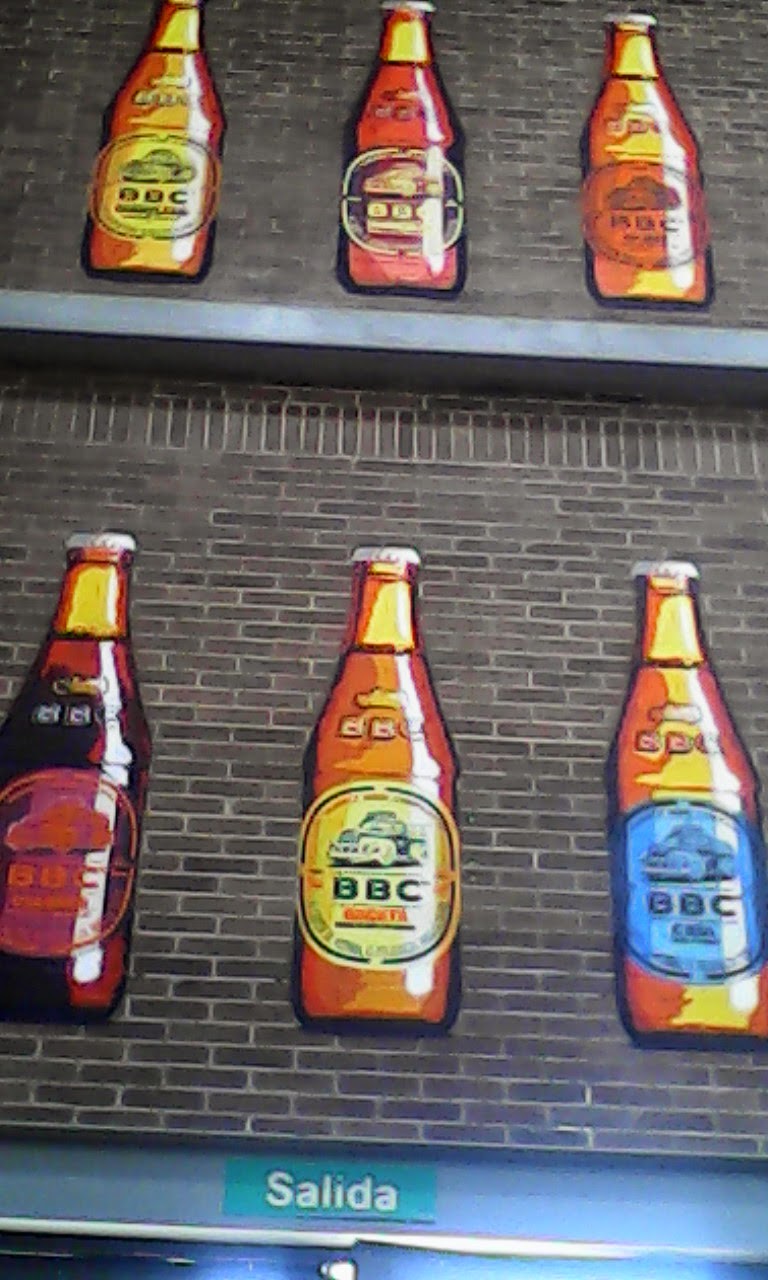
The entrance to the Bogotá Beer Company factory outside Bogotá, Colombia.
Bogotá Beer Company: Interesting initials.
On the flip side, you have the Bogotá Beer Company (BBC), which brands itself as ‘the biggest small brewery in Colombia’ (‘la cervecería pequeña más grande de Colombia’ in Spanish). Up against Bavaria/SABMiller, in terms of overall market share, it barely registers a beat.

So, in theory, it falls into the category of those I like to support. However, its market is quite removed from your typical bargain-basement Bavaria beer drinker. 

It only sells its produce – at a far greater price than the likes of Costeña or Poker – in its own pubs, more upmarket establishments and a couple of supermarket chains. You're talking about a more exclusive product, out of the daily reach of the majority of Colombians.

The BBC will point to what it sees as its superior quality and more artisanal approach in brewing compared to Bavaria. That may be so, but when it comes to letting the hair down, a fine ale retailing at least five times more than a mass-produced lager tends not to be the most attractive option.

What's more, it's not like those cheaper beers are unpalatable; on the contrary, they're rather agreeable to the taste buds.

In one regard, you might say choosing the Bavaria beers is supporting the simple over the sophisticated. And we could all do with toning things down every now and again, especially around this time of year.

Now, where did I leave that Macallan fine and rare?

Thursday, 18 December 2014

Brazil: A thorn in Colombia's side

Damn Brazilians, at it again. Not satisfied with unceremoniously and controversially knocking Colombia out of this year's Fifa World Cup — aided by a Spanish referee it must be said — now they're ensuring their north-western neighbours endure a dreary and dull December.

Brazil: A thorn in Colombia's side. Another heavy downpour in downtown Bogotá ...
Here comes the rain again ...
You see, the November rains that habitually inundate Colombia have been continuing well into this month. The source of these daily prolonged downpours? Why none other than Brazil, so the meteorologists tell us.

What more pain is the 'big bully' neighbour to the south-east going to inflict on us before the year is out?

OK, I have to admit that from a personal point of view, in one sense, these rains are kind of nice; watching them under the safety of cover that is. 

Dry, warm weather for the Christmas season is still something that doesn't fit right with me. Hence, it feels a little more correct, the grey days with some freshness — or cold as most locals feel it — about. (Do note, a typical Irish Christmas tends to be grey rather than white, weather-wise.)

Who knows, but we may even get a white Bogotá Christmas if the current conditions keep up. All we need is a hailstone deluge like we had a few weeks back to see to that.

All that aside and on a more sombre note, with all this extra water swashing about the place, it does make you wonder how there could be people dying because of a lack of it, and other associated life essentials, in this country. However, dying they are.

Of course, it's not a uniquely Colombian contrast this, it happens in other regions. Where it occurs, there are usually geographical, climatic and political issues at play. There is also the issue of a serious lack of public will to deal with it.

That comes down to the fact that death from a shortage of food and water is a slow process. It tends not to rouse the emotions in fellow human beings as much as dramatic natural or human disasters such as earthquakes or terrorist attacks.

Also, in developing and under-developed countries, there is the question of management — or lack thereof. Very often the means and resources are there to deal with the problem, but the structures needed are not.

You just need to look at Bogotá for an example of this. When the heavens do open here, the insufficiency of an adequate drainage system is glaring. For a city that regularly experiences severe downpours, this seems negligent. It’s like each time it happens it comes as a surprise.

'Run for cover' time in Bogotá ...
Streets like rivers: Bogotá turns into Venice for a time ...

One mitigating factor, but again this highlights poor management and practices, is the rubbish problem in the city. Many drains are clogged because of this and thus rendered useless.

Indeed, it’s not only in Colombia’s more peripheral regions where a shortage of water can be a problem. With regular water service cuts in various barrios in the capital, you often have the scenario of ‘water, water everywhere, but none to drink.’

We can’t really blame the Brazilians for those latter issues. On the football field, though, there is always the chance of revenge at the 2015 Copa América. The weather might be better then, too.
_____________________________________
Facebook: Wrong Way Corrigan - The Blog.

Saturday, 13 December 2014

Respecting the hand(writing) of time

‘The pen is mightier than the sword.’ ‘Time is a great healer.’

They are two of the oldest sayings in the book and in many ways they complement and support each other. The result of using the sword is instant and, at its most effective, it generally doesn't allow the outcome to be modified.
Respecting the hand(writing) of time: Smartphones and instant communication — dangerous tools in the wrong hands.
Beware! Instant communication via smartphones. (Photo from Facebook.)

Healing hand/harmful hand

On the other hand, intelligent use of the pen, i.e. writing something with a clear head and thought, is physically less damaging than the barbaric sword and can be revised; or at least it’s not usually terminal.

In addition, it’s more time-consuming and can get you much better results in the long run. In this way, it's tied in with time and, depending on the circumstances, healing. Conversely, of course, it can be used to more devastating effect, depending on the author’s wishes.

The problem these days is that the pen has been replaced by the keyboard and keypad, linked to the World Wide Web, with the latter's multitude of ways of disseminating your message. Thus, the old time advantage, insofar as allowing for review and reflection, is wiped out.

For sure, in many aspects, instant communication can not only be advantageous but it can also be a lifesaver. It can be extremely efficient as well, especially in work environments. However, in other instances, it is damaging and dangerous.

We've seen numerous examples where the careers of influential people have been tarnished or ended by publishing things on social media that on 'mature reflection' they should never have uttered, or at least made public knowledge.

Nonetheless, our 21st-century communication tools are just that – tools. And like all such things, how they are used and/or abused depends largely on the human being operating them.

Just because you have the means to immediately respond to or comment on something, doesn’t mean you must – this is obviously more pertinent when the context is a negative or attacking one. Some people (and this writer has been guilty in this regard), though, just can’t resist. A virtual swipe of the sword, carried out with little forethought.

Twitter: A communication tool, as it is for the rest of them, to be treated with caution ...
Nice birdie; but it can bite ... (Image from Facebook.)

Writing under the influence 

Such actions are normally much worse if done ‘under the influence’. Indeed, in the same way that you shouldn’t drive when drunk, it would be a good idea for many to avoid means of communication – real as well as virtual in some cases – when inebriated.

Now, in mitigation, you do have the old nursery rhyme, ‘Sticks and stones may break my bones but names will never hurt me.’ Should we really let a few ill-advised comments, in whatever form they come, offend us? Judge people by their actions rather than their words.

This, however, brings us back to the old pen trumping the sword. As mentioned above, the written (and spoken) word can and does cause harm, as much as it may seem, in a physical way in any case, silly to let it.

So just before you engage in your blitzkrieg-esque virtual written warfare, pause for a moment, take a long walk if needs be. And remember, some things are better left unsent.
________________________________________
For a related piece, see Unsocial media.

Thursday, 4 December 2014

Colombia's peace 'impaz'

It’s been expressed here before that I generally go along with the ‘communicate rather than exterminate’ stance when it comes to dealing with human enemies.

This line is practically sacrosanct when the other side is showing a willingness to compromise. 

What’s more, when you have a conflict that has been ongoing for more than a couple of generations, showing scant signs of progress on either side, engaging in talks seems not only prudent but unavoidable.
Colombia's peace 'impaz': The Colombian army showing its skills.
Both parties to the Colombian peace talks remain in combat. (Photo from Twitter.)
That was basically the case when Colombia’s latest peace talks got underway over two years ago.

However, to say they’ve hit a stumbling block or two over the last few weeks and months is putting it mildly. You could say that this was always a strong possibility given that both the Farc and government forces have remained largely on the offensive; that is to say, there has been no meaningful ceasefire.

The rebels' (Farc et al.) strategy of kidnapping not only combatants but also civilians continued.

Yet, the talks also carried on regardless. Well, they did until the Rubicon – or more precisely a river in the Chocó department – was crossed by Farc in terms of what the government saw as permissible acts throughout this whole process: That being the kidnapping of army general Rubén Darío Alzate.

Colombia's peace 'impaz': Colombian army general Rubén Darío Alzate announces his resignation after being kidnapped.
Saying goodbye: General Alzate. (Picture from Twitter.)
His release after two weeks in captivity and subsequent resignation have meant the passage is clear for the peace talks to move forward again, resuming as they will on 10 December. (The fact that the general in question has admitted he and his companions breached safety protocols in a known red zone in the country is also somewhat of a mitigating factor; “one shouldn’t 'dar papaya', General.”)

That being so, the pessimism that has grown in many quarters over the direction these discussions are taking is understandable.

OK, agreement, we’ve been told, has been reached in both land reform and the rebel’s future political participation should a final deal be sealed, while decent progress seems to have been made on victims’ rights. 

These are three of the six key areas of the talks. The other elements are drug trafficking, rebel disarmament and the implementation of the peace deal itself.

The most infamous of the above sextet, drug trafficking, could no doubt prove to be another major barrier, as mentioned in these pages before.

Colombia's peace 'impaz'
Chocó: Beautiful, but with dangers.
In that regard, President Juan Manuel Santos caused a stir of late by suggesting drug dealing could be made a political offence and not a criminal one. For him to publicly say it seems to imply that it is being looked at as a potential sweetener for Farc members involved in the trade, however exactly it would play out in practice.

Needless to say, in a country that has suffered more than most due to the illegal narcotics business, not everybody is waxing lyrical about such a possibility.

On a broader, what you might call more abstract scale, there is also the question of who and/or what is Farc? 

In other words, are those doing the guerrilla group’s negotiating in Havana representative of a unified body? It’s difficult to believe they are. But at the very least they represent some warring faction that is tinkering with the possibility of changing its ways.

This process, of course, was always going to be a long one; only the utterly negative or ludicrously positive thought otherwise.

The only certainty, for now, is that there are set to be many more twists and turns before war-weariness wins the day.