Showing posts with label Villeta. Show all posts

Tuesday, 3 April 2018

Serene Suesca

In terms of little escapes from Bogotá, generally speaking, we prefer to hit for one of the many lower-lying, warmer locations dotted all around the metropolis.

This is even more so the case when the capital city is going through one of its somewhat depressingly grey, wetter-weather phases, as it has been of late.
Serene Suesca: Suesca, Cundinamarca, Colombia.
A view of Suesca with Las Rocas in the left background.
The thing is, when it's public holiday time in Bogotá, most people have the same idea. Thus, you have a run on the likes of Girardot, Melgar, Tobia and Villeta to name just a few. And with that, the prices for hotels and other tourist-related things shoot up.

In fact, if you're your own boss and can take holidays more or less whenever you want, staying in a much more relaxed Bogotá during these peak holiday times is an appealing option.

Nonetheless, not every town in a 200-kilometre radius or so of the capital sees an influx of tourists when work's out for a few days.

A 90-minute bus drive from the north of Bogotá, the quaint, tranquil town of Suesca is one of them. At about 2,600 metres above sea level, it certainly does not fall into the 'warm-weather escape' category.

One of the main — if not the main  — pull factors is the alluring cliff rocks, Las Rocas, on the town's outskirts. 

These imposing cliffs stretch for about four kilometres and are popular with rock climbers. Many visitors avail of the camping facilities alongside them as an accommodation option; there was a steady stream of crusty campers about when we were there in any case.

Yet, around Suesca's picturesque main plaza, there's still very much a local, 'unspoilt' feel to it. This we very much like.

Now, in similar style to our San José del Guaviare trip, we just rocked up here with little or no prior planning.

So the fact that the tourism office was closed didn't help things in terms of finding out what to do and see outside of Las Rocas.

Armed with contradictory information, we did set off on an ill-fated wander to Laguna (Lake) Suesca. Had we been unequivocally told at the start that it was at least a three-hour trek and that the lake was pretty much dry — it had been dry season despite the bit of rain and overcast conditions we had for most of our stay — we probably wouldn't have attempted it on foot at all. (My fellow Irish companion wasn't up for a long, potentially fruitless hike; tut, tut Finbarr.)

So after an hour-and-a-half walk that culminated in stumbling across a 'hidden gem' of a tienda bar, where the owners told us we were still some way off the lake, we paused for a liquid refreshment before returning to Suesca. We did get some nice views along the way, as well as discovering the aforementioned tienda, so it certainly wasn't fruitless.
Suesca, Cundinamarca, Colombia.
Wandering the hills around Suesca ... Reminds us of home, kind of!
Speaking of watering holes, Suesca could be seen as the home of the tiendas. It appears that every second establishment is one where you can sit in and have a beer. 

However, while we're not averse to a Poker or two, Suesca's rather chilly weather and exposed tiendas aren't conducive to knocking back a few cold ones. Not wanting to be rude, we did give it a go all the same.

Sipping on a tasty and very reasonably priced coffee whilst watching the day go by in the panadería (bakery-cum-café) 'Las Rocas de Suesca' on the main square is a decent alternative to the tiendas.

Whatever tipple you choose, as refreshing, short breaks from Bogotá go, weather aside (it's not that bad either, especially from an Irish perspective), Suesca is as good as they come.

*The rather expensive Hotel Casona Quesada aside, there aren't too many obvious budget accommodation options in Suesca. However, with a bit of persistence, we found a well-kept house-cum-hotel for 30.000 COP per night for a room with three beds. It's located on Calle 4, just off Carrera 5 next to a little park with a basketball court.
_________________________________________
Facebook: Wrong Way Corrigan - The Blog & IQuiz "The Bogotá Pub Quiz".

Tuesday, 25 April 2017

Feisty Fusagasugueños

When it comes to nearby escapes from the madness of Bogotá, we're not stuck for options. There's Choachí, Girardot, La Vega, Melgar, Pandi, Tobia and Villeta to name just some of the places we're familiar with. Each of those differs in terms of their tranquillity factor, but all are unquestionably more relaxing than the capital city.

We can't, however, say the same for the big town -- city by Irish standards -- of Fusagasugá. OK, on the weather front, it scores well; warmer than Bogotá, but not too stickily hot as some of the locations mentioned above can be. Yet, with a population of over 130,000, it's not quite a peaceful rural getaway.
Feisty Fusagasugueños: Fusagasugá, Cundinamarca, Colombia.
Fusagasugá: It has a couple of things going for it, in fairness.

In fairness, it's not marketed as that. Well, it's not marketed at all really, and with reason considering there doesn't seem much of interest to draw tourists. The pull factors tend to have nothing to do with the urban centre. For most of those who do go to the area, it's all about the rural retreats dotted around.

Yet cities and towns that don't rate high on the popularity scale have an attraction for us and, usually, we aren't disappointed (if you go not expecting too much, then it's easy to be satisfied; for example see previous posts on Buenaventura, Maicao and Turbo, to name just three).

So a stay in the centre of Fusagasugá with a couple of like-minded Irishmen seemed like a win-win plan. And in many ways, it was.

For starters, it's reasonably cheap in terms of food, drink and accommodation, especially compared to Bogotá. What's more, unlike some towns close to the capital and other locations in the regions, there is an abundance of well-kept attractive ladies about (that is to say, not carrying far too many pounds than they should be; each to their own and all that). Then you have the aforementioned agreeable climate.

That's about as good as it gets, though.

On arrival, not having a Colombian cédula (national ID) for the hotels there was a bit of a problem. It was hard work trying to convince them to let us stay. 

You would have thought that the Colombian-issued cédula extranjería, the compulsory ID all visa-holding foreigners must have, would have worked fine. But no. After a long chat with one receptionist we managed to convince her that all would be OK. If the police had any issue -- the reason behind this reluctance to check us in -- we'd speak with them directly. 

Pity those arriving with just a foreign passport, they'd have no chance it seems. This, though, rarely happens, it would seem.

Then there's the "people on edge" feel to things. Many appear to be lacking that relaxed, happy-go-lucky style that you'll find with Colombians in most other places (peak commuting hours in Bogotá excepted). No, in Fusagasugá it was more a "what are you doing here" attitude from a number of its inhabitants, and not in a friendly way, that.

One good representation of this was an off-duty policeman giving one of us an earful for, so it appeared anyway, no more than just because we were foreigners.

All this negativity might be down to the fact that the place tends to get types of a less-than-desirable nature spilling over from Bogotá -- the word for them in these parts being 'ñero'. Just a thought.

Now, not everybody was in fighting form it has to be said. The onset of dusk, however, is the signal for the feisty Fusagasugueños to come out in force.

So if you're planning to let the hair down in Fusagasugá some weekend, it's probably best to do it by day; leave the locals to their own devices at night.
_______________________________________
Facebook: Wrong Way Corrigan - The Blog & IQuiz "The Bogotá Pub Quiz".

Friday, 27 November 2015

Tobia or not Tobia?

Bogotá, as much as any big smoke (if not a little bit more than some) can get exhausting after a while. It's generally a good idea to get away from it all on a regular basis.

Now, considering I was out of it, and the country, for a whole five weeks recently, that I was happy to leave the city virtually as soon as I got back may not seem like I was completely at ease with my return.
Tobia or not Tobia? (Río Negro, Tobia, Cundinamarca, Colombia.)
Río Negro, Black River, Tobia.
There might be a half truth to that, but seeing how I was effectively homeless on my return plus the fact there was no immediate rush to get back to my, um, work here, taking the opportunity to check out a new, hotter and much quieter location didn't take much persuading.

And as has been detailed on this blog before, these type of more alluring places are dotted all around Bogotá. You don't need to travel far to escape the metropolis' madness.

This time around the venue was the small settlement of Tobia, tucked away at 800 metres above sea level off the main road between the towns of La Vega and Villeta, both of which I already explored earlier this year.
Tobia or not Tobia? Tobia, Cundinamarca, Colombia.
Downtown Tobia.

Tobia has been building itself up as an adventure sports/tourism destination for the last number of years now; a place to rival the more well-known San Gil

However, for both foreign and native holiday makers alike, it's not exactly the first place on the must-see list. In fact, you'll meet plenty of Bogotá locals who don't even know it exists, even though it's just a 90-minute drive north-west from the capital.

Nonetheless, from what I discovered during my midweek stay there, you'll do well to find as laid-back, tropical a setting, as this so close to Bogotá, with plenty of things to keep you active.

It offers pretty much all that the far popular San Gil does in terms of extreme sports — minus the steady stream of backpackers and associated hostels. 

Alongside rafting, kayaking, rock climbing/descending and the like, it has, so the locals say, the second highest zip line/canopy in all of Latin America. Whether it is or not, at over 200 metres above the village and the river it straddles, the Río Negro, gliding over in two separate lines at speeds of up to 40 mph, the canopy certainly has a James Bond feel to it. The views, if you're not too spooked, aren't half bad either.

For the more budget-conscious visitor or for those just not that bothered to do any of the paid activities, taking in the nature and vistas with a walk along the banks of the Río Negro, where its waters, in some spots, provide a refreshing dip from the heat, is well worth it.

Tobia or not Tobia? The old railway line walk, Tobia, Cundinamarca, Colombia.
Tobia's natural delights.
The village itself, midweek in any case, is as peaceful as you're likely to find. The Colombian standard of belting out vallenato or ranchero music to eardrum-breaking levels at any time of the day, even in the middle of nowhere, doesn't seem to exist. 

Indeed, at times it looks like there are more dogs than people, and those humans who are present tend to leave you to your own devices, apart from a few inquisitive, yet pleasant, children.

There are a number of accommodation options, with what appear like the more 'upmarket' ones located a short walk outside the village itself. My Dutch companion and I landed ourselves what must be the best spot in the actual village, Hotel San Pedro, for a very reasonable price. 

We had the place and its swimming pool to ourselves for the three nights we stayed, save for the sporadic interruptions of day trippers from Bogotá who breakfasted and lunched there.

From what we could gather, this is the weekday norm; day-trip visitors with very few outsiders overnighting it. It can be a different story at weekends, especially holiday ones.

That midweek tranquillity might change a little in the coming years. For when it comes to a quick overland escape from Bogotá, the message is slowly getting out that 'It's got to be Tobia.'
_____________________________
Facebook: Wrong Way Corrigan - The Blog & IQuiz "The Bogotá Pub Quiz".
Thursday, 30 July 2015

Escaping with the masses

In general, leaving Bogotá on a public holiday weekend, or puente as it's known in these parts, can be more hassle than it's really worth, especially if you're going overland, as the majority tend to do.

Apart from the obligatory long queues at the bus terminals alongside inflated prices both for tickets and in hotels/hostels, there are the traffic jams on outward and inward journeys that have to be contended with.
Escaping with the masses: Bogotá from a distance.
Sometimes it can be good to put Bogotá well in the background ...
The Wrong Way stance has usually been to stay put; when you're a freelance worker you can take your breaks at more relaxed times, on your own terms (that's the theory anyway, practice has been somewhat different). 

What's more, as Bogotá tends to be a little quieter at such holiday times it can be nice to take in this, relatively speaking, more tranquil side to it.

However, with a little flexibility, getting out of the metropolis on a long weekend — and Colombia has plenty of them each year — need not be a massive chore.

Avoiding the peak times, in a similar way to using Bogotá's Transmilenio, is a big help. If you can leave before close of business on Friday and return in the early hours on Tuesday morning (that will be place dependent, but anything within eight hours of the capital fits into this) you should avoid the worst of the queues. If an early Friday departure is difficult, leaving late on Saturday or early on Sunday is also an option.

The ideal Friday and Sunday morning/early afternoon escapes were something I squeezed into one weekend recently; returning to Bogotá in between two different places. 

Of course the destination plays an important part too; if you're going somewhere with a festival in full swing then getting in and out can be taxing at any time during its duration, plus accommodation will be both hard to come by and more expensive than normal.

That aside, most of the sunnier towns and villages outside of the big smoke are lively on holiday weekends, if not on standard ones.

My recent, and what this year has been rare, sojourn out of Bogotá was firstly camping in the wilderness of a mountain desert outside the city followed by a trip to a popular sun city for Bogotanos, Girardot — let's call it a second-rate, more unkept Villeta.

The main plaza in Giradot, Cundinamarca.
Girardot: it has a more aesthetically pleasing side to it ...
Both were squeezed into the same weekend, but thankfully there were no annoyingly long queues at bus terminals or being stuck standstill (for too long) as peak travel times were avoided. (It must be said that travelling solo helps. Things could have got messy for the return journey from Girardot had there been a group with me looking to travel together; another plus point to singlehood!) Nor were things ridiculously overpriced; that's always good.

Thus, the whole idea to get away from, and forget about, the big concrete jungle and chill out in a, um, smaller one — the mountain wilderness excepted — was fulfilled without encountering additional stress (let's let my friend's misplacing of our food supplies for the mountain camp and a gold-digging acquaintance in Girardot slide).

A miscalculation on the return, leaving in the early evening on Monday rather than staying put early on Tuesday meant that the trip back turned into more of an odyssey than it needed to have been; an accident en route didn't help things either.

There's also still plenty of room for improvement on the main arteries leading into the capital and elsewhere. Colombia could learn a little from neighbouring Ecuador on this front (just saying like ...). Nothing is perfect, though, right?
______________________________
Facebook: Wrong Way Corrigan - The Blog & IQuiz "The Bogotá Pub Quiz".

Sunday, 18 January 2015

¡Viva Villeta!

When it comes to the main vacation times in Colombia, there appear to be three chief types of holidaymakers.

Firstly, you have the upper-to-middle classes, that is to say those with lots of spare cash at their disposal, who tend to escape the country and continent in order to rub shoulders with their ‘wealthy idols’ from the Western world.
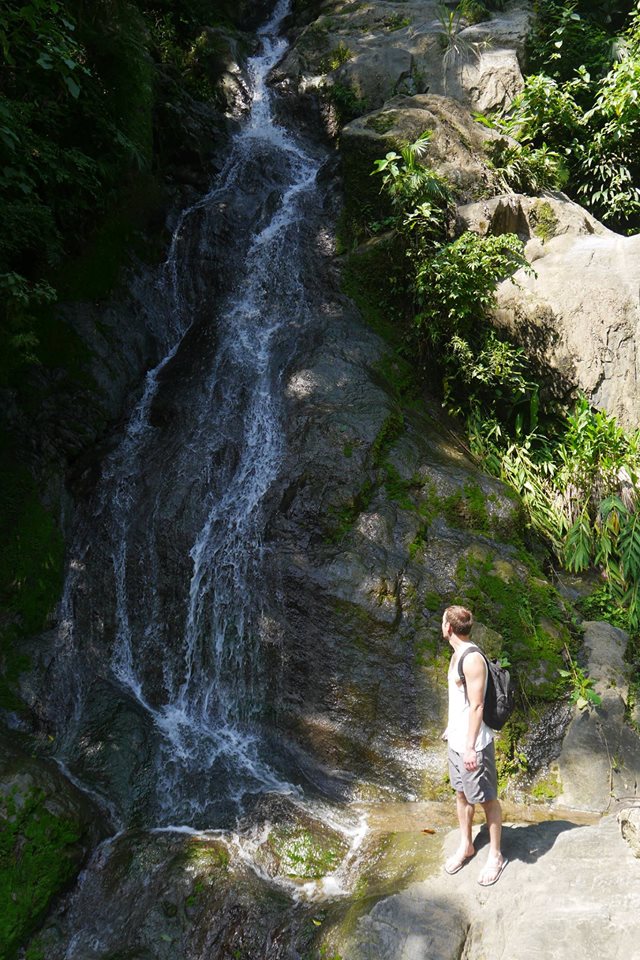
¡Viva Villeta! Refreshing: The 'Seven Waterfalls' ('Siete Cascadas'), Villeta, Cundinamarca, Colombia.
A natural, refreshing shower on the 'Seven Waterfalls' trek in Villeta. (Photo: Pieter Immanuël Hupkes.)
Then you have those with slightly less disposable income, but not in too bad of a way, who stay within the country or at most visit neighbouring countries. The important thing is that they travel a relatively decent distance from their regular abodes.

Lastly, is the most popular group; those hard-pressed working classes whose holiday getaways generally amount to a short break in a nearby department or another town within the same department.

From a Bogotá perspective (and Colombia in general, really), thankfully, those who fall into this latter category are pretty much spoilt for choice — the only thing missing is the sea, but there are plenty of inland waterways to partially fill that void.

¡Viva Villeta! Waterfall one, down-river, on the 'Seven Waterfalls' trek, Villeta, Cundinamarca, Colombia.
The view atop of the first of the 'Seven Waterfalls'.
One of those places that I had the pleasure of checking out recently, impromptu as it was, is Villeta, an approximate two-hour drive north-west from the capital. 

Anecdotally speaking, it still lags behind the likes of Girardot and Melgar as a destination hotspot for those looking for a nearby escape from Bogotá.

A big reason for this is that some wealthier types see it, so I’ve been told anyway, as a bit of a ‘ñero’ (Colombian word for, let’s say, not very pleasant types) holiday location.

So just up the Wrong Way street you might say — because that is, of course, this blog doesn't like to prejudge. ‘Altogether now’ and all that.

Anyway, ñeros or no ñeros, the place has enough going for it to entertain most, at least for a time.

At an altitude of about 800 metres, almost 2,000 metres lower than Bogotá, the climate is more than agreeable, unless you’re a polar bear type. You certainly don’t need your woollies at night, as you often do in the capital.

The village itself is quaint enough – Villeta does mean ‘little village’ in English – if not spectacular. It also has a little more of a modern feel to it than some other similar-sized places in Colombia.

Mini-trains: Villeta, Cundinamarca, Colombia.
The 'train' to Villeta's 'Iguazú Falls' ...
There are a host of hotels and mini-resorts equipped with swimming pools, from the elementary to the somewhat more elegant, allowing you the chance to take in both the sun and subsequently cool off in a modicum of tranquillity.

Better still, though, are the natural cooling-off spots. There are the easy-to-reach ‘mini Iguazú Falls’ (well, they deceivingly resembled them from an advanced photo viewing), a nice 30-minute walk from the village. Or you can also take micro-train transport if you don’t feel like stepping it out in the heat.

Yet far more rewarding, in terms of sights, nature and exercise, is the ‘Seven Waterfalls’ (‘Siete Cascadas’) trek.

It’s not the most taxing, but if walking in nature is your thing, along with having the chance to bathe in cool freshwater to refresh from the tropical sun, it’s pretty enjoyable. 

The more adventurous types can also engage in some extreme diving (see video below). (I didn’t want to show up our very helpful accommodation provider-cum-guide Edwin, so I abstained from partaking.)


Outside of that, as you’ll find in most urban locations in Colombia regardless of size, the village itself isn’t short on lively watering holes. 

The only problem my Dutch companion and I encountered during our nights out was that the place was full of families and teenagers. There seemed to be a dearth of single women in their 20s to ‘converse’ with.

Perhaps it’s a sign of the rising Colombian middle class; these ladies holiday elsewhere. Or at least those who aren’t yet mothers that is.

Oh well, it just leaves more of Villeta (and the odd yummy mummy) for us.