Showing posts with label cédula de extranjería. Show all posts

Saturday, 29 June 2024

Respite from uncertainty (and Migración Colombia's online system!) with residency

@wwaycorrigan

[For an audio/vlog version of this story, click here.]

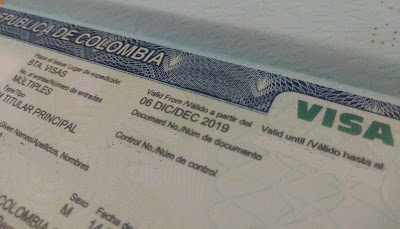
So after more than 12 years of having Colombia as my main base and ten years of various work visas, I've finally managed to get residency.

Respite from uncertainty (and Migración Colombia's online system!) with residency
'Relax, you've got residency now.'
Truth be told, since securing a two-year M visa as an independent worker in 2022, residency wasn't a major priority.

Revel in residency

An M visa puts one on the road to residency. For most who have such a visa for work reasons, that road is a five-year one i.e. after five years of consecutive M visas — no breaks allowed — one can then apply for residency.

Thus, getting back on an M visa after the weaker V visa (effectively a tourist with official permission to do certain work) I had from 2020 to 2022 meant I was rather relaxed about my situation compared to the more troubling visa-application times in 2020 and 2021 (for some background on all that, see Colombia's tough love).

Nonetheless, the M visa I had was due to expire in November this year, so I was facing into another nervy renewal process — one just never knows. (After being granted — largely hassle-free — four year-long visas as an independent worker from 2014 to 2018, the process then got more complicated, as I explained in Colombia's independent work visa: ¿Vale la pena?)

Now, though, with my R visa approved — that's R for residency, in case you're not following — a nervy November is less likely. (I'm sure there'll be something else I'll be nervous or worried about, it's just unlikely it'll be visa-related.)

The biggest benefit of such a visa, as I see it at this stage in any case — no, it's not that I can now vote in local elections — is that I can leave Colombia for up to two years with no change to my legal status. It might seem strange that I'm highlighting this as a positive after just getting residency but I'm referring to the flexibility/freedom it offers. An M visa, in contrast, is invalidated if one is out of Colombia for more than 180 days.
'I wonder if Migración Colombia is cursed. It did, after all, come into being on Halloween 2011.'
Linked to this, I've always had this concern — justified or otherwise — about having difficulties with my bank if I no longer have a valid Foreigner Identification Card, cédula de extranjería. It was with my cédula de extranjería that I opened my current Colombian bank account and they can be quite bureaucratic here about such matters. 'Oh, the ID you have linked to this account is out of date. We can't let you access your funds so.'

Flawed system

Bureaucracy and the cédula de extranjería bring us on to Migración Colombia, the entity one goes to for said cédula once the visa department at La Cancillería, the Ministry for Exterior Relations, has granted a visa.

Migración Colombia is under the control of La Cancillería but at times its processes make one feel that it operates in a completely different dimension to the ministry.

In my December 2022 post, Lending Migración Colombia a helping hand, I tried to do just that, lend the body a hand, by highlighting some frustrating flaws in its online system. My article — surprise, surprise — didn't have the desired effect.

The same blind spots I mentioned back then are still present. Or not present, as it is.

Now, though, in addition to the information-light email replies to users of its services, there are a couple of more headaches — for those dealing with the Bogotá office in any case.

That all in-person procedures, bar picking up a new cédula when it's ready, must first be booked online isn't a major deal in itself. It beats, in theory, waiting in line physically. For the Bogotá office, due to demand I surmise, the window to book appointments opens at 5 pm on Sundays and, by all accounts, closes in a matter of hours.

One is thus advised to be ready to enter the booking system as soon as the clock strikes five. The thing is, it seems the system just can't cope.
Respite from uncertainty (and Migración Colombia's online system!) with residency
System overload.

On the two occasions I had to use it over the last few weeks, the first couple of hours I spent simply trying to enter the website were largely a waste of time. At times it did feel like progress was being made, I'd pass an initial step or two but then the system would crash and I'd have to start all over again.

For fear of missing out on reserving an appointment, especially for registering my R visa and with it applying/paying for a new cédula to reflect my changed circumstances, something that has to be done within 15 calendar days of getting a visa, I didn't take a break from trying to enter the system.

On reflection, it seems that one would be better off waiting until 7 pm. It was only after that time that I started to make progress. Yet, as mentioned, there's the fear of entering the system too late. 'Sorry, all appointments have been booked out for this week.' There is probably a sweet spot timewise, I'm just not sure where it is.

The Cursed

And now, having completed the process, I don't really care. As things stand, I won't have to deal with Migración again, in this sort of way that is, until May 2029. Who knows what my circumstances will be then?

Therein lies another benefit of my R visa: not having to use Migración Colombia's online system for years to come. I'm fairly sure it's already taken, if not quite years, certainly months off my life.

Even what had previously been a rather simple procedure, checking if my new cédula was ready, turned out to be more complicated than I remember it before. It took me a long time to find the appropriate online page. In mitigation, I was searching on my phone. Perhaps the website is more easily navigated on a PC or laptop.

I do wonder, though, if Migración Colombia is cursed. Or better said, it puts a curse on those who use its services. It did, after all, come into being on Halloween 2011. Certainly, all the drama I've had with it has been akin to some slapstick horror show.

Migración Colombia: A Nightmare on Bogotá's 100th Street (Calle 100). Box office potential that.
__________________________________________________________
Listen to The Corrigan Cast podcast here.

Facebook: Wrong Way Corrigan — The Blog & IQuiz "The Bogotá Pub Quiz".
Wednesday, 23 September 2020

Colombia's independent work visa: ¿Vale la pena?

[Listen to an audio version of this blog entry here.]

Pathetic. When thinking of a one-word summary for it all, that's what comes to mind. No, I'm not referring to the content of this blog — it's not all bad, is it? And no, it's not my assessment of President Duque's administration, although I'm sure some of you would use that particular adjective.
Colombia's independent work visa: ¿Vale la pena? Applying for an independent visa in Colombia isn't that straightforward.
Vis-à-visas: Wrong Way has faced nine Colombian visa applications.

Nein, nein, nein

What is pathetic is the fact that in the space of just seven years I've made nine — yes, nine — visa applications in Colombia. Surely, most other self-respecting individuals would have thrown away the ruana and sombrero vueltiao and said a firm 'adiós' well before this. It's not like I've been on to a winner here, rolling in a bed of pesos, living the high life.

In fact, it could be said this is one of the main reasons why I still stubbornly stay here. I'm able to make the few pesos I've managed to earn since 2012 last longer in this country compared to opting for a 'risky' return to Ireland, the homeland always being the default option. 

Basically, while I await that Universal Basic Income — it's on its way, isn't it? — I can get by on much less in these environs.

That and a feeling that in certain ways I've more independence here, left to my own devices so to put it. 

For sure, the one and only full-time, contracted job I took on from December 2018 to January 2020 put a temporary hold on 'being my own boss', relative as that has always been, but it also helped me build up some funds for the drought periods. And things have been pretty dry from an income perspective for months now. 

Therein lies the problem. The struggle to survive as an independent, a freelancer if you will, coupled with the difficulty of actually trying to stay in Colombia legally as such an 'actor' (no, I'm not referring to my under-appreciated thespian talent).

For me, from 2014 to 2018 getting an independent visa for Colombia was a relatively straightforward affair. These days, it's quite the opposite. In fact, it seems as if La Cancillería — the body in charge of these things — would prefer if no independents applied.

'Oh, we forgot to mention we need this.'

Well, it clearly doesn't mind picking up the study fee one has to pay seeing how on first inspection it makes it seem rather uncomplicated. 

It's only after submitting 'draft one' that you invariably — the many comments on Facebook groups vouch for this — get hit with a host of other requirements, a number of which can take some time to organise. 

Why not mention all these at the beginning so a potential applicant can weigh up all the pros and cons before paying for the study? 

To talk specifically, there is no mention in the initial application of uploading a copy of your Colombian-issued ID (cédula). Nor does it say you must provide proof of health insurance and other social security payments. (If you're a first-time applicant, I take it international health insurance will suffice but as for the other social security payments, I've no idea what's acceptable. Also, what if you're in Colombia but not currently in gainful employment?)

What's more, it explicitly says there is no need to issue a copy of your previous visa if it was issued electronically, as mine certainly was. Surprise, surprise, but in response to my latest application, I was asked for a copy of same. With that, unsurprisingly, the guys at La Cancillería are contradicting themselves.
'What rankles is the constant moving of the goalposts. Also, as it's an online process, it's very difficult to get specifics about the exact requirements for your own application. Replies are generic: 'This isn't acceptable', but there's no reason as to why.'
Here's another sign of regression for the once slick Cancillería system. In all previous applications where additional material was requested — mostly because of perceived document illegibility and/or my mugshot not meeting the specifications — I got an email informing me of this. This time around, nothing. I had to log on to the system to find this out. Whisper it, but it's almost like they didn't want me to know.

On the plus side, it seems that the translation, authentication and legalisation of my degree has been accepted. In May 2018, the last time I applied for an independent visa, this was the stumbling block. I ran out of time/salvoconductos (30-day emergency passes to stay in the country, two-in-a-row being the limit).

However, as far as I'm aware, the Cancillería doesn't provide information on all the steps that are needed for the above. Let me help. 

In the following order, here's what has to be done: 

Get apostilles on both your degree and diploma supplement from the country where you studied; get these translated and signed by an officially recognised translator in Colombia; authenticate the translator's signature at the notary office where he/she is registered; then get these translations legalised — an online process — by the Cancillería. (This is when journalism is your independent activity. For other professions you may have to get your degree validated at the Ministry of Education.)

Unrequited love

While all this may seem like a bitter rant against La Cancillería, I must state I have no issues whatsoever with Colombia tightening its requirements. Needless to say, the visa authority can request from applicants whatever documentation it deems necessary.

What does rankle is what seems like the constant moving of the goalposts with absolutely no prior notice. This and the fact that, as it's a fully online process, it's very difficult to get specifics about the exact requirements for your own application. Replies are generic: 'This isn't acceptable', but there's no reason as to why. Little wonder one loses confidence when it all appears rather arbitrary.

In some ways — again, one can say it's only right — things have gone from one extreme to another. While I never got the benefit of La Cancillería's previous lax approach, I know of a number of foreigners who blatantly stayed in the territory illegally for years and then sweet talked their way to a visa and even residency. Can you imagine Colombians getting the same treatment in Europe or the US? They'd be fined, sent packing and barred from returning for life.

There's also the odd sycophantic influencer who is given citizenship for effectively selling Colombia to the Colombians. A perfect representation of the national insecurity and the-US-knows-best mentality.

Then there are others who try to do things by the book, have given La Cancillería plenty of money over the years through numerous applications and shown their commitment to the country, yet they face new obstacles at every turn.

It brings to mind an Irish phrase from my secondary school days that has stayed with me: Grá éagmhaise, unrequited love. Yes, I truly am the pathetic one in this one-way relationship with Colombian officialdom.

Sad as it is, but perhaps I need La Cancillería to give me the knock-out blow. It might just be doing me a favour.
_____________________________________________________________
Listen to Wrong Way's Colombia Cast podcast here.

Facebook: Wrong Way Corrigan — The Blog & IQuiz "The Bogotá Pub Quiz".


Tuesday, 25 April 2017

Feisty Fusagasugueños

When it comes to nearby escapes from the madness of Bogotá, we're not stuck for options. There's Choachí, Girardot, La Vega, Melgar, Pandi, Tobia and Villeta to name just some of the places we're familiar with. Each of those differs in terms of their tranquillity factor, but all are unquestionably more relaxing than the capital city.

We can't, however, say the same for the big town -- city by Irish standards -- of Fusagasugá. OK, on the weather front, it scores well; warmer than Bogotá, but not too stickily hot as some of the locations mentioned above can be. Yet, with a population of over 130,000, it's not quite a peaceful rural getaway.
Feisty Fusagasugueños: Fusagasugá, Cundinamarca, Colombia.
Fusagasugá: It has a couple of things going for it, in fairness.

In fairness, it's not marketed as that. Well, it's not marketed at all really, and with reason considering there doesn't seem much of interest to draw tourists. The pull factors tend to have nothing to do with the urban centre. For most of those who do go to the area, it's all about the rural retreats dotted around.

Yet cities and towns that don't rate high on the popularity scale have an attraction for us and, usually, we aren't disappointed (if you go not expecting too much, then it's easy to be satisfied; for example see previous posts on Buenaventura, Maicao and Turbo, to name just three).

So a stay in the centre of Fusagasugá with a couple of like-minded Irishmen seemed like a win-win plan. And in many ways, it was.

For starters, it's reasonably cheap in terms of food, drink and accommodation, especially compared to Bogotá. What's more, unlike some towns close to the capital and other locations in the regions, there is an abundance of well-kept attractive ladies about (that is to say, not carrying far too many pounds than they should be; each to their own and all that). Then you have the aforementioned agreeable climate.

That's about as good as it gets, though.

On arrival, not having a Colombian cédula (national ID) for the hotels there was a bit of a problem. It was hard work trying to convince them to let us stay. 

You would have thought that the Colombian-issued cédula extranjería, the compulsory ID all visa-holding foreigners must have, would have worked fine. But no. After a long chat with one receptionist we managed to convince her that all would be OK. If the police had any issue -- the reason behind this reluctance to check us in -- we'd speak with them directly. 

Pity those arriving with just a foreign passport, they'd have no chance it seems. This, though, rarely happens, it would seem.

Then there's the "people on edge" feel to things. Many appear to be lacking that relaxed, happy-go-lucky style that you'll find with Colombians in most other places (peak commuting hours in Bogotá excepted). No, in Fusagasugá it was more a "what are you doing here" attitude from a number of its inhabitants, and not in a friendly way, that.

One good representation of this was an off-duty policeman giving one of us an earful for, so it appeared anyway, no more than just because we were foreigners.

All this negativity might be down to the fact that the place tends to get types of a less-than-desirable nature spilling over from Bogotá -- the word for them in these parts being 'ñero'. Just a thought.

Now, not everybody was in fighting form it has to be said. The onset of dusk, however, is the signal for the feisty Fusagasugueños to come out in force.

So if you're planning to let the hair down in Fusagasugá some weekend, it's probably best to do it by day; leave the locals to their own devices at night.
_______________________________________
Facebook: Wrong Way Corrigan - The Blog & IQuiz "The Bogotá Pub Quiz".

Monday, 20 October 2014

Colombia's best bank: And our winner is ...

Sometimes you have to accept that certain things are the way they are – at least for a specific moment in time. So while the Colombian banking system frustrates more than what I had been used to, you just have to deal with it.

However, depending on your circumstances and requirements, it is worth shopping around if you're looking for a safe place for your money here.

Banco Caja Social: Colombia's best bank?
Banco Caja Social: Wrong Way's kind of bank. (Image from Facebook.)

What’s more, reflecting the general lack of customer service in this country, banks don’t seem to care one iota if you decide to ‘take your money and run’, closing an existing account. A great business sense that, leaking clients at will. My ‘millions’ are better off in Ireland and the UK for now.

If you do, though, require a Colombian bank account, from my investigations, coming at it as an independent visa holder, without having to go to extraordinary lengths to prove your importance,* here’s the low-down on the lukewarm to the damn right cold:

Banking is Caring and Sharing: 

First place goes to Banco Caja Social or in its initialism form, BCS (hence the introduction, geddit?). 

This bank offers a standard savings account without any management fee, or so they say. 5,000 COP (Colombian pesos, roughly €1.90) is held in bolsillo (‘pocket’) and taken from your account each month. 

However, it’s your money, not theirs; you can access it whenever you want, apparently. You’re allowed up to five free ATM withdrawals per month – in BCS’s own cash machines that is, of course (there is a fee to use those of other banks, the standard practice in Colombia).
Banco Caja Social: The best bank for independent workers in Colombia.
Moreover, all you need is your Colombian immigration card (Cédula de Extranjería), and cash obviously, to open an account. That is to say you don’t need to show a certified proof of income, a requirement in many of the other banks and something that can be a bit of a hassle to get as an independent, non-contracted worker.

On top of all this, in a case of what’s seldom is wonderful for this country, the guy I dealt with in the bank’s 19th Avenue with Fourth Street (Calle 19 con Carrera 4) branch was extremely friendly and helpful and seemed genuinely interested in having me as a customer (cheers Oscar!).

Worthy of mention: 

A much smaller bank than Caja Social, Bancoomeva’s standard savings account comes free of charges for the first six months. Thereafter, there is no standard monthly fee, but you pay for every transaction. 

At their own ATMs the fee is minimal; 1,300 COP for each of your first four monthly withdrawals. However, it’s more than double that if you withdraw from other banks. This could prove costly considering the current small size of their network nationwide.

A newcomer to the market, the Ecuadorian Banco Pichincha, has a monthly management fee of a not-too-excessive 6,900 COP. Like Caja Social, it’s simple to open an account, with no proof of income required. On the downside, like Bancoomeva, the network is small.

Banco de Bogotá’s monthly fee is 6,500 COP, which allows up to five cost-free ATM transactions per month. The paperwork required to open an account there is somewhat off-putting, though.

It’s relatively straightforward to open an account with Davivienda but the monthly fee of 9,500 COP is at the higher end of the scale. Plus, in one of its branches at least, employees could do with some intensive customer-service training.

Best to be avoided: 

With a total monthly fee of a whopping 18,000 COP, broken down as 10,000 COP for management plus an 8,000 COP administration charge for good measure, Banco Popular is certainly not popular with Wrong Way anyway.

Three of the less favourable banks operating in Colombia, side-by-side.
Three of a kind: Disinterested, costly banks ...
Bancolombia charges 9,700 COP per month and requires proof of income. The Spanish bank BBVA is also one of the more expensive ones with which to do business.

I have it on good authority that Citibank’s priority in Colombia is at the upper end of the market; fee-wise it’s at the upper end of things in any case.

It must be said that some banks such as Banco Av Villas, Banco Occidente and Banco Agrario failed to provide me with information as requested (and promised in a couple of cases). 

Also, if anyone knows of any other bank operating in Colombia that can trump Banco Caja Social – bearing in mind this little study is based on an independent visa holder or somebody without contracted employment – please do tell.

For now, though, it’s off to Caja Social I go.
____________________________________
*By ‘extraordinary lengths’ I mean having to write, in a strong manner, to branch managers and indeed company directors to get any sort of positive attention. Even that doesn’t guarantee any improvement in conditions. 

Thursday, 9 May 2013

Colombia: A banker's paradise

For the second time in a number of months here in Colombia we found ourselves snookered as to what to do with our cash. 

OK, it could be seen as a pleasant headache to have – better looking at it than for it, in a sense. The issue, though, on both occasions was that without a bank account, where do we put the cash we’ve (finally) built up over our time freelance English teaching in the country when we go travelling?
Colombia: A banker's paradise. The safest bank in the world — under the bed?
Safe haven: cash under the bed.
You see, it’s not a problem when we stay in Bogotá. We just keep it tucked away in safekeeping, accessing it when we need to. 

But going on the road with a relatively nice bit of "real money" – enough, in any case, that we certainly don’t want to lose – is not the brightest idea around these parts, or anywhere for that matter. It would be bringing ‘dar papaya’ to new levels of stupidity (see http://bit.ly/XLDyLg for an explanation of that).

Due to our visa situation and a lack of the foreigners’ version of the national identity card (a cédula extranjería as it’s known – it took Colombia immigration almost six months to get us one of those issued, getting it just six days before it actually expired) we couldn’t open a bank account back in January.

Our three-pronged cash solution for our travels back then was thus: we brought more than maybe advisable with us; we left some behind and; in an extremely generous gesture, a friend of ours gave us her bank card to use for the duration of the trip (cheers, Melissa) – so we put the remainder of our cash into that account as cover.

Now, all that worked out quite well in the end, but we didn’t feel fully in control of the situation. So for our latest voyage, one where we had to pop into neighbouring Venezuela for visa purposes,* we tried again to open a Colombian bank account. 

The game changer this time was that we had our cédula – the lack of it beforehand was the only obstacle preventing us doing business with Davivienda (the other banks, for the record, needed written proof of income, something Davivienda did not).

So cash and national identity card in hand, we go to open what they call a savings account – after all, all we wanted was somewhere to "securely" store our money while also having the ability to access it at some stage if needs be.
The Davivienda building in downtown Bogotá stands tall
Standing tall('ish') - Davivienda.
‘Right, what kind of benefits do we get?’ ‘Benefits? Well, you can use the debit card to withdraw your cash at any Davivienda ATM in the country (but use another bank’s machine and you’ll be nicely charged) – get this, free of charge!’ 

‘Wow! Tell us more.’ 

‘You can also make point-of-sale and internet transactions with your card without incurring a charge from us.’ 

‘Great. What about the interest rate?’ 

‘Well that’s minimal, less than one per cent.’ 

‘Ah, that’s OK, it’s better than zero – at least our money will make something.’ 

‘Well, you are, of course, charged $9,300 Colombian pesos (COP officially – roughly US$5) per month to have this account.’ 

‘Hold on, what? We leave our money with you, money you use to invest to make more and you charge us for our "generosity"? How can you do that?’ 

‘Bienvenidos to the banking world of Colombia.’

Yep, we get charged for letting the bank play around with our money. Indeed, if the interest rate was one per cent (it’s less) we’d need to leave a minimum of ten million pesos (about US$5,000) just to break even – that's if the interest was calculated monthly, which it’s not. 

This isn’t just Davivienda (a company where we, incidentally, teach many of its high-rolling staff) we must add – it applies to all the banks; Colombian law apparently.

In fact, it seems to be a cosy cartel between the banks and the country’s lawmakers – nobody seems willing or, more importantly, legally allowed to break ranks. From what we’ve been told, even the international banks play the same game. The likes of HSBC and Citi must love things here – easy money and all that.

We don’t make any secret of the fact that we’ve never been big fans of banks, wherever in the world, but the above practices are just plain wrong. 

How the ordinary Colombian can accept it is beyond us. And, of course, it is the working- and lower-middle-class Colombians that are most affected by it. The lower classes tend not to have bank accounts – they’ve enough problems without them – while the upper-middle and upper classes either don’t really care about such charges or, perhaps more likely, have their wealth elsewhere.
Another Bogotá protest
A popular protest, just not about the banks, though.

At least in the other two countries we’ve banked in – namely the Republic of Ireland and the UK – we don’t get charged just for leaving our money with them. The balance we’ve left in our UK bank account – the current account that is – hasn’t budged since we departed, only for the small sums of cash we’ve taken out.

What’s more, our instant-access savings account, where we can transfer funds from this to our current account in seconds via the internet, is making money for us – not a lot, but at least it’s moving in a positive direction. It’s more or less the same in the Republic of Ireland.

Yes, "proper" savings accounts do exist in Colombia, but from what we can gather they are highly restrictive and not very practical for the average worker. So with seemingly little or no public or political pressure to change their ways, why would the banks do so?

They are on a nice little winner here. After all, it is a banker's paradise.
___________________________
*We’ll have more on what turned out to be a very positive, highly enjoyable trip to Venezuela in the coming days.