Showing posts with label countryside. Show all posts

Thursday, 12 January 2023

A Pauna cracker: Somewhat satisfying and not too dry

@wwaycorrigan

[For a YouTube version of this blog entry, click here.]

After having visited over 50 of Colombia's Andean towns, in particular in the Boyacá, Cundinamarca and Santander departments, I do feel I'm in a strong position to evaluate the region.

A Pauna cracker: Somewhat satisfying and not too dry
Pauna has its plus points. 
Yes, I'm well aware that what's important for me may not be too critical for another. Then there's the fact that I'm quite the minimalist and have rather modest wants when I explore a new place.

Distant beauty

Those looking for close-to-high-income-nation standards in terms of accommodation, food and general tourism infrastructure will be disappointed in the vast majority of Andean towns. 

The exceptions are the likes of Barichara, Girardot, San Gil and Villa de Leyva, places with a now-established reputation, having been popular with international tourists for years.

Most other towns are either only beginning to discover their tourism potential or remain seemingly indifferent to it.

That pretty much every one of them, no matter how small, has some sort of accommodation available for visitors usually has less to do with tourism and more to do with business e.g. emerald mining or some major construction project that had/has been going on for years. Indeed, from my travels, only Saboyá fails on the hotel front.

Nonetheless, if it's simply just a bit of bucolic bliss in a majestic mountain setting you're after and you're not terribly fussy, then a case could be made for any Andean town. Even more so if you like to wander around hilly countryside without the need for a guide.

Those looking for warmer climes — warmer than Bogotá that is — should seek out places below an altitude of 2,000 metres. It's generally short sleeves with shorts day and night, all year round, in such places, save for the need to cover up from tropical downpours.

The Boyacá town of Pauna, at 1,215 masl, firmly fits into that category. With an unusually dull and rainy early January in Bogotá, the feeling that I was being unfairly denied some sun sent me in Pauna's direction. Well, that and the fact that the brothers who own my preferred panadería "office" are from there, so on hearing this, I thought it would be as good as any place for an unplanned escape.

The picturesque Briceño in Boyacá, Colombia.
Briceño's beauty is a little more obvious than Pauna's.
Weather-wise, it wasn't quite the sun-drenched spot I was hoping for — the whole Andean region is enduring a protracted rainy season. It was, though, still quite warm, with afternoon highs around 25 degrees Celsius.

The main tourist attractions appear to be the various swimming pool "resorts" on the town's outskirts. Seeing as how my visit coincided with high season, I gave these pools a wide berth. Surrounded by screaming, water-splashing children together with tipsy adults blaring out music is not my idea of relaxation.
'In a land of plenty when it comes to tourist attractions and natural beauty, a place does have to offer something different to entice potential visitors.'
Architecturally, Pauna has little going for it. Its main square and church certainly won't win awards for beauty. In contrast, in nearby, smaller Briceño, 12 kilometres away via undulating, largely dirt-track, traffic-free roads — yes, I did walk there and back — the main square and church are quite picturesque.
Cascada la Tunera near Pauna, Boyacá, Colombia.
Cascada la Tunera: Click here to get a better idea of it.
Pauna's prettiest side is from a high. There are a few hilltops around from which to view it, although the best one is from a private residence that's used as a holiday home. Thankfully its temporary occupiers allowed me in for the obligatory photo and a YouTube Shorts video. Cheers, Horacio! The two Aguila beers he gifted me were also well received.

Pauna's people power

The biggest draw for nature lovers is surely Cascada la Tunera. This impressive, somewhat hidden waterfall — it can be heard well before it's seen — is about five kilometres from the town. An internet search tells me that the fall is about 50 metres — I would have said more.

There's also a far gentler tributary waterfall next to it that is quite alluring thanks to the golden-brown soil over which it flows.

Back in Pauna, another area where it won't be winning awards is for its coffee. Yes, this is a coffee-growing region but the townsfolk don't make a good brew. Unsweetened, strong coffee is hard to find. There is an exception, though. Páramo, the fancy ice cream shop on the main square, makes a panela/sugar-free, tasty tinto for an agreeable 1,500 pesos.

Never a frown with golden-brown: The soil over which this waterfall flows appears to sparkle. (Location: Pauna, Boyacá, Colombia)
Alluring: The golden-brown soil over which this waterfall flows seems to sparkle.
Coffee concerns assuaged, with all the wandering I did, it would have been nice to refresh with my preferred Poker beer offering i.e. a litre bottle. Or at least the 750 ml serving. 

Alas, similar to some other small towns I've visited, only the 330 ml bottles are available at 2,500 pesos a pop (in my Bogotá barrio, one can still get a litre bottle for 4,000 pesos). On the plus side, sticking to my not-too-strict beer budget, it meant my alcohol consumption was kept in check.

Considering there are easier towns to reach from Bogotá — Pauna is over a 160 km drive away and the windy road after Chiquinquirá is, well, rustic to put it mildly — it's unlikely to attract the masses.

Having said that, my trip coincided with an annual five-a-side football tournament. With a not-to-be-sniffed-at winners' prize of 12 million pesos, the competition attracts teams from far and wide. Thus, the town was heaving for my last couple of days there.

In a land of plenty when it comes to tourist attractions and natural beauty, a place does have to offer something different to entice potential visitors. So credit to Pauna on the football fest.

It gets less credit for its slogan of being the 'green gate to Colombia'. No doubt many other municipalities would contest that one.

For me, alongside the setting, Pauna's big pull factor is its people.

*Accommodation info:
Hospedaje El Mirador has quite spacious, bright rooms available for 25,000 pesos per person with good WiFi.
I also had a night at Hospedaje Doña Evita for 30,000 pesos (this was forced on me as El Mirador was booked out for the football tournament and I had no reservation). Doña Evita, ran by an affable elderly couple, is more like a house than a hostel/hotel. No WiFi is a drawback, though.
__________________________________________________________
Listen to The Corrigan Cast podcast here.

Facebook: Wrong Way Corrigan — The Blog & IQuiz "The Bogotá Pub Quiz".

Wednesday, 27 April 2022

Paths to cleaner living

@wwaycorrigan

[Listen to an audio version of this blog entry here.]

One has to admire an individual who realises that he/she has a personal problem and takes corrective action. As a species, we are often quick to see the faults of others yet are blind to our own shortcomings.

Paths to cleaner living: The odd Poker beer doesn't do too much harm, does it? (Photo shows three litre bottles of Poker on a table in a tienda bar in Verbenal, Bogotá, Colombia.)
There are always hurdles to overcome on the path to cleaner living ...

Beer barrios

When it comes to drug addiction or simply just bad/self-destructive habits with mind-altering substances, be they legal or otherwise, stopping the rot can be particularly tricky.

With alcohol consumption, the widely accepted socialising drug, a heretofore regular drinker may have to change his/her life considerably, at least initially, to say no.

Personally, if I decided to cut beer drinking entirely from my life, I think I'd have to leave Bogotá. Or at least move out of my current barrio. This is because the majority of my socialising revolves around the tienda and with it a few litrazos (a litre bottle, that is) of Poker.

I hasten to add that this isn't a daily occurrence. Two or three times per week, max. And, with age, I'm getting better, for the most part, at knowing when I've had my fill even if, to use an Irish word, the craic is mighty when I decide to head home (do note, craic here means 'enjoyable social activity', lest one think of something else).

It's because I'm more in the jomo (joy of missing out) camp these days rather than with the fomo (fear of missing out) brigade.
'From a marijuana chain smoker and seemingly daily beer drinker — not a good combination for a taxi driver — to a fundamentalist Christian (of sorts) in a few weeks.'
Yet, for those who have trouble knowing when to stop imbibing and the like, a lively-ish city with a beer-drinking culture can be quite a dangerous place to be. There are, quite literally, temptations at every corner.

Thus, in such circumstances, when one reaches a point where it's a case of 'make lifestyle changes now or be left with no life', it requires quite an amount of willpower to overcome the "demons".

Christian convalescence

Some, as I touched on a few years ago in Strength in belief, find the answer to their problems in God.

One barrio friend has recently taken this path. From a marijuana chain smoker and seemingly daily beer drinker — not a good combination for a taxi driver — to a fundamentalist Christian (of sorts) in a few weeks.

While I may not agree with his new-found religious beliefs — or if not exactly new-found, at least renewed enthusiasm for Christianity — I am impressed with the transformation. Considering his previous form, it could be said the end — in this case, being "clean" — justifies the means.

What's more, he has changed his ways without becoming a recluse. Apart from a few weeks back in the land of his birth on Colombia's Caribbean coast, he's still to be found socialising in the barrio, just this time with a gaseosa (fizzy drink) in hand rather than a beer (we'll cut him a little slack for the dangerous sugar indulgence).

As I've mentioned above, I'm not sure if I could do the same; hang out in the barrio and not drink beer. Not indefinitely in any case. I'd simply prefer not to go out.

I like to think that if I decided to go cold turkey, I could do it more easily in the countryside. A rural retreat, removed, as best one can be, from other human beings with fewer potentially harmful temptations.

There is another school of thought suggesting that if one were to "settle down" i.e. enter a relationship, this would also "tame the beast" so to put it. Whatever the dubious truth of that, one may be just too accustomed to singlehood for it to happen any time soon.

So Mother Nature and a modicum of isolation; I see that as my path to cleaner living, should I decide that it's needed. That's the theory anyway.

City life, its many evils notwithstanding, does, however, still have its advantages and appeal. At times.
_______________________________________________________________
Listen to Wrong Way's Colombia Cast podcast here.

Facebook: Wrong Way Corrigan — The Blog & IQuiz "The Bogotá Pub Quiz".
Thursday, 20 January 2022

Gachetá if you can

@wwaycorrigan

[Listen to an audio version of this blog entry here.]

I've generally been reluctant to leave Bogotá during Colombia's tourism high season or at long weekends. So the first holiday Monday of the year is a negative on both fronts.

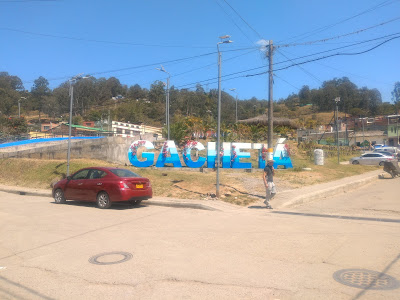
Gachetá if you can: Well, if the letters say so! Gachetá, Cundinamarca, Colombia.
In case you forget where you are, most Colombian towns now have their name spelt out in big letters to remind you.
However, feeling somewhat annoyed and frustrated with my rather bland routine in the capital, I took a gamble and escaped during the January holiday weekend.

Pueblo peace

My default option these days is to travel north of Bogotá as I live a convenient five-minute walk from the northern bus terminal. 

Any destination to the south requires a trek across Bogotá to either the main terminal in Salitre or the satellite station in the far south. Avoiding Bogotá's public transport and traffic is good for the body and mind at any time.

In terms of the destination, as readers of previous posts detailing small-town (pueblo) visits will know, the location itself isn't the most important aspect.

Almost any town within a 200-kilometre radius of Bogotá will have a reasonably priced hotel, a picturesque main square, a panadería with drinkable coffee, a tienda with affordable beers and a few hills to wander around to work up a sweat and enjoy a little bit of nature. 

It's a bonus if there's a relatively clean river or lake to chill out by and even bathe in. On the minus side, one usually has to be prepared to encounter some mad dogs — nothing's perfect.

This time around, I wanted somewhere warmer than Bogotá but not ridiculously hot. Looking at the map, for some unknown reason I was drawn to the town of Gachetá.

Gachetá if you can: The picturesque cemetery in Gachetá, Cundinamarca, Colombia.
A scenic resting place ...
Capital of the Guavio Province in the department of Cundinamarca and situated about 100 km (depending on the route taken) east of Bogotá, a Google search told me it's at an altitude of just under 1,800 metres with average daytime temperatures of over 20 degrees Celsius and no colder than eight degrees at night. The jacket can stay in the bag.  

A mistake, however, was to assume that buses from Bogotá to Gachetá leave from the northern terminal. They don't. Thankfully, though, I didn't have to go to the other terminals. Gachetá-bound buses leave from Calle 72 with Avenida Caracas, a 40-minute Transmilenio journey from Terminal Norte.
'No Colombian town is complete without a hilltop statue of Mary or Jesus to "discover".'

That minor miscalculation aside, another anxiety I have about leaving the city on the Friday of a long weekend, heavy traffic, mercifully didn't come to pass on this particular route. In fact, it was largely congestion-free.

The only slight inconvenience — down to my terminal mix-up — was that I arrived in Gachetá after dusk. Normally, I like to get to a new place before nightfall. However, for a small and very safe country town where the bus terminal is a short walk from the centre, this is less of a concern. Rocking up in an unfamiliar big city at night is another matter entirely.

The first item on the agenda, then, was to find a reasonably priced hotel. That came in the form of Hotel El Portal de la Cuarta. 

At 25,000 COP per night for a spacious ensuite room with a hot-water shower (not that the hot water was needed), a comfortable double bed, cable TV and, of course, the essential steady WiFi, one can't go too wrong. Wilmer, the mild-mannered owner, is also on hand to give some sightseeing tips.


Scenery to die for

One of those tips, perfect for the hillwalker that I am, was the Ruta del Agua (Water Route). This incorporates a four-kilometre trek (taking the most direct route) up to a statue of — go on, give a guess  — yes, that's right, the Virgin Mary (no Colombian town is complete without such an attraction. If it's not Mary, it's Jesus). The spot offers a nice view of the town and surrounds.

Gachetá if you can: The town down in the valley: Gachetá, Cundinamarca, Colombia.
Looking down on Gachetá en route to the loftier Junín.
It's not a cul-de-sac trail, but whether you go the shorter way or take the slightly longer route via Carrera 5 and a townland called La Chamba, you'll cross the Río Salinero. This predominantly shallow, fast-flowing river does have some deeper spots where you can have a refreshing dip — in rainy season it might be a different animal altogether.

Mentioning Carrera 5, exiting the town taking this street is where you'll pass what is arguably one of the most scenic cemeteries in the country. It is, um, to die for. Sorry!

Río Salinero, Gachetá, Cundinamarca, Colombia.
Río Salinero: It does have some deeper spots in which to submerge oneself.
The hill on which the Virgin Mary stands is perhaps about 100 metres higher than Gachetá. So for those looking for something a little more taxing in terms of a trek, a walk to the nearby village of Junín offers just that.

At an altitude of 2,300 metres, it's a good 500 metres closer to the stars than Gachetá. The shortest, largely traffic-free, rustic approach is just six kilometres away. It does, though, involve a few decent inclines. It certainly puts the legs to work. The reward is getting to take in the quaint Junín, sipping on a coffee and arepa or, whisper it, a cold beer.

The quaint main plaza in Junín, Cundinamarca, Colombia.
Win-win in Junín!
It would be remiss of me not to go into a little more detail on the arepa, Colombia's traditional cornflour snack, available in these parts.

Each region of the country has its own take on them but I have to say the cheese-filled, unsweetened ones in the Guavio Province are about as good as they get. (I mean this in terms of plain arepas, not the delicious Venezuelan ones that are stuffed with all sorts of fillings or the egg/meat-filled arepas originating from Colombia's Caribbean coast.)

Back to Gachetá, some might say that it is the least impressive of Guavio's towns. From what I've been told, the similar-sounding Gachalá, for one, on the banks of the Guavio Reservoir, a very scenic man-made lake, is more idyllic.

That may be so, but in terms of a quiet rural retreat, Gachetá grades well. It beats being bored in Bogotá anyway.
_______________________________________________________________
Listen to Wrong Way's Colombia Cast podcast here.

Facebook: Wrong Way Corrigan — The Blog & IQuiz "The Bogotá Pub Quiz".


Wednesday, 26 June 2019

Rednecks rise again

Back in my early secondary school days, as a country lad heading off to mix it with the townies, it was common for the latter to mock us. We were farmer boys, or rednecks, as they say in some parts. 

It was generally a bit of innocent slagging but no doubt it had its origins in the long-held belief that workers of the land were a bit "behind", simple if you will, compared to those from urban settings.

Rednecks rise again: Some city grazers in Barrio Santandercito in the north of Bogotá, Colombia.
Cattle on Bogotá's northern limits: Bringing a bit of the country to the city.
Of course, the townies of Ballaghaderreen, along with everybody else from "down the country", were derogatorily seen as bog folk, "culchies" being the precise word, by those from the capital Dublin.

Zoom out even more and the whole of Ireland was traditionally viewed as being backward by our "superior" neighbours in Britain. 'Strange specimens those Irish, aren't they?'

City fat cats

Modern, advanced, rich societies emanate from urban strongholds with their schools of excellence and suchlike. Rural areas only get the crumbs, enough to keep them ticking over, from the power brokers seated around that grandiose table. So it goes anyway.

Nonetheless, keeping those seated at the urban table well-fed and content with affordable food is nigh-on impossible without the simple country folk doing their bit to provide it.
'We’re just a few consecutive disasters away from very troubling times.'
The irony here is that while the great advancements in communications and technology have made the world a smaller place, many urban dwellers have become quite removed, mentally at least, from the rural areas that they rely on to stay alive.

OK, they have other, more complicated, complex concerns to worry about. The country serves simply as escapism from the concrete jungle. Engagement with it is at a superficial level only.

What's more, aren't the technological improvements in agriculture and the like, urban brainchildren as most have been, resulting in greater yields and reduced workloads for those who farm the land?

There's merit to that.

Yet, to continue providing for the growing urban masses, more engagement with, and investment in, the countryside are required, not less.

Misplaced priorities

Whether one believes in man-made climate change or not (Donald Trump, considering his age, doesn't have to concern himself with it), we can't deny the fact that we have been experiencing extreme weather events that threaten our precious food supply. We could be just a few consecutive disasters away from quite troubling times.

How many of us would be able to survive in a kind of post-apocalyptic planet, something akin to what we often see portrayed in Hollywood movies?

It would seem fair to say that a majority of First Worlders have become too reliant on our modern comforts, on a lifestyle where we can get pretty much anything we want when we want it.
'We won't be too concerned about our mental health when our very existence is under threat.'
As a species, we could also be accused of vastly overvaluing non-essentials at the expense of the essentials. Think Hollywood again, that whole world of showbiz and fame.

Heck, I left the land I was reared on (as the majority of rural-born people do these days) to go on to pursue a career (can I call it that?!) in media. Fair enough, journalism plays — or at least used to play — an important role as the fourth estate, it can be a force of positive change.

However, the counter-argument here is that this vocation has lost its way and relevance in recent times (whisper it, #FakeNews. Thanks Donald). And don't get me started again on the evil incarnate that is marketing!

On a similar note, a Colombian psychologist friend told me how he wanted to get "back to the land", fearing that without preventative action now he would be useless when faced with a future scenario where one had to fend for oneself for the bare necessities.

As he put it, when it's a simple matter of life or death, very few people will be looking to take the time to think deeply about it all, teasing out the pros and cons. His profession would be practically surplus to requirements.

Basically, and as much as I'm not a fan of Christianity (or any religion really), the old mantra of 'ashes to ashes, dust to dust and dust you shall return' rings true.

The land, the planet will have the last laugh.

Those old backward rednecks who understand it a little better than most mightn't seem so repulsive then.
________________________________
Facebook: Wrong Way Corrigan – The Blog & IQuiz “The Bogotá Pub Quiz”.
Listen to The Colombia Cast podcast here.