Showing posts with label arepas. Show all posts

Saturday, 9 April 2022

A balmier (and wetter) side to Boyacá

@wwaycorrigan

[Listen to an audio version of this blog entry here.]

When one thinks of Colombia's Boyacá department, if one thinks of it at all, it tends to conjure up images of the awe-inspiring Andes, clean, cool country air and the odd superstar cyclist.

It's generally not thought of as a tropical paradise. That's because, for the most part, it's not one.

A balmier (and wetter) side to Boyacá: First impressions — it was sunny when we first got to the small town of Santa María in Colombia's Boyacá Department. The rain wasn't long in arriving, though!
First impressions: Santa María on a sunny day.

Right as rain

Yet, Boyacá does have its lower-lying areas and, as Colombia is in the tropics, with that comes hotter weather, day and night (the sun can and does show its force during the day in the loftier parts, as I discovered in Tibaná recently).

One of those balmier Boyacá places is the small town of Santa María in the department's southern Neira Province. Warm it may be (at an altitude of 850 metres, the average low is 23 degrees Celsius), its tropical monsoon climate means it gets plenty of rain. I just so happened to plan my brief visit at the start of its wet season. Oh well.
Grey skies but Santa María in the south of Colombia's Boyacá Department is far from dull.
Santa María gets its fair share of rain, especially between April and November.
Thus, the idea of a sun-kissed trip to Santa María, bronzing oneself up, didn't really materialise. It was far from cold, though, of course. And the sun did peep through on occasions. In further mitigation, the heaviest, most intense rain seemed to fall at night. Indeed, that helped to make things more relaxing in a way, listening to the rain hammer down on tin roofs whilst cosily tucked up in bed.

Alongside that, for some relative peace and quiet compared to the Bogotá bustle, it certainly comes good.

Now some of you may be aware that I do like to get it in some hillwalking where possible and on that front Santa María has various options.
'Perhaps the townsfolk figured it would simply be a waste of time and money building a big church, competing in vain with the beauty that nature has to offer all around.'
La Cristalina is an "official" — i.e. signposted, for the most part, anyway — roughly four-kilometre (one-way, from the town centre) trek through rolling forested hills, incorporating a nice view of the town from the south and leading to a small waterfall.
The calmer parts of the river along Santa María's La Cristalina trek offer some refreshing bathing time.
From calm waters to ...
Close to the beginning and at the end of this walk, the largely fast-flowing river does provide some refreshing bathing spots. These are well-received when the sun is out.

River wild: Trekking La Cristalina in Santa María, Boyacá, Colombia.
... the river wild.

A dam good place

Immediately to the north of the town there is an alluring peak that I had to try to master. Alas, with just vague instructions on how to arrive at the summit, I only managed to get about three-quarters of the way, wading through some thick grassland en route, before encountering some rather dense forest. I figured it was best to make a safe retreat at that stage. At least I made it far enough so as to get a good view of Santa María well below.

I subsequently discovered some other walks along quiet country lanes, passing through both farmland and forests. (A special mention to 76-year-old and father of a five-year-old daughter, Gonzalo, who generously fed and watered me with guarapo [a sometimes fermented sugarcane juice, in case you're wondering] and arepas after I stumbled upon his secluded homestead on one of the various hills I wandered up. The refreshments were well received following about six hours of ascending and descending.)
A view of Santa María from the south.
A view of that alluring peak to the north of Santa María.
Santa María itself, unlike most towns in these parts, is devoid of an impressive Catholic church on its main plaza. For sure, it has a church, it's just not that aesthetically pleasing. Perhaps the townsfolk figured it would simply be a waste of time and money trying to compete with the beauty that nature has to offer all around. If that is the case, I'm in agreement.
The homestead of the friendly Gonzalo Daza, Santa María, Boyacá, Colombia.
Top man: Gonzalo came good with copious amounts of guarapo and a couple of arepas.
As for a place to lay one's head, for a small settlement, it has, somewhat surprisingly, at least five accommodation options. I was told this is a legacy of the construction of the nearby and visually stunning La Esmeralda Dam, built in the 1970s for hydroelectric power (see video below).

I opted for Hotel La Posada, with rooms from a very reasonable 25,000 COP per night. Going by outward appearances, the other hotels may be a little fancier but, I must confess, I didn't check them out. This was for the simple reason that Don Jaime and his wife Margarita, La Posada's owners, are a delightful elderly couple so I was content to stay put.
There are plenty of hills to wander all-round Santa María in Colombia's Boyacá Department.
Spying Santa María from the hills to the north.

In fact, Don Jaime insists I should return, preferably in the dry season (I don't mind the rain, Jaime!), as he wants to bring me to his farm on the outskirts of the town, where he herds about 80 cattle.

For the old farmhand that I am, it's a very tempting invitation. As the saying goes, you can take the man out of the farm but you can't take the farm out of the man.

I guess it's why I have a liking for these rural retreats.

*There are almost hourly buses to Santa María from Bogotá's northern bus terminal (Calle 193) with Flota La Macarena and Flota Valle de Tenza the main operators. A one-way ticket costs 35,000 COP during normal times (expect to pay more during holiday and festival periods). The journey time is about 3.5 hours.

_______________________________________________________________
Listen to Wrong Way's Colombia Cast podcast here.

Facebook: Wrong Way Corrigan — The Blog & IQuiz "The Bogotá Pub Quiz".
 

Thursday, 20 January 2022

Gachetá if you can

@wwaycorrigan

[Listen to an audio version of this blog entry here.]

I've generally been reluctant to leave Bogotá during Colombia's tourism high season or at long weekends. So the first holiday Monday of the year is a negative on both fronts.

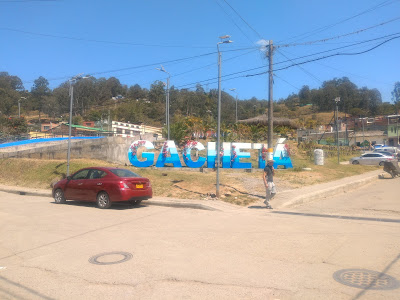
Gachetá if you can: Well, if the letters say so! Gachetá, Cundinamarca, Colombia.
In case you forget where you are, most Colombian towns now have their name spelt out in big letters to remind you.
However, feeling somewhat annoyed and frustrated with my rather bland routine in the capital, I took a gamble and escaped during the January holiday weekend.

Pueblo peace

My default option these days is to travel north of Bogotá as I live a convenient five-minute walk from the northern bus terminal. 

Any destination to the south requires a trek across Bogotá to either the main terminal in Salitre or the satellite station in the far south. Avoiding Bogotá's public transport and traffic is good for the body and mind at any time.

In terms of the destination, as readers of previous posts detailing small-town (pueblo) visits will know, the location itself isn't the most important aspect.

Almost any town within a 200-kilometre radius of Bogotá will have a reasonably priced hotel, a picturesque main square, a panadería with drinkable coffee, a tienda with affordable beers and a few hills to wander around to work up a sweat and enjoy a little bit of nature. 

It's a bonus if there's a relatively clean river or lake to chill out by and even bathe in. On the minus side, one usually has to be prepared to encounter some mad dogs — nothing's perfect.

This time around, I wanted somewhere warmer than Bogotá but not ridiculously hot. Looking at the map, for some unknown reason I was drawn to the town of Gachetá.

Gachetá if you can: The picturesque cemetery in Gachetá, Cundinamarca, Colombia.
A scenic resting place ...
Capital of the Guavio Province in the department of Cundinamarca and situated about 100 km (depending on the route taken) east of Bogotá, a Google search told me it's at an altitude of just under 1,800 metres with average daytime temperatures of over 20 degrees Celsius and no colder than eight degrees at night. The jacket can stay in the bag.  

A mistake, however, was to assume that buses from Bogotá to Gachetá leave from the northern terminal. They don't. Thankfully, though, I didn't have to go to the other terminals. Gachetá-bound buses leave from Calle 72 with Avenida Caracas, a 40-minute Transmilenio journey from Terminal Norte.
'No Colombian town is complete without a hilltop statue of Mary or Jesus to "discover".'

That minor miscalculation aside, another anxiety I have about leaving the city on the Friday of a long weekend, heavy traffic, mercifully didn't come to pass on this particular route. In fact, it was largely congestion-free.

The only slight inconvenience — down to my terminal mix-up — was that I arrived in Gachetá after dusk. Normally, I like to get to a new place before nightfall. However, for a small and very safe country town where the bus terminal is a short walk from the centre, this is less of a concern. Rocking up in an unfamiliar big city at night is another matter entirely.

The first item on the agenda, then, was to find a reasonably priced hotel. That came in the form of Hotel El Portal de la Cuarta. 

At 25,000 COP per night for a spacious ensuite room with a hot-water shower (not that the hot water was needed), a comfortable double bed, cable TV and, of course, the essential steady WiFi, one can't go too wrong. Wilmer, the mild-mannered owner, is also on hand to give some sightseeing tips.


Scenery to die for

One of those tips, perfect for the hillwalker that I am, was the Ruta del Agua (Water Route). This incorporates a four-kilometre trek (taking the most direct route) up to a statue of — go on, give a guess  — yes, that's right, the Virgin Mary (no Colombian town is complete without such an attraction. If it's not Mary, it's Jesus). The spot offers a nice view of the town and surrounds.

Gachetá if you can: The town down in the valley: Gachetá, Cundinamarca, Colombia.
Looking down on Gachetá en route to the loftier Junín.
It's not a cul-de-sac trail, but whether you go the shorter way or take the slightly longer route via Carrera 5 and a townland called La Chamba, you'll cross the Río Salinero. This predominantly shallow, fast-flowing river does have some deeper spots where you can have a refreshing dip — in rainy season it might be a different animal altogether.

Mentioning Carrera 5, exiting the town taking this street is where you'll pass what is arguably one of the most scenic cemeteries in the country. It is, um, to die for. Sorry!

Río Salinero, Gachetá, Cundinamarca, Colombia.
Río Salinero: It does have some deeper spots in which to submerge oneself.
The hill on which the Virgin Mary stands is perhaps about 100 metres higher than Gachetá. So for those looking for something a little more taxing in terms of a trek, a walk to the nearby village of Junín offers just that.

At an altitude of 2,300 metres, it's a good 500 metres closer to the stars than Gachetá. The shortest, largely traffic-free, rustic approach is just six kilometres away. It does, though, involve a few decent inclines. It certainly puts the legs to work. The reward is getting to take in the quaint Junín, sipping on a coffee and arepa or, whisper it, a cold beer.

The quaint main plaza in Junín, Cundinamarca, Colombia.
Win-win in Junín!
It would be remiss of me not to go into a little more detail on the arepa, Colombia's traditional cornflour snack, available in these parts.

Each region of the country has its own take on them but I have to say the cheese-filled, unsweetened ones in the Guavio Province are about as good as they get. (I mean this in terms of plain arepas, not the delicious Venezuelan ones that are stuffed with all sorts of fillings or the egg/meat-filled arepas originating from Colombia's Caribbean coast.)

Back to Gachetá, some might say that it is the least impressive of Guavio's towns. From what I've been told, the similar-sounding Gachalá, for one, on the banks of the Guavio Reservoir, a very scenic man-made lake, is more idyllic.

That may be so, but in terms of a quiet rural retreat, Gachetá grades well. It beats being bored in Bogotá anyway.
_______________________________________________________________
Listen to Wrong Way's Colombia Cast podcast here.

Facebook: Wrong Way Corrigan — The Blog & IQuiz "The Bogotá Pub Quiz".


Monday, 11 February 2013

Finding Filandia

Despite hailing from an island, we’ve always felt more at home inland. That we were brought up in a landlocked county in our native Ireland probably has something to do with our mindset in this regard – our ability in deep water matching that of a handicapped cat has also played its part, no doubt.
Finding Filandia: 'Wrong Way's' terrain, high up in the hills!
At home in the hills.
Now, we don’t have an irrational fear of water. Heck, we’ve snorkelled and scuba-dived the planet’s great oceans. Plus, as last week’s story detailed (‘Lesser-spotted Colombia: Bahía Solano’ http://bit.ly/X3lWpV), we’ve no problem sailing the high seas. It’s just up in the hills has always felt a bit better (after over a year living in Bogotá, it would want to).

So with that in mind plus our desire to check out quiet, slow-paced places on our recent escape from the Colombian capital, our final short stop ticked many boxes. 

Perched at an altitude of 1,900 masl, the quaint little town of Filandia** in Colombia’s famed Eje Cafetero (‘Coffee-Growers Axis’ or ‘Coffee Triangle’ as it’s also known as) is, as far as we’re concerned, a close to perfect inland location to unwind.
Filandia's neat & tidy main square
Filandia's main square - where it all happens.

Eye-catching scenery among the green rolling hills, tranquil country roads to ramble aimlessly about with warm, but not unbearable (like the friendly locals) daytime temperatures along with a well-kept town (we're not always in search of dirty places - see 'Buenaventura's dirty delights' http://bit.ly/11ksFmP) all contribute to make this a highly enjoyable place to visit. Throw in the fact that it’s not quite as well known as nearby Salento and thus sees fewer tourists, it’s hard to find a fault if a bit of peace and quiet in the countryside air is what you’re looking for.

In many ways, the place is a picture-postcard image of rural, old-school Colombia: A colourful little main plaza replete with a standout Catholic church; the compact, door-less, plastic-top Jeep Willis used to transport coffee, people and whatever else you fancy; farm animals wandering, without a care, about the streets; and of course the middle-aged/elderly local men kitted out in trademark poncho and wide hat (or ‘aguadeño’ in the native lingo) with most sporting a little moustache. 
Typically dressed Colombian men
The 'boyos'!
A tasty little touch for us was the way that almost every second dwelling in the town seemed to sell chargrilled arepas in the morning and again in the evening (we do like an arepa from time to time as discussed in ‘Six of the best in 2012 (well kind of)’ http://bit.ly/VQGxxo). Plain arepas with a touch of butter and/or salt they may just have been – the odd few houses offered cheese – but they hit the spot (in fairness, for $300 pesos a pop – about $0.15US – you really can’t go wrong).

After a couple or more of those, you’re in no better place to wash them down with a nice cup of coffee. There’s no shortage of options in this regard – all very reasonably priced as well for the hard-pressed, as, you may have guessed, we are.
Filandia's big business - arepas
Arepas, lots of arepas - yummy!
If you do happen to get bored with things in the town and its surrounds – our stay was much too short for this to happen – there is a coffee park about 20 km away that’s meant to be worth a visit (we didn’t get to it, this time). The small city of Armenia is less than an hour's bus ride away if you’re perhaps looking for a bit more ‘action’ (not something we wanted, though, as pointed out above).

For us, the relative peace and serenity in the comfortable hillside surroundings were more than enough. Enough, in any case, to leave a desire in us to go back for more.

*In terms of accommodation, the hostel/hospedaje ‘Eden de Filandia’ (above ‘Droguería Bristol’, the pharmacy on the square) offers basic rooms – although with a balcony where you can see the square – for the giveaway price of $12,000 pesos per night, less than $7US. There are other, slightly more expensive options if you feel like splashing the cash.

**As you’ll discover should you visit, the name ‘Filandia’ has nothing to do with the country Finland (which is ‘Finlandia’ in Spanish) as some people mistakenly think. It comes from the Latin ‘fila’ meaning daughter and ‘andia’ referring to the Andes Mountains. So basically the town’s name means ‘Daughter of the Andes’. Now you know!

Monday, 31 December 2012

Six of the best in 2012 (well, kind of)

Despite the irrational and subsequently unfounded fear in some quarters that the world would end on 21 December just gone (remember all the hullabaloo?) because of a Mayan prediction, we’re still here, same as always, more or less. 

Of course, ‘officially’ the Mayans weren’t predicting the end of the world at all; it was just the end of their twelfth calendar and the beginning of number thirteen.

In any case, a large number of us use the Gregorian calendar these days, which sees us entering a new year. So, in keeping with our exceptional originality here, we’re going to look back at some of the things that we’ve derived most pleasure from in 2012. 

Well, at least we’re being outwardly positive for a change. And as you’ll see — in no particular order and far from exhaustive, by the way — there have been plenty of things that brought a smile to our face in the past year:

Six of the best in 2012 (well, kind of): A shot from the Miraflores Locks at the Panama Canal.
The Panama Canal.


Seeing more of the world

Considering it’s travelling that has us in Colombia in the first place, we’ll start off on this one. 2012 saw us add four more countries to our imaginary visited list — but far from done list (don’t get us started on that one. A very irritating turn of phrase used by far too many backpackers). 

Firstly, there were the ‘delights’ of Venezuela – it’s true, time is a great healer (for what we thought of the country at the time, see http://bit.ly/OLR2Ev).*

Then there was the very beautiful — if a little bit pricey for our modest and declining earnings — Barbados. That necessary trip to see a very good friend get married included a brief stop in Trinidad, enough, though, to take in a bit of Port-of-Spain, with its almost unbearable heat and quite friendly locals from what we encountered. 

We finished off our brief little Caribbean adventure with a longer return to Panama – we had actually walked into that country earlier in the year from bordering Capurganá in Colombia. This time around we actually got to stay a few nights; and it was well worth it.

On top of all this, we did take in more of the wonderful country that is Colombia itself, but there is still plenty more we want to see here. Time to get moving again pretty soon we reckon.

‘La Grande’ arrives

This may shock some of you, but we like a beer every now and again – the bigger (and cheaper) the better. 

For some unknown reason, though, since we first visited Colombia in 2009, all you could purchase in the majority of bars/tiendas were the small 330ml bottles. In most of the other South American countries 750 ml or litre bottles are the norm.

Thankfully this year saw Colombia get up to standard with both Aguila and Poker introducing the 750 ml bottles. Linked to this is the ‘discovery’ of cheap and cheerful tiendas with appreciative staff (are you listening Doña Ceci et al?) to consume said bottles. 

We thought we were doing well with $3,000 COP a bottle (roughly €1.20), but that’s been trumped by a lovely little place in Bogotá’s Belén district for $2,500 COP a bottle. It’s the little-big things in life that count. 

For a related article, which also details our perhaps dangerously addictive liking for value-for-money coffee and biscuits, see “Bogotá’s simple pleasures” http://bit.ly/Uzc3lk.
Six of the best in 2012 (well, kind of): A 'grande' poker - why would you go for the smaller one?
Game-changer.

A star is born

OK, not quite. But we did get a glimpse inside the telenovela (that’s utterly cheesy Latino soap operas) world with our work as an extra from time to time. Heck, we’re even due to appear prominently in some made-for-TV US movie, Left to Die, which is already out apparently. 

Although, we can’t help but think that we’ve already had our, precisely speaking, ’30 seconds’ of fame from this type of work. That came during our appearance in Colombia Tiene Talento (Colombia’s Got Talent), where we had to wave a flag all dressed in white for one of the acts. 

Such was the quality of our performance it made waves across the globe, with The Irish Daily Star giving us a spread in its pages. 

Alas, we failed to get the expected flag-bearer gig at the Olympics for either Team Ireland or Team Colombia. There’s always Rio in 2016... For more on this see Giving just a little bit ‘extra’ http://bit.ly/NrbPc3 and for our flag-waving extraordinaire see, http://bit.ly/TZsutM, from 2' 30".
'Wrong Way' in the Irish Daily Star
'Flagtastic'. indeed.

Teaching English

There are times when we wouldn’t feel like putting this down as a positive, but on the whole we’ve found it quite enjoyable. 

It’s helped us meet some very interesting, decent people, both in terms of the companies we’ve worked for (firstly Instituto Nordico, now BSR Idiomas and indeed our private classes) and the students we’ve taught. 

We’ve even managed to make a little bit of money out of the whole gig — just a little, mind you. For a more thorough look at this world, see our earlier piece, The ‘Money’ Tongue http://bit.ly/V8ELH4. 

Best Man for an old-time friend

As mentioned above, the reason we went to Barbados. It was a privilege and an honour to be at the side of one of our oldest (in length of time we've been mates that is, not age, lest we insult anyone) and best friends. 

Second time to be a best man, the chances of our own tying of the knot are a long, long way off, however. We’re happy to watch from the sidelines at this moment in time; horses for courses and all that.
A shot of the 'altar' for our friend's wedding in Barbados
Picturesque.

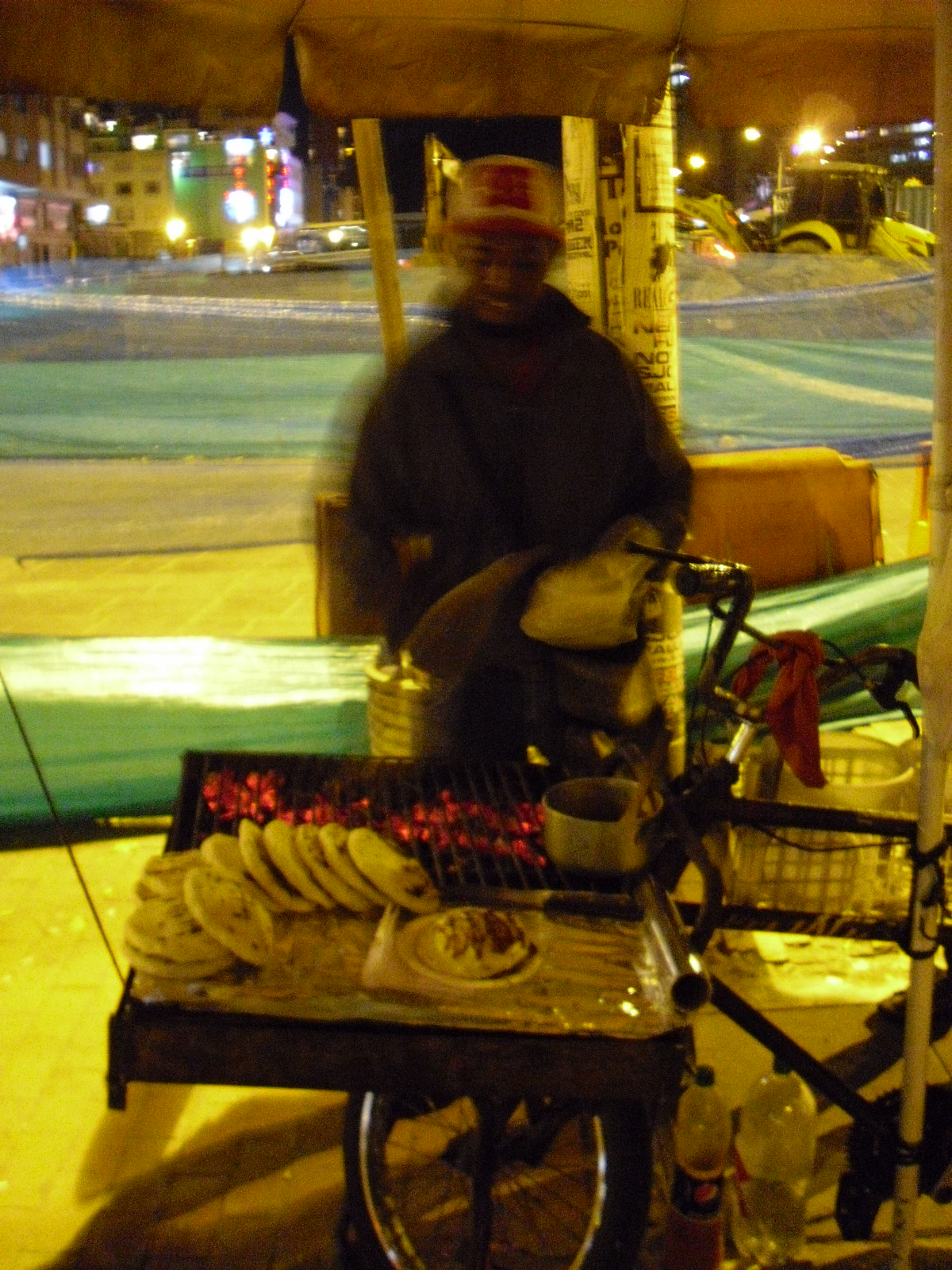
Street arepas

OK, we knew about these round corn-based delights before the start of 2012, but it was in this year that we really got to enjoy them; simple yet wonderful pleasures. 

The perfect hunger-buster on a chilly Bogotá evening, our preference has been the ‘carne con queso’ (that’s meat with cheese with a bit of BBQ sauce to boot) for a very agreeable $2,200 COP (roughly €1). 

For those of you who know the Colombian capital, our favourite place to consume these is from the vendor that operates outside the Colombo-Americano, Calle 19 with Carrera 3. We’ve missed them over the Christmas break — come back soon.
Street arepas - quite delicious
Quality grub.
So that's some of our highlights from 2012. All that's left for us to say for now is, Happy New Year to all; onwards and upwards in 2013.

 ________________________ 
*Please note, for an updated, more positive piece on Venezuela, see (for starters) see Venezuela: A necessary reappraisal.