Showing posts with label journalism. Show all posts

Monday, 21 February 2022

Lest we forget

@wwaycorrigan

[Listen to an audio version of this blog entry here.]

Sitting unhidden in one of my barrio tiendas sipping on a litre of Poker beer, it dawned on me that less than a year ago such behaviour was officially prohibited and had been for the guts of 12 months.

Lest we forget: Lads on the lash, facemasks in force. A tienda bar in Barrio Santandercito, Bogotá, Colombia.
Saving face: Colombians seem particularly keen on facemasks.
I'm not sure about you, but as things gradually return, for the most part anyway, to how they were pre-pandemic, I've nearly forgotten how absurd those "lockdown"/restricted-movement days were (it's good to have my various blog posts during the period as a reference point. See, for example, https://wwcorrigan.blogspot.com/2020/03/coronavirus-collateral-damage.html and https://wwcorrigan.blogspot.com/2020/06/coronavirus-auxiliary-killers.html. Here's hoping the internet's Ministry of Truth doesn't get at them).

Failed estate

This isn't to say that my tried-and-trusted Bogotá tiendas are devoid of signs of those crazy times. Clientele's wearing of facemasks under the chin is one rather inane reminder. There's also the odd sign to wash one's hands (a tad difficult in establishments without adequate facilities in this regard), to wear aforementioned masks and even notices to disinfect your footwear, a practice that was found early on to be rather ineffective in combatting contagion in most settings.

As for the facemasks, Colombians seem quite happy to wear them, anywhere and everywhere. Whatever about their efficacy in terms of reducing the spread of respiratory infections — the jury is still very much out — they may at least offer some protection from Bogotá's contaminated air. Although, when worn around the chin, it's unlikely they'll be of much help.

Nonetheless, it's good to have some reminders of what we've just gone through — as long as they're kept at a safe physical distance that is.

Of course, people still afflicted by coronavirus monomania will not only say that all draconian measures introduced were necessary but they are also likely to argue that they didn't go far enough nor last long enough.

Again, the evidence that strict lockdowns work in combatting a disease such as covid-19 is far from conclusive. And when viewed solely through the lens of Sars-CoV-2, one is guilty of inflicting other causes of pain and death on those who would otherwise be fine. It's a delicate balance, one that many countries appear to have got shockingly wrong.
"Those who have been most faithful to the creed, if they're not quite rewriting recent history their changing tack is explained as 'we weren't to know.' Really?"
As we begin to accept that we must learn to live with covid rather than stop living and as we move our focus onto the next global cause for concern, any proper, unbiased analysis of the last two years must critically examine the role of much of the media in unquestioningly following the official line.

A majority in the Fourth Estate, not for the first time and it certainly won't be for the last, decided to take refuge elsewhere.

A dubious narrative was established and followed with fervour. "The Science" — the one that promoted heavy-handed containment measures and has coerced people into taking covid vaccines even when it is clear that some have robust natural defences against the infection — became the true faith.

Signs of the time: Hygiene recommendations aimed at reducing the spread of coronavirus on display in Bogotá, Colombia.
Signs of the time. Careful now ...

Those of us who dared ask fair and reasonable questions were blasted as heretics. We were selfish, content to needlessly let people die, so the attacks went. Very early on in this collective, dangerous insanity I called out what was for the most part nauseating, hypocritical virtue signalling (see https://wwcorrigan.blogspot.com/2020/03/coronavirus-fallout-virtue-signalling.html).

We now have some of those who were most faithful to the creed backtracking. If they're not quite rewriting recent history their changing tack is explained as 'we weren't to know.' Really? They seemed utterly convinced of their righteousness at the time, trying to rubbish those of us who went against them.

Centre fight

In any case, it's quite easy for them to shrug all this off now. Vaccine certs proudly in hand, life is pretty much back to normal. (More power to the countries that are doing away with jab passes — little by little, society appears to be taking a more reasonable, rounded approach to this. Let's not mention atrocious Australia, crazy Canada or nefarious New Zealand, though.)

Thus, some people tell me I should get over all this, 'hum a different tune'. For the most part, I am doing that.

However, the agents of coercion and control who were given a new lease of life with the arrival of the novel coronavirus continue to try to make life difficult for us "infidels". 'Just conform, goddamn it!'

Many appear quite happy to have the state overseeing more aspects of their lives, often falsely believing that it's for the greater good of society. It generally means a little less personal responsibility, too, so they'll acquiesce.

Yet, an all-powerful state with much of the media in tow, doing its best to silence — or cancel, if you will — dissenting voices, painting any opposition as conspiracy theorists and so refusing to engage with it, is not something to be endorsed.

It's why I won't simply let this go, not while we still have what is effectively nothing more than official opinion or debatable science being peddled as unquestionable fact.

As we've seen over the last couple of years and as history has repeatedly shown us, giving free rein to such forces rarely leads to positive outcomes.

The centre can hold for a little while longer. We have to be prepared, though, to battle hard to keep it together.
_______________________________________________________________
Listen to Wrong Way's Colombia Cast podcast here.

Facebook: Wrong Way Corrigan — The Blog & IQuiz "The Bogotá Pub Quiz".
 

Wednesday, 23 September 2020

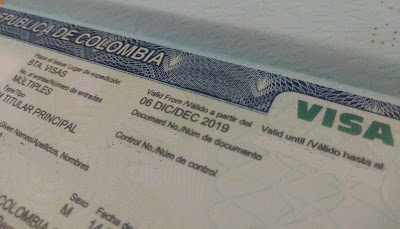
Colombia's independent work visa: ¿Vale la pena?

[Listen to an audio version of this blog entry here.]

Pathetic. When thinking of a one-word summary for it all, that's what comes to mind. No, I'm not referring to the content of this blog — it's not all bad, is it? And no, it's not my assessment of President Duque's administration, although I'm sure some of you would use that particular adjective.
Colombia's independent work visa: ¿Vale la pena? Applying for an independent visa in Colombia isn't that straightforward.
Vis-à-visas: Wrong Way has faced nine Colombian visa applications.

Nein, nein, nein

What is pathetic is the fact that in the space of just seven years I've made nine — yes, nine — visa applications in Colombia. Surely, most other self-respecting individuals would have thrown away the ruana and sombrero vueltiao and said a firm 'adiós' well before this. It's not like I've been on to a winner here, rolling in a bed of pesos, living the high life.

In fact, it could be said this is one of the main reasons why I still stubbornly stay here. I'm able to make the few pesos I've managed to earn since 2012 last longer in this country compared to opting for a 'risky' return to Ireland, the homeland always being the default option. 

Basically, while I await that Universal Basic Income — it's on its way, isn't it? — I can get by on much less in these environs.

That and a feeling that in certain ways I've more independence here, left to my own devices so to put it. 

For sure, the one and only full-time, contracted job I took on from December 2018 to January 2020 put a temporary hold on 'being my own boss', relative as that has always been, but it also helped me build up some funds for the drought periods. And things have been pretty dry from an income perspective for months now. 

Therein lies the problem. The struggle to survive as an independent, a freelancer if you will, coupled with the difficulty of actually trying to stay in Colombia legally as such an 'actor' (no, I'm not referring to my under-appreciated thespian talent).

For me, from 2014 to 2018 getting an independent visa for Colombia was a relatively straightforward affair. These days, it's quite the opposite. In fact, it seems as if La Cancillería — the body in charge of these things — would prefer if no independents applied.

'Oh, we forgot to mention we need this.'

Well, it clearly doesn't mind picking up the study fee one has to pay seeing how on first inspection it makes it seem rather uncomplicated. 

It's only after submitting 'draft one' that you invariably — the many comments on Facebook groups vouch for this — get hit with a host of other requirements, a number of which can take some time to organise. 

Why not mention all these at the beginning so a potential applicant can weigh up all the pros and cons before paying for the study? 

To talk specifically, there is no mention in the initial application of uploading a copy of your Colombian-issued ID (cédula). Nor does it say you must provide proof of health insurance and other social security payments. (If you're a first-time applicant, I take it international health insurance will suffice but as for the other social security payments, I've no idea what's acceptable. Also, what if you're in Colombia but not currently in gainful employment?)

What's more, it explicitly says there is no need to issue a copy of your previous visa if it was issued electronically, as mine certainly was. Surprise, surprise, but in response to my latest application, I was asked for a copy of same. With that, unsurprisingly, the guys at La Cancillería are contradicting themselves.
'What rankles is the constant moving of the goalposts. Also, as it's an online process, it's very difficult to get specifics about the exact requirements for your own application. Replies are generic: 'This isn't acceptable', but there's no reason as to why.'
Here's another sign of regression for the once slick Cancillería system. In all previous applications where additional material was requested — mostly because of perceived document illegibility and/or my mugshot not meeting the specifications — I got an email informing me of this. This time around, nothing. I had to log on to the system to find this out. Whisper it, but it's almost like they didn't want me to know.

On the plus side, it seems that the translation, authentication and legalisation of my degree has been accepted. In May 2018, the last time I applied for an independent visa, this was the stumbling block. I ran out of time/salvoconductos (30-day emergency passes to stay in the country, two-in-a-row being the limit).

However, as far as I'm aware, the Cancillería doesn't provide information on all the steps that are needed for the above. Let me help. 

In the following order, here's what has to be done: 

Get apostilles on both your degree and diploma supplement from the country where you studied; get these translated and signed by an officially recognised translator in Colombia; authenticate the translator's signature at the notary office where he/she is registered; then get these translations legalised — an online process — by the Cancillería. (This is when journalism is your independent activity. For other professions you may have to get your degree validated at the Ministry of Education.)

Unrequited love

While all this may seem like a bitter rant against La Cancillería, I must state I have no issues whatsoever with Colombia tightening its requirements. Needless to say, the visa authority can request from applicants whatever documentation it deems necessary.

What does rankle is what seems like the constant moving of the goalposts with absolutely no prior notice. This and the fact that, as it's a fully online process, it's very difficult to get specifics about the exact requirements for your own application. Replies are generic: 'This isn't acceptable', but there's no reason as to why. Little wonder one loses confidence when it all appears rather arbitrary.

In some ways — again, one can say it's only right — things have gone from one extreme to another. While I never got the benefit of La Cancillería's previous lax approach, I know of a number of foreigners who blatantly stayed in the territory illegally for years and then sweet talked their way to a visa and even residency. Can you imagine Colombians getting the same treatment in Europe or the US? They'd be fined, sent packing and barred from returning for life.

There's also the odd sycophantic influencer who is given citizenship for effectively selling Colombia to the Colombians. A perfect representation of the national insecurity and the-US-knows-best mentality.

Then there are others who try to do things by the book, have given La Cancillería plenty of money over the years through numerous applications and shown their commitment to the country, yet they face new obstacles at every turn.

It brings to mind an Irish phrase from my secondary school days that has stayed with me: Grá éagmhaise, unrequited love. Yes, I truly am the pathetic one in this one-way relationship with Colombian officialdom.

Sad as it is, but perhaps I need La Cancillería to give me the knock-out blow. It might just be doing me a favour.
_____________________________________________________________
Listen to Wrong Way's Colombia Cast podcast here.

Facebook: Wrong Way Corrigan — The Blog & IQuiz "The Bogotá Pub Quiz".


Wednesday, 26 June 2019

Rednecks rise again

Back in my early secondary school days, as a country lad heading off to mix it with the townies, it was common for the latter to mock us. We were farmer boys, or rednecks, as they say in some parts. 

It was generally a bit of innocent slagging but no doubt it had its origins in the long-held belief that workers of the land were a bit "behind", simple if you will, compared to those from urban settings.

Rednecks rise again: Some city grazers in Barrio Santandercito in the north of Bogotá, Colombia.
Cattle on Bogotá's northern limits: Bringing a bit of the country to the city.
Of course, the townies of Ballaghaderreen, along with everybody else from "down the country", were derogatorily seen as bog folk, "culchies" being the precise word, by those from the capital Dublin.

Zoom out even more and the whole of Ireland was traditionally viewed as being backward by our "superior" neighbours in Britain. 'Strange specimens those Irish, aren't they?'

City fat cats

Modern, advanced, rich societies emanate from urban strongholds with their schools of excellence and suchlike. Rural areas only get the crumbs, enough to keep them ticking over, from the power brokers seated around that grandiose table. So it goes anyway.

Nonetheless, keeping those seated at the urban table well-fed and content with affordable food is nigh-on impossible without the simple country folk doing their bit to provide it.
'We’re just a few consecutive disasters away from very troubling times.'
The irony here is that while the great advancements in communications and technology have made the world a smaller place, many urban dwellers have become quite removed, mentally at least, from the rural areas that they rely on to stay alive.

OK, they have other, more complicated, complex concerns to worry about. The country serves simply as escapism from the concrete jungle. Engagement with it is at a superficial level only.

What's more, aren't the technological improvements in agriculture and the like, urban brainchildren as most have been, resulting in greater yields and reduced workloads for those who farm the land?

There's merit to that.

Yet, to continue providing for the growing urban masses, more engagement with, and investment in, the countryside are required, not less.

Misplaced priorities

Whether one believes in man-made climate change or not (Donald Trump, considering his age, doesn't have to concern himself with it), we can't deny the fact that we have been experiencing extreme weather events that threaten our precious food supply. We could be just a few consecutive disasters away from quite troubling times.

How many of us would be able to survive in a kind of post-apocalyptic planet, something akin to what we often see portrayed in Hollywood movies?

It would seem fair to say that a majority of First Worlders have become too reliant on our modern comforts, on a lifestyle where we can get pretty much anything we want when we want it.
'We won't be too concerned about our mental health when our very existence is under threat.'
As a species, we could also be accused of vastly overvaluing non-essentials at the expense of the essentials. Think Hollywood again, that whole world of showbiz and fame.

Heck, I left the land I was reared on (as the majority of rural-born people do these days) to go on to pursue a career (can I call it that?!) in media. Fair enough, journalism plays — or at least used to play — an important role as the fourth estate, it can be a force of positive change.

However, the counter-argument here is that this vocation has lost its way and relevance in recent times (whisper it, #FakeNews. Thanks Donald). And don't get me started again on the evil incarnate that is marketing!

On a similar note, a Colombian psychologist friend told me how he wanted to get "back to the land", fearing that without preventative action now he would be useless when faced with a future scenario where one had to fend for oneself for the bare necessities.

As he put it, when it's a simple matter of life or death, very few people will be looking to take the time to think deeply about it all, teasing out the pros and cons. His profession would be practically surplus to requirements.

Basically, and as much as I'm not a fan of Christianity (or any religion really), the old mantra of 'ashes to ashes, dust to dust and dust you shall return' rings true.

The land, the planet will have the last laugh.

Those old backward rednecks who understand it a little better than most mightn't seem so repulsive then.
________________________________
Facebook: Wrong Way Corrigan – The Blog & IQuiz “The Bogotá Pub Quiz”.
Listen to The Colombia Cast podcast here.

Wednesday, 2 January 2019

All for one, none for all

There is a general belief that true journalism — the old, honest, non-fake news kind that is — and marketing don't go together. Or, by definition at least, the former should always be very suspicious of the latter.

A science versus religion kind of battle. Yes, for business reasons they are often side by side, but there are clear boundaries.
All for one, none for all: Journalism versus marketing.
There's money in that marketing ... (Image from web.)

Sowing the seeds of dislike

Indeed, in my first ever full-time radio job back in Ireland, those boundaries were made very clear. The ground floor was home to the advertising and marketing staff, the first floor housed the journalists and presenters.

Of course, as a commercial radio station, advertising and marketing are vital components of the operation. We journalists/presenters wouldn't have been in a position to get our wages without them.
"A desire not to deal in horse manure."
At the same time, without our, um, top-quality on-air work, no company would want to advertise with the radio station. Thus, journalistic integrity had to be preserved. There, as happens across all commercial media groups, the battle lines were drawn (not that, in my own experiences anyway, open conflict regularly followed).

With that background, coupled with a strong desire not to deal in horse manure (what I see as such anyway), I've tended to look somewhat unfavourably at much of the whole marketing world.

For sure, with the likes of IQuiz I've had to dabble in it, but that's just innocent (and honest!) self-promotion. 

However, putting my energies into helping promote large companies, ones that I have no real connection with, especially so when it's via a third party, that's another story.

Work, sleep, eat, repeat

Nonetheless, when opportunity knocks during tight times, you've got to act. Do what's asked of you, nod and agree with your superiors (within reason), get your pay and repeat, for as long as you need to or can. Keep the head down.

This is where I kind of find myself right now. It's a mercenary gig in a sense.
"Experience tells us that this 'care' comes with caveats."
Now, this isn't to say that all the publicity being churned out for the respective clients is complete hyperbole. No, from my perspective, the most disconcerting part is putting together all this positive speak for a company in which I have no direct role.

You know, like if you get the standard phrase of 'We care about our customers' when, through personal experience, you know that said 'care' appears to come with a number of caveats.

If I could deal directly with the client/company, relay my negative experiences as the paying customer they 'care' so much about, explain to them there's plenty of room for improvement and get a commitment from them that they'll 'try harder', it might make me feel more relaxed.

'Me speak English good'

Experience lets me know that it's unlikely much would change, though. What's more, when they think their non-native English works better than mine, it shows you what we're up against.

It must be pointed out here that it's not a case of having sleepless nights or the like over this. Things aren't that sinister.

Marketing, be it in-house or by a third party and no matter how slick it may be, can only do so much for a company.

If the product or service doesn't match the message, in whatever language it's written, patrons won't be long fooled.
_________________________________________
Facebook: Wrong Way Corrigan - The BlogIQuiz "The Bogotá Pub Quiz" & The Colombia Cast.