Showing posts with label Dublin. Show all posts

Tuesday, 2 March 2021

Remembering Des: Trying to comprehend the incomprehensible

@wwaycorrigan

It has been said that we know more about the intricacies of our vast planet than we do about the human mind.

Tiny as it may be compared to the size of our world, it is very complex in composition. We may know it physically, superficially, but its inner workings remain largely a mystery.

Remembering Des: Trying to comprehend the incomprehensible. Des McAleenan in happier times in Bogotá, January 2020.
Des relaxes before our interview at Colombia's football federation HQ in Bogotá, January 2020.

Misunderstood

While great advancements have been made in recent decades in dealing with deadly physical diseases, treating psychological problems still relies on, to a large extent, a trial-and-error approach. Generalisations on behaviour can be made and on many occasions are accurate, but the very essence of one's uniqueness emanates from his or her own brain.

We never truly know what another person is thinking, how he or she is feeling. It is, perhaps, medical science's greatest challenge: to find an effective, lasting way to treat those suffering from mental illness.

I used to have quite an unsympathetic view of people who were going through depression. My thinking was, 'Stop feeling sorry for yourself. Snap out of it.'

Time and closer dealings with depressed individuals have seen me change this stance. When one is in such a state of mind, nothing is seen in a positive light. Both the inward and outward filters are at best a dark shade of grey, at worst a bleak, hopeless black.

Nothing that one says or does seems capable of altering this. What's more, the feelings are generally irrational. One can highlight to the sufferer all the reasons why he or she should feel grateful for life but it's usually a pointless exercise. Yes, the darkness can pass, but it's normally just a brief respite.
'While I still see suicide as a horrible act, I've come to understand a little better the complete hopelessness that one feels in order to take that final, dreadful step.'
At most we know it's a chemical imbalance in the mind and with the right mix of medication, some people can learn to cope. Finding that balance is the tricky part, however.

For those who don't get that help, the ultimate solution becomes the only option to escape the constant doom.

Similar to how I used to think about depression, I used to also view very negatively that irreversible "cure" chosen by some sufferers. I saw suicide as an utterly selfish act. The depressed ends his or her suffering but leaves behind loved ones who have to try to come to terms with the fateful decision.

Again, though, my perception has changed with experience. While I still see suicide as a horrible act, I've come to understand a little better the complete hopelessness that one feels in order to take that final, dreadful step.

Demons return

Just over a year ago, I interviewed Des McAleenan, the Irish goalkeeping coach who landed what he described as a dream job with Colombia's men's football team. In that interview, he spoke candidly about the 'demons' that had taken over his mind in the past.

He was, however, in a much happier place in January 2020. There was much to look forward to — World Cup qualifiers against some of the best nations on the planet, a Copa América in front of a home Colombian crowd. Des's present and future looked bright.

Then, along came covid. The World Cup qualifiers and Copa América were postponed. With his job paused, Des left Colombia and returned to Ireland.

Initially, though, everything was fine. He even found, so he told me, more fulfilment in life by training some children in his native Dublin in the Irish summer. Facebook posts showed him enjoying daily runs along the north Dublin coast.

It was what seemed from afar a fairly innocuous ankle injury that plunged him into darkness again. He began to worry about his career. In his early 50s, if he couldn't carry out training properly, would he be let go?

In any case, he was involved with the Colombian set-up for the World Cup qualifiers in October. A straightforward home win over Venezuela and a very credible draw away to Chile did nothing to improve his state of mind.

He was ruled out for the November round of qualifiers after he contracted covid. As Colombia slumped to heavy defeats at home to Uruguay and away to Ecuador, Des was in quarantine in Bogotá's five-star Grand Hyatt Hotel.

We had a telephone call at the time and he told me how it just didn't make sense that he felt so depressed. Financially he was fine and while manager Carlos Queiroz's position was on the line after the damaging losses, Des was rather sanguine about the prospect of losing his job.
'The darkness just got darker. The demons wouldn't go away. To get rid of them, he had to get rid of himself.'

He joked, true as it was, that he hadn't actually lost a game with Colombia. Also, listening to my visa travails, lack of a steady job and general uncertainty, he said I should be the one depressed, not him. Of course, it doesn't work that way.  

Queiroz's tenure — and by extension Des's — was indeed ended shortly afterwards.  'A shit time all round' was how Des put it to me in a WhatsApp message.

Nonetheless, he told me there was a potential coaching job with a club in the US, in Salt Lake City. That prospect made him feel a lot better, so he told me. The ankle, which seemed like a physical manifestation of the mental problems he was battling, was still annoying him, however.

He went back to Ireland again in December.

The last message I received from him was on 30 December. It read: 'Back in Dublin Brendan, it's a fuckin' nightmare. Having a very difficult time coming to terms w[ith] the problem w[ith] my ankle. How are you? Still in Colombia?'

Less than two months later Des took his own life.

I only knew him for just over a year but during that time we had some long and deep conversations. Different as we were, I felt a connection with him.

I don't know what to make of his decision to kill himself. It doesn't make sense.

I tried to offer words of encouragement, tried to make him see the positive side of things. But the darkness just got darker. The demons wouldn't go away. To get rid of them, he had to get rid of himself.

Adiós, Des. Adiós.

*****
For those in Colombia troubled by what's written in this article, Bogotá has the phone line 106, ‘El poder de ser escuchado’, which offers support in times of crisis including cases of sexual violence, suicide and substance abuse. The 24-hour service is also available via WhatsApp on 300 7548933.

The city also operates the Línea Psicoactiva on 01800 0112439 (Mon-Sun from 7.30 am-10.30 pm) Facebook and Skype at Psicoactiva and WhatsApp on 301 2761197.

In Ireland, you can contact the following:

Samaritans 116 123 or email jo@samaritans.org;

Aware 1890 303 302 (depression, anxiety);

Pieta House 01 601 0000 or email mary@pieta.ie (suicide, self-harm).
_______________________________________________________________
Listen to Wrong Way's Colombia Cast podcast here.

Facebook: Wrong Way Corrigan — The Blog & IQuiz "The Bogotá Pub Quiz".

Wednesday, 26 June 2019

Rednecks rise again

Back in my early secondary school days, as a country lad heading off to mix it with the townies, it was common for the latter to mock us. We were farmer boys, or rednecks, as they say in some parts. 

It was generally a bit of innocent slagging but no doubt it had its origins in the long-held belief that workers of the land were a bit "behind", simple if you will, compared to those from urban settings.

Rednecks rise again: Some city grazers in Barrio Santandercito in the north of Bogotá, Colombia.
Cattle on Bogotá's northern limits: Bringing a bit of the country to the city.
Of course, the townies of Ballaghaderreen, along with everybody else from "down the country", were derogatorily seen as bog folk, "culchies" being the precise word, by those from the capital Dublin.

Zoom out even more and the whole of Ireland was traditionally viewed as being backward by our "superior" neighbours in Britain. 'Strange specimens those Irish, aren't they?'

City fat cats

Modern, advanced, rich societies emanate from urban strongholds with their schools of excellence and suchlike. Rural areas only get the crumbs, enough to keep them ticking over, from the power brokers seated around that grandiose table. So it goes anyway.

Nonetheless, keeping those seated at the urban table well-fed and content with affordable food is nigh-on impossible without the simple country folk doing their bit to provide it.
'We’re just a few consecutive disasters away from very troubling times.'
The irony here is that while the great advancements in communications and technology have made the world a smaller place, many urban dwellers have become quite removed, mentally at least, from the rural areas that they rely on to stay alive.

OK, they have other, more complicated, complex concerns to worry about. The country serves simply as escapism from the concrete jungle. Engagement with it is at a superficial level only.

What's more, aren't the technological improvements in agriculture and the like, urban brainchildren as most have been, resulting in greater yields and reduced workloads for those who farm the land?

There's merit to that.

Yet, to continue providing for the growing urban masses, more engagement with, and investment in, the countryside are required, not less.

Misplaced priorities

Whether one believes in man-made climate change or not (Donald Trump, considering his age, doesn't have to concern himself with it), we can't deny the fact that we have been experiencing extreme weather events that threaten our precious food supply. We could be just a few consecutive disasters away from quite troubling times.

How many of us would be able to survive in a kind of post-apocalyptic planet, something akin to what we often see portrayed in Hollywood movies?

It would seem fair to say that a majority of First Worlders have become too reliant on our modern comforts, on a lifestyle where we can get pretty much anything we want when we want it.
'We won't be too concerned about our mental health when our very existence is under threat.'
As a species, we could also be accused of vastly overvaluing non-essentials at the expense of the essentials. Think Hollywood again, that whole world of showbiz and fame.

Heck, I left the land I was reared on (as the majority of rural-born people do these days) to go on to pursue a career (can I call it that?!) in media. Fair enough, journalism plays — or at least used to play — an important role as the fourth estate, it can be a force of positive change.

However, the counter-argument here is that this vocation has lost its way and relevance in recent times (whisper it, #FakeNews. Thanks Donald). And don't get me started again on the evil incarnate that is marketing!

On a similar note, a Colombian psychologist friend told me how he wanted to get "back to the land", fearing that without preventative action now he would be useless when faced with a future scenario where one had to fend for oneself for the bare necessities.

As he put it, when it's a simple matter of life or death, very few people will be looking to take the time to think deeply about it all, teasing out the pros and cons. His profession would be practically surplus to requirements.

Basically, and as much as I'm not a fan of Christianity (or any religion really), the old mantra of 'ashes to ashes, dust to dust and dust you shall return' rings true.

The land, the planet will have the last laugh.

Those old backward rednecks who understand it a little better than most mightn't seem so repulsive then.
________________________________
Facebook: Wrong Way Corrigan – The Blog & IQuiz “The Bogotá Pub Quiz”.
Listen to The Colombia Cast podcast here.

Thursday, 24 May 2018

Up your Paipa

Since we first came to know a few years back of the various Irishmen who played significant roles in modern Colombia's history, the town of Paipa came into our sights.

That's because the main park/square of the somewhat popular tourist spot is named after Dublin-born James Rooke — well they've Hispanicised the name to Jaime Rook, but we won't castigate them for that. The park is also home to a bust in his honour, in need of a power wash and lick of paint as it is.
Up your Paipa: The bust of James Rooke in Parque Jaime Rook, Paipa, Boyacá, Colombia.
The bust of James Rooke, aka Jaime Rook; we think!

Irish, English or Colombian?

Coronel Rooke fought and died here in the wars of independence against the Spanish.

How Irish he felt is open to debate. As the story goes, when he lost his arm in battle he shouted, "Viva la patria" ("Live the homeland"). When asked if that was Ireland or England, he is alleged to have responded, "The country that will bury me." Now, as far as we are aware, although we've been unable to get it confirmed, he's buried in Colombia.

That aside, considering Paipa is less than a three-hour drive from the north of Bogotá, it falls inside our 'short escape from the madness of the metropolis' category.

It's not quite the 'pueblito' we were expecting — it's a decent enough sized town. Yet, it's still far more chilled-out than midweek Bogotá (OK, that's not too hard to achieve, in fairness).

Lake placid

Like other lake-side towns we've visited through the years — Queenstown in New Zealand and Chile's Pucón spring to mind — it seems to have a very pleasant vibe to it. The man-made Lake Sochagota's tranquillity appears to exert a calming influence on the locals. (It might be slightly different at the weekend when more visitors are about, but the locals say it doesn't change that much.)
A view of Paipa, Boyacá, Colombia from the hills to its north.
Paipa from a high.
For those, like ourselves, who like to do their own thing, a stroll around the lake, with a 1.6-kilometre surface area, is a nice way to take it in and get some light exercise in the process.

If you're up for something a little more taxing, great views of the town, lake and surrounding countryside can be got by trekking up the hills to the north, behind the church on the main square.

Kayaking and other activities on the lake are also an option, but for our short stay on a tight budget, we gave them a miss.

Hot springs are another popular attraction that we left out — we've experienced our fair share of them.

Cheesy cazuela

From a culinary perspective, Paipa is known for its dairy-related products, particularly cheese.

In this regard, the cazuela Paipana is worth a try to kick-start your day. It's basically a super-charged changua, packed with almojábanas (a rather delicious-when-just-baked type of cheesy bread made from corn flour, another favourite in these parts) and decent offerings of quality cheese.
Cazuela Paipa, a popular dish in these parts. Paipa, Boyacá, Colombia
Hearty & wholesome-ish! Cazuela Paipana.
Speaking to some other Colombians, Paipa has a bit of a reputation for being costly in terms of accommodation. For sure, there are a number of relatively expensive, 'fancy' hotels overlooking the lake, but budget lodgings can be found as well.

The respectable Canada Hotel has single rooms from 20.000 pesos per night. It's not gold standard, but it more than adequately does the job.*

All told, and not that we're making any connection with James Rooke, but if Paipa was to be our last Bogotá escape before we potentially have to leave the country (very much alive, though, we hope), it's not a bad one to go out on.

*Canada Hotel is on Carrera 20 #23-61, just a few blocks away from Parque Jaime Rook. The friendly owner Adelaida can be contacted on +573138314483.
___________________________________________

Monday, 13 February 2017

Restrengthening the Irish-Latino links

For a small country without a history of conquest, the Irish do certainly get around. Of course, the chief reason most left and still leave the island was and is for economic reasons. Ireland has only ever been able to sustain a certain number; whether it could or should be able for a greater population doesn't concern us here for now.

Understandably enough, other English-speaking countries such as Australia, Britain, Canada and the USA are the popular go-to locations. Yet, Paddy doesn't limit himself to just those places. There aren't many spots on the globe in which he hasn't set foot.

Restrengthening the Irish-Latino links: President Higgins — "Ireland a bridge to Europe for Colombians." Um, there are easier routes at present.
President Michael D. Higgins arrives in Colombia.
In terms of Latin America, the Irish links here are relatively strong, as we've written about on previous occasions (see With O'Leary in Bogotá and Remembering Casement's Colombian connection). 

What's more, it has been said that the Irish are (or at least were) the Latinos of Europe, be that good, bad or indifferent (somewhat disorganised, left-leaning, former colonies with a happy-go-lucky disposition, something along those lines).

However, it could be argued, anecdotally if in no other way, that these ties have weakened somewhat. Or at least the Irish blood hasn't been as prominent in Latin affairs as it was previously.

Thus, President Michael D. Higgins' historic state visits to Colombia, Cuba and Peru are an opportunity to restrengthen those links.

For one, during his stay in Peru, it was announced that Lima is to open an embassy in Ireland (no word on Dublin returning the 'favour', though).

Here in Colombia, where official relations between the two countries have been almost non-existent through the years,* foreign minister María Ángela Holguín will sign a Memorandum of Understanding with Ireland to foster political consultation between both states. 

According to an official statement from the Colombian president's office, this memorandum will act as a declaration to set in motion a cultural and sporting exchange as a way to contribute to social cohesion and consolidate peace. It sounds like a good idea, in theory anyway.

Alongside this, both Michael D. and his counterpart Juan Manuel Santos are to discuss potential investment opportunities, as well as business and tourism promotion. As part of the latter, perhaps the Irish delegation will consider removing the tedious tourist visa requirement for Colombians who want to visit Ireland?

On that front, President Higgins spoke about Ireland being "a bridge to Europe for Colombians", during his keynote address in Bogotá on Monday. Eh, Colombians can rightly question, why bother to attempt to cross a dodgy bridge when there's an easier direct route?

We can also ask the question, bearing in mind Colombia's strategic location and the fact that Buenos Aires and Mexico City are the only cities in Latin America where Ireland has embassies, is it time one was opened here?

That aside, expect similar political announcements of greater official cooperation to come from Cuba, where the Irish president finishes up this three-country trip.

It's all diplomatic manoeuvring, of course. The success or otherwise of such things depends on the people on the ground. Or getting the actual people on the ground as the case may be.

From an investment-in-Colombia perspective, now might be as good a time as ever to strike. 

For those of us who have called the place home for a while but are still somewhat doubting our futures here, the words of one Irish long-termer are worth noting: 'If you can't make it here, you can't make it anywhere.' Perhaps. However, this does beg the question:: 'Do we want to make it here?' It might not be time to run just yet.

*Footnote: Diplomatic relations between Colombia and the Republic of Ireland have only been in place since November 1999.
___________________________________
Facebook: Wrong Way Corrigan - The Blog & IQuiz "The Bogotá Pub Quiz".

Wednesday, 4 March 2015

Promoting Ireland

'Ireland; a great little country, if only you could put a roof over it.'

It's difficult to go against that comedic summation of my homeland. Actually, you could add to it and suggest the construction of a few massive wind barriers as well.

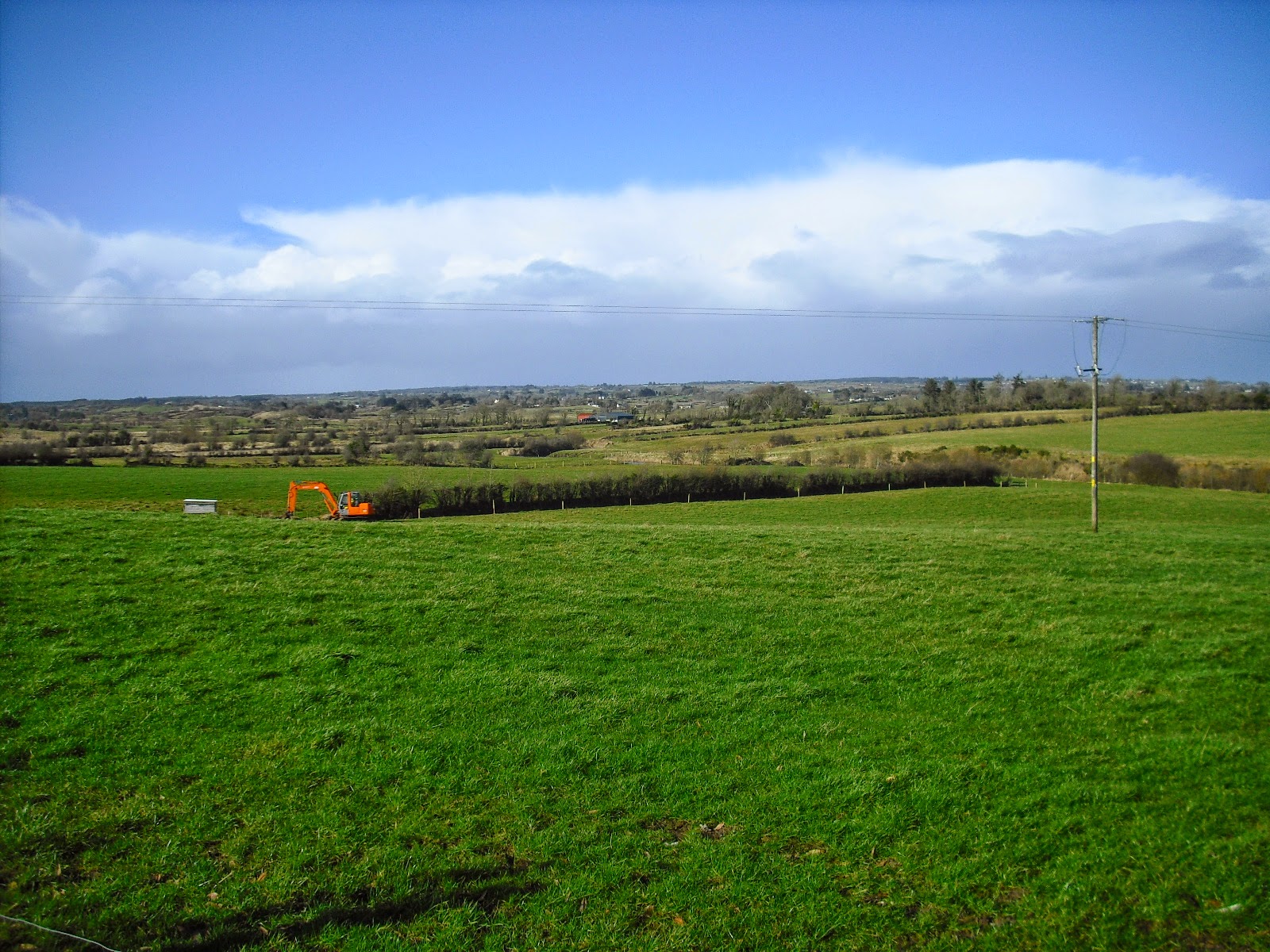
Promoting Ireland: A view inland from Keel Strand, Achill Island, Co. Mayo, Ireland.
Ireland's practically ever-present cloud. It does let up every now and again, though. Really, it does.
You see there's a good reason it's dubbed 'The Emerald Isle'. There are plenty of, picturesque, rolling green hills that give it a sparkling look, especially when viewed from above. That's if you could actually see the land beneath the practically perpetual, thick, grey rain clouds that smother the place.

Therein lies the Irish problem; the dull, wet weather. If it was pulled a thousand miles further south, you could be talking about one of the world's greatest tourist spots. But then again, there's the risk it'd lose a bit of that greenness; the land that is anyway, whatever about the people (well, we'd get a little redder for one).

Blue skies in Creevy, Lisacul, Co Roscommon.
Irish weather: Four seasons in one day (more or less) ...
Plus, an Ireland with nicer weather might tone down that fine Irish cynicism; what a terrible shame that would be for the world.

Now, needless to say, it's not always raining here (I write from ‘home’, in case you’re wondering). The odd few visitors get lucky with the sun coming out to play. Predicting when that's going to happen, though, is anyone's guess.

Winter wonderland, in spring: Creevy, Lisacul, Co Roscommon.
... from green to white, and back to green again.
As an Irish expat living in Colombia, I do, on occasions, try and talk up Ireland as a go-to destination. With a rising middle class (so it goes anyway) more Colombians are taking foreign holidays. Although you’d have to say that promoting other locations when in Colombia seems a little pointless considering the extent of its own natural beauty.

It more or less has everything in one neat package, save for violent storms. These can be good to experience every now and again, from a safe perch of course. Do note we’re talking weather-related ones, not the human emotional variety you regularly get from some Latinas.

Yet, even if my talking up of Ireland raises the interest of a visit from Colombians, as it sometimes does, the practicalities of doing so make the reality of it happening less likely.

We're talking visa issues here. The hassle of having to go through the process of applying for a separate one, separate from other European countries and the UK that is, pretty much extinguishes any enthusiasm to make Ireland part of a European holiday.

OK, with a UK visa they can visit the north-eastern part of the island, the part that is not the Republic of Ireland that is. And they could risk a run across the fluid border and more than likely get away with it. But why potentially jeopardise future travel by doing that?

A fine, creamy pint of Guinness at Gieltys Bar, Achill Island, Co. Mayo, Ireland.
If the weather fails, there's always Guinness ...
Now, the powers that be in London and Dublin have changed the rules of engagement as regards a common tourist visa for the two states. However, this little arrangement is limited to the Chinese and Indians — lucky guys. That's a bit unfair, no?

Considering all European citizens who travel to Colombia for tourism don't need to get a visa in advance — up to 90 days is given on arrival, with the option of getting another 90 after that — shouldn't the same apply for Colombians who visit Europe? (As pointed out in Soft touch Colombia, it could be argued that authorities are a little too generous in some aspects.)

So come on Ireland, take the lead, give a little more genuine substance to the motto of being 'the land of a thousand welcomes' and allow the country's doors to be opened more easily by many more.

'Open it and they will come.' Weather permitting.

Monday, 30 June 2014

Colombia: Here come the good times?

So the World Cup party rolls on and, thankfully, Colombia is very much still in the mix. These heady times that the country is going through, something mentioned on this blog a few weeks back, are not only continuing but also appear to be increasing in magnitude.
Colombia: Here come the good times? Wrong Way in the Colombian jersey with the 'World Cup trophy'.
Colombia, World Cup champions? Why not?
Of course, having got to the last eight, should La Selección now fail to go further, the excitement and gushing pride and joy being experienced across the land will take a significant dent.

However, wherever the team finishes – here's hoping that's lifting the trophy – Colombians both near and far should, and no doubt will, be immensely proud of the efforts. They ought to be, especially so considering the lads went to Brazil minus their talisman Radamel Falcao, a loss that certainly dampened expectations ahead of the tournament.

In a number of ways, looking at events both on and off the field, this World Cup represents for Colombia what the World Cups of both 1990 and 1994 did for my homeland, the Republic of Ireland.

Granted, unlike the Republic in 1990, this is not Colombia's debut, but the country was a much different place back in the '90s when they last qualified. 

This time, like Ireland in the early '90s, there's a feeling that a bright new dawn is about to break. The football team could be seen not only as a manifestation of that, but also as an important part of it.

For one, José Pékerman's side is, with merit, filling Colombians with an enormous amount of pride and a sense that they are finally being talked about seriously, in a positive manner, on the world stage. (Incidentally, Pékerman is an 'outsider', an Argentinian, who is now very much seen as Colombian – à la the Englishman Jack Charlton who managed Ireland in '90 and '94.)

Then you have the enormous support the team is getting at the tournament, mirrored by the outpouring of emotion following each victory back home. Colombians, as the Irish did for Italia '90 and USA '94, have made their way in droves to Brazil, getting there by any means necessary, sourcing money however they can. Some would even sell their grannies.

Heck, in a further similarity, for two peoples who like to have a beer or two, Dublin's barmen went on strike for Ireland's opener in '94, the victory over Italy, forcing inhabitants of the capital to booze up at home. 

Here in Bogotá, we have to put up with ley seca (alcohol prohibition) for each game – it hasn't stopped the drinking or revelling though. Let's just hope La Selección doesn't suffer the same fate that befell the Republic in 1990 and lose to the hosts in the last eight.

This is all happening alongside a more general mood of optimism that seems to be sweeping over Colombia. There are green, or yellow if you like, shoots emerging signalling much better times ahead – economically, politically and socially. 

For sure, not everyone is sharing in that positivity and there are solid reasons for that, but there is a scent of peace in the air, that a solution to the more than 50 years of internal conflict can be found.
President Juan Manuel Santos and company celebrate Colombia's victory over Uruguay
President Santos: Leading Colombia to a bright new dawn? (Photo: Facebook.)
Linked to this, in a financial and social context, things are improving for many Colombians – although, tackling the huge inequality that still exists must be one of the chief priorities for re-elected president Juan Manuel Santos.

This is all quite similar to the Republic of Ireland in the early '90s, just before the Celtic Tiger started to roar (remember that?) and politics largely took over from the gun in the Northern Ireland conflict. The island of Ireland was about to experience the good times for a change. Yes, they didn't last, but you can argue it was better to have them than not.

Thus, for what it's worth, the advice for Colombia right now from an Irish perspective, both at the World Cup and in general, is carpe diem.

In football terms, you're doing that pretty good so far. The other things might prove much trickier.
____________________________________
For more Colombia-Ireland 'links', check out Colombia & Ireland – a tale of two old Catholic countries.

Reeling in the Years: 1994 gives a nice snapshot of Ireland entering the 'good times'.

Wednesday, 8 January 2014

In defence of hoping (and fighting) for, at least, a 'Freer Bogotá'

We came in for a bit of criticism in the wake of our Fighting for 'Free Bogotá' piece a few weeks back. 

Now, this didn't come from Colombians but from fellow expatriates. The main grievance was that we were painting a stereotypical negative, dangerous picture of Bogotá and Colombia in general. The fact that we were writing about particular incidents in one notorious barrio of the country's capital seemed to go over our critics' heads.
In defence of hoping (and fighting) for, at least, a 'Freer Bogotá': Entering one of Bogotá's 'darker sides', La Perseverancia
The darker side -- entering La Perseverancia.

We did, of course, point them in the direction of previous posts we've written, detailing how we find the external perception of Colombia and how dangerous it is a little frustrating and very often inaccurate, to say the least.* 

Also, the amount of solo travelling we've done around this physically stunning country, most of it detailed on this blog, is, we hope, sending out a positive message that this country is very much open for tourism (and, for some, business) and generally safe.

However, as pointed out in Fighting for 'Free Bogotá', it would be remiss of us to write that there is nothing dangerous at all about this country. A message some of our detractors seemingly wish we would portray. 

There are, though, plenty of other English language websites and blogs about Colombia that set out from the onset not to include one negative word about the place, even if that means bending reality at times.

In any case, what we wrote wasn't inherently negative about Bogotá. In every big (and small) city in the world there are dangerous neighbourhoods where, as a taxi driver once told us about a particular part of Dublin, 'even the dogs hang around in packs and watch each others' backs.' 

Also, we tend to, especially owing to the types of places we like to drink in, take more risks than most other visitors/foreign residents who come to this city.**

We are where we are, we do what we do, and we have our beliefs, likes and dislikes. Right now, for convenience, price but above all, the friendliness of the locals (part of that being the free beers we often get) we find ourselves socialising regularly in La Perseverancia. As stated in previous posts this area is, at this moment in time, as the locals put it, 'muy caliente' (literally 'very hot' i.e. dangerous).

In the last number of weeks, this view has only been further reinforced in our minds. For if we're being honest, we put the minor early morning incident mentioned in Fighting for 'Free Bogotá' down to stupidity on our part. 

Plus, very often when Colombians tell us certain areas are dangerous our first reaction is to shrug it off, believing that they're still thinking of rougher times in the not-to-distant (but distant all the same) past.

However, the kind of things we've encountered over the last few weeks give an idea of this 'darker side'. 

There was the pretty lame attempt – but an attempt all the same – by two young thugs to rob us in broad daylight in the area; the friendly locals insisting they escort us home for our own safety at night; police officers standing guard outside a tienda we were drinking in, in the afternoon, because we were foreigners and 'at risk' (we find this a little hard to believe, but it's what we were told); plus, being witnesses to two local women getting mugged, again in the middle of the day. 

All of the above have firmly illustrated the real dangers that exist in this part of the city, day and night.

In defence of hoping (and fighting) for, at least, a 'Freer Bogotá': Officer 'Wrong Way'. Any takers?
Officer 'Wrong Way'.
That last incident was particularly annoying, angering even. We figured had we been a little closer and quick-thinking that we may have been able to intervene in some way. Then again, perhaps it was better we didn't? 

There were people closer to it than us who seemed content enough to let the damn delinquents get their booty; a 'thank god it's them instead of us' kind of thinking and certainly not unique to Colombia.

Yet, this could be one area to, literally speaking, start a fightback. If enough people, particularly the locals, those who might be seen as community leaders (it's debatable if such figures exist in certain lower-class barrios, or if they do, to what extent they encourage a law-abiding lifestyle), confronted such scum rather than turn a blind eye, it might evoke some sort of change of behaviour, for the better.

From what we've witnessed and anecdotally, few assailants, especially in these daytime raids, are carrying firearms. Usually, if anything, they just have knives. And, usually, you don't have to look too far on Bogotá's streets to find some sort of a stick that could be used to confront anyone carrying a blade; something to put more than an arm's length between you and the would-be attacker.

More police on the beat is another deterrent and at times they can be hard to come by in La Perseverancia, but it's not a panacea.

Of course, there are a range of social issues that must be tackled as to why some people get involved in criminality and, for one, with such a huge disparity in incomes in this city and questionable priorities by the ruling classes, Bogotá and Colombia in general have a long way to go in addressing those.**

We're not looking for an unattainable utopia (although it's not a bad goal to aspire to), we just want things to improve; and there's certainly scope for that.

Those who would like us to believe that Bogotá/Colombia is a peaceful paradise are plain delusional. Nowhere is. They're also helping nobody by peddling such a notion.

______________________
*For a start see Dangerous Colombia Part III.

**On both fronts i.e. an idea of the places we like to socialise in and the inequality issues, check out No somos Colombianos, pero... (We're not Colombian, but...).

For some other issues that need addressing in Bogotá read Bogotá's 'broken windows'.

Thursday, 26 September 2013

Our alcohol problem

A couple of weeks ago we were moved to reply to a letter from a Mr T. Broderick in the sports section of Ireland’s Sunday Independent. First of all, here’s the offending letter:
Our alcohol problem: Fr Ted and Fr Dougal take a stance.
What would Bishop Brennan make of all of this?

“I watched the All Ireland hurling final last weekend and three things have really bothered me since then.
1. Should pundits/commentators be discussing and commenting on gambling during such a game? Michael Duignan got very excited about Liam Sheedy having a great bet for the draw at 14/1.
2. Should Michael Lyster be posing questions regarding players drinking after matches? Was he implying that they could not survive without a drink for another three weeks? Why would he pose such a question?
3. Cyril Farrell's comment about the Clare team "jumping in the Shannon" if they had lost that game. Is hurling that important? Did the Galway minors consider jumping in the Corrib when they got back to Galway after their loss? These words although said in jest are very powerful and could be heard differently by people in difficult situations.
What subliminal messages are said comments sending out to people dealing with gambling or alcohol problems or contemplating suicide? This banter also normalises these behaviours for our teenagers. What are they thinking listening to these comments?
These are serious problems and I know that the above-mentioned commentators did not mean to cause offence but they have a greater responsibility than maybe they realise.
With 1.3 million watching this programme at some stage, surely we should expect a higher standard of broadcasting?
Keep the pub banter for off air in the future.”*


This got our blood up at the time of reading it, so we decided to respond. Our riposte, below, was published the following week:
Our alcohol problem: A pint of 'the black stuff' — 'sorry, we're out'
Ireland's own.
“What a brittle, brainless bunch we Irish ‘commoners’ must be, if the words of Mr T. Broderick are to be taken seriously.
A jovial brief chat by some ‘Sunday Game’
(a programme that covers the Irish sports of hurling and Gaelic football) analysts about a spot of betting and downing a few pints and this means that we’re all going to gamble away our house (those of us that have one that is) down at the bookies while making our way to the nearest hostelry to get inebriated.
Heck, perhaps we should ban the announcement of stock market news on the airwaves in case it encourages us ‘dumb masses’ to get involved in that dirty business too.
A typical Irish attitude, blame somebody else for any ‘problems’ we may have.
The phrase ‘grow a pair’ springs to mind.
In any case, you need to have a long, hard look at yourself if you heed the word of those working with the state broadcaster.”*


No prizes, then, for guessing where we’re coming from on all this.

For now, we're just going to focus on the alcohol issue. Irish people’s relationship with it has been quite topical in recent days – to be honest, it’s something that’s never too far off the national debating agenda here. 

The reason, though, why it’s back on the front pages is to do with Arthur’s Day. To the uninitiated this now annual event (for the time being anyway) was first introduced in 2009 to celebrate 250 years of the alcoholic beverage Guinness, the brainchild of Arthur Guinness, being brewed in Dublin.

Many see it – and we tend to agree – as purely a marketing ploy by Diageo, the owners of Guinness, to promote the consumption of its leading brand. 

More stringent critics say it gives an easy excuse for people to ‘go on the lash’ where otherwise they may not have bothered; the fact it is always fixed for a Thursday, traditionally a big student night out in Ireland’s big towns and cities, underscores this ‘excuse’ point for many.

However, alongside encouraging people to raise a pint glass ‘to Arthur’, the day (or indeed days as it now is) incorporates a number of music events sponsored by the drinks company. 

So with the once well-celebrated Irish pub apparently in terminal decline, if these free or cost-price music shows entice a few extra people out, isn’t that a good thing?

Out for one or two beers...
Our coffee is blocked out by all the bottles in the front.
As we wrote about before in more detail in An Irish lament, it’s not like Irish people are drinking less with the decline of the pubs; if anything, as a nation we’re drinking more than ever. 

The difference now is that most of it is done at home, away from prying, perhaps judgemental, eyes. Yes, it might be cheaper but it doesn't mean it's any better.

The question the whole Arthur’s Day should-we-shouldn’t-we debate brings up is as a country are we not responsible enough and mature enough to have such events, whether you support them or not, without us getting ‘ossified’ (drunk that is)? 

If you do drink to excess, that’s your issue – don’t be looking for others to blame. Are we meant to ban every occasion we like to celebrate, public or private, just because some people might over-indulge in alcohol?

While the Arthur’s Day experiment may die a quick death (and we won’t shed a tear for it), many other more internationally recognised and celebrated festivals such as St Patrick’s Day and Christmas won’t be going anywhere soon. Many Irish and a host of other nationalities will drink perhaps a little bit too much in marking these and other such events.

Go ahead we say, just don’t shirk the personal responsibility you have for your own actions. 

It’s something we’re slowly trying to learn. Without, that is, blaming the media or some marketing event for any drunken escapades we might get up to.
_________________________

*Both letters can be found in digital form on independent.ie. The first is here http://www.independent.ie/sport/other-sports/have-your-say-29580333.html, while our reply is midway down this: http://www.independent.ie/sport/other-sports/have-your-say-29596689.html.

For a previous article on a similar theme of being responsible for our own actions, see Survival of the dumbest http://bit.ly/NNg2E8.

Wednesday, 5 June 2013

The 'extranjero-files' — that is, not a xenophobe

Right, we’re admitting defeat. Or, to put it more correctly perhaps, we’re changing our angle of attack. It’s all to do with the word gringo and our sometimes laborious attempts to ‘correct’ numerous Colombians and other Latinos who refer to us as such. 

You see, for us the word has always referred to English speaking North Americans only (which we obviously are not) and, to be honest, most locals in these parts go along with that.
The 'extranjero-files' – that is, not a xenophobe: 'Wrong Way' with some fellow Colombian outcasts.
A bunch of foreigners.
However, at first glance some people here automatically think we’re from the US and hence call us gringo. We generally get a little uptight and politely tell them that we’re not gringos but Irish, so the word ‘extranjero’ (foreigner) is a more accurate label. 

Yet, the ‘g-word’ is theirs (Latinos) and some do use it to describe any foreigner. So in fairness, they can apply it as they see fit.

In terms of accuracy, though, and to avoid, heaven forbid, being mistaken as a Yank, if we are called a gringo in the future we will respond by saying that if you’re using it in its broader all-foreigners sense, fine, but if not, then we must clarify.

Then, of course, many of the people here who do call us gringo or extranjero or whatever are not that far removed from the Old Continent; that's Europe if you will, or more specifically Spain. 

So perhaps the only people here who have a real right to call us any of the above are the true indigenous – they could also call many of the Latinos they now share this land with the same.

In any case, they are just words, so should we really give them as much thought as we’re doing right now? 

Heck, Colombia is a country where the inhabitants regularly call their friends ‘gay’ (marica that is; for more on that see http://bit.ly/18eEfhd) and have no problem referring directly to people by their distinctive features: ‘gordo/gorda’ for a fat person; ‘negro’ for blacks; ‘mono’ for fair haired/skinned people and suchlike.

Supporting the forgotten - Laos lads standing up for Dublin
Supporting minorities.
As a Dutch friend mused, because of many other, real life-or-death problems this country has recently faced (and still does), what might be seen as offensive/racist words in some other places cause little fuss here (for more on not getting too worked up about words, read http://bit.ly/NNg2E8).

What is important in the above, though – and is the case the world over – is how those words are delivered and the actions that thus follow. 

That is to say, is there real meaning to what is uttered? Are they just throwaway, jovial remarks or is there more of, in the case of referring to people’s skin colour and the like, a racist element to it?

It will come as no surprise that we’ve witnessed racism here – you’ll find it in every corner of the globe. Very often it’s directed at the Afro-Colombians and/or the indigenous. That is, those on the peripheries, not generally part of the ruling class. They don’t quite fit in. 

Of course, for different reasons, you’ll also find some anti-US sentiment here which could be considered racist too – even though, politically speaking, Colombia is the most pro-US country in South America.

What might be seen as ironic is that many Latinos, when they depart for the Western world, will encounter discrimination, suspicion and racism aimed at them for no real logical reasons other than that they’re different.* Yet, surrounded in the comfort blanket of their own, they do the same to the minorities in their midst.

Together in death; as perhaps we should be in life...
At the end of it all, this is our lot ...
This, of course, is a global phenomenon, far from restricted to this region. 

Many Irish see no problem hurling, at the very least, generalisations at immigrants who seek refuge on the island – a practice that often influences government policy – while at the same time expect right of passage wherever they go in the world. 

OK, some will argue this isn’t a racist tendency and more to do with protecting a small, bungling economy but that’s not always the case.

You see at certain times and in certain contexts, we can all be part of the minority, the outsider. We found it interesting to read in a newspaper in Malaysia that they referred to the West as the ‘minority world’ – the ‘haves’ versus the ‘have nots’ that is.

It can be a good practice to think outside your group – try to place yourself with the outcasts from time to time. 

We all have prejudices – it’s part of being human. The trick is trying not to let them unduly and irrationally influence us; easier written than done, of course.

As the saying goes, ‘before you criticise someone, walk a mile in their shoes. That way, when you criticise them you’ll be a mile away and you’ll have their shoes.’ And if you’re lucky, they might be the right fit.

____________________
*Things may be changing on this front. Check out Latinos on the rise http://bit.ly/1784NCY for more on that.

You may also want to check out Phantom freedom at http://bit.ly/SOQUl0.

Saturday, 16 March 2013

Ireland's calling

A frequent question that travellers or expats get asked by the locals in their new location is, ‘Do you not miss home?’ 

It’s no different here in Colombia – the Latinos' strong sense of family often has many of them scratching their heads as to how some of us Westerners can just take flight indefinitely, seemingly without a care. 
Ireland's calling: Bringing an Irish 'feel' to Colombia
'A few of our favourite things.'
The immediate response then, of course, is that we miss our family and close friends (well, those few who remain in Ireland) – honestly, we do. There are times, though, and these vary, when we long for other, what we’ll term less emotional things. 

So for the time of year that’s in it – the St Patrick’s festival that is (why just celebrate one day when you can make a week or more out of it?) – we’re going to take a look at some of the aspects from Ireland that we miss every now and again. Some of these, as you’ll discover, are purely specific to the old country, others a bit more generic.

Draught Guinness

Can you hear us St. James’s Gate?* Please send over a few kegs of your finest black stout – this ‘draught in a can’ never worked. 

In any case, it’s too expensive to buy here, so we stick to the local beers. They fill the void somewhat, but a proper pint of The Black Stuff from time to time would see us right. There’s a growing market for it here from what we can see (at a reasonable price, that is). You know where to find us. Oh, and in a sop to our Belfast days, a keg of Harp wouldn’t go astray either.

The Guinness draught can.
Just not the same in a can.

Seasons

Right, in terms of weather these days, Ireland might only have two seasons – rainy and rainier. But it’s the daylight changes we’re referring to here. This time of year back home is generally a more positive one – yes, even for the Irish – as the days grow longer and a bit warmer and we anticipate the ‘hot’ summer days ahead (we like to dream). Yes, we have to suffer the dark, cold winter nights, but we get through them with the thoughts of the ‘brighter delights’ from May through to September.
 
The yearly sameness in daylight hours and weather (it’s either sun or rain, no more) in this part of the world is a bit stale as far as we’re concerned. This might explain why nothing changes that much, in terms of doing things that is. On the other hand, it may also explain why some of the people are a bit emotionally unstable, to make up for the boring seasonal conditions.

A wintry scene in the west of Ireland
Snow, super snow!

GAA

The old craic and banter of an Irish sporting summer – in terms of our native sports that is, Gaelic football and hurling – is hard to beat. 

Hailing from a mediocre county (Roscommon – no sniggering) in terms of our football prowess means our championship run doesn’t last that long – but there’s always our neighbours Mayo to fill the void of heroic failure that bit longer when our own boys, true to form, tamely exit.
 
We do miss playing as well, of course – the pantomime of the local club championship is where it’s truly at really. We’ve suffered more bad days than good on that front, but it’s all about character-building, right?

'Wrong Way' in action for Belfast's Naomh Bríd.
'When we were kings'. Well, not quite.

Driving

Not at all specifically Irish this, but it is another thing we miss from the home sod nonetheless, considering it was the last place we drove for any meaningful length of time. 

Spinning along the open road with some good tunes can be a nice way to relax. You just have to avoid other road users, the potholes, cattle and/or sheep, the Gardaí (not that we’d be doing anything illegal, but it’s just good practice to dodge them at all times) and, for your own safety and that of others, the pub.

Grub

As we’ve written about before we have no problem with the food in Colombia,** however, there are a few old Irish staples – preferably cooked by mammy – that you just can’t replicate in these parts. 

Bacon and cabbage for one would certainly go down well on the many rainy Bogotá evenings. Same goes for a hearty Irish stew; although we have experimented with our own meatless version of this and it fills a hole at least – an average alternative, we’ll call it. 

Then there are the tried and tested Sunday roasts – beef, lamb, pork even, with all the extras. Snack wise, some decent brown bread (O’Hara’s of Foxford, your only man!) wouldn’t go astray as well as a good lump of soda bread. Um, guess there’s a reason we’re losing weight these days.

Our meat-free version of an Irish stew
Tasty!

Countryside

Again, it’s not like this doesn’t exist in Colombia – far from it, of course, you’ve some of the best untouched countryside on the planet here. 

However, due to work ‘commitments’, the concrete jungle of the country’s sprawling, smog-filled capital is where we spend the majority of our time right now. So having relatively unrestricted access to wander carelessly (or, when we’re feeling energetic, kick a ball) around the fields and bogs of our home place is something we do miss. As long as, that is, we don’t have to do too much physical work on them.

The place we call home
Home sweet home.

Bookies

Might seem like a strange one, but being able to pop into Paddy P – er, I mean Ladbrokes, the old employer (see the parting screen, below) – on the odd occasion and waste away an hour or so while losing a few euros has left a little gap in our lives. 

Yes, you can gamble anywhere in the world now with the online facilities, but it’s just not the same as handing over your money, usually never to be seen again, in person. 

Plus, a bookmaker (for the uninitiated, this is a place where you can gamble on sports and much more besides) is what you might call a ‘healthy’ buffer between the house and the pub.

Ladbrokes says 'goodbye' to Wrong Way
Leaving Ladbrokes :-(
Just for the record, Barry’s Tea would have made the list, too, had it not been for a special delivery of same from Ireland in January – plus we were gifted Irish tea last year, too, that kept us tied over on that front. Cheers Podge, David and Olivia – much appreciated!
________________________
*For those wondering, St. James's Gate is the home of Guinness in Dublin — The Black Stuff has been brewed there since 1759.

**As for previous snippets about Colombian food, see 'Six of the best in 2012 (well kind of)' http://bit.ly/VQGxxo & 'Horse it into ya' http://bit.ly/WhbuAE.

Tuesday, 3 July 2012

Marketing matters

We don’t do generalisations here. No really, we don’t. However, if it so happens that we notice certain traits in some groups or nationalities, or whatever the case may be, we feel obliged to point them out. 

As far as we are concerned, when person after person from a particular sect behave in the same manner, making assumptions about their character becomes more acceptable.

Throughout our professional career we’ve had to deal closely with marketing people – or women, to be more specific. You can’t really avoid them when you’re working as a broadcaster as they normally have more of a say as to what gets aired than you do. 

We did, however, think, naively, that we wouldn’t encounter them working in the world of English teaching here in Colombia. Alas, no such luck. They just seem to follow us wherever we go.
Marketing matters: Puppies sucking on their mother
An honest, hard-working female dog.

So, what is it about them? Why do they get under our skin so much? 

Well, firstly it must be said that on face value, they tend to be semi-attractive specimens. Initial encounters are usually positive – heck they come across as likeable, almost. But it’s not long before all that begins to change. Their personalities – or lack thereof – turn any superficial beauty well and truly on its head.  

For one, in both conversational and written English, they use a different language to us mere mortals. 

In an Irish context, even the healthiest of country accents is transformed into a posh, ‘D 4-ish’ (an area of Dublin, but its cringe-worthy characteristics are not geographically confined) drawl. We have it on good authority that similar transformations occur in these ‘mor-keting’ types across the globe. 

Then you have their love of acronyms. It’s neurotic to say the least. OK, the use of an odd one here and there isn’t that bad but these guys feel a need to put everything into a shortened form. They then expect you to fully understand what they just said or wrote. You’re obviously ‘stupid roight’ if you don’t get it.

Nazi Propaganda supremo Joseph Goebbels in a typical pose
Nazi Marketing - Goebbels in his prime.
Now, we’re not sure when the word ‘bitch’ was first used to describe some women, but no doubt a marketing-type was the initial recipient of the snide remark. Not that it would faze them. They are masters of the verbal put-downs. Indeed, playing them at the same game is a futile exercise – there will only be one winner.

All of the above, of course, fast tracks them to positions of power in their particular business/organisation in no time at all. If they’re not actually running the show then they’ll be the head honcho’s number one go-to girl for all company matters – and perhaps some extra-curricular activities to boot. They’ll do anything to have a bit of power firmly within their grasp.

You must remember that all this is only evident when you’re working for the same company as them. That is when you’re not a potential client or of any worth as far as they’re concerned. 

Because if you happen to be of value to them then they’ll make you feel very special - very special indeed. Many have perfected their art to such a degree that you may even think they’re human. Do not discount the power of years of marketing indoctrination. Joseph Goebbels in his prime wouldn’t do half as good a job.
Fr. Ted's Mrs. Doyle - 'Will you have a cup of tea father?'
'Tea for everyone.'
Of course, as you know, we always like to find positives even from the direst of situations. 

In this context, difficult as it may be to find any, we’re glad to state we have one. On rare occasions – if you’re lucky – a number of our marketing ‘friends’ do make a fine cup of coffee. 

It’s a modicum of proof that they do hold on to some of the finer feminine characteristics – knowing what to do in the kitchen. Perhaps they’re a dab-hand at ironing, too? OK, let’s not get too greedy.