There's been a lot of frustration expressed on social media about the world's longest coronavirus-induced lockdown.
Since mid-March Colombia has not only been in a state of emergency but also in an 'obligatory quarantine'. On the face of it, this appears quite intense compared to other countries. However, as is often the case here, the practice doesn't match the theory. The severity of the lockdown has fluctuated over the months.
After a couple of weeks, when people who didn't buy into 'the virus is an existential threat' mantra realised that lockdown enforcement was fairly lax, we began to see a bit more movement around the city.
In response, city authorities introduced an ill-thought-out sex-based restriction. No, no, it had nothing to do with the act of having sex — although it would have been nice if born-again virgins like me were given the freedom of the place — it was in relation to gender. Only men were allowed out on one day, women the next. Trans and non-binary folk had to pick one 'side' and stick to it.
Despite reports of discrimination against transexuals, this was stubbornly persevered with for a couple of weeks after which we returned to the original stay-at-home orders.
Again, alarmed at too many people wandering the streets, an ID restriction then came into force. This remains the modus operandi. It functions thus: Those whose identity card number ends with an even number can go out for the essentials on odd-number dates, even-number dates are for those whose ID number ends in an odd digit. Geddit?
It has been said that the thinking behind this odd-even, even-odd mix is that it makes things more confusing and, so it's hoped, people will be more inclined to err on the side of caution and stay at home.
Whatever the case, this measure alone wasn't deemed sufficient for certain areas of the sprawling capital. This month, stricter (in name anyway) lockdown measures were introduced for various 'Covid-19 hot zones', staggered over a six-week period — a couple of weeks in one sector, then on to the next. For the record, my part of town, Bogotá's northern limits, isn't part of these hotspots, for now at least.
In the freer areas, one can still go out on any day and at any time one wishes without fear of interrogation — the ID number/date restriction applies to entry into banks, supermarket chains and the like only.
(Do note, the fact the public-private health system is under pressure has more to do with its structure, general inadequacies and tardy responses that have led to a build-up of problems all at once rather than the pandemic itself — it's been on the brink for years. The pandemic and associated panic have simply served to underscore these shortcomings. Indeed, official channels are now looking into complaints about how these EPSs have handled the crisis. A cynic might say this is simply incompetents investigating incompetents.)
It's understandable, considering the number of people who think with their heart and not their heads on such matters, failing to see the bigger picture and the consequences of widespread lockdowns. An emotionally tuned-in politician such as López can tap into that and win some priceless brownie points.
The counterweight is President Iván Duque. I think it's fair to say that if he had his own way we'd be seeing far more economic activity and greater inter-municipal movement in the country right now, with the appropriate bio-security measures in place of course.
However, considering the emotions involved and the 'López leverage', he's had to rein himself in somewhat. The result of this clash of personalities and outlooks is what's been mentioned above. We're in lockdown alright, but with an amount of flexibility.
From a personal perspective, the frustrating prohibition on leaving the environs of Bogotá excepted, it's tolerable. While some of our leaders are slowly waking up to the fact that we have to learn to live with coronavirus, that locking ourselves away indefinitely is not the answer, for now this Colombian middle way is the about the best we can hope for from a highly spooked, emerging-market country.
It could be a lot better, it could be much worse, a motto for Colombia in general really. That being said, I'm well aware of the many whose livelihoods are practically done for, some of whom I've featured on my podcast.
For the moment, selfish as it might be, I'm glad I can still get out for my daily clear-the-head — with nose and mouth covered as they must be — walks, free from interrogation by over-zealous police officers. Here's hoping I haven't jinxed it now.
_____________________________________________________________________
Listen to Wrong Way's Colombia Cast podcast here.
Facebook: Wrong Way Corrigan — The Blog & IQuiz "The Bogotá Pub Quiz".
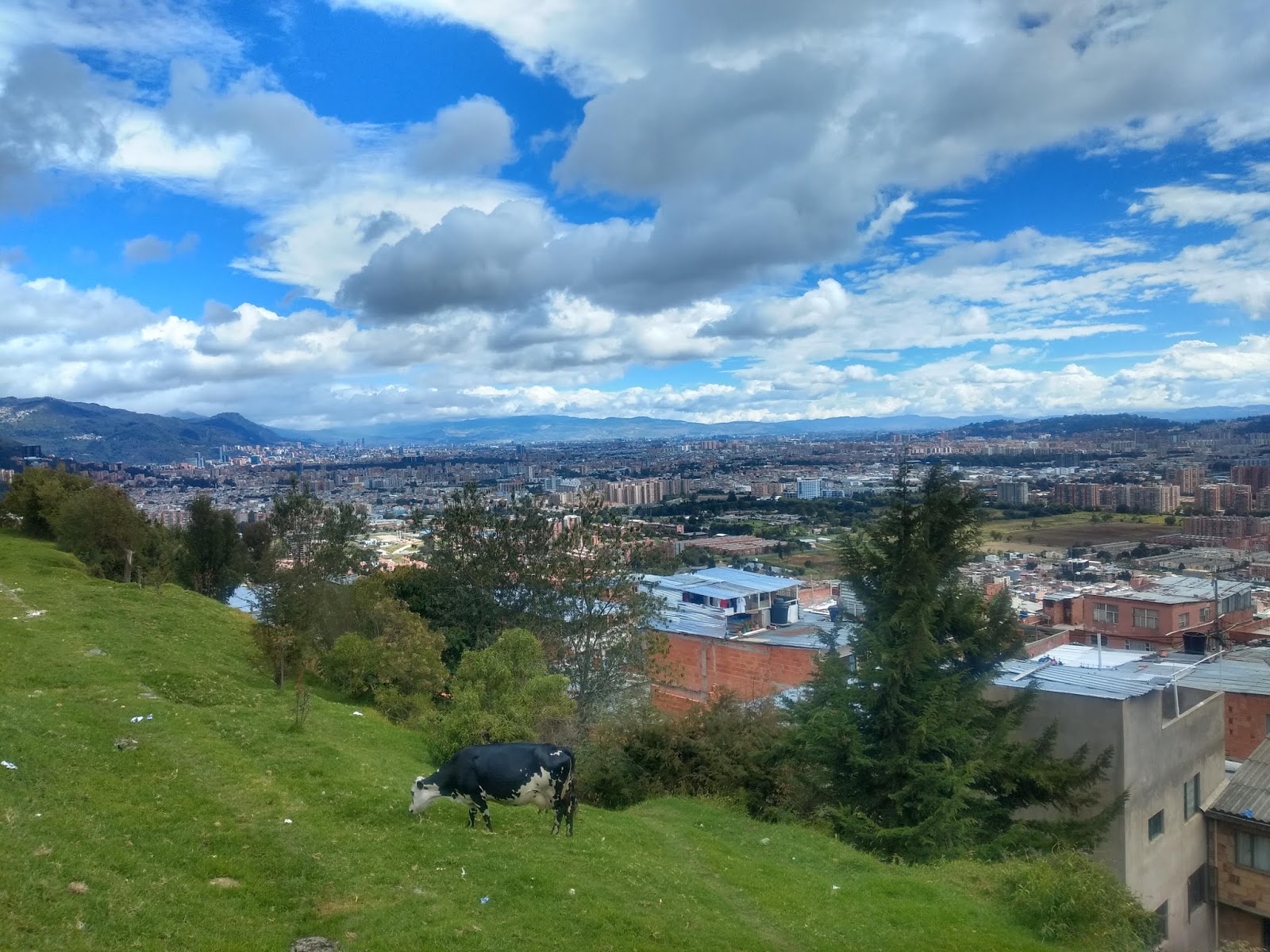 |
| Even Bogotá's cows practise social distancing these days. |
Bogged down in Bogotá
From a Bogotá perspective, in the early, testing-the-water days, the stay-at-home orders for all but essential needs and those working in what were deemed essential services were well obeyed for the most part.After a couple of weeks, when people who didn't buy into 'the virus is an existential threat' mantra realised that lockdown enforcement was fairly lax, we began to see a bit more movement around the city.
In response, city authorities introduced an ill-thought-out sex-based restriction. No, no, it had nothing to do with the act of having sex — although it would have been nice if born-again virgins like me were given the freedom of the place — it was in relation to gender. Only men were allowed out on one day, women the next. Trans and non-binary folk had to pick one 'side' and stick to it.
Despite reports of discrimination against transexuals, this was stubbornly persevered with for a couple of weeks after which we returned to the original stay-at-home orders.
Again, alarmed at too many people wandering the streets, an ID restriction then came into force. This remains the modus operandi. It functions thus: Those whose identity card number ends with an even number can go out for the essentials on odd-number dates, even-number dates are for those whose ID number ends in an odd digit. Geddit?
It has been said that the thinking behind this odd-even, even-odd mix is that it makes things more confusing and, so it's hoped, people will be more inclined to err on the side of caution and stay at home.
Whatever the case, this measure alone wasn't deemed sufficient for certain areas of the sprawling capital. This month, stricter (in name anyway) lockdown measures were introduced for various 'Covid-19 hot zones', staggered over a six-week period — a couple of weeks in one sector, then on to the next. For the record, my part of town, Bogotá's northern limits, isn't part of these hotspots, for now at least.
In the freer areas, one can still go out on any day and at any time one wishes without fear of interrogation — the ID number/date restriction applies to entry into banks, supermarket chains and the like only.
'The hysterical, monomaniac folk in the stop-coronavirus-at-all-costs camp feel the measures aren't tough enough. If Bogotá mayor Claudia López had her own way she'd surely be more draconian in her approach.'The bottom line is, notwithstanding the rising case figures over the last few weeks, the measures appear to work. By 'work' I mean they have found that balance between a city/country feeling it is doing the necessary to stop the spread of coronavirus and the desire not to be viewed as too authoritarian and restrictive.
(Do note, the fact the public-private health system is under pressure has more to do with its structure, general inadequacies and tardy responses that have led to a build-up of problems all at once rather than the pandemic itself — it's been on the brink for years. The pandemic and associated panic have simply served to underscore these shortcomings. Indeed, official channels are now looking into complaints about how these EPSs have handled the crisis. A cynic might say this is simply incompetents investigating incompetents.)
'Heart over head' López
The hysterical, monomaniac folk in the stop-coronavirus-at-all-costs camp will feel the measures aren't tough enough. One gets the feeling that if Bogotá mayor Claudia López had her own way she'd surely be more draconian in her approach.It's understandable, considering the number of people who think with their heart and not their heads on such matters, failing to see the bigger picture and the consequences of widespread lockdowns. An emotionally tuned-in politician such as López can tap into that and win some priceless brownie points.
The counterweight is President Iván Duque. I think it's fair to say that if he had his own way we'd be seeing far more economic activity and greater inter-municipal movement in the country right now, with the appropriate bio-security measures in place of course.
However, considering the emotions involved and the 'López leverage', he's had to rein himself in somewhat. The result of this clash of personalities and outlooks is what's been mentioned above. We're in lockdown alright, but with an amount of flexibility.
From a personal perspective, the frustrating prohibition on leaving the environs of Bogotá excepted, it's tolerable. While some of our leaders are slowly waking up to the fact that we have to learn to live with coronavirus, that locking ourselves away indefinitely is not the answer, for now this Colombian middle way is the about the best we can hope for from a highly spooked, emerging-market country.
It could be a lot better, it could be much worse, a motto for Colombia in general really. That being said, I'm well aware of the many whose livelihoods are practically done for, some of whom I've featured on my podcast.
For the moment, selfish as it might be, I'm glad I can still get out for my daily clear-the-head — with nose and mouth covered as they must be — walks, free from interrogation by over-zealous police officers. Here's hoping I haven't jinxed it now.
_____________________________________________________________________
Listen to Wrong Way's Colombia Cast podcast here.
Facebook: Wrong Way Corrigan — The Blog & IQuiz "The Bogotá Pub Quiz".

