Showing posts with label Iván Duque. Show all posts

Tuesday, 21 June 2022

Conservative Colombia left in the cold — for now

@wwaycorrigan

[Listen to an audio version of this blog entry here.]

So the last bastion of conservatism and right-wing populism in Latin America has fallen. Colombia has chosen a leftist president for the first time in its history.
Conservative Colombia left in the cold — for now: Gustavo Petro and Francia Marquéz celebrate their historic win in Colombia's presidential election.
A new dawn for Colombia? Gustavo Petro and Francia Marquéz celebrate their historic election win. (Photo from Facebook.)
The rains that fell incessantly on the capital city, Bogotá, as the results flooded in on Sunday 19 June were most likely viewed as cleansing waters from the heavens for supporters of now president-elect Gustavo Petro. Indeed, in a tweet, he did put the victory down to 'God and the citizens and their history (or story).'

New Colombia

For those who loathe the former rebel — and there are many in that category — the dreary weather must have felt like pathetic fallacy, heralding a decadent, possibly very unstable era.

In fairness, both Petro and the surprise-package challenger in this run-off contest, 77-year-old Rodolfo Hernández who ran on a strong anti-corruption ticket, were representing a change of sorts. Hernández — or the more affectionate Rodolfo as he goes by — was hardly mentioned as a serious contender a month or so out from the first election on 29 May.

His social media campaigning was Trumpesque, making particular use of TikTok. The plan for the former mayor of Bucaramanga appeared to be, 'don't give too much away and just say what many want to hear'. It nearly produced the hoped-for effect.

Petro, on the other hand, has been in the national political limelight for quite some time. Alongside his highly divisive guerilla involvement in the 1970s and '80s, he was elected to Colombia's lower house of Congress in 2002, became a senator in 2006 and won the Bogotá mayor's office in 2012. He also previously ran for president in 2010 and 2018.
'A taxi driver who voted for the winner told me it was a case of opting for the least-bad candidate. Or, to borrow from a saying in these parts, to avoid going from Guatemala to Guatepeor.'
This familiarity may have actually been a significant factor in getting Petro over the line this time. The loose-cannon nature of Rodolfo that displayed itself on numerous occasions worked to his rival's advantage.

As a far-from-euphoric taxi driver who voted for the winner told me, it was a case of opting for the least-bad candidate. Or, to borrow from a saying in these parts, to avoid going from Guatemala to Guatepeor — from bad to worse, basically.

Petrograd

The concerns of those against Petro are in relation to what is seen as his socialist agenda. 'He'll turn Colombia into another Venezuela', that's the common mantra.

A dramatic disruptor in the mould of Hugo Chávez, he is unlikely to be, however. Yes, he and, to an even greater extent, his vice president, the Afro-Colombian environmentalist and human-rights activist Francia Marquéz, represent something quite removed from those of the old Conservative/Liberal heritage who have dominated these offices before.

Yet, the idea that they'll tear down the existing state structures and construct an entirely new system seems somewhat farfetched.

The term, which begins on 07 August, is, after all, limited to four years with reelection constitutionally prohibited. What an administration with a potentially radical programme — and much to do with it — can achieve in such a timeframe in a rather legalistic country is open to debate.

Thus, paving the way for a successor will most likely be a high priority. The 'Petro Plan' is going to need more than four years to deal with the likes of deep-rooted inequality, to name just one of the country's many ills.

As outgoing President Iván Duque discovered in 2021 with his tax-reform proposals — a perennial problem here — opposition in Colombia can be fierce and bring together disparate sections of society.

Mentioning Duque, when he hands over the reins to Petro he'll have just turned 46. One gets the feeling, however, that he'll be happy to end his career in Colombian politics when he vacates Casa de Nariño, unlike his mentor, the president from 2002 to 2010, Álvaro Uribe.

Whatever lies in store for Duque, these next four years for Colombia are certainly set to be intriguing.

While many thought it would never happen, Petro's big moment has arrived. For sure, he'll face many obstacles as, it would appear, about half the country won't want him to succeed, some of whom wield considerable power in various influential spheres.

Yet, for the other half, he is the president they have been waiting for to make what they see as the necessary changes to finally improve their lot.

It's now time to deliver, Presidente Petro. Your enemies aren't willing to stay in the cold for long.
_______________________________________________________________
Listen to Wrong Way's Colombia Cast podcast here.

Facebook: Wrong Way Corrigan — The Blog & IQuiz "The Bogotá Pub Quiz".

Friday, 22 April 2022

Colombia decides: Go with Gutiérrez or plump for Petro?

@wwaycorrigan

[Listen to an audio version of this blog entry here.]

In just over a month, 29 May 2022 to be precise, Colombians go to the polls to elect their next president.
Colombia decides: Go with Gutiérrez or plump for Petro? Colombia's likely lads, Gustavo Petro and Federico Gutiérrez look set for a presidential election run-off.
In the left corner, Gustavo Petro. And in the right-ish corner, Federico "Fico" Gutiérrez. (Photos from https://www.facebook.com/gustavopetrourrego/photos/ & https://federicogutierrez.com/.) 

Fico fights back

There are two things that we can take as virtually certain at this stage. One is that the country's next leader will be a man. The other is that this man won't be declared the winner on 29 May.

The reason for the latter is that for a candidate to win the presidency in the first round, he/she needs more than 50 per cent of the overall valid votes cast. With eight runners currently in the field for the nation's top job and polls showing no runaway favourite, it's pretty much certain a run-off will be needed between the top two candidates.

That head-to-head — barring some dramatic game-changer in the coming weeks — will be between former Bogotá mayor and runner-up in the 2018 presidential election, Gustavo Petro, and Federico "Fico" Gutiérrez, former mayor of Colombia's second city, Medellín.

Opinion polls have shown the leftist Petro with a relatively consistent lead throughout for some time now. Indeed, with a split centre/centre-right vote in round one — that there is no official candidate from the party of the still popular yet divisive former president, Álvaro Uribe, the man who helped propel outgoing president Iván Duque to victory, is a factor here — it seems safe to assume the one-time guerrilla will win the first round but fall somewhat short of the magic number to obviate a second day out.
'All this has to be balanced against the idea that a leftist, former guerrilla becoming Colombia's president takes the cherished sweetness out of the morning coffee of many citizens.'

Thus, similar to 2018 (see my post from that year, Right you are Colombia, for background), the key question is, where will the votes from the losing candidates in round one go in round two?

Most observers, backed up by polling — polls do tend to be reliable in Colombia — suggest Gutiérrez (I'm loath to call him by the affectionate "Fico" monicker) will take the lion's share. This may be enough to get him over the line but it looks set to be very close. (Do note that traditionally conservative Colombia has never returned what one may consider a genuine leftist candidate.)

The country's electoral system does also allow for a valid protest/blank vote, 'voto en blanco' (see https://wwcorrigan.blogspot.com/2018/02/colombia-vote-ve-blanco-for-real-change.html). In the 2018 run-off, this took 4.2 per cent of the overall votes, an increase of three percentage points from that year's first round. In one opinion poll in March this year, 16 per cent of respondents said they would vote blank. With that in mind, this phantom candidate may play a decisive role this time.

A turnout for Petro?

Another important factor is turnout. It hovered around 54 per cent in both rounds in 2018, a rather high figure compared to all the other presidential elections this century. As a reference, turnout for this year's congressional elections in March was just over 47 per cent of registered voters, about 1.5 percentage points lower than the 2018 figure.

If turnout increases for this year's presidential election — the various controversies with voter registration in Colombia aside — and we guesstimate that this means a greater participation of younger voters, the belief is that this would be a positive for Petro.

All this has to be balanced against the idea that a leftist and former guerrilla becoming Colombia's president takes the cherished sweetness out of the morning coffee of a not-insignificant number of citizens.

Even the slightest suggestion of something socialist sees many people point to the east and the ongoing mess that is neighbouring Venezuela.

That aside, and while Petro's mayorship of Bogotá was not without its ideological battles (see https://wwcorrigan.blogspot.com/2012/12/petrograd-colombias-new-capital.html & https://blogs.eltiempo.com/wrong-way-corrigan/2014/01/24/ordonez-petro-et-al-fiddle-while-bogota-continues-to-burn/), one finds it hard to envisage a Petro presidency turning the country into the next Venezuela.

Brother countries they may be but the overall more conservative nature of Colombia means it is unlikely radical social change will occur here akin to what we've seen in Venezuela over the last twenty years. What's more, Gustavo Petro is no Hugo Chávez Frías.

Indeed, it could be argued that the most radical departure Colombians could take in this presidential election would be if voto en blanco won the day.

That won't happen. So, as a largely independent observer, if I was forced at this stage to put some of my hard-earned pesos on the outcome, I'd go with Gutiérrez. Very hesitantly, that is.
_______________________________________________________________
Listen to Wrong Way's Colombia Cast podcast here.

Facebook: Wrong Way Corrigan — The Blog & IQuiz "The Bogotá Pub Quiz".


Wednesday, 26 May 2021

The Colombian compromise

@wwaycorrigan

[Listen to an audio version of this blog entry here.]

'There are decades where nothing happens, and there are weeks where decades happen.'

That famous observation, attributed, rightly or wrongly, to Vladimir Ilyich Ulyanov — better known as Lenin to most of us — has been used to describe many situations over the years.

The Colombian compromise: Colombia's under pressure President Iván Duque & Vice President Marta Lucía Ramírez.
Lame ducks: President Iván Duque & Vice President Marta Lucía Ramírez. (Photo from presidencia.gov.co.)

Plus ça change

Some might be tempted to apply it to what's been happening in Colombia of late.

The truth of it is, however, that despite the ongoing protests — linked, it must be remembered, to a movement that started on 27 November 2019, so not quite a matter of just a few weeks — nothing much has changed in the country, the pandemic effects excepted.

Indeed, so far the protesters' main achievements have been to stop things from happening. No to the proposed tax and health reforms, no to the co-hosting of the Copa América.

What's more, calls for police and military reform have been heard from Colombians since before the new constitution of 1991. Like that of the perennial tax-reform debate that only ever really trims around the edges at best, we're still waiting.

While there does appear to be broad agreement that there's something more lasting to the current protests, that those taking to the streets won't go away without concrete commitments to change, in a country that, officially speaking, displays a deep respect for "due process" through the courts, rapid, radical overhauls are most unlikely.
'There is a Colombian tradition of finding a workable solution to an impasse without completely ripping up the script.'

Of course, in a number of respects, this is a good thing. Throwing away the existing rule book when it's not at all clear what would follow could go disastrously wrong. Nonetheless, there are many who say, justifiably, that that existing rule book only really serves the interests of a comfortable minority.

'Hay un camino'

That being said, there is a Colombian tradition of finding a workable solution to an impasse without completely ripping up the script. The Colombian compromise we could call it. (One could argue that the new constitution of 1991 was the wrong solution at the right time, change for change's sake.)

I've experienced this compromise for day-to-day affairs while there are also "grander" historical examples (the Frente Nacional, to name but one). It might require a questionable interpretation of the rules or the turning of a blind eye but the idea is that all parties walk away feeling they've achieved something.

For now, for the current bungling administration headed by President Iván Duque, the hope must be that it can tap into that old Colombian trait. As Venezuela's former presidential candidate Henrique Caprile's campaign slogan went, 'Hay un camino', there is a way (alas, for him, he's still looking for that 'way').

It's both a blessing and a curse for Duque that his term ends in just over a year, August 2022. The blessing, in theory anyway, is that he can be more flexible in ceding to various demands safe in the knowledge that they'll get tied up in Colombia's Byzantine bureaucracy. In that scenario, when he leaves office, he could say: 'Hey, I did try in the end. It's out of my hands now.'

The curse is that it appears the majority of Colombians wish he wasn't president. There is zero trust in him in many quarters.

Furthermore, the unspectacular but largely positive change Colombia has experienced over the last couple of decades has now, understandably, only led to a desire for greater, quicker change amongst its younger citizens.

They know what they want — in a general sense in any case — and they want it now, in a number of weeks, not in a decade or two.

Step forward the Colombian compromise.
_______________________________________________________________
Listen to Wrong Way's Colombia Cast podcast here.

Facebook: Wrong Way Corrigan — The Blog & IQuiz "The Bogotá Pub Quiz".


Wednesday, 12 May 2021

Colombia: A system failure

@wwaycorrigan

[Listen to an audio version of this blog entry here.]

The chaotic times Colombia is experiencing bring to mind just how inflexible a presidential system can be.

Back me or sack me

Faced with such a crisis in a parliamentary democracy, a motion of no confidence would most likely be tabled against the prime minister. 

If there was enough dissent in government ranks, the ruling party could lose such a vote. That would trigger, barring a new arrangement amongst the parties in parliament to choose a new premier, an election.

Colombia: A system failure. Protesters block the main transport route into Bogotá from the north.
Widespread protests are ongoing in Colombia.
Either that or the prime minister, in a put-up-or-shut-up cry to the electorate, could call an election of his/her own accord. (In the Irish system, this would need to be signed off on by the largely ceremonial president, something that is normally just a matter of course.)

Think of Boris Johnson's sweeping victory in the UK's December 2019 general election. Having won the support of his party to take over as PM from Theresa May with a more hard-line Brexit position, he put it all on the line and went to the country in a bid to strengthen his mandate. 

It worked, quite stunningly. The many loud, influential voices against the Conservative leader had to grudgingly accept that the British electorate backed Boris.

Of the various demands from Colombia's protesters, some are calling for the resignation of President Iván Duque. As I mentioned in my previous post, with an election for a new head of state just 12 months away, it's unlikely in the extreme that this will happen.

However, I wonder if Duque right now wishes he was a prime minister in a parliamentary system where he could call a snap election. 

It would certainly put to the test the belief, particularly seen in international media, that the current protests are widely supported. (I must add, while Duque's own popularity appears on the floor, his party, Centro Democrático, still has a solid support base. If we can call the Centro Democrático the party in power, the opposition is far from united — it's quite a mixed bag.)

My take on it, from my humble estrato dos abode in the far north of Bogotá, is a little more nuanced.

Of course the many struggling to make ends meet want to see their lot improve. Don't we all? The killing of innocent protesters by state forces is also wholly unacceptable. Most Colombians would appear to agree that some sort of police reform is badly needed.

However, as I've written oft-times before, the more radical, mostly younger forces that appear to make up the majority of the protesters aren't exactly lovingly embraced by your average barrio-popular resident.

Unsurprisingly, there is a certain arrogance amongst the leftist, university-attending protesters towards those not of their ilk. 'The uneducated idiots don't know what's good for them' is a regular refrain.
'Is it a case that the majority of Colombians feel they're somewhere in the middle and relatively content with that?'
It's a standard line of attack by those on the left. It rarely works. In fact, it's often counterproductive.

Who are these "educated" folk to say that the construction worker or housecleaner doesn't know what he/she wants?

Colombians don't have to look too far to find an example of what can go horribly wrong when a country takes a hard turn to the left based on promises to end corruption and bring about a better life for all. Venezuela, anyone?

OK, some of you will say I'm being dramatic here. That what the protesters are really calling for is simply a fairer system, a reduction in inequality, not a version of Hugo Chávez Frías' socialism for the 21st century.

The price of fairness

In terms of some of the standout demands on the protesters' list — a guaranteed one month's minimum wage for those officially living in poverty and no university tuition fees — it's true that we're not talking about unrealistic proposals when viewed from an international perspective. 

In fact, President Duque has already announced the introduction of free, temporary for the moment albeit, public higher education for students from the lowest three strata (for a brief introduction to the strata system, see https://wwcorrigan.blogspot.com/2014/10/end-of-strata-republic.html).

All such measures, to state the obvious, must be paid for somehow. In Ireland, my home country, a relatively generous social welfare system and "free" third-level education for undergraduates is financed by redistributing wealth through what one might call "progressive" taxes. 

There are always the complaints that the richest in society aren't contributing enough and, on the other extreme, some people are just scrounging off the state.

Colombia, I'm guessing, would have to do something similar in terms of taxation. What might worry some who consider themselves to be just making ends meet, however, is that they would be asked to contribute more than they currently are to fund an expanded social welfare state. In other words, in a Colombian context, they're not as poor as they think they are.

In a country where informal, unregulated employment and illegality — officially uncontrolled and outlawed by the state but unofficially approved — are commonplace and "suffice" for many involved in such activities, rocking the system is a risk they are reluctant to take.

It remains to be seen if the proposals to significantly expand Colombia's welfare state make any real headway. By their very nature, they would require more government control in a country where there is much mistrust of state institutions. Colombia, do remember, tends to move to a conservative, raw-capitalist beat.

Without completely tearing down the house, in common with the social-democratic countries in Northern Europe, those looking for wholesale changes might find that a parliamentary system is the best vehicle to implement them.

They might also find, though, that they haven't as much support as they may believe they have.

No system is perfect. Each one has its losers and winners. Is it a case that the majority of Colombians feel they're somewhere in the middle and relatively content with that? 

On the other hand, there is the nothing-ventured-nothing-gained argument. Deciphering the amount of change needed, or not as the case may be, is a delicate balance.

Future elections, the candidates that go forward and the manifestos they present will give us some indication of where 'el pueblo colombiano' stands on all this.
_______________________________________________________________
Listen to Wrong Way's Colombia Cast podcast here.

Facebook: Wrong Way Corrigan — The Blog & IQuiz "The Bogotá Pub Quiz".


Thursday, 6 May 2021

Colombia, between a rock and a hard place

@wwaycorrigan

[Listen to an audio version of this blog entry here.]

'Hey Johnny, what are you rebelling against?'
'Whaddaya got?'
 
Some of you will recognise those lines from a classic scene in the 1953 US crime film The Wild One, with Marlon Brando playing protagonist Johnny Strabler. It was parodied, for those of us of a much younger age, some 40 years later in The Simpsons by Lisa (taking Johnny's role) and Principal Skinner.

Colombia, between a rock and a hard place: Colombia's National Strike — the country has been experiencing ongoing, violent protests since 28 April, 2021.
Protesters block Bogotá's Autopista Norte.

A taxing issue

Not wanting to make light of the very real issues at the heart of the latest wave of protests in Colombia, in some ways it seems as if the protesters are against pretty much anything the state represents. One could say, much rhetoric, little real detail.

The spark that led to this so-called Paro Nacional, National Strike, was the controversial tax reform proposals. While many other grievances were highlighted by the various organisations officially behind the mobilisation that started on 28 April, it seems unlikely that the movement would have garnered as much support if it hadn't been for these mooted tax changes. (It must be said, the numbers protesting in recent days aren't massive by any means but they are causing widespread disruption via roadblocks, damage to public transport and such like.)

Across the class spectrum, there was widespread anger at the Ministry of Finance's proposals. It matters little whether this anger has been justified or not. The narrative was set that the government was looking to take more than was fair from the middle and lower classes to increase its revenues, something it badly needs to do.

For one, looking to widen the income tax base, as these proposals did, doesn't seem too unreasonable in a country where a small percentage of the population actually contributes in this way. Nonetheless, when state politicians earn about 30 times the national minimum wage and there's a belief that corruption is commonplace among the controlling classes and wealthier folk, asking the masses to fork out more in such a blatant manner was always going to be met with resistance.
'Taking it as a given that it's Colombia's centre-left/left behind most of this, if there was a presidential election next week, one would be taking a significant gamble betting on politicians from that side of the spectrum to be poll toppers.'

In the end, President Iván Duque's administration capitulated. The Finance Minister resigned and the tax reform proposals have been binned. They'll be back in some form again as the country must find ways to raise revenues (or cut spending) — my podcast interview from last year with the renowned economist Leopoldo Fergusson gives a good overview of the situation together with some considered ideas of what could be done.

So with the tax reform proposals shelved, the minister responsible sent packing and President Duque promising an inclusive national dialogue, why have the protests continued? (They are into day nine as I write.)

Police state

The biggest reason is the response of state security forces. Depending on whose figures you believe, we've had either over 20 protest-related deaths or over 30. Culpability for the majority of these has been laid squarely at the police and individuals acting on their behalf. In this age where social media dominates the discourse, deciphering fact from fiction is difficult, to say the least.

All this follows on from previous protest fatalities, the most recent spate occurring in Bogotá in September 2020 when violence erupted after the death at the hands of police of Javier Ordóñez, something I wrote about at the time.

This time around it's the south-western city of Cali that has borne the brunt of killings and violence, although all major urban centres in the country have seen some level of violent disturbances.

Thus, protesters' ire is yet again directed at police brutality. Each morning since 28 April we've woken up to news of another killing allegedly at the hands of state forces. As long as that continues, the chances of the protests petering out, as has happened previously, seem low.

The official organisers of the National Strike are scheduled to meet with government officials in the coming days. Whether this will result in an easing of tensions remains to be seen.

How much the various workers' unions are actually in control of the movement at this stage is highly debatable.

For many of the younger protesters, it would seem that nothing short of President Duque's resignation will placate them. That is extremely unlikely to happen. We are, after all, just a year away from a presidential election.

What's more, as alluded to above, the extent to which those protesting represent the majority of public opinion is difficult to measure. Taking it as a given that it's Colombia's centre-left/left behind most of this, if there was a presidential election next week, one would be taking a significant gamble betting on politicians from that side of the spectrum to be poll toppers.

While the more "visible" problem of police brutality is now driving the protests, the broader issue here is — and always has been — inequality in all its manifestations. For that, there is no quick-fix solution.

Of course, this doesn't mean that decision-makers just shrug their shoulders and say 'it is what it is.' The goal of achieving a more equal society has to start somewhere. One of those places, it can be argued, is with a fairer redistribution of wealth, i.e. tax reform and the like. Ring a bell?

In the same way, referring back to our opening lines, rebelling against everything with little rhyme or reason to proceedings is unlikely to lead to a glorious revolution.

Go ahead, tear down the structures and start again. To do that, one has to be prepared to shoulder the cost of reconstruction.
_______________________________________________________________
Listen to Wrong Way's Colombia Cast podcast here.

Facebook: Wrong Way Corrigan — The Blog & IQuiz "The Bogotá Pub Quiz".


Wednesday, 10 February 2021

'I dated President Duque's sister' — Daniel Coronell

@wwaycorrigan

Renowned Colombian journalist, Daniel Coronell, has revealed how he once dated the sister of current Colombian president, Iván Duque.

Renowned Colombian journalist Daniel Coronell gives a wide-ranging interview in English.
Bad romance: Coronell reveals he dated Iván Duque's sister.
Coronell, a regular critic of Duque as well as his party Centro Democrático and, more controversially, that party's leader, former president Álvaro Uribe Vélez, made the revelation in an English-language interview on Wrong Way's Colombia Cast podcast.

Divine intervention
'Many years ago, like 30 years ago, I was the boyfriend of Duque's sister. I loved her a lot', he said.

They even discussed plans to marry. 'I cannot imagine my life (today) if I was the brother-in-law of this president of Colombia.'

Miami-based Coronell, an atheist, joked that it was a higher power that put an end to their romance. 'There was a kind of superior decision — and I am an atheist — that broke (up) the relationship on time.'
"I loved her a lot."

Asked whether he still remains in contact with President Duque's sister, his response was a blunt 'no'.

He also spoke about his April 2020 departure from his columnist role with Colombia's leading current affairs magazine, Semana, a gig he had held for 15 years. 

His leaving coincided with sweeping changes at the publication, with well-known broadcast journalist Vicky Dávila eventually taking over as director, a move seen by some as a shift to a more populist, sensationalist editorial style.

Quoting the Italian film director, Federico Fellini, Coronell said, 'Yo nunca había visto nada igual (which translates as 'I'd never seen anything like it'), that's my opinion of Semana.'

As for writing for the magazine again, his simple reply to that question was 'probably not'.

In relation to the 2022 Colombian presidential election, the current president of news at the US-based Univisión TV channel expressed his concerns that the election would, as in 2018, become a left versus right shoot-out.

While he suggested he would be against whoever is selected by the Centro Democrático side on the right — the 'Uribe puppet' as he calls it — Coronell also has concerns about the leftist former candidate Gustavo Petro who is set to run again.

Nonetheless, if it came down to a choice between Tomás Uribe, Álvaro Uribe's son who is being mooted as a runner, and Gustavo Petro, Coronell said he would vote for the latter.

However, he predicted that the Centro Democrático may opt for a more traditional conservative candidate such as Luis Alberto Moreno.

Whatever the case, he said he hopes that a solid centrist candidate can emerge in the coming months.

Watch the YouTube interview in full at https://youtu.be/ZsWTBwGXRXY or listen to an audio-only podcast version at https://anchor.fm/brendan-corrigan/episodes/Daniel-Coronell-on-dating-Duques-sister--unmasking-Uribe--Petros-problems--Vicky-Dvilas-Semana-eq798l.
_______________________________________________________________
Listen to Wrong Way's Colombia Cast podcast here.

Facebook: Wrong Way Corrigan — The Blog & IQuiz "The Bogotá Pub Quiz".


Wednesday, 27 January 2021

Comunes: Old Farc wanna live like common people

@wwaycorrigan

[Listen to an audio version of this blog entry here.]
So Colombia's Farc has rebranded.

The old rebel group that for over five decades waged guerrilla warfare across the country until signing a peace agreement with the government in 2016 is looking to put further distance between its political party of today and its bloody past.

Comunes: Old Farc wanna live like common people. Members of Colombia's Farc party vote to change its name to Comunes.
Old Farcs: The party is changing its name to Comunes. (Photo from Twitter.)

Long live Farc?

Thus, Farc is officially dead — bar for some dissidents — and it's long live the Comunes (roughly translated as 'Common folk' in English).

Considering the fact that an armed Farc never enjoyed anything close to widespread support in the country, except for a few remote pockets, the idea that a political party with the same name could do well at the polls was always far-fetched.

For a greater understanding for Irish/UK readers, imagine the IRA being listed on a ballot paper — it would, and no offence intended, bomb. OK, some will say IRA equals Sinn Féin, but at least the latter has a long-standing, even rich, political past.

Comunes has, on the face of it, a much more accepting ring to it than Farc, the Spanish acronym for the Alternative Revolutionary Force of the Common (people) [not to be confused with the Revolutionary Armed Forces of Colombia, the old military Farc]. Not exactly a title that warms the heart, is it?

Changing one's name, however, is one thing. Changing the negative opinion that others have of you, quite another.

It will take some time for a traditionally conservative Colombian electorate to disassociate this "new" party from Farc.

'Centro Democrático is, in many ways, simply the Conservative Party minus its sheep's clothing.'
Yes, it can be reasonably argued that Colombia has been far more accepting of new political movements since the turn of the millennium compared to the Conservative/Liberal duopoly of the 19th and 20th centuries which saw, amongst other acts of purging, the effective extermination of the Union Patriótica (UP, Patriotic Union) party. The election of Álvaro Uribe Vélez under the Primero Colombia (Colombia First) banner as president in 2002 and 2006 is a case in point.

Uribe and others would go on to found in 2013 Centro Democrático (Democratic Centre), the party of incumbent president, Iván Duque. It is, nonetheless, in many ways simply the Conservative Party minus its sheep's clothing. It fits in nicely with the Colombian psyche.

Bad branding

Comunes, in contrast, purely as a signifier before one even studies its actual politics, looks and sounds too much like Communist. 'Eh, don't call us guys, we'll call you.'

Come on, could Farc's powers that be not have come up with a name that wouldn't be so anathema to so many Colombians? How about the People's Party of Colombia, El Partido del Pueblo Colombiano? (I must get that registered forthwith, it's mine.)

As things stand, there's a greater chance that I'll have Colombian residency before the artists formerly known as Farc make any significant political inroads here. Yes, that long.

Nonetheless, if they need some additional rebranding help more in tune with the Colombian masses, they know where to find me. I come at a reasonable price.
_______________________________________________________________
Listen to Wrong Way's Colombia Cast podcast here.

Facebook: Wrong Way Corrigan — The Blog & IQuiz "The Bogotá Pub Quiz".


Wednesday, 6 January 2021

2021: Reasons to be fearful

@wwaycorrigan

[Listen to an audio version of this blog entry here.]

New year, new hope. And after the stagnation that was 2020 for many — save for the comfortable, virtue-signalling folk who have seen their lot actually improve — there appears to be more of a focus than usual on the positives that lie in store for us over the next 12 months.

2021: Reasons to be fearful. Former Colombian president Álvaro Uribe Vélez. Will his son Tomás run for the country's top job?
Uribe, mi presidente. (Image from Facebook.)

Nonetheless, positivity is one thing, reality another — we'll leave to one side the postmodernist view on what is real and what isn't, only to say that when you're dead, you're dead. So while we'll do our best to carry on regardless, here are some reasons to be less than optimistic that 2021 will be brighter than 2020.

Covid chaos

Let's start with the most obvious. Regardless of where you stand on the efficacy of lockdowns and the true severity of coronavirus (in a recent interview, the historian Niall Ferguson noted how in terms of lethality the disease isn't even in the top 25 of global pandemics humanity has suffered), the closedown-to-suppress-the-virus approach has been adopted by many countries.

For sure, with vaccines now on the scene, hopes are high in richer nations that they'll be able to get on top of the situation in the first six months of this year or so.

However, considering the way our decision-makers and much of the media have become completely engrossed in every detail of this virus and its modus operandi to the detriment of pretty much all other areas of life, those who hope that by this time next year we'll be in AC (After Coronavirus) times need a reality check.

'Closer to Colombia, strong rhetoric against Venezuelan President Nicolás Maduro has the potential to morph into something more than mere words.'
What's more, emerging-market countries, such as here in Colombia, look set to be well behind the curve in any vaccine bounce. 

By going along with the richer nations' moment of crisis in their otherwise comfortable existence, in following the lead of said richer nations and neglecting other, arguably more serious problems, developing countries will be cast further adrift. Inequality will widen, not only between nations but within them as well.

One final covid "fear" is the continuation of Colombian President Iván Duque's cringeworthy, quite condescending evening TV addresses. Mercifully, they are easily avoidable. I'm clearly not the only one who has had enough. The owner of one of my panadería offices changes channel as soon as El Presidente comes on.

Biden bombs

Much of the world will breathe a sigh of relief when US President Donald J. Trump vacates the White House on 20 January. In his place comes a veteran establishment figure, a man who many view as a safe pair of hands, Democrat Joe Biden.

The thing is, after four years of a president who put America (the United States part of it, that is) first, who largely preferred isolationism rather than internationalism, a Biden administration will look to reassert Washington's influence on the global stage. How that manifests itself over the next few years will be fascinating to watch, from a safe distance that is, if one can be found.

OK, another flare-up in the Middle East doesn't exactly usher in Armageddon, but an outwardly bullish, confident China is sure to lay down the gauntlet to what it must perceive as a weak, disjointed rival.

Closer to Colombia, strong rhetoric against Venezuelan President Nicolás Maduro — a China ally of sorts — has the potential to morph into something more than mere words. In fact, the centrist faction of the Democratic Party might see it as a way to show it's not being highjacked by the left, as well as adhering to its stated global clampdown on corruption.

In addition, "corrective" action against Caracas would do no harm at all in helping to boost support among certain Hispanic voters who loathe the socialist wing hovering in the USA's blue corner.

And attacking fellow human beings is more box office than fighting a microscopic, common enemy of mankind.

Uribe presente, es mi presidente

One man's terrorist is another man's freedom fighter. So while large swathes of the Colombian electorate will be thrilled with the prospect of an Uribe running for the presidency next year, many will be filled with dread.

Reports in late 2020 suggested that Tomás Uribe, son of former president, the divisive Álvaro Uribe, was being sounded out by Centro Democrático officials to run for the country's top job.

By all accounts, it's a long shot — he's reputedly not keen — but if Colombia was to put an Uribe back in Casa de Nariño, it would open the door for old scores to be settled, à la US President George W. Bush finishing off some of his father George H.'s business.

In such a scenario, we may not need the US to instigate war with the neighbours to the east. The Uribes are coming for Chavismo in all its manifestations, abroad and at home.

Whatever transpires over the course of the next 12 months, it promises to be an exciting ride.
_______________________________________________________________
Listen to Wrong Way's Colombia Cast podcast here.

Facebook: Wrong Way Corrigan — The Blog & IQuiz "The Bogotá Pub Quiz"


Monday, 4 January 2021

Bogotá's Fraudia López

 @wwaycorrigan

[Listen to an audio version of this blog entry here.]

At the best of times, it's not easy being a politician. In today's social-media dominated world, our elected leaders are scrutinised like never before.

OK, they willingly sign up for a life in the public eye and benefit from this, so many will say they're fair game.

Yet, the attacks they receive regularly cross the line, entering into their private lives.

Bogotá's Fraudia López: Bogotá Mayor Claudia López and her wife Angélica Lozano depart for Costa Rica while parts of Bogotá enter a strict lockdown in a bid to contain the spread of coronavirus.
'Enjoy your lockdown, Bogotá! See you when we're back!' (Image from Twitter.)

López's lost it

Nonetheless, on occasions, our leaders do things completely out of touch with the people they claim to represent that it only seems right to call this out.

In these pandemic days, as many people's livelihoods have been mortgaged away due to questionable measures introduced to contain our relatively mild viral enemy, that some politicians fail to show sincere solidarity with those suffering the most is, as far as I'm concerned, unforgivable.

Take — and to use the old joke, do please take her — Bogotá Mayor Claudia López. On the 1st of January, she completed her first year in office.

What does she decide to do to mark the milestone? Why head off on a holiday to Costa Rica.

Now,  in a normal year, people would be justified to some extent to question a self-proclaimed mayor of the working classes in a city with deep inequality taking a holiday outside the country. With so many beauty spots in Colombia, why the need to go elsewhere?
'I do actually think López cares, at least as much if not more so than many of Colombia's other top politicians. Yet perception is key and she has netted a public-relations own goal here.'

Of course, we're not in normal times. Outside of the millions of Bogotanos who regularly struggle to find the resources to take a holiday from the city, over the last few months those who normally do get away have seen their movements curtailed.

A bad act

To add insult to injury to those most badly hit by coronavirus-containment measures, while Mayor López is nonchalantly trekking around the jungles of Costa Rica, a strict two-week lockdown is reintroduced in three sectors of Bogotá.

That this is announced by some fresh-faced acting mayor who most people hadn't heard of up until a few days ago just adds to the sense of anger felt amongst the working classes. (It also begs the more general question, why isn't there an office for vice-mayor, a position that is filled at the same time as the top job, preferably elected on the same ticket as the mayor?)

It would be stretching it to believe that López didn't know this lockdown was coming as she packed her bags for Costa Rica. Therefore, the shrewder move, to really show she is at one with "her people", would have been to cancel the holiday. But no, off she went. It smacks of a couldn't-care-less attitude.

I do actually think López does care, at least as much if not more so than many of Colombia's other top politicians. Yet perception is key and she has netted a public-relations own goal here.

In reality, however, it won't amount to much — and this she knows. For those most annoyed right now tend not to vote and her many supporters will most likely just brush it off.

On a broader scale, there's an old saying around these parts that what works in Dinamarca (Denmark) doesn't work in Cundinamarca (the department in which Bogotá is located).

Taking that as a guide, lockdowns and stay-at-home orders that may — although it's far from certain — be effective in more developed nations are highly unlikely to work in an emerging-market country such as Colombia.

President Duque, Mayor López and the acting guy, whatever your name is, you would do well to bear this in mind.
_______________________________________________________________
Listen to Wrong Way's Colombia Cast podcast here.

Facebook: Wrong Way Corrigan — The Blog & IQuiz "The Bogotá Pub Quiz".


Friday, 11 September 2020

Will Javier Ordóñez's death mark a turning point for Colombia?

[Listen to an audio version of this blog entry here.]

'In the same way we condemn police abuse, we also condemn the violence and vandalism carried out by some protesters. Abuse and violence are not solved by more violence.'

So Bogotá Mayor Claudia López tweeted in response to a night of deadly protests across the Colombian capital that left at least nine people dead and saw over 50 police stations as well as a number of city buses and other buildings vandalised and burnt to cinders.

The protests were a reaction to the death of Javier Ordóñez, a 44-year-old unarmed civilian who was pinned to the ground and tasered for over a minute by two police officers on the night of Tuesday, 8th of September.

The incident was filmed by an onlooker and quickly went viral. While the exact details as to why Mr Ordóñez was stopped by the police remain unknown, it is believed he had been drinking in a house with friends and had gone out to get some more alcohol when he was met by the officers.

In the video, he can be heard pleading various times for the tasering to stop but it continues until a couple of other police officers arrive. He's then taken away to a nearby station where he allegedly receives more abuse that eventually leads to his death.

The Minister for Defence's announcing of a full internal investigation did little to quell the growing outrage in a country that tends to have little trust in its police force.

The vigil organised the next day in the neighbourhood where Mr Ordóñez was attacked was replicated across Bogotá, mostly in working-class areas, with the focal point for each being the local police station, small rapid response centres as they are (known as CAI, Centro de Atención Inmediata).

In my own neighbourhood (Verbenal), in the far north of the metropolis, 25 kilometres from where Mr Ordóñez lived, the gathering started off largely peacefully, similar to what happened elsewhere. 

No more than 20 people blocked one lane of traffic outside the police station which was manned by two officers. Banging pots in the trademark cacerolazo non-violent protest, they chanted 'murderers' and other anti-police slogans.

It wasn't long before a group of youths, mostly male, joined. With their arrival, came the use of physical force in the shape of launching stones and other rudimentary missiles at the well-protected police station — these stations were built to survive bomb blasts, so a few stones barely left a mark on the large reinforced windows. 

Nonetheless, the attack turned into a constant barrage as the number of protesters grew significantly, with attempts made to set the building alight.

With similar incidents occurring elsewhere, reinforcements for the stranded pair of police officers were slow to arrive. But arrive they did, about 20 on motorbikes. 

They managed to push back the protesters and secure the station. What ensued was an ugly stand-off with projectiles being fired in both directions amidst the occasional gunshot, which we assume came from the police.

After hours of attack and counter-attack, the outnumbered officers eventually had to abandon the small station, which was later torched.
A temporary shrine honouring one of the anti-police protesters who died in Verbenal in north Bogotá.
Mourners surround the temporary shrine in honour of one of the dead protesters.
The net result at this particular stand-off was three dead protesters to add to the other deaths elsewhere in the city.

Mayor López's — Colombia's most vociferous anti-corruption politician who attracts much liberal support — subsequent call for calm and purely peaceful protests has been largely followed bar a few small but no less destructive incidents in some sectors of Bogotá, as well as in a number of other major cities in the country.

The focus is now turning to what kind of police reform, if any, will be forthcoming.

It's fair to say that most Colombians agree that better training is fundamental to changing the force's attitude in a country with a fairly low level of basic education across the  board. 

There's a widespread belief that many officers use unnecessary force far too often. According to official sources, before this week's violence, there were already over 130 reports of police abuse in Bogotá this year alone. The idea that the horrific abuse suffered by Javier Ordóñez was a rare event doesn't wash with many.

Right now, however, with centre-right President Iván Duque from a party that has had as its motto 'mano firme, corazón grande' — 'firm hand, big heart' — there's a concern in more liberal quarters that he and his administration focus too much on the former and very little on the latter.

The family of the late Mr Ordóñez, as well as Mayor López, have spoken of their hope that his death will be the catalyst for meaningful reform of state forces. 

Those who have been following Colombia for years will be forgiven for being less than optimistic of that being realised.

Tuesday, 28 July 2020

Bogotá's lax lockdown

There's been a lot of frustration expressed on social media about the world's longest coronavirus-induced lockdown.
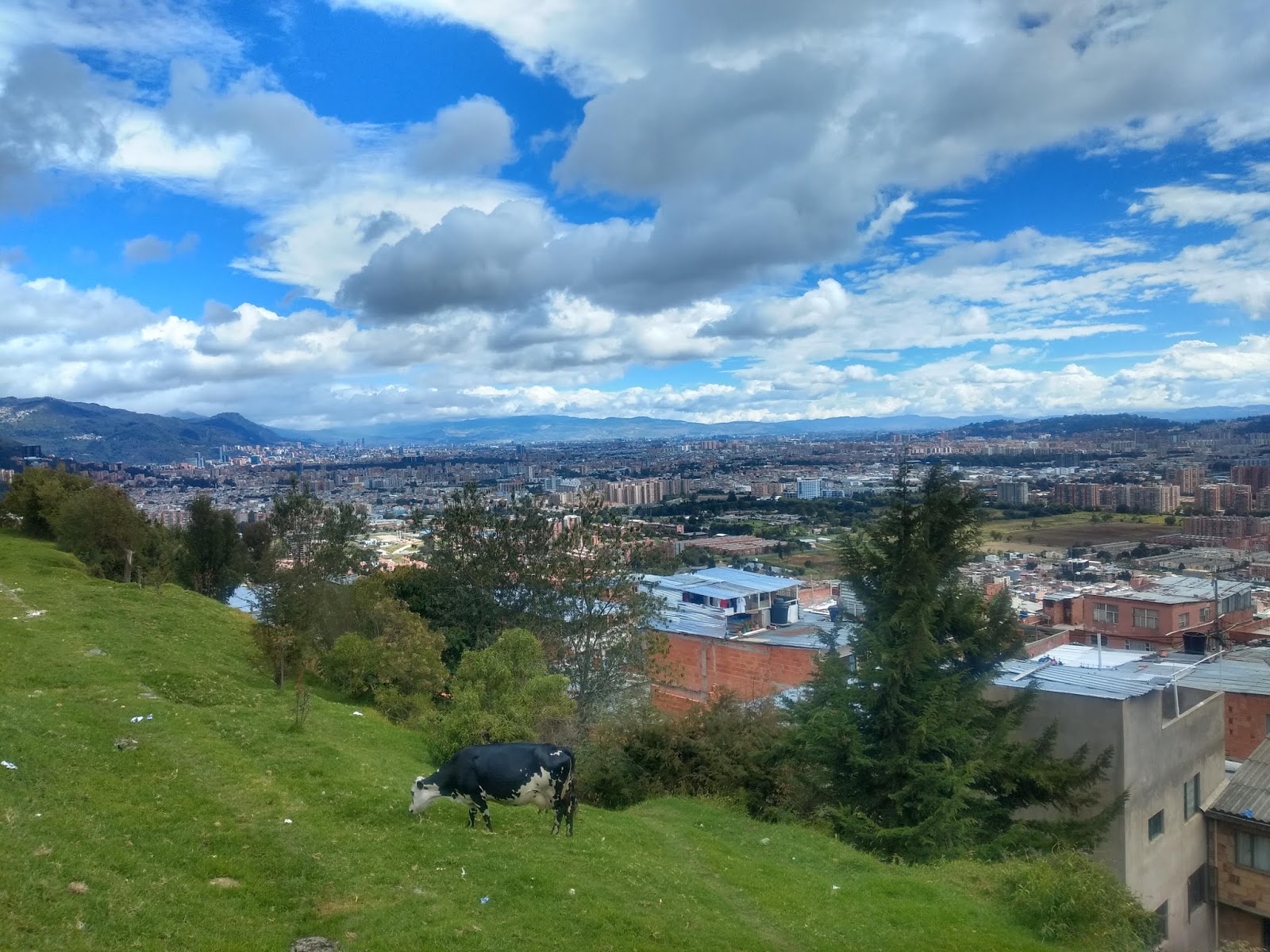
Bogotá's lax lockdown: A view of Bogotá, Colombia, looking towards the centre from the hills in the northeast.
Even Bogotá's cows practise social distancing these days. 
Since mid-March Colombia has not only been in a state of emergency but also in an 'obligatory quarantine'. On the face of it, this appears quite intense compared to other countries. However, as is often the case here, the practice doesn't match the theory. The severity of the lockdown has fluctuated over the months.

Bogged down in Bogotá

From a Bogotá perspective, in the early, testing-the-water days, the stay-at-home orders for all but essential needs and those working in what were deemed essential services were well obeyed for the most part.

After a couple of weeks, when people who didn't buy into 'the virus is an existential threat' mantra realised that lockdown enforcement was fairly lax, we began to see a bit more movement around the city.

In response, city authorities introduced an ill-thought-out sex-based restriction. No, no, it had nothing to do with the act of having sex — although it would have been nice if born-again virgins like me were given the freedom of the place — it was in relation to gender. Only men were allowed out on one day, women the next. Trans and non-binary folk had to pick one 'side' and stick to it.

Despite reports of discrimination against transexuals, this was stubbornly persevered with for a couple of weeks after which we returned to the original stay-at-home orders.

Again, alarmed at too many people wandering the streets, an ID restriction then came into force. This remains the modus operandi. It functions thus: Those whose identity card number ends with an even number can go out for the essentials on odd-number dates, even-number dates are for those whose ID number ends in an odd digit. Geddit?

It has been said that the thinking behind this odd-even, even-odd mix is that it makes things more confusing and, so it's hoped, people will be more inclined to err on the side of caution and stay at home.

Whatever the case, this measure alone wasn't deemed sufficient for certain areas of the sprawling capital. This month, stricter (in name anyway) lockdown measures were introduced for various 'Covid-19 hot zones', staggered over a six-week period — a couple of weeks in one sector, then on to the next. For the record, my part of town, Bogotá's northern limits, isn't part of these hotspots, for now at least.

In the freer areas, one can still go out on any day and at any time one wishes without fear of interrogation — the ID number/date restriction applies to entry into banks, supermarket chains and the like only.
'The hysterical, monomaniac folk in the stop-coronavirus-at-all-costs camp feel the measures aren't tough enough. If Bogotá mayor Claudia López had her own way she'd surely be more draconian in her approach.'
The bottom line is, notwithstanding the rising case figures over the last few weeks, the measures appear to work. By 'work' I mean they have found that balance between a city/country feeling it is doing the necessary to stop the spread of coronavirus and the desire not to be viewed as too authoritarian and restrictive.

(Do note, the fact the public-private health system is under pressure has more to do with its structure, general inadequacies and tardy responses that have led to a build-up of problems all at once rather than the pandemic itself — it's been on the brink for years. The pandemic and associated panic have simply served to underscore these shortcomings. Indeed, official channels are now looking into complaints about how these EPSs have handled the crisis. A cynic might say this is simply incompetents investigating incompetents.)

'Heart over head' López

The hysterical, monomaniac folk in the stop-coronavirus-at-all-costs camp will feel the measures aren't tough enough. One gets the feeling that if Bogotá mayor Claudia López had her own way she'd surely be more draconian in her approach.

It's understandable, considering the number of people who think with their heart and not their heads on such matters, failing to see the bigger picture and the consequences of widespread lockdowns. An emotionally tuned-in politician such as López can tap into that and win some priceless brownie points.

The counterweight is President Iván Duque. I think it's fair to say that if he had his own way we'd be seeing far more economic activity and greater inter-municipal movement in the country right now, with the appropriate bio-security measures in place of course.

However, considering the emotions involved and the 'López leverage', he's had to rein himself in somewhat. The result of this clash of personalities and outlooks is what's been mentioned above. We're in lockdown alright, but with an amount of flexibility.

From a personal perspective, the frustrating prohibition on leaving the environs of Bogotá excepted, it's tolerable. While some of our leaders are slowly waking up to the fact that we have to learn to live with coronavirus, that locking ourselves away indefinitely is not the answer, for now this Colombian middle way is the about the best we can hope for from a highly spooked, emerging-market country.

It could be a lot better, it could be much worse, a motto for Colombia in general really. That being said, I'm well aware of the many whose livelihoods are practically done for, some of whom I've featured on my podcast.

For the moment, selfish as it might be, I'm glad I can still get out for my daily clear-the-head — with nose and mouth covered as they must be — walks, free from interrogation by over-zealous police officers. Here's hoping I haven't jinxed it now.
_____________________________________________________________________
Listen to Wrong Way's Colombia Cast podcast here.

Facebook: Wrong Way Corrigan — The Blog & IQuiz "The Bogotá Pub Quiz"

Tuesday, 18 June 2019

Colombia's not-so-magical realism

Back in the heady days of the Republic of Ireland's "glorious" run at Italia '90 — fair enough, the team reached the last eight but did so without winning a single game in 90 minutes — it practically amounted to treason to question the side's approach or not to be fully supportive of the boys in green.
Colombia's not-so-magical realism: Róger Martínez celebrates his goal for Colombia against Argentina at the Copa América 2019.
Relax, la Selección is winning, everything's fine! (Image from fcf.com.co.)
The one pundit who did go against the national zeitgeist, Eamon Dunphy, was temporarily banished from his role with the state broadcaster RTÉ. He dared to criticise the Irish performance after a drab 0-0 draw with Egypt.

He wasn't really wrong with what he said but the country didn’t want to hear such harsh truths in the flood of bonhomie and giddy excitement that a first-ever World Cup appearance swept in.

Don't rock the boat, baby!

This was pre-Celtic Tiger Ireland. Much poorer and, it could be said, more innocent times. The nation badly needed a pick-me-up and Jack Charlton's heroes delivered that (some people have even attributed it to playing an important part in the economic boom that was to follow). Clear-headed, unbiased analysis wasn't wanted.

Nowadays, however, it's pretty much a national pastime to be critical of the Republic of Ireland soccer team. It could even be said that some of it is over the top.

Nonetheless, as a nation matures, its people, in most cases, are better equipped to carry out some introspection, as difficult as it may be.

Looking at Colombia from a self-governing perspective, it is older than the Republic of Ireland. Yet, in many aspects, it hasn't quite mastered the art of self-criticism.

This can be seen clearly enough in the soccer (or football, if you will) world, for the beloved Selección.

Now, I've never really believed in the impartial reporter malarkey, especially when it comes to sports commentary, but you'd like to think that such professionals could at least try to bring a semblance of balance to proceedings. Not here in Colombia.

The lads and lassies commentating and analysing on Colombian games see things solely through yellow-coloured (or blue or red when the side is playing in its alternative strip) glasses. Their heavily biased approach only adds further fuel to the fire of an already highly strung watching public. Win, lose or draw, all sense of realism is lost.
"It was the euphoria that led me to stab you. Que pena!"
Take the opening, and fully merited, Copa América win over Argentina. Yes, the Argies have a number of individuals of truly world-class standard. Yet, the reality is, the collective has been much less than the sum of its parts for a couple of years now.

Their form of late against fellow South American teams, for one, has been patchy to say the least. That should be factored into any proper analysis of Colombia's victory. However, on the whole here, it's not.

This isn't to say that it was a "nothing win" for Colombia, not at all. You can make a case for them to go far. Colombia's performance was as solid as what we've seen thus far. But let's just take it game by game for now, keep things in perspective.

Going backwards, at speed

Of course, a country losing the run of itself over football "success" is harmless really, save for the odd violent incident that happens post-match. ("Oops, it was the euphoria that led me to stab you. ¡Que pena!").

In politics and the general running of the country, on the other hand, overlooking facts, ignoring certain obvious signs that things may not be as you're saying they are, that's a recipe for disaster. 

For more balanced commentators on Colombia, there's a feeling that the country's on the slide (two years ago, in Colombia's comedown?, I touched on some of these challenges).

The right-leaning president, Iván Duque, not quite a year in the post, hasn't done much to steady the ship. On the contrary, for many observers, things are in reverse.

There is a theory that keeping the country on the precipice suits certain powerful interests. One wouldn't want to unlock Colombia's great potential for the masses or those of a different ilk. A jobs-for-the-boys kind of approach. Considering this land's history, you'd have to say there might be something to that.

But hey, as long as La Selección keeps on winning, everything's wonderful, isn’t it?
_________________________
Facebook: Wrong Way Corrigan – The Blog & IQuiz “The Bogotá Pub Quiz”.
Listen to The Colombia Cast podcast here. 

Tuesday, 24 April 2018

'Right you are, Colombia'

There is very often a significant difference between what one might like to see happen and what actually does transpire.

In this regard, in relation to our previous post, lest there be any confusion, we don't expect Humberto de la Calle to be Colombia's next president. As much as we may like what he's about, the majority of the Colombian electorate, those who actually matter in this, don't. Or at least they don't want him as their next president.
'Right you are, Colombia': Iván Duque, Colombia's president-in-waiting.
Iván Duque: The "right" fit for Colombia (photo from Facebook).
In fact, de la Calle himself more than likely realises he won't be taking up residence at Casa de Nariño.

The man who will be doing that, barring what would amount to a significant sea change in the state of play, is Iván Duque.

It's pretty clear why.

Firstly, in normal circumstances, those who bother to vote in Colombia look to the centre/centre-right when electing their president.

Taking that as a given, there are really only two other serious challengers to Duque: Sergio Fajardo and Germán Vargas Lleras.

Yet, if we are to trust the majority of opinion polls, the country's left, or more socially democratic minded we could say, are behind Gustavo Petro in significant numbers. For many in this bracket, it's Petro or nothing (or certainly not Álvaro Uribe's protégé Duque). 

So this large minority, if they get out and vote, should do enough to get their "messiah" into the decisive second-round vote. The thing is, faced with a split centre-right vote, the Petro ticket does well.

However, in a straight shoot-out against just one, let's say more acceptable candidate for this country, Petro's a losing bet. This is especially so when it's seen as a black-and-white contest, left versus right, as it will be with Duque.

It seems safe to assume that the majority of Vargas Lleras's votes would transfer to Duque. Some Fajardo voters might swing to Petro, but certainly not all of them.

Thus, for the many 'Anybody but Duque/Uribe' Petro voters, their best chance of keeping the Centro Democrático out might be to opt for Fajardo in the first round. That is, try and make it a Duque-Fajardo head-to-head. In that scenario, some more centrist-type voters who wouldn't contemplate siding with Petro might be more inclined to go with Fajardo rather than Duque.

Of course, this sort of tactical, second-guessing voting largely based on opinion polls is risky. It could all backfire.

Nonetheless, regardless of how the others line up, this looks to be Duque's contest to lose.

This brings us on to the broader issue of why Colombia tends to shun anybody with a hint of "left" to him/her when it comes to its president.

The fact that the state has been battling leftist insurgents since the 1950s is a significant factor. 

For this particular election, the murderous activities of Farc dissidents on the Ecuadorian border, the controversial arrest of a high-up ex Farc guerrilla on drug trafficking charges and the stop-start peace talks with a still active ELN reinforce the commonly held view that 'left is bad'. The political and social turmoil in neighbouring "socialist" Venezuela is also playing its part.

Yet, other Latin American countries have had to deal with a violent left without this resulting in such political thinking being pretty much dismissed outright.

One of the differences for Colombia is due to the fact that the state, with significant help from right-wing paramilitaries, systematically destroyed the political left, rendering it no more than an irritant. The discourse has been dominated by the victors, the rightist state and its media friends.

Those on the left are subversives, a threat to the Colombian republic. So the narrative goes anyway.
(It is important to note here that the United Nations estimates that the Farc and ELN accounted for 12 per cent of civilian deaths in the conflict up to 2016, with 80 per cent attributed to right-wing paramilitaries. The government was responsible for the remaining eight per cent.)

Thus, with the recent violent events mentioned above, Colombia's rightist guardians look as appealing as ever to urban dwellers across the stratum divide.

Now is not the time to rock the boat. Better the devil you know guys.
___________________________________________
Facebook: Wrong Way Corrigan - The Blog & IQuiz "The Bogotá Pub Quiz".

Tuesday, 10 April 2018

Colombia, to de la Calle!

OK, we may need to change our preference. While we still have plenty of respect for V.E. Blanco, the sad reality is, for, um, existential reasons he won't actually physically make it to Palacio de Nariño, Colombia's presidential palace.

That being so, you still have to admire his performance ahead of the presidential first-round vote on 27 May. He's doing better than four of the seven actual candidates in the race. Only Iván Duque, Gustavo Petro and Sergio Fajardo (just about) are more popular according to the opinion polls.

Colombia, to de la Calle! Colombian presidential candidate Humberto de la Calle. A good compromise choice?
De la Calle: As his name suggests, he's right at home on the streets. (Picture from Facebook.)

To the left, to the right 

Yet, taking Dr Blanco out of things, who do we endorse for Colombia's top job? For many locals, it's either the rightist Duque, the candidate of former president, the divisive Álvaro Uribe, or former Bogotá mayor and once leftist guerrilla with the defunct M-19, Petro

The never-again-to-be-trusted opinion polls have Duque ahead, a man who has promised to make significant adjustments to the peace agreement outgoing President Juan Manuel Santos signed with the Farc.

In many ways, it would be interesting to see how Colombia would operate under a leftist president, something it has never really had. Now, how left Petro actually is, depends on who you listen to. He talks a somewhat leftist game in any case, yet he certainly doesn't dress like a man at one with the impoverished masses.

For sure, all candidates realise the need to address the vast inequality Colombia has and they have various ideas in this regard. Yet proposals on paper are one thing, putting them into practice, quite another. Needless to say, there's no simple solution.

Fajardo the fair

Notwithstanding that, considering Duque-Petro is seen as a battle of the extremes — "A hawkish Duque presidency will result in deepening political and social division, a Petro administration will see the country slide towards socialism and potentially cripple the economy" — more moderate Colombians are looking for the centre ground. On this front, former Medellín mayor and Antioquia department governor Fajardo appears to be the preferred candidate.

He's promising to be a "president of reconciliation", playing, in a way, to that concern that a win for either of the current leading candidates will dangerously divide the country.

Of course, he's not the only centrist candidate. However, the polls have him comfortably ahead of both Germán Vargas Lleras, who had a stint as vice president under Santos, and the Liberal party's Humberto de la Calle, whose last political role was government chief negotiator in the Farc peace talks.

That the two men had important posts in the Santos administration is no doubt working against them. The electorate is looking for change and both Vargas Lleras and de la Calle have been too close to the outgoing crowd.

De la Calle: The stopgap president?

Yet, the country could do worse than taking stock of things after a few rocky years. For one, there's been that aforementioned controversial peace agreement which ended up being rejected in a referendum yet its implementation went ahead anyway. 

We've also seemingly never-ending corruption scandals and the delicate issue of streams of Venezuelans continuing to enter the country as they escape the mess they have at home.

In such an environment, an experienced, largely respected pair of hands in the shape of Humberto de la Calle could be seen as a good compromise, interim choice.

At almost 72 years of age and with his moderate background, he’s not exactly in the same mould as a Putin or Uribe. A ‘president for life’ by whatever means possible he will not be.

He's unlikely to dramatically change things, for better or for worse. However, at a time when the tendency across the globe seems to be to run to the extremes, de la Calle offers Colombia a little breather from the madness, and maybe even a bit more.

Humberto de la Calle: Steady as she goes for four short years?
____________________________________________