Showing posts with label Claudia López. Show all posts

Friday, 5 November 2021

The thuggish thief: a growing problem for Colombia?

@wwaycorrigan

[Listen to an audio version of this blog entry here.]
A
glance at most reports into the levels of crime and violence in Colombia shows that the country has gradually been getting safer since the turn of the millennium.

The thuggish thief, a growing problem for Colombia?:A bus shelter ad in Bogotá, Colombia asks locals not to make negative generalisations against Venezuelans.
Some Colombians blame Venezuelans for a perceived rise in violent crime.
The headline-grabbing one — and the easiest to measure really — is how the homicide rate has dramatically fallen, from almost 70 per 100,000 inhabitants in 2002 to just over 24 per 100,000 in 2020.

Not-so-decent criminals

Other insecurity issues — theft, violent crime, rape and suchlike — are more difficult to both accurately measure and interpret. 

This is because they aren't always reported and thus aren't counted while, conversely, any apparent rise could be down to an increase in victims coming forward and/or better detection by official bodies.

So the "real" picture could actually be better. Or it could be worse. It's not for nothing we have the saying, 'there are lies, damned lies and statistics.'

Whatever the current situation is in Colombia — homicides, for one, are on track to increase this year compared to both 2020 and 2019 — the perception here in Bogotá and elsewhere is that violent crime has shot up over the last couple of years.

The belief, supported by numerous anecdotes, is that many armed assailants are no longer just content to steal from their defenceless victims, victims who put up no resistance whatsoever that is, but the delinquents also seem hellbent on inflicting serious bodily harm on their targets.
'One hypothesis is that this increase in violent crime is down to the arrival of a different breed of thief from the East i.e. Venezuelans.'

In the past, so it goes, most robbers just wanted their booty. So if it was handed over to them immediately the chances of a physical attack were practically zero. The 'ordinary decent criminal' one could say, to borrow from the 2000 movie.

Now, however, the idea is proliferating that wanton violence is increasingly a part of such robberies. And, in some quarters, it's led to a hypothesis that this is down to the arrival of a different breed of thief from the East i.e. Venezuelans.

It's no revelation to state that some Venezuelans commit crimes here.

I recall an El Tiempo article from a few months back highlighting the nationality of those arrested for various offences. The percentage of Venezuelans on the list was slightly higher than their proportion in the population as a whole. Again, one must treat such statistics with caution.

Drug paraphernalia in Bogotá, Colombia.
Is drug use contributing to more violent crimes?
In addition, Bogotá Mayor Claudia López has previously reflected publicly what appears to be a popular opinion amongst the city's residents that Venezuelans are responsible for this rise — perceived or otherwise — in violent crime.

Drugged-up delinquents

Nationality aside, one has to ask why there seems to be a new-found desire in some thieves to draw blood when robbing people?

I'm not a thief but I would have thought that the principal goal was to take whatever can be taken with as little fuss as possible, as quickly as possible. Wasting time inflicting injuries on cowed victims seems counterproductive to me, potentially detrimental to the "business".

I say detrimental because in these parts most people expect to suffer from thefts from time to time. Thus, non-violent robberies are almost accepted. When violence is introduced, assailants can expect to see greater pushback from state authorities and the community at large.

One theory for the bloodier thefts is that they are conducted by drugged-up delinquents not tied to any "disciplined" gang. They are their own, dangerously deranged bosses.

There might be something to that. In a more general sense, the British journalist and author Peter Hitchens, for one, is quick to point to the link between violent crime and long-term drug use, particularly marijuana.

Throw in a feeling of hopelessness and associated desperation and one can at least understand the temptation to steal.

It could be done without the reckless violence, though. It rarely ends well for either victim or assailant.
_______________________________________________________________
Listen to Wrong Way's Colombia Cast podcast here.

Facebook: Wrong Way Corrigan — The Blog & IQuiz "The Bogotá Pub Quiz"


Friday, 11 September 2020

Will Javier Ordóñez's death mark a turning point for Colombia?

[Listen to an audio version of this blog entry here.]

'In the same way we condemn police abuse, we also condemn the violence and vandalism carried out by some protesters. Abuse and violence are not solved by more violence.'

So Bogotá Mayor Claudia López tweeted in response to a night of deadly protests across the Colombian capital that left at least nine people dead and saw over 50 police stations as well as a number of city buses and other buildings vandalised and burnt to cinders.

The protests were a reaction to the death of Javier Ordóñez, a 44-year-old unarmed civilian who was pinned to the ground and tasered for over a minute by two police officers on the night of Tuesday, 8th of September.

The incident was filmed by an onlooker and quickly went viral. While the exact details as to why Mr Ordóñez was stopped by the police remain unknown, it is believed he had been drinking in a house with friends and had gone out to get some more alcohol when he was met by the officers.

In the video, he can be heard pleading various times for the tasering to stop but it continues until a couple of other police officers arrive. He's then taken away to a nearby station where he allegedly receives more abuse that eventually leads to his death.

The Minister for Defence's announcing of a full internal investigation did little to quell the growing outrage in a country that tends to have little trust in its police force.

The vigil organised the next day in the neighbourhood where Mr Ordóñez was attacked was replicated across Bogotá, mostly in working-class areas, with the focal point for each being the local police station, small rapid response centres as they are (known as CAI, Centro de Atención Inmediata).

In my own neighbourhood (Verbenal), in the far north of the metropolis, 25 kilometres from where Mr Ordóñez lived, the gathering started off largely peacefully, similar to what happened elsewhere. 

No more than 20 people blocked one lane of traffic outside the police station which was manned by two officers. Banging pots in the trademark cacerolazo non-violent protest, they chanted 'murderers' and other anti-police slogans.

It wasn't long before a group of youths, mostly male, joined. With their arrival, came the use of physical force in the shape of launching stones and other rudimentary missiles at the well-protected police station — these stations were built to survive bomb blasts, so a few stones barely left a mark on the large reinforced windows. 

Nonetheless, the attack turned into a constant barrage as the number of protesters grew significantly, with attempts made to set the building alight.

With similar incidents occurring elsewhere, reinforcements for the stranded pair of police officers were slow to arrive. But arrive they did, about 20 on motorbikes. 

They managed to push back the protesters and secure the station. What ensued was an ugly stand-off with projectiles being fired in both directions amidst the occasional gunshot, which we assume came from the police.

After hours of attack and counter-attack, the outnumbered officers eventually had to abandon the small station, which was later torched.
A temporary shrine honouring one of the anti-police protesters who died in Verbenal in north Bogotá.
Mourners surround the temporary shrine in honour of one of the dead protesters.
The net result at this particular stand-off was three dead protesters to add to the other deaths elsewhere in the city.

Mayor López's — Colombia's most vociferous anti-corruption politician who attracts much liberal support — subsequent call for calm and purely peaceful protests has been largely followed bar a few small but no less destructive incidents in some sectors of Bogotá, as well as in a number of other major cities in the country.

The focus is now turning to what kind of police reform, if any, will be forthcoming.

It's fair to say that most Colombians agree that better training is fundamental to changing the force's attitude in a country with a fairly low level of basic education across the  board. 

There's a widespread belief that many officers use unnecessary force far too often. According to official sources, before this week's violence, there were already over 130 reports of police abuse in Bogotá this year alone. The idea that the horrific abuse suffered by Javier Ordóñez was a rare event doesn't wash with many.

Right now, however, with centre-right President Iván Duque from a party that has had as its motto 'mano firme, corazón grande' — 'firm hand, big heart' — there's a concern in more liberal quarters that he and his administration focus too much on the former and very little on the latter.

The family of the late Mr Ordóñez, as well as Mayor López, have spoken of their hope that his death will be the catalyst for meaningful reform of state forces. 

Those who have been following Colombia for years will be forgiven for being less than optimistic of that being realised.

Tuesday, 28 July 2020

Bogotá's lax lockdown

There's been a lot of frustration expressed on social media about the world's longest coronavirus-induced lockdown.
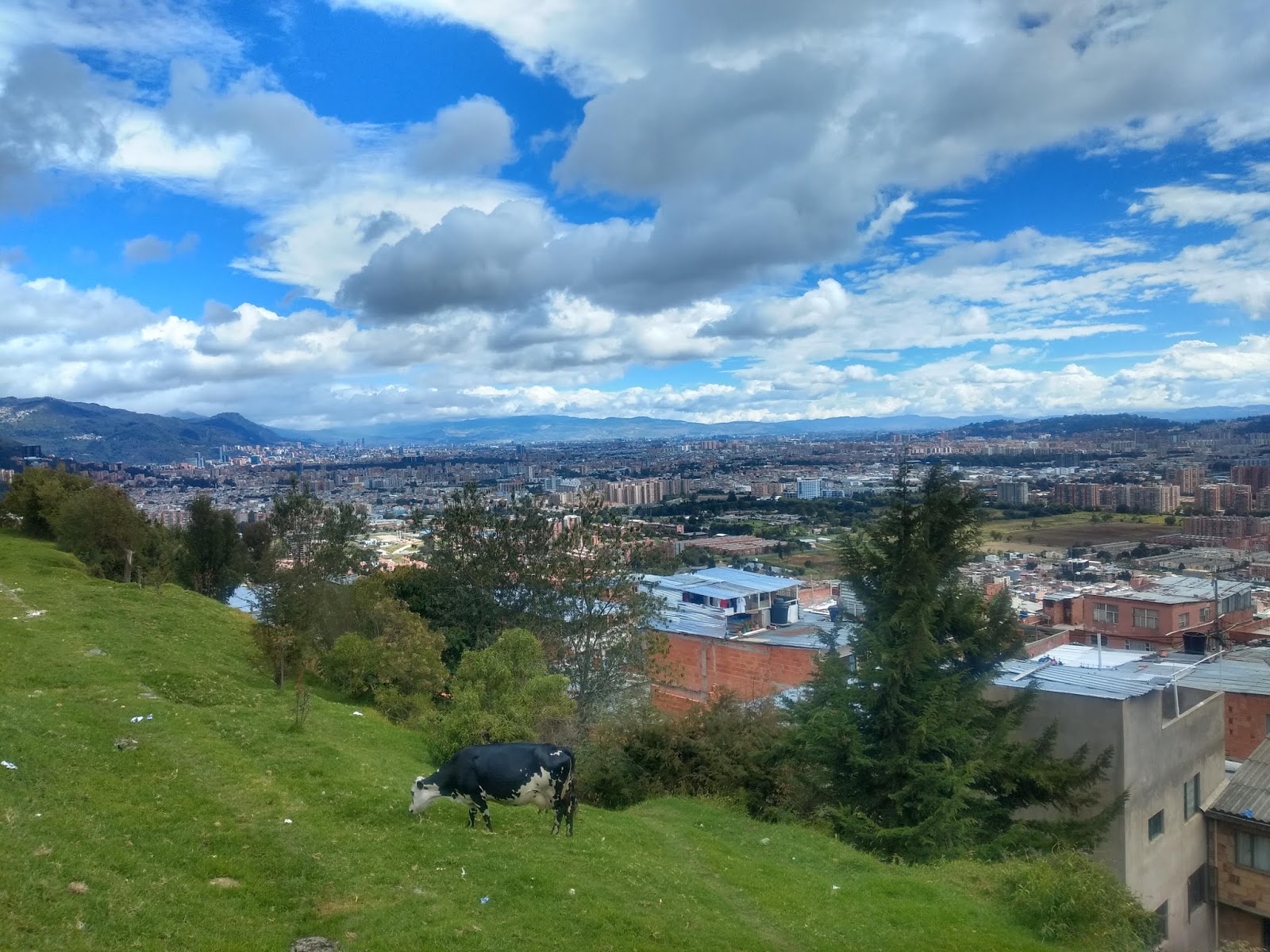
Bogotá's lax lockdown: A view of Bogotá, Colombia, looking towards the centre from the hills in the northeast.
Even Bogotá's cows practise social distancing these days. 
Since mid-March Colombia has not only been in a state of emergency but also in an 'obligatory quarantine'. On the face of it, this appears quite intense compared to other countries. However, as is often the case here, the practice doesn't match the theory. The severity of the lockdown has fluctuated over the months.

Bogged down in Bogotá

From a Bogotá perspective, in the early, testing-the-water days, the stay-at-home orders for all but essential needs and those working in what were deemed essential services were well obeyed for the most part.

After a couple of weeks, when people who didn't buy into 'the virus is an existential threat' mantra realised that lockdown enforcement was fairly lax, we began to see a bit more movement around the city.

In response, city authorities introduced an ill-thought-out sex-based restriction. No, no, it had nothing to do with the act of having sex — although it would have been nice if born-again virgins like me were given the freedom of the place — it was in relation to gender. Only men were allowed out on one day, women the next. Trans and non-binary folk had to pick one 'side' and stick to it.

Despite reports of discrimination against transexuals, this was stubbornly persevered with for a couple of weeks after which we returned to the original stay-at-home orders.

Again, alarmed at too many people wandering the streets, an ID restriction then came into force. This remains the modus operandi. It functions thus: Those whose identity card number ends with an even number can go out for the essentials on odd-number dates, even-number dates are for those whose ID number ends in an odd digit. Geddit?

It has been said that the thinking behind this odd-even, even-odd mix is that it makes things more confusing and, so it's hoped, people will be more inclined to err on the side of caution and stay at home.

Whatever the case, this measure alone wasn't deemed sufficient for certain areas of the sprawling capital. This month, stricter (in name anyway) lockdown measures were introduced for various 'Covid-19 hot zones', staggered over a six-week period — a couple of weeks in one sector, then on to the next. For the record, my part of town, Bogotá's northern limits, isn't part of these hotspots, for now at least.

In the freer areas, one can still go out on any day and at any time one wishes without fear of interrogation — the ID number/date restriction applies to entry into banks, supermarket chains and the like only.
'The hysterical, monomaniac folk in the stop-coronavirus-at-all-costs camp feel the measures aren't tough enough. If Bogotá mayor Claudia López had her own way she'd surely be more draconian in her approach.'
The bottom line is, notwithstanding the rising case figures over the last few weeks, the measures appear to work. By 'work' I mean they have found that balance between a city/country feeling it is doing the necessary to stop the spread of coronavirus and the desire not to be viewed as too authoritarian and restrictive.

(Do note, the fact the public-private health system is under pressure has more to do with its structure, general inadequacies and tardy responses that have led to a build-up of problems all at once rather than the pandemic itself — it's been on the brink for years. The pandemic and associated panic have simply served to underscore these shortcomings. Indeed, official channels are now looking into complaints about how these EPSs have handled the crisis. A cynic might say this is simply incompetents investigating incompetents.)

'Heart over head' López

The hysterical, monomaniac folk in the stop-coronavirus-at-all-costs camp will feel the measures aren't tough enough. One gets the feeling that if Bogotá mayor Claudia López had her own way she'd surely be more draconian in her approach.

It's understandable, considering the number of people who think with their heart and not their heads on such matters, failing to see the bigger picture and the consequences of widespread lockdowns. An emotionally tuned-in politician such as López can tap into that and win some priceless brownie points.

The counterweight is President Iván Duque. I think it's fair to say that if he had his own way we'd be seeing far more economic activity and greater inter-municipal movement in the country right now, with the appropriate bio-security measures in place of course.

However, considering the emotions involved and the 'López leverage', he's had to rein himself in somewhat. The result of this clash of personalities and outlooks is what's been mentioned above. We're in lockdown alright, but with an amount of flexibility.

From a personal perspective, the frustrating prohibition on leaving the environs of Bogotá excepted, it's tolerable. While some of our leaders are slowly waking up to the fact that we have to learn to live with coronavirus, that locking ourselves away indefinitely is not the answer, for now this Colombian middle way is the about the best we can hope for from a highly spooked, emerging-market country.

It could be a lot better, it could be much worse, a motto for Colombia in general really. That being said, I'm well aware of the many whose livelihoods are practically done for, some of whom I've featured on my podcast.

For the moment, selfish as it might be, I'm glad I can still get out for my daily clear-the-head — with nose and mouth covered as they must be — walks, free from interrogation by over-zealous police officers. Here's hoping I haven't jinxed it now.
_____________________________________________________________________
Listen to Wrong Way's Colombia Cast podcast here.

Facebook: Wrong Way Corrigan — The Blog & IQuiz "The Bogotá Pub Quiz"

Monday, 10 April 2017

Colombia decides 2018: What'll yours be?

After eight years of the good, the bad and the ugly with Juan Manuel Santos, next year the Colombian electorate will vote for a new president.

There's still a bit to go before we know the, um, range of candidates on the actual ballot paper, but there are a few who have already indicated their intention to run for the highest office in the land.

Plus, considering there's generally very little ideological difference among those who do put their names forward — due largely to an old policy of murdering any politician with just a hint of socialism about him/her — it's very much like choosing you're favourite, bog-standard Bavaria beer, the beer company of Colombia (owned by Anheuser-Busch InBev as it is now).

Colombia's former Inspector General, the conservative Alejandro Ordóñez ...
'Aguila' Ordóñez, what Colombia should be about ..
We all tend to prefer one over the other, but they're essentially the same not-very-classy poison that may leave us with a headache and regret if we get too involved and put too much faith in them as instruments of change in our mediocre lives. (OK, that's a bit harsh on the beer, and at least it's not the ridiculously overpriced Bogotá Beer Company.)

With that as a guide, here we look at some of those in the mix at this early stage (subject to much change):

Gustavo 'Poker' Petro

Poker Petro is at home in Bogotá, where it has held sway for much of the working-to-middle classes for some time, a few flat, controversial moments notwithstanding.

The problem is, this populism doesn't tend to transfer to the other major urban centres. The label is seen as a little bland elsewhere, a tad bitter even. Thus, we'd expect it to do well in Bogotá along with a smattering of other towns and could go close. Yet a decent volume of support doesn't always turn into votes. The Poker grande (750 ml) might be popular and look impressive, but it's just one bottle. Two standard 330 ml Aguila bottles appear better on the table in the minds of some Colombians.

Alejandro 'Aguila' Ordóñez

At this remove it's all a bit clustered and hazy on Colombia's right, where you'll find all the 'políticos Aguila'. Yet for the moment an Aguila Ordóñez fits this slot pretty well (as does any one coming out of the ideologically-similar Centro Democrático). That is to say, the beer of Colombia. It matches, in a typically paradoxical way, what the country should be about. Aguila has the Colombian colours, the chicas, the vibrancy; Ordóñez the old-school Catholicism, the traditionalism, the elitism. A perfect match.

Foreigners often fail to get the appeal; it's a Colombian thing, we wouldn't understand.

Jorge 'Costeña' Robledo

The beer that could be king. However, in a significant part of the country it's not even known about. Ask for a Costeña Robledo and you'll get a strange look. Where you can get it, it suffers from not sharing in the same sort of lofty limelight as our Pokers and Aguilas, even though it's just as good if not a bit better. Yet it's the black, 'potentially dangerous' sheep of the family, with its funny little shape. Knock back this brew and god knows what kind of crazy socialist path you might stumble down.

Sergio 'Pilsen' Fajardo

We're in Medellín/paisa country and surrounds with this one. In its own backyard, a Pilsen Fajardo more or less beats all the other Bavaria beers put together; it gets its people. The thing is, it doesn't travel well. In fact, it doesn't really travel at all.

Sure it's recognisable to those who aren't in its catchment area. Indeed many Aguila and Poker stalwarts have dabbled in it and spoken highly of it. Nonetheless, it's still a little different and a bit too regional, self-centred even. If Pilsen Fajardo broadens its horizons, it could be a force to be reckoned with.

Germán 'Aguila Cero' Vargas Lleras

This ticket has a strong name behind it, but it lacks any real punch and tastes rather odd. If you were going to pick a beer, you'd have to ask why would you go for this one? The other ones out there are more exciting and give you a little high, at least for a while before it all starts going downhill. An Aguila Cero Vargas might turn out to be the safest option (scientific research pending), but it seems a kind of a 'last resort' this. The dregs of Santos in a way.

Current Colombian senator & presidential hopeful Claudia López.
Aguila Light López tends to leave you disappointed ...

Claudia 'Aguila Light' López

It almost seems like a great deal. An alternative to the traditional 'Aguilistas', an Aguila Light López speaks for a new, brighter Colombia, but not in ridiculously radical ways. A sensible, middle-ground option we might say, yet refreshingly different enough from the old-school popular boys.

That's the theory anyway. The reality is, it generally leaves you a little disappointed. It promises a high, but you tend to get too tired and lose patience before you reach it. What's more, you end up with a bigger hole in your wallet than if you'd just stuck with the old normal ones.

So there we have it. The not-very-definitive guide to some of the potential candidates for the Colombian presidency. Merry times ahead indeed.
________________________________________