Showing posts with label lockdown. Show all posts

Wednesday, 4 August 2021

Wrong Way Corrigan radio interview on pandemic life in Bogotá

@wwaycorrigan

Shannonside Northern Sound's Joe Finnegan Show spoke to me as part of their series on Irish people living abroad during the coronavirus pandemic.

The evergreen Anne Norris — my news editor for the majority of the time I was working at the station — was deputising for JF.

Click on the following link to listen to the interview: https://www.northernsound.ie/podcasts/the-joe-finnegan-show/podcast-irish-abroad-brendan-corrigan-in-colombia-179546.

I must say, it's always nice to return to the Shannonside Northern Sound airwaves, the radio station where I cut my teeth (badly!) as a broadcaster!

Brendan 'Wrong Way' Corrigan's radio interview on life in Bogotá, Colombia during the pandemic.
One of Ireland's top regional radio stations (Image from Wikipedia.)

_______________________________________________________________
Listen to Wrong Way's Colombia Cast podcast here.

Facebook: Wrong Way Corrigan — The Blog & IQuiz "The Bogotá Pub Quiz".


Thursday, 24 June 2021

Scaling down survival mode

@wwaycorrigan

[Listen to an audio version of this blog entry here.]

Whether one agrees or not with the coronavirus pandemic response taken by most of the world, the fact is we've all had to live with the constraints for well over a year now.

This public school in north Bogotá, close to Barrio Santandercito, has been shut since March 2020 due to the pandemic.
School's still out in many parts of Bogotá, even if some kids would like to see it back.

Fear mentality

As is well known, and as is the case for so many causes of death, those who have had most to fear from covid-19 are the elderly, followed by people with underlying conditions.

For the rest of us, the majority, the risk the infection represents is minimal. 

However, the extraordinary measures introduced across the globe to reduce contagion resulted in irrational reactions by some folk who in reality face greater threats to their lives than this virus. (Some will say, altruistically, they've done it to save the lives of others. All they may have done, though, is caused more harm to themselves and others.)

The lifting of this fear mentality is not something that will come easily. This is particularly so when we have overly cautious leaders who continue to suffer from covid monomania and a majority in the media who submissively follow the official line. It has been as if no other cause of hardship and death really exists.  

This myopia appears most acute in high-income countries, places where many enjoy a comfortable existence, relatively speaking, with restrictions less impactful. While Colombia has had its lockdowns and the like, the approach of late has largely been 'carry on regardless'.

Except, that is, for arguably the most pressing area where a return to "normality" is needed: primary and secondary education. Most schools are continuing with sub-standard virtual learning. 

OK, we have seen some in-person classes with reduced capacity and alternate days, but it's the private schools that have been more proactive on this front. The public institutes, as they tend to do, lag behind. Thus, the divide between the privileged and the rest deepens.
'The monster is the irrational fear that continues to dominate public discourse and policy.'
The thing is, because of health concerns amongst teachers and other staff — misplaced as they are for many — plus the general state of covid fear being promulgated, no one is in a major panic to go back to pre-pandemic ways.

Monster mash

In the same way that people mistakenly call Frankenstein the monster — Frankenstein was, of course, the monster's creator — coronavirus is not monster-in-chief, it created the conditions for a scarier one to emerge.

That monster is the irrational fear that continues to dominate public discourse and policy. Even those of us who have questioned the pandemic response can't avoid being caught up in this.

I, for one, went into survival mode, financially speaking in any case. 

So even though one has been free to travel around Colombia largely unrestricted for months now — the national strike disturbances notwithstanding — nonchalantly moving around the country, eating into one's steadily diminishing savings just hasn't seemed prudent. (OK, my own future would have been uncertain pandemic or not, but the overall atmosphere doesn't help whatsoever.)

As is the case for millions of others across the world, the lack of a steady income muddies the waters further. When one isn't sure where the next significant payment is coming from, it makes it more difficult to ease off the financial brakes.  

A more liberal approach would be to not get bogged down in cash concerns (for those who have the luxury to do so, that is. Most of my Colombian friends live, at best, from week to week). Bet on things improving both personally and on a grander scale in the not-too-distant future. Calmer waters are on the horizon.

While there may be truth to that, my conservative side dominates my thinking here. Or based on last week's post, some of you might say my doomsday, glass-is-half-empty view darkens the landscape.

Whatever the case, there are certain things beyond our control. The best we can do is to have mechanisms in place to ensure those uncontrollables have less of an impact on us than they might otherwise have if left unthought of.

That is to say, survival mode is somewhat permanent. It's just that certain events see us scale up this modus operandi more so than others. They also tend to make us more risk-averse in numerous ways, damaging as that may be over the medium to long term.
_______________________________________________________________
Listen to Wrong Way's Colombia Cast podcast here.

Facebook: Wrong Way Corrigan — The Blog & IQuiz "The Bogotá Pub Quiz".


Monday, 4 January 2021

Bogotá's Fraudia López

 @wwaycorrigan

[Listen to an audio version of this blog entry here.]

At the best of times, it's not easy being a politician. In today's social-media dominated world, our elected leaders are scrutinised like never before.

OK, they willingly sign up for a life in the public eye and benefit from this, so many will say they're fair game.

Yet, the attacks they receive regularly cross the line, entering into their private lives.

Bogotá's Fraudia López: Bogotá Mayor Claudia López and her wife Angélica Lozano depart for Costa Rica while parts of Bogotá enter a strict lockdown in a bid to contain the spread of coronavirus.
'Enjoy your lockdown, Bogotá! See you when we're back!' (Image from Twitter.)

López's lost it

Nonetheless, on occasions, our leaders do things completely out of touch with the people they claim to represent that it only seems right to call this out.

In these pandemic days, as many people's livelihoods have been mortgaged away due to questionable measures introduced to contain our relatively mild viral enemy, that some politicians fail to show sincere solidarity with those suffering the most is, as far as I'm concerned, unforgivable.

Take — and to use the old joke, do please take her — Bogotá Mayor Claudia López. On the 1st of January, she completed her first year in office.

What does she decide to do to mark the milestone? Why head off on a holiday to Costa Rica.

Now,  in a normal year, people would be justified to some extent to question a self-proclaimed mayor of the working classes in a city with deep inequality taking a holiday outside the country. With so many beauty spots in Colombia, why the need to go elsewhere?
'I do actually think López cares, at least as much if not more so than many of Colombia's other top politicians. Yet perception is key and she has netted a public-relations own goal here.'

Of course, we're not in normal times. Outside of the millions of Bogotanos who regularly struggle to find the resources to take a holiday from the city, over the last few months those who normally do get away have seen their movements curtailed.

A bad act

To add insult to injury to those most badly hit by coronavirus-containment measures, while Mayor López is nonchalantly trekking around the jungles of Costa Rica, a strict two-week lockdown is reintroduced in three sectors of Bogotá.

That this is announced by some fresh-faced acting mayor who most people hadn't heard of up until a few days ago just adds to the sense of anger felt amongst the working classes. (It also begs the more general question, why isn't there an office for vice-mayor, a position that is filled at the same time as the top job, preferably elected on the same ticket as the mayor?)

It would be stretching it to believe that López didn't know this lockdown was coming as she packed her bags for Costa Rica. Therefore, the shrewder move, to really show she is at one with "her people", would have been to cancel the holiday. But no, off she went. It smacks of a couldn't-care-less attitude.

I do actually think López does care, at least as much if not more so than many of Colombia's other top politicians. Yet perception is key and she has netted a public-relations own goal here.

In reality, however, it won't amount to much — and this she knows. For those most annoyed right now tend not to vote and her many supporters will most likely just brush it off.

On a broader scale, there's an old saying around these parts that what works in Dinamarca (Denmark) doesn't work in Cundinamarca (the department in which Bogotá is located).

Taking that as a guide, lockdowns and stay-at-home orders that may — although it's far from certain — be effective in more developed nations are highly unlikely to work in an emerging-market country such as Colombia.

President Duque, Mayor López and the acting guy, whatever your name is, you would do well to bear this in mind.
_______________________________________________________________
Listen to Wrong Way's Colombia Cast podcast here.

Facebook: Wrong Way Corrigan — The Blog & IQuiz "The Bogotá Pub Quiz".


Tuesday, 13 October 2020

Colombia's Migración mess

@wwaycorrigan

[Listen to an audio version of this blog entry here.]

In September, Migración Colombia, the body responsible for granting extensions to temporary tourist passes, announced that the grace period for foreign visitors who found themselves stranded in the country was coming to an end.

Colombia's Migración mess: Migración Colombia offices are now open on Saturdays in the country's three biggest cities. Will this be enough to deal with the backlog of cases? Probably not.
Opening on Saturdays is a help, but is it enough? (Image from Facebook.)

Escape from limbo land

From the 21st of the month, days spent here would, in effect, start to be counted again, having been frozen when lockdown was introduced in March. 

For tourists, the deadline is 01 November to either apply for another 90-day permit or leave. 

If you're leaving within the time period, well that's straightforward enough. However, it gets trickier if you're looking for an extension as this requires an in-person meeting at a Migración office.

The initial communication from the government body stated that all appointments must be booked online. Those who turned up at Migración without one would be turned away. 

However, facing into a six-month backlog and reopening at only 30 per cent capacity, securing an appointment any time this year quickly became next to impossible for many. 

You see, it's not only tourists Migración deals with. All foreigners based here who aren't currently residents or citizens have to use its services at least once a year. 

Those who, during lockdown, were granted a visa or residency — a fully online process done with a different entity, La Cancillería — are expected to have these registered at Migración. This is one side of the same coin for the issuing of an ID card — cédula extranjería — corresponding to said visa/residency.

As far as I'm aware, this process must be begun on or before 21 October. (In old-normal times you had 15 days to register a newly-issued visa.)
'I've been told of incidents where people with such emergencies were refused entry to a Migración office because they didn't have an appointment reserved online. This is completely at odds with the official line.'
That deadline also applies to foreigners living here who had a visa/residency application deemed inadmissible or whose visas have expired or who find themselves in the country as an "irregular" for whatever reason. 

How I initially understood it was that those in such a position had only to register their intent to legalise their status, which in most instances means applying for an emergency stay called a salvoconducto. (Another option is to leave the country at the earliest possible opportunity — that usually means no more than 30 days after a visa expiry date.) 

If these people in limbo can't get an actual in-person appointment before 21 October because the system is overwhelmed, surely they can't be held responsible for that?

It now appears, however, Migración expects such cases to have reached a conclusion by the deadline. 

The latest advice on its website states that if your appointment is after the date your document expires or you simply can't get an appointment and yours is a case that needs urgent attention, you should go immediately to one of its offices, preferably, I'm guessing, the one closest to you. 

But for the grace of Duque?

That's the official line. As is often the case with such things, though, what's happening on the ground is different. I've been told of incidents where people in such dilemmas were refused entry because they didn't have an appointment reserved online. 

I'm also aware of a number of Bogotá-based foreigners being forced to travel to Migración offices in cities hundreds of kilometres away to resolve their situation before they became irregular. Great in these coronavirus times, isn't it?

One of these was somebody applying for residency. A day before his latest visa expired he received notification from La Cancillería that his application was deemed inadmissible — something that seems to be happening to a lot of folk requesting visas or residency these days.

Thus, faced with losing the continuity of five years of visas, the most crucial, time-consuming requirement for a residency bid, he had to hightail it from the capital to Neiva in order to seek a salvoconducto from the Migración office there, effectively buying time to sort out the issue with his original residency application. 

It worked out for him, he got what he needed. However, this is the exact type of case where I would have thought flexibility would be forthcoming from both La Cancillería and Migración. 

The applicant didn't want to test that, hence his last-minute dash south to Neiva. It must be said, the fact these processes involve two different government entities doesn't help.

The chief press officer at Migración did tell me in a WhatsApp message that they were being flexible. I've no reason to doubt that. I must also state that I've always found officials at that body reasonable and informative. 

Nonetheless, potential arbitrary flexibility and understanding aside, one immediate solution to all of this would be an extension to the grace period. We're still in the middle of this pandemic after all. Forcing people into unplanned travel in such times doesn't seem like best practice. 

So, President Duque, you have it in your power to tidy up this messy situation. Or are the conspiracy theorists on to something? Is Colombia systematically forcing foreigners out? Surely not. _______________________________________________________________
Listen to Wrong Way's Colombia Cast podcast here.

Facebook: Wrong Way Corrigan — The Blog & IQuiz "The Bogotá Pub Quiz".

Tuesday, 28 July 2020

Bogotá's lax lockdown

There's been a lot of frustration expressed on social media about the world's longest coronavirus-induced lockdown.
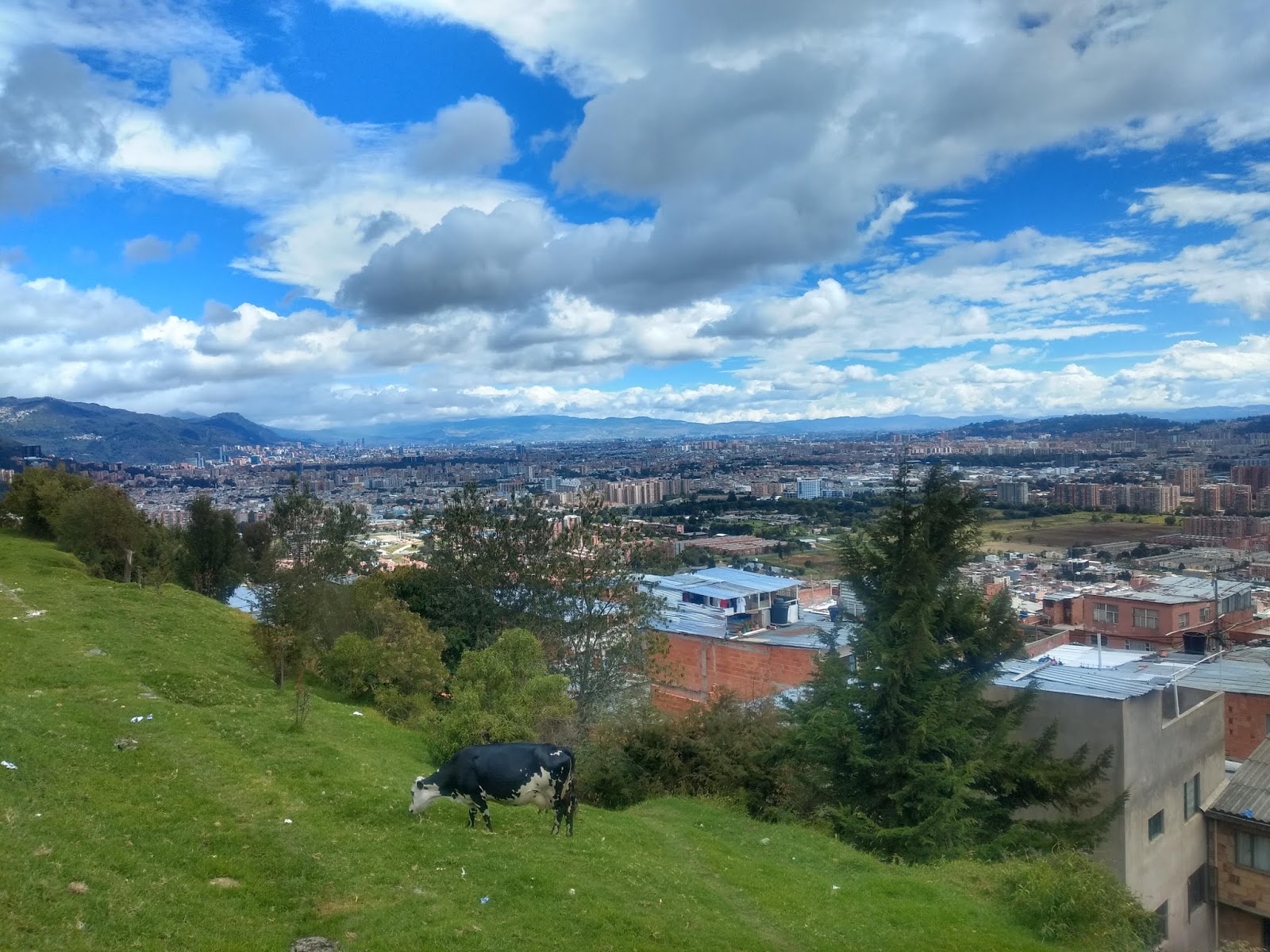
Bogotá's lax lockdown: A view of Bogotá, Colombia, looking towards the centre from the hills in the northeast.
Even Bogotá's cows practise social distancing these days. 
Since mid-March Colombia has not only been in a state of emergency but also in an 'obligatory quarantine'. On the face of it, this appears quite intense compared to other countries. However, as is often the case here, the practice doesn't match the theory. The severity of the lockdown has fluctuated over the months.

Bogged down in Bogotá

From a Bogotá perspective, in the early, testing-the-water days, the stay-at-home orders for all but essential needs and those working in what were deemed essential services were well obeyed for the most part.

After a couple of weeks, when people who didn't buy into 'the virus is an existential threat' mantra realised that lockdown enforcement was fairly lax, we began to see a bit more movement around the city.

In response, city authorities introduced an ill-thought-out sex-based restriction. No, no, it had nothing to do with the act of having sex — although it would have been nice if born-again virgins like me were given the freedom of the place — it was in relation to gender. Only men were allowed out on one day, women the next. Trans and non-binary folk had to pick one 'side' and stick to it.

Despite reports of discrimination against transexuals, this was stubbornly persevered with for a couple of weeks after which we returned to the original stay-at-home orders.

Again, alarmed at too many people wandering the streets, an ID restriction then came into force. This remains the modus operandi. It functions thus: Those whose identity card number ends with an even number can go out for the essentials on odd-number dates, even-number dates are for those whose ID number ends in an odd digit. Geddit?

It has been said that the thinking behind this odd-even, even-odd mix is that it makes things more confusing and, so it's hoped, people will be more inclined to err on the side of caution and stay at home.

Whatever the case, this measure alone wasn't deemed sufficient for certain areas of the sprawling capital. This month, stricter (in name anyway) lockdown measures were introduced for various 'Covid-19 hot zones', staggered over a six-week period — a couple of weeks in one sector, then on to the next. For the record, my part of town, Bogotá's northern limits, isn't part of these hotspots, for now at least.

In the freer areas, one can still go out on any day and at any time one wishes without fear of interrogation — the ID number/date restriction applies to entry into banks, supermarket chains and the like only.
'The hysterical, monomaniac folk in the stop-coronavirus-at-all-costs camp feel the measures aren't tough enough. If Bogotá mayor Claudia López had her own way she'd surely be more draconian in her approach.'
The bottom line is, notwithstanding the rising case figures over the last few weeks, the measures appear to work. By 'work' I mean they have found that balance between a city/country feeling it is doing the necessary to stop the spread of coronavirus and the desire not to be viewed as too authoritarian and restrictive.

(Do note, the fact the public-private health system is under pressure has more to do with its structure, general inadequacies and tardy responses that have led to a build-up of problems all at once rather than the pandemic itself — it's been on the brink for years. The pandemic and associated panic have simply served to underscore these shortcomings. Indeed, official channels are now looking into complaints about how these EPSs have handled the crisis. A cynic might say this is simply incompetents investigating incompetents.)

'Heart over head' López

The hysterical, monomaniac folk in the stop-coronavirus-at-all-costs camp will feel the measures aren't tough enough. One gets the feeling that if Bogotá mayor Claudia López had her own way she'd surely be more draconian in her approach.

It's understandable, considering the number of people who think with their heart and not their heads on such matters, failing to see the bigger picture and the consequences of widespread lockdowns. An emotionally tuned-in politician such as López can tap into that and win some priceless brownie points.

The counterweight is President Iván Duque. I think it's fair to say that if he had his own way we'd be seeing far more economic activity and greater inter-municipal movement in the country right now, with the appropriate bio-security measures in place of course.

However, considering the emotions involved and the 'López leverage', he's had to rein himself in somewhat. The result of this clash of personalities and outlooks is what's been mentioned above. We're in lockdown alright, but with an amount of flexibility.

From a personal perspective, the frustrating prohibition on leaving the environs of Bogotá excepted, it's tolerable. While some of our leaders are slowly waking up to the fact that we have to learn to live with coronavirus, that locking ourselves away indefinitely is not the answer, for now this Colombian middle way is the about the best we can hope for from a highly spooked, emerging-market country.

It could be a lot better, it could be much worse, a motto for Colombia in general really. That being said, I'm well aware of the many whose livelihoods are practically done for, some of whom I've featured on my podcast.

For the moment, selfish as it might be, I'm glad I can still get out for my daily clear-the-head — with nose and mouth covered as they must be — walks, free from interrogation by over-zealous police officers. Here's hoping I haven't jinxed it now.
_____________________________________________________________________
Listen to Wrong Way's Colombia Cast podcast here.

Facebook: Wrong Way Corrigan — The Blog & IQuiz "The Bogotá Pub Quiz"

Friday, 26 June 2020

Niall Ferguson: 'Colombia didn't have the capacity to do East Asia's smart coronavirus policies'

Renowned historian and author Niall Ferguson believes Colombia had little option but to impose what he refers to as the 'pretty blunt instrument' of a lockdown for dealing with coronavirus.

Niall Ferguson: 'Colombia didn't have the capacity to do East Asia's smart coronavirus policies'. Professor Niall Ferguson, Milbank Family Senior Fellow at Stanford University's Hoover Institution, speaks to Wrong Way's Colombia Cast.
Professor Niall Ferguson chats to Wrong Way's Colombia Cast.
Speaking to Wrong Way's Colombia Cast podcast (recorded on 19 June) Professor Ferguson, Milbank Family Senior Fellow at Stanford University's Hoover Institution, revealed Colombian government officials contacted him for advice on dealing with the pandemic.

'It became clear (in conversation with government officials) that Colombia didn't really have the capacity to do the smart policies of some East Asian countries in tackling coronavirus and therefore had to rely on cruder policies,' he said.

While he highlighted the relatively good performance of the authorities here in dealing with the health crisis in contrast to other South American countries such as Brazil, Chile and Ecuador, he warned that the data suggest Colombia will be in a 'worse position four weeks from now.'

'It won't be the first time a pandemic has had a very severe impact on South America,' he explained. 'The big ones of 1918/19 and 1957/58 hit Latin America very hard indeed and there's a sense this history is repeating itself. The explanation for this lies in the fact that the region has big cities with dense populations and rather poor public health infrastructure with wide inequalities.'
'Early detection, early action. If that had happened in Colombia in January people wouldn't now be locked in their homes and the economy wouldn't be in the tank.'
Ferguson, author of a number of influential books including The Square and the Tower, Civilization: The West and the Rest and Empire: How Britain Made the Modern World, did admit he doesn't know 'what good option there is for Colombia in tackling coronavirus.'

He did, however, offer this advice for the next pandemic which 'will come and could be much worse':

'There's no real reason why Colombia should not be able to do testing and contact tracing if it does it early enough. Most people have mobile phones and a significant amount have smartphones ... Early detection, early action, that way you avoid lockdowns. If that had happened in Colombia in January people wouldn't now be locked in their homes and the economy wouldn't be in the tank.'
'In Venezuela, you have a regime that is as destructive as any that we've seen in the world in the last 50 years ... It is a criminal racket ... Under those circumstances, it seems kind of a no-brainer to do something to tip the scales in favour of the democratic opposition.'
As regards the temptation for Colombia's electorate to seek comfort in extreme politics in the years to come as it deals with the coronavirus fallout, he said 'the key is to make sure that the range of political options is not too wide. As soon as you have the populism of the left or the populism of the right offering their quick fixes you risk destroying either the economy, which is what the left specialises in, or destroying the free, open society which is what the far-right tends to do.'

Speaking in relation to the possibility of direct US military intervention in Venezuela, the Scottish-born American citizen called the Maduro administration 'a criminal racket' and, as such, 'it seems kind of a no-brainer to do something to tip the scales in favour of the democratic opposition.'

In a wide-ranging interview, Ferguson also talked about the 'dithering response' of the US and the UK to coronavirus, the problems with and unintended consequences of the Black Lives Matter movement, today's 'cancel culture' and counterfactual history in relation to Colombia and colonisation.

Listen to the Wrong Way's Colombia Cast interview with Niall Ferguson in full here, on Spotify or at Apple Podcasts. (Also on YouTube at https://youtu.be/8r06Lv6sKC8?si=70up0zGlUSoB0zyF.)
___________________________________________________________
Listen to Wrong Way's Colombia Cast podcast here.

Facebook: Wrong Way Corrigan — The Blog & IQuiz "The Bogotá Pub Quiz".

Wednesday, 25 March 2020

Coronavirus' collateral damage

A sure-fire way to ensure you get the blood up of a large section of readers is to start off a blog post quoting Donald J. Trump.

So here goes. The US president tweeted the other day about coronavirus and the measures being taken to control it that 'We cannot let the cure be worse than the problem itself.' 
Coronavirus' collateral damage: Empty streets in Bogotá as people are told to stay at home in a bid to contain the spread of the novel coronavirus.
Coronavirus: Things will never be the same again?
Of course, true to form, Trump's discourse since this 'Chinese virus' emerged has read like a dark comedy. He's gone from 'we have it under control' to 'it will be gone by April' to 'the US is in great shape to tackle it' to 'this is a pandemic and I felt it was a pandemic long before it was called one.' 

What ails you?

Nonetheless, he does have a point about the cure potentially becoming worse than the viral infection itself. 

In this regard, we're talking about the cure being self-isolation and strictly imposed countrywide lockdowns, the approach being taken by many states battling covid-19 right now. Basically, it's a degree or two less severe than the Chinese model of tackling "their" virus. 

The idea in the short-term is not to eradicate it completely (although if that did happen, great), it's to, as most are well aware by now, flatten the curve in terms of the rate of infection. In that way, the health systems of the many countries trying to deal with this crisis will be in a better position to cope. 

The nightmare scenario is hundreds of thousands of cases in a short period of time. Hospitals just wouldn't be able to cope with those in a critical condition. 

Of course, as experts readily admit, in countries that were slow to enforce self-isolation and social distancing, the majority of the population is likely to get infected. On the plus side, the majority of that number should make a full recovery. 

So, at this remove, we could end up with the same number of coronavirus-related deaths regardless of the measures taken. Even with the best medical care in optimum conditions, the sick and vulnerable who contract the virus might die. 
'The global death rate in the coming years could be lower due to coronavirus.'
To use an analogy from a history professor from my university days when talking about the demise of Britain's Liberal Party, World War One was the bus that gave it the knockout blow but the postmortem revealed it was in terminal decline in any case, on "borrowed time" so to put it. 

There is the possibility, once we get on top of this, that the global death rate in the coming years could be lower than would be normally expected, as coronavirus ended some people's lives a few years earlier than they would have departed the scene.

Death by association 

Thus, coming back to the "cure" currently being implemented, leaving aside the severe financial heartache and associated problems it will cause for millions of people across the globe, especially in developing countries such as here in Colombia, could it turn out that it ends up being responsible for a good number of deaths in its own right? Or, better put, coronavirus' collateral damage. 

With the panic and chaos being caused by these lockdowns, there's a fair chance that people who get struck down with other life-threatening conditions are either neglected or choose not to seek medical attention due to all the fear that abounds. Of course, this is going to be next to impossible to calculate. 

For the moment, we have to trust that the measures currently in place are the best option. We have no other choice. 

Nonetheless, from a Colombian perspective, if this 19-day lockdown we've entered proves successful in terms of keeping cases down, the hard-pressed masses will look for a prompt easing of restrictions. 

On the other hand, if it doesn't work, if cases skyrocket between now and 13 April, there's a fair chance those same people will ask what's the point? Why all this extra hardship for nothing? 

They might just decide that they have to carry on regardless. 

The next few weeks will tell a tale.   
________________________________________________
Listen to The Colombia Cast podcast here.