[Listen to an audio version of this blog entry here.]
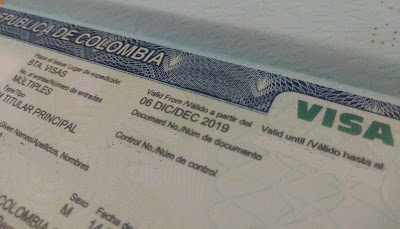 |
| Vis-à-visas: Wrong Way has faced nine Colombian visa applications. |
Nein, nein, nein
What is pathetic is the fact that in the space of just seven years I've made nine — yes, nine — visa applications in Colombia. Surely, most other self-respecting individuals would have thrown away the ruana and sombrero vueltiao and said a firm 'adiós' well before this. It's not like I've been on to a winner here, rolling in a bed of pesos, living the high life.In fact, it could be said this is one of the main reasons why I still stubbornly stay here. I'm able to make the few pesos I've managed to earn since 2012 last longer in this country compared to opting for a 'risky' return to Ireland, the homeland always being the default option.
Basically, while I await that Universal Basic Income — it's on its way, isn't it? — I can get by on much less in these environs.
That and a feeling that in certain ways I've more independence here, left to my own devices so to put it.
That and a feeling that in certain ways I've more independence here, left to my own devices so to put it.
For sure, the one and only full-time, contracted job I took on from December 2018 to January 2020 put a temporary hold on 'being my own boss', relative as that has always been, but it also helped me build up some funds for the drought periods. And things have been pretty dry from an income perspective for months now.
Therein lies the problem. The struggle to survive as an independent, a freelancer if you will, coupled with the difficulty of actually trying to stay in Colombia legally as such an 'actor' (no, I'm not referring to my under-appreciated thespian talent).
For me, from 2014 to 2018 getting an independent visa for Colombia was a relatively straightforward affair. These days, it's quite the opposite. In fact, it seems as if La Cancillería — the body in charge of these things — would prefer if no independents applied.
In the following order, here's what has to be done:
There's also the odd sycophantic influencer who is given citizenship for effectively selling Colombia to the Colombians. A perfect representation of the national insecurity and the-US-knows-best mentality.
Then there are others who try to do things by the book, have given La Cancillería plenty of money over the years through numerous applications and shown their commitment to the country, yet they face new obstacles at every turn.
It brings to mind an Irish phrase from my secondary school days that has stayed with me: Grá éagmhaise, unrequited love. Yes, I truly am the pathetic one in this one-way relationship with Colombian officialdom.
Sad as it is, but perhaps I need La Cancillería to give me the knock-out blow. It might just be doing me a favour.
_____________________________________________________________
Listen to Wrong Way's Colombia Cast podcast here.
Facebook: Wrong Way Corrigan — The Blog & IQuiz "The Bogotá Pub Quiz".
Therein lies the problem. The struggle to survive as an independent, a freelancer if you will, coupled with the difficulty of actually trying to stay in Colombia legally as such an 'actor' (no, I'm not referring to my under-appreciated thespian talent).
For me, from 2014 to 2018 getting an independent visa for Colombia was a relatively straightforward affair. These days, it's quite the opposite. In fact, it seems as if La Cancillería — the body in charge of these things — would prefer if no independents applied.
'Oh, we forgot to mention we need this.'
Well, it clearly doesn't mind picking up the study fee one has to pay seeing how on first inspection it makes it seem rather uncomplicated.
It's only after submitting 'draft one' that you invariably — the many comments on Facebook groups vouch for this — get hit with a host of other requirements, a number of which can take some time to organise.
Why not mention all these at the beginning so a potential applicant can weigh up all the pros and cons before paying for the study?
To talk specifically, there is no mention in the initial application of uploading a copy of your Colombian-issued ID (cédula). Nor does it say you must provide proof of health insurance and other social security payments. (If you're a first-time applicant, I take it international health insurance will suffice but as for the other social security payments, I've no idea what's acceptable. Also, what if you're in Colombia but not currently in gainful employment?)
What's more, it explicitly says there is no need to issue a copy of your previous visa if it was issued electronically, as mine certainly was. Surprise, surprise, but in response to my latest application, I was asked for a copy of same. With that, unsurprisingly, the guys at La Cancillería are contradicting themselves.
On the plus side, it seems that the translation, authentication and legalisation of my degree has been accepted. In May 2018, the last time I applied for an independent visa, this was the stumbling block. I ran out of time/salvoconductos (30-day emergency passes to stay in the country, two-in-a-row being the limit).
However, as far as I'm aware, the Cancillería doesn't provide information on all the steps that are needed for the above. Let me help.
What's more, it explicitly says there is no need to issue a copy of your previous visa if it was issued electronically, as mine certainly was. Surprise, surprise, but in response to my latest application, I was asked for a copy of same. With that, unsurprisingly, the guys at La Cancillería are contradicting themselves.
'What rankles is the constant moving of the goalposts. Also, as it's an online process, it's very difficult to get specifics about the exact requirements for your own application. Replies are generic: 'This isn't acceptable', but there's no reason as to why.'Here's another sign of regression for the once slick Cancillería system. In all previous applications where additional material was requested — mostly because of perceived document illegibility and/or my mugshot not meeting the specifications — I got an email informing me of this. This time around, nothing. I had to log on to the system to find this out. Whisper it, but it's almost like they didn't want me to know.
On the plus side, it seems that the translation, authentication and legalisation of my degree has been accepted. In May 2018, the last time I applied for an independent visa, this was the stumbling block. I ran out of time/salvoconductos (30-day emergency passes to stay in the country, two-in-a-row being the limit).
However, as far as I'm aware, the Cancillería doesn't provide information on all the steps that are needed for the above. Let me help.
In the following order, here's what has to be done:
Get apostilles on both your degree and diploma supplement from the country where you studied; get these translated and signed by an officially recognised translator in Colombia; authenticate the translator's signature at the notary office where he/she is registered; then get these translations legalised — an online process — by the Cancillería. (This is when journalism is your independent activity. For other professions you may have to get your degree validated at the Ministry of Education.)
Unrequited love
While all this may seem like a bitter rant against La Cancillería, I must state I have no issues whatsoever with Colombia tightening its requirements. Needless to say, the visa authority can request from applicants whatever documentation it deems necessary.
What does rankle is what seems like the constant moving of the goalposts with absolutely no prior notice. This and the fact that, as it's a fully online process, it's very difficult to get specifics about the exact requirements for your own application. Replies are generic: 'This isn't acceptable', but there's no reason as to why. Little wonder one loses confidence when it all appears rather arbitrary.
In some ways — again, one can say it's only right — things have gone from one extreme to another. While I never got the benefit of La Cancillería's previous lax approach, I know of a number of foreigners who blatantly stayed in the territory illegally for years and then sweet talked their way to a visa and even residency. Can you imagine Colombians getting the same treatment in Europe or the US? They'd be fined, sent packing and barred from returning for life.
What does rankle is what seems like the constant moving of the goalposts with absolutely no prior notice. This and the fact that, as it's a fully online process, it's very difficult to get specifics about the exact requirements for your own application. Replies are generic: 'This isn't acceptable', but there's no reason as to why. Little wonder one loses confidence when it all appears rather arbitrary.
In some ways — again, one can say it's only right — things have gone from one extreme to another. While I never got the benefit of La Cancillería's previous lax approach, I know of a number of foreigners who blatantly stayed in the territory illegally for years and then sweet talked their way to a visa and even residency. Can you imagine Colombians getting the same treatment in Europe or the US? They'd be fined, sent packing and barred from returning for life.
There's also the odd sycophantic influencer who is given citizenship for effectively selling Colombia to the Colombians. A perfect representation of the national insecurity and the-US-knows-best mentality.
Then there are others who try to do things by the book, have given La Cancillería plenty of money over the years through numerous applications and shown their commitment to the country, yet they face new obstacles at every turn.
It brings to mind an Irish phrase from my secondary school days that has stayed with me: Grá éagmhaise, unrequited love. Yes, I truly am the pathetic one in this one-way relationship with Colombian officialdom.
Sad as it is, but perhaps I need La Cancillería to give me the knock-out blow. It might just be doing me a favour.
_____________________________________________________________
Listen to Wrong Way's Colombia Cast podcast here.
Facebook: Wrong Way Corrigan — The Blog & IQuiz "The Bogotá Pub Quiz".

