Showing posts with label Lisacul. Show all posts

Thursday, 23 July 2026

Little joy from the west of Ireland's summer sun

@wwaycorrigan

[For an audio/vlog version of this story, click here.]

'The summer sun was sinking low
Behind the western sea
The lark's loud song was pealing sweet
But it brought no joy to me.'


Picture shows the sun setting in Lisacul, Co. Roscommon, Ireland.
A brighter future lies just over the horizon. It's hard to reach, though.

So go the opening lyrics to the Irish ballad, The Woodlands of Loughglynn.

It was a favourite of my late Uncle Jackie's. I suspect one reason why he liked it so much is that Loughglynn is a neighbouring village to his — and my — birthplace, Lisacul, with the latter in the parish of the former. So for a man who lived most of his life in England, the song probably made him feel that bit closer to his west of Ireland origins.

Lamenting the death of Irish rebels fighting British colonial forces in the War of Independence, the song's tone is understandably melancholic.

Farm friendly

As I write these words just a few miles from those same Loughglynn woodlands, watching the summer sun sinking low — and slowly — with the sweet song of various birds for background music, the tranquil scene brings little joy to me, if not quite no joy.

This is not, thankfully, because I'm mourning lost comrades in arms. It has more to do with my reminiscing about what were more hopeful bygone times.

For despite all I've done and seen over the last 20 years, returning to where I grew up, the land where I dreamt of a fabulous future, leads me to dwell on all that I haven't yet achieved, and perhaps never will.

Such feelings are even more pronounced when I find myself engaged in the same tasks on the family farm that I carried out in those days when I was dreaming big. What has me back in this scenario is a sense of filial duty together with some gentle persuasion from an exiled elder sibling to lend a hand in his stead.

'There's a certain novelty in returning to the mid-summer chores after a long absence, but being a farmhand indefinitely?'

The various farming tasks themselves aren't the problem; some of them I enjoy, specifically those that I can do on my own, that is to say when I'm not taking direct orders from my 'you're doing it wrong' octogenarian father! The real roots of my melancholic mood in this environment are due to my own uncertainty. Or, to put a more positive spin on it, my employment flexibility and relative independence.

Climate change

Now, this uncertainty is independent of place — I very much have it in my adopted country of Colombia, too. However, it seems more manageable, more tolerable there. There's also the feeling that my life in Colombia seems rather surreal, as I've explained here before. Ireland provides something of a reality check: there are those unwanted 'What do you do in Colombia?' questions, for one. 'Various things' tends not to satisfy the inquisitors. Come on, just ask me about Colombia's climate; I can deal with that one more easily.

Mentioning climate, or more specifically weather, my first July in Ireland in 16 years has, fortunately, coincided with a long dry and fairly warm spell. I certainly wasn't expecting to be basking in the west of Ireland's summer sun. It's usually buried behind thick, cantankerous cloud.

Indeed, as something of a sun worshipper, were Ireland like this most of the time — mid-20s in degrees Celsius with the long daylight hours and not a mosquito in sight (the cumbersome horsefly's bloodsucking attempts are easily thwarted) — I'd almost be tempted back to live here. Almost.

Yet, I know only too well what the standard is. Navigating the colder, darker seasons is one negative; the usual inglorious summer weather another. And then there's the what-would-I-do-in-Ireland question.

Lending a helping hand on the family farm isn't a long-term solution. Nor would I want it to be. Yes, there's a certain novelty in returning to the mid-summer chores after a long absence, but being a farmhand indefinitely? The thought of that brings little joy to me.
__________________________________________________________
Listen to The Corrigan Cast podcast here.

Facebook: Wrong Way Corrigan — The Blog & IQuiz "The Bogotá Pub Quiz".

Friday, 24 October 2025

'I do care but that doesn't make me a great carer'

@wwaycorrigan

[For an audio/vlog version of this story, click here.]

For those of us lucky enough to see our parents live to what's generally considered a decent age, this does come with their inevitable sad decline, both mentally and physically.

Brendan Corrigan rounds up a herd of cattle on his father's farm in Ireland.
Master of his herd. Or maybe not.
From being the guardians and providers of their children, the roles then get reversed in many families. It's the offspring who become the guardians of the parents.

There is, though, one major difference: Most parents who care for their children do so with the expectation that their young ones will grow up to become self-sufficient, to be independent (as independent as one can be, that is).

With elderly parents — and the elderly in general — it's the opposite. The trajectory is towards dependence. It's like they become children again. In some cases, they require as much care as newborns. Of course, not all elderly go the same way before they breathe their last. Some do remain active and with it up to their final months and days.

Care necessities

With my own parents, at the risk of sounding facetious here, if we could merge my mother's physical fitness with my father's mental acuity, we'd have a fairly robust individual — robust considering the ages in question anyway. My mother is a few years shy of her 80th birthday, my father is already an octogenarian.

As it is, a life of toil appears to have taken its toll on the body of my father. That and arthritis. As for my mother, she's afflicted with Alzheimer's, the 'disease that gnaws away at the kernel of who you are, leaving only the dry empty husk of the person you love behind', as I heard it accurately, if depressingly, put recently.

All this makes for visits to my parents that are more melancholic than filled with the making of new, positive, memorable moments. It's hard not to think back to livelier times, even if they weren't always happy. Nostalgia can be rather nefarious.

That I haven't regularly seen my parents over the last decade-plus plays a part in this.
'My mother used to be able to find anything. She was like St Anthony's representative on Earth. Now she's the one who misplaces almost everything.'
There's also the fact that my own situation is far from stable. Over the last few years, I've done more pondering than producing. Indeed, returning to the house I grew up in to help out on the farm and whatnot is, in a way, a welcome departure. And, somewhat shamefully, I'm happy to avail of the rent-free board. However, this positivity is nothing more than temporary. After a few days, it brings little to no satisfaction because of my overall uncertainty. I start to think I'm better off lost in Colombia's llanos than lost in Lisacul.

I wager such thoughts are made worse by the fact that I am childless. Were I a father, I probably wouldn't be in a position to be under the same roof as my parents for weeks on end. Also, I most likely wouldn't have the time nor the luxury to be so reflective. Or to be picky about potential employment. One can be guilty of overthinking.

Omniscient offspring

Yet, even if my own situation were more stable, I don't think I'd make for a great carer, even just occasionally, of my now more dependent parents.

With my mother, as much as I know that there's a disease taking over her brain, I still find it difficult to overlook all the frustrating things she says and does.

From somebody who seemed to be able to find anything — she was like St Anthony's representative on Earth — now she's the one who misplaces almost everything.

One dubious positive with her condition is that any disagreement or argument we may now have is forgotten by her moments later. If only this had been the case when I was a teenager.

In my father's case, while he's clearly physically impaired, he is largely refusing to accept that he can't operate like he did even just ten years ago. While I wish he would scale down what he has to manage to levels that he can personally carry out, he's still scaling up.

OK, I think I understand the mindset. To show weakness is to become weak. So he's manifesting strength and growth.

The problem is, he needs assistance for many of the tasks under his control. Caring for the cattle he currently has is, at times, beyond his capabilities. Yet, right now, he's firing ahead with what I consider to be an unnecessary, fairly substantial farmyard construction project. From what I can see, there's more than enough to keep him busy if he tried to clean up and organise what he already has — fix what's already broken. Or at least what's already terribly untidy.

It's why I find it difficult to enthusiastically offer a helping hand. But hey, if it makes him happy, fine.
Teenagers often think they know everything. In contrast, many elderly go from knowing a lot to seemingly knowing very little.
We could do with a version of this for the elderly.

Thinking about all this does remind me of a sign that used to hang in our kitchen when I was a child: 'Teenagers, tired of being harassed by your stupid parents? Act now! Move out, get a job, pay your bills while you still know everything.'

A version for those in their twilight years would run something like this: 'Senior citizens, tired of being harassed by your stupid adult children/relatives? Act now! Downsize, hire non-judgemental home help and enjoy what's left of your hard-earned money while you still can.'

'While you still can', indeed. We all must succumb at some stage.
__________________________________________________________
Listen to The Corrigan Cast podcast here.

Facebook: Wrong Way Corrigan — The Blog & IQuiz "The Bogotá Pub Quiz".

Tuesday, 7 November 2023

A little blue in the green, green grass of Ireland

@wwaycorrigan

[For an audio/vlog version of this story, click here.]

As a sun worshiper of sorts, travelling to Ireland as winter sets in may seem a rather curious thing to do.

A little blue in the green, green grass of Ireland: Life in Ireland as an adult is is an acquired taste and I haven't acquired it!
Ireland is nice for a visit but it's not the best place to be when looking for work.

While summer in my birthplace does not at all mean glorious sunshine, at least the hours of daylight surpass the hours of night. So for a better chance of enjoying some sun heat in Ireland, visiting between April and September is the optimum period. Just always have a rain jacket close to hand.

Tired land

That being so, cloudless skies and sultry air over Ireland at any time are almost as rare as finding precious-metal-laden cooking containers at the end of a prismatic optical phenomenon from the heavens (locating leprechauns may be an easier task).

That the country gets tourists at all — those with little-to-no blood ties to the land that is — is thanks to its topographical treats and friendly folk, so it goes anyway. It's not for the weather and it's certainly not because it's relatively cheap to visit — far from it these days.

My backend-of-the-year trip home has been chiefly for family reasons.

Had my father's parents been more considerate back in the 1940s and given birth to him sometime during that aforementioned April-September window, his 80th birthday would have fallen during what I consider to be a more agreeable season. Shame on my grandparents for such a lack of forethought. The difficult hand one is dealt in life, eh?

That aside, considering it had been five years since my last trip to Ireland, I felt a visit was called for. Also, it's not like I was leaving behind a host of well-paid projects in Colombia. 2023 hasn't exactly been a year of joyous jobs.

Thus, the chance to celebrate a joyous jamboree or two with family was welcome. It was something to aim for during complicated times.

I wasn't, however, filled with huge excitement making the journey back.

This had/has nothing to do with family. It's more a case that regardless of where I am I face the same dilemma: What do I do to make ends meet?
'The laneways of Lisacul and its surrounds that I've trodden many a time don't offer a sense of adventure.'
So while it's been great to see family and some friends again — and a niece and nephew for the first time — that what-do-I-do cloud is one that no west of Ireland gale will blow away.

And of all the places I could be whilst trying to source some fulfilling work, rural Ireland in winter, with its long dreary, uninspiring nights, is well down the list. Indeed, selfish as this may sound, being back in the house of my increasingly dependent parents only adds to the sense of gloom.

Yes, the travails of old age are inevitable for most of us yet it's particularly sad to see our loved ones decline. (This is balanced out somewhat by seeing nieces and nephews grow and develop into young adults.)

It speaks volumes that I was only back in Ireland a few hours before I felt that I'd never left. I guess that's normal.

Where the wind blows

Right now, though, in this time of particular uncertainty — nothing is ever certain, of course — I believe I'd be far more energised stepping into some unknown new adventure, finances permitting.

The laneways of Lisacul and its surrounds that I've trodden many a time don't offer that. Nor does the slobbering around on the unkempt family farm. These have been well tried but not quite trusted to deliver any sort of fulfilment, so to put it.

As things stand, the default is to take the return flight to Bogotá. For sure, I've had my struggles there. It's also not an unknown new adventure. Yet, from a purely financial perspective, I could manage my affairs a little better there. My Colombian pesos carry scant weight in high-income Ireland.

Colombia can be my, whisper it, wolf's lair, until, perhaps, La Cancillería finally tells me I'm a persona non grata (my current visa is valid for another year yet).

It could be argued that a return to Colombia is just a return to an increasingly less satisfying, mediocre comfort zone — to clarify, that is mediocre in terms of what I've been doing there, not the actual country.

There's truth to that, although I feel I can be a little freer, more independent in Colombia than in an expensive, public transport-light rural Ireland.

I do still have, though, a few more weeks to go in my birth country. And far from fixed to one place as I am, a winter storm could yet blow me in another direction.
__________________________________________________________
Listen to The Corrigan Cast podcast here.

Facebook: Wrong Way Corrigan — The Blog & IQuiz "The Bogotá Pub Quiz".

Friday, 7 January 2022

Covid-19, anti-vaxxers & immunity: My chat with Noel D. Walsh on Shannonside Northern Sound

@wwaycorrigan

Noel D. Walsh is in the Joe Finnegan Show hot seat on Shannonside Northern Sound and he chats to me about covid-19, vaccines and plans to return to Ireland for a long-overdue pint!

Listen to the interview via the YouTube video below or click on this link https://youtu.be/4_VaHniwBpw or visit https://anchor.fm/brendan-corrigan/episodes/Covid-19--anti-vaxxers--immunity-My-chat-with-Noel-D--Walsh-on-Shannonside-Northern-Sound-e1ckrjo. (The piece was recorded on Wednesday 05 January and broadcast on Friday 07 January 2022.)

Visit the Shannonside Northern Sound websites at https://www.shannonside.ie/ and https://www.northernsound.ie/.


Covid-19, anti-vaxxers & immunity: My chat with Noel D. Walsh on Shannonside Northern Sound. Shannonside Northern Sound, one of Ireland's favourite regional radio stations!
One of Ireland's favourite regional radio stations!

Wednesday, 4 March 2015

Promoting Ireland

'Ireland; a great little country, if only you could put a roof over it.'

It's difficult to go against that comedic summation of my homeland. Actually, you could add to it and suggest the construction of a few massive wind barriers as well.

Promoting Ireland: A view inland from Keel Strand, Achill Island, Co. Mayo, Ireland.
Ireland's practically ever-present cloud. It does let up every now and again, though. Really, it does.
You see there's a good reason it's dubbed 'The Emerald Isle'. There are plenty of, picturesque, rolling green hills that give it a sparkling look, especially when viewed from above. That's if you could actually see the land beneath the practically perpetual, thick, grey rain clouds that smother the place.

Therein lies the Irish problem; the dull, wet weather. If it was pulled a thousand miles further south, you could be talking about one of the world's greatest tourist spots. But then again, there's the risk it'd lose a bit of that greenness; the land that is anyway, whatever about the people (well, we'd get a little redder for one).

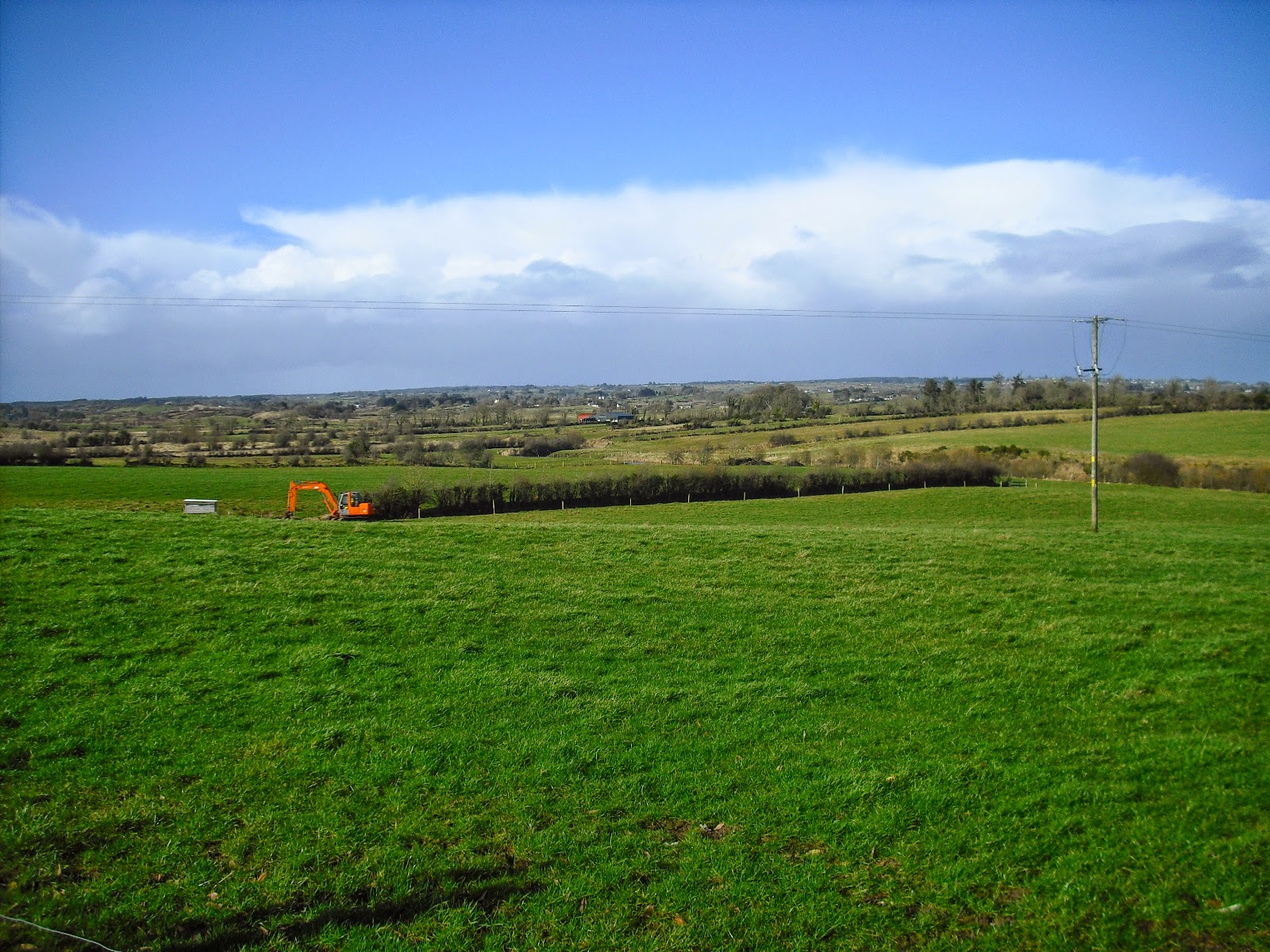
Blue skies in Creevy, Lisacul, Co Roscommon.
Irish weather: Four seasons in one day (more or less) ...
Plus, an Ireland with nicer weather might tone down that fine Irish cynicism; what a terrible shame that would be for the world.

Now, needless to say, it's not always raining here (I write from ‘home’, in case you’re wondering). The odd few visitors get lucky with the sun coming out to play. Predicting when that's going to happen, though, is anyone's guess.

Winter wonderland, in spring: Creevy, Lisacul, Co Roscommon.
... from green to white, and back to green again.
As an Irish expat living in Colombia, I do, on occasions, try and talk up Ireland as a go-to destination. With a rising middle class (so it goes anyway) more Colombians are taking foreign holidays. Although you’d have to say that promoting other locations when in Colombia seems a little pointless considering the extent of its own natural beauty.

It more or less has everything in one neat package, save for violent storms. These can be good to experience every now and again, from a safe perch of course. Do note we’re talking weather-related ones, not the human emotional variety you regularly get from some Latinas.

Yet, even if my talking up of Ireland raises the interest of a visit from Colombians, as it sometimes does, the practicalities of doing so make the reality of it happening less likely.

We're talking visa issues here. The hassle of having to go through the process of applying for a separate one, separate from other European countries and the UK that is, pretty much extinguishes any enthusiasm to make Ireland part of a European holiday.

OK, with a UK visa they can visit the north-eastern part of the island, the part that is not the Republic of Ireland that is. And they could risk a run across the fluid border and more than likely get away with it. But why potentially jeopardise future travel by doing that?

A fine, creamy pint of Guinness at Gieltys Bar, Achill Island, Co. Mayo, Ireland.
If the weather fails, there's always Guinness ...
Now, the powers that be in London and Dublin have changed the rules of engagement as regards a common tourist visa for the two states. However, this little arrangement is limited to the Chinese and Indians — lucky guys. That's a bit unfair, no?

Considering all European citizens who travel to Colombia for tourism don't need to get a visa in advance — up to 90 days is given on arrival, with the option of getting another 90 after that — shouldn't the same apply for Colombians who visit Europe? (As pointed out in Soft touch Colombia, it could be argued that authorities are a little too generous in some aspects.)

So come on Ireland, take the lead, give a little more genuine substance to the motto of being 'the land of a thousand welcomes' and allow the country's doors to be opened more easily by many more.

'Open it and they will come.' Weather permitting.

Monday, 22 April 2013

Electricity 'storm'

There seems to be a bit of an electricity storm brewing in our quaint home village – one that has been replicated in many places not just in Ireland, but even here in Colombia and across the globe.
Electricity 'storm': Creevy on a 'rare' grey day — but the rainbow adds a splash of colour
Storm clouds gathering in Creevy.

It’s over proposals to erect electricity pylons in the area – all part of what’s being described as essential upgrading of the country’s power network by the state-owned company EirGrid.*

Those opposed to them, from what we can gather from afar, have as one of their main arguments that these pylons cause cancer. Of course, as we all know and very often with reason, any mention of the big ‘C’ sends people into hysterics.

However, studies examining the link of such pylons to an increased cancer risk are inconclusive, to say the least. One published in the British Medical Journal in 2005 for example, titled ‘Childhood cancer in relation to distance from high voltage power lines in England and Wales’, had the following conclusion:

“There is an association between childhood leukaemia and proximity of home address at birth to high voltage power lines, and the apparent risk extends to a greater distance than would have been expected from previous studies. About 4% of children in England and Wales live within 600 m of high voltage lines at birth. If the association is causal, about 1% of childhood leukaemia in England and Wales would be attributable to these lines, though this estimate has considerable statistical uncertainty. There is no accepted biological mechanism to explain the epidemiological results; indeed, the relation may be due to chance or confounding.”**

Far from irrefutable and plenty of doubt still exists. Indeed, it would seem quite irrational to have the cancer link as your main argument against these pylons. Naturally occurring chemicals in the fruit and vegetables we eat could carry a more carcinogenic threat – just not enough studies have been carried out in this area.

Pylons in the hills around Bogotá
Pylons - eyesores or part of the landscape?

There are plenty of substances in the world that can give you cancer that we surround ourselves with every day. Yet we tend not to overly worry about the majority of these – it would be illogical to do so and you wouldn’t have much of a life if you did.

Statistics from Britain show that the death rate from childhood cancer is 3.2 per 100,000 children (from about 13 per 100,000 children that actually get the disease) - that's all forms of cancer remember, wherever it was contracted from.

Now put that alongside the estimated 1 in 10,000 chance of being struck by lightning in your lifetime, something which could kill you or leave you severely disabled. Also, US stats state you have a 1 in 98 chance of being killed in a car crash throughout your life, but we're not abandoning our vehicles in huge numbers just yet.

Unduly worrying about some life-threatening risks while ignoring others can lead to not just poor decision-making but even unnecessary deaths.

Take, for example, the 12-month period after the 9/11 terrorist attacks in the USA. Due to the horrific images of the planes crashing into the Twin Towers that we all witnessed, this persuaded many to stop flying as a means of transport. 

The fact that you are statistically safer in a plane – terrorist attacks considered – than in a car didn’t matter. With the extra traffic on US roads as a result of this, it has been calculated that an additional 1,595 lives were lost on America’s highways and byways in the year immediately after the 11th of September, 2001. Lives that could have been saved had people made a rational risk analysis.***

So coming back to the pylon issue, the biggest argument we have against them – much more pressing than the dubious cancer link as far as we’re concerned – is the visual pollution that they’ll bring to the area. At a likely height of about 50 metres (from what we can gather the exact pylon type has yet to be decided), they’re not exactly going to blend in seamlessly with a landscape that has just a mildly undulating topography.

Could the cables they'll carry be put underground? It would appear that international practice is to have them over-ground – perhaps burying them in the earth could be worse for the environment and no doubt would make maintenance work more cumbersome.
'Wrong Way' gets ready to jump...
Extreme sports for Lisacul?

As for many of these often essential man-made structures for the continued development of a country, there exists the case of ‘not in our backyard’.

The experts – and we must trust that this is what they are – who work in maintaining and upgrading Ireland’s electricity supply believe the construction of such pylons to carry the high-voltage cables is needed. In that case, they have to go somewhere. This time our little village is in the firing line and it seems pretty inevitable that they’re going to be built – ‘in the national interest’.

As a good friend said, perhaps we could make a tourist attraction out of them. Anyone up for a spot of bungee jumping in Lisacul?

_______________
*For more information on the project, see: http://www.eirgridprojects.com/projects/gridwest/

**Full report can be found on the British Medical Journal website at: http://www.bmj.com/content/330/7503/1290

***For further information on the majority of the statistics quoted, as well as being essential reading on risk, see ‘Risk: The Science and Politics of Fear’, Dan Gardner, Virgin Books, 2009.