Showing posts with label UK. Show all posts

Wednesday, 26 June 2024

From Cool to Fool Britannia | Letter to the editor

@wwaycorrigan

Oh those heady days of 1990s Cool Britannia. The Oasis-Blur rivalry, Girl Power one could genuinely believe in with the Spice Girls, and Western innocence that we'd reached the end of history.

How wrong we were. Specifically for Britain, nay the United Kingdom, ahead of its general election on 04 July, the choice is a full return to the Blairite Revolution started in 1997 or continued Conservative Party incompetence.

My latest letter, published in the Irish Examiner on Wednesday 26 June, looks at this bleak choice for the UK through a pop lens. Pop goes Britannia, so to put it.

The letter is at https://www.irishexaminer.com/opinion/yourview/arid-41423608.html or see the copy of it below.

From Cool to Fool Britannia | Letter to the editor
Fool Britannia


Thursday, 18 August 2022

A Hack(ett) job on Britain

@wwaycorrigan

Oh, how one can be irked by what are to all intents and purposes rather inconsequential matters.

This happened to me with a Ms Alison Hackett after reading two similar-themed letters she had published in Irish dailies over the last few days. They can be found at https://www.independent.ie/opinion/letters/if-we-have-a-minimum-wage-why-not-a-maximum-one-41917129.html (fourth one down) and https://www.irishexaminer.com/opinion/yourview/arid-40939784.html.

Her utter vitriol for the way Britain runs its affairs and her apparent Gallic glorification is rather misplaced.

Indeed, this sentiment that exists in some quarters in Ireland that the EU can do no wrong while Britain just blunders is worryingly myopic, particularly so as it seems to dominate official policy and media coverage. It would be best to focus on the myriad shortcomings in one's own backyard before attacking the neighbours.

I did write a reply to Ms Hackett's Irish Independent letter which is published online here, https://www.independent.ie/opinion/letters/investing-in-renewables-will-guarantee-returns-for-all-41919458.html (third one down). The letter is also in the images below.


Wrong Way Corrigan's reply to Alison Hackett's letter in the Irish Independent, a woman who seems to have a deep hatred of Britain.
Right of reply. 

_______________________________________________________________
Listen to Wrong Way's Colombia Cast podcast here.

Facebook: Wrong Way Corrigan — The Blog & IQuiz "The Bogotá Pub Quiz".

Thursday, 27 January 2022

A reinvigorated fun police

@wwaycorrigan

[Listen to an audio version of this blog entry here.]

And just like that, it's all over — kind of. Within a couple of days of each other, both England (just England initially that was, not the other UK nations) and, more shockingly, a heretofore extremely cautious — officially, anyway — Republic of Ireland announced that they were ending most of the coronavirus pandemic restrictions.

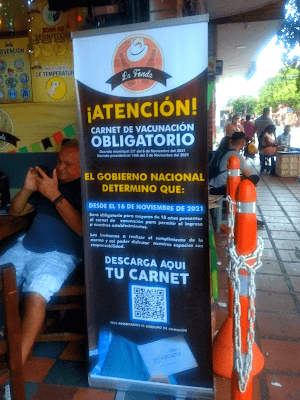
A reinvigorated fun police: Compulsory vaccine passes to try to combat an infection, covid-19, to which many have natural immunity is nothing short of control and coercion by the state.
Thou shalt not pass without a covid-19 vaccine pass: The social credit system in action — comply or be ostracised.

Learning to live again

Of course, I don't (currently) reside in either jurisdiction but I was somewhat optimistic on hearing the news. I'm not, however, expecting a domino effect around the globe in the coming weeks.

It does, nonetheless, give one hope that other nations will start to accept that we have to learn to live with covid-19 rather than stubbornly and damagingly maintain a suppression strategy.

As has been said oft-times before on this blog, we're not talking about an indiscriminate killer here, despite the efforts of many governments and media groups to portray Sars-Cov-2 as such. This covid monomania comes at a price — not just economically but in lives lost as well — and that price is something we're set to live with for some time to come.

I wrote previously (see https://wwcorrigan.blogspot.com/2021/09/rocking-in-fear-world.html) about the irrational fear that has been instilled in the masses over the last two years. 

Thus, for people to return to their pre-pandemic lives — as much as they want to, that is — it was always going to take more than just an address from our esteemed leaders simply telling us that it's all pretty much back to normal and "away with you".

What's more, all the various rules and recommendations aimed at saving lives have empowered what one could call a citizen's army of do-gooders and virtue-signallers. Well-intentioned they may be but, as is often the case in such affairs, they are potentially doing more harm than good — and most likely to themselves than to anyone else.
'"Recklessly" going against the doctrine puts us all in jeopardy. So, à la Novak Djokovic in authoritarian Australia, an example must be made of these apostates.'

You see, many of us at the receiving end of such unsolicited help to save ourselves and humanity at large can, to a certain extent, shrug it off. The preachers, on the other hand, are so worked up about it that it appears to consume them.  

In effect, they almost stop living because they become so concerned about avoiding death.

Pernicious pretenders

Raised as an Irish Catholic, I see something quite familiar here. The top brass who issue the orders largely ignore them in their private (and not-so-private) lives — vide the No. 10 Downing Street parties and Golfgate in Ireland — but the foot soldiers follow the commands with zeal.

In other words, the plebs are the ones who do the donkey work, pay the biggest price, yet they'll never see the green pastures, the promised land.

For these covid crusaders, the non-believers, the heathens, must equally — or, preferably, to a greater extent — suffer. In fact, it's those who question the gospel who are the problem. They must be brought into line.

"Recklessly" going against the doctrine puts us all in jeopardy. So, à la Novak Djokovic in authoritarian Australia, an example must be made of these apostates.

The Catholic Church — together with other such institutions — has done a great job at convincing folk through the ages that having fun in the here and now only leads one to the depths of hell. Not only is living fundamentally a struggle but you must also suffer whilst going through it. (I must say, these days I do move to a more ascetic beat — I'm certainly no party animal anyway — but I don't expect everyone to follow my lead. I'm happy for people to mix, mingle and live as they see fit as long as they don't inconvenience me too much.)

Where religion has lost its (often malignant) influence we have plenty of pernicious pretenders to step into the vacuum.

This coronavirus pandemic has given such fanatical forces a shot in the arm, literally and metaphorically. The fun police have been reinvigorated. The officers won't go away quietly.
_______________________________________________________________
Listen to Wrong Way's Colombia Cast podcast here.

Facebook: Wrong Way Corrigan — The Blog & IQuiz "The Bogotá Pub Quiz".


Saturday, 25 September 2021

Rocking in the fear world

@wwaycorrigan

[Listen to an audio version of this blog entry here.]

Earlier this month, the UK's Daily Telegraph reported that accidents at London Tube stations have increased because some passengers are too afraid to hold onto the escalator handrails.

This is apparently due to fear of picking up the Sars-CoV-2 virus, or coronavirus as many simply call it. For the record, intoxication was also cited as a factor.

Rocking in the fear world: A government advertising in Bogotá, Colombia with information about how to stop the spread of of covid-19.
Careful now, coronavirus & Big Brother are watching you.
We must assume that those in the former category had no other choice but to use public transport to get to where they were going.

Fear play

Moreover, if they are so frightened of coming into contact with the coronavirus and thus potentially becoming ill with covid-19, it is perplexing how they managed to step outside and mix with the mad, morbid masses in the first instance. Think of all the dangers one encounters before entering the dungeon of disease that must be the London Tube.

Surely there are other, safer commute options? OK, I'm not au fait with the English capital, so perhaps it's not the case that the most efficient form of transport is by pushbike or on foot, as it is in many cities. 

Also, for health or other reasons cycling or walking what may be relatively long distances isn't an option for everybody (we're still waiting for these 15-minute cities).

That aside, congratulations are in order for the UK government, its public health body and malleable media. While they and their counterparts across the globe have got many things wrong during this pandemic — I've highlighted plenty of them previously — one can only applaud their remarkable success in instilling irrational fear about covid amongst the populace.
'No doubt there are many who hope I get my comeuppance for what they view as such an arrogant, indifferent stance.'
Judging by many people's reactions over the last 19 months or so, it's almost as if humanity had found the secret to immortality before our microscopic enemy from the East entered the global stage. Some seem so determined to avoid this virus that they'll actually harm themselves in other ways in the process.

There's no need here to once again repeat that covid-19 is a relatively mild infection for the majority — indeed, for some, it seems to cause no harm whatsoever — and that it is a very discriminate killer. One either knows this by now or simply refuses to accept the facts.

Fatal flaws

There are those who appear to want this to be an existential threat, one where we're all equally at risk. When one points out information to the contrary, he/she is accused of being heartless, of not caring enough, of wanting people to die.

I do find this odd as, in public pronouncements in any case, I usually do gravitate towards the worst-case scenario. I tend to see the problems more easily than the solutions. With covid, when I say, 'Look, all things considered, it's not that bad, it could be much worse', I get shouted down.

No doubt there are many who hope I get my comeuppance for what they view as such an arrogant, indifferent stance. I hasten to add, I'm not indifferent to those who have experienced loss due to covid.

All I'm trying to do is to put it into its proper context alongside all the other deadly threats we face as a species, something that I believe has been damagingly lacking throughout the pandemic. Overly focusing on one problem allows others to foment. Covid monomania can cause as much harm as the infection itself.

Perhaps I am setting myself up for a fatal fall. Wandering about unvaccinated (see The vaccine vexers for my thoughts on that), living my life as normal as I possibly can in these straitened times — save for any long-distance travelling of note — trying not to let fear of death affect my daily interactions.

Maybe coronavirus is just waiting for its moment to pounce on this blasé being. Maybe.

If it is, it is. The alternative is locking myself away indefinitely until it's "safe" to venture out again. I know if I did that, I wouldn't be long bidding adieu to this world.

I want to live life my way, as much as I can, not simply spend my days trying to avoid death.
_______________________________________________________________
Listen to Wrong Way's Colombia Cast podcast here.

Facebook: Wrong Way Corrigan — The Blog & IQuiz "The Bogotá Pub Quiz".

Thursday, 22 July 2021

Our freedom isn't being taken away — we never had it in the first place

@wwaycorrigan

[Listen to an audio version of this blog entry here.]

Back in those halcyon days in the early years of the last decade, I published a blog post called Phantom freedom. If you're too busy to click on the hyperlink to read it, the basic idea was that despite today's more interconnected world (particularly in terms of travel, pre-pandemic of course), in many ways we are less free and independent now compared to our ancestors.

Our freedom isn't being taken away — we never had it in the first place: When it comes to green new deals and cleaner living in general, there are many hypocrites about.
'Never in the field of human activity was so much damage done to so many by so few.' Indeed. (Graph from www.vox.com.)

Peak freedom

Little did I know that I was living through our time's freest period. Back then, it could be said, was peak freedom for the 21st century. Fair enough, one can excuse the current restrictions imposed on many aspects of our lives, being as they are a result of the damaging coronavirus monomania afflicting many across the globe, especially those in the agenda-setting, high-income nations.

The hope is that they'll recover soon enough and realise that there are other causes of death and destruction out there, that focusing too much on one threat results in the flourishing of others. One must try to be optimistic on this front.

However, for how long we'll be forced to prove in myriad ways that we're not a health risk to society to do just about any activity that involves mixing with others remains to be seen.

Whatever about the above, for better or for worse — and it's not at all clear which it will be — the kind of measures being proposed for the coming years in a bid for cleaner, greener living should finally — and thankfully — put an end to the crazy notion that we live in a free world. I say thankfully simply because it irks me when I hear people, particularly our rule-makers, utter that falsehood.
'It's difficult to be enthusiastic about these green new deals when those who do the most damage pay little more than lip service in terms of changing their ways.'
I must state that I'm all for living in a more efficient and greener way. In fact, I wager that if more people in the comfortable classes lived as minimalist a life as I do there would be much less of a resource drain on the planet.

Whilst it was written somewhat tongue-in-cheek, I already follow to some degree a number of the recommendations in my The Great Reset post from earlier this year.

Thus, the likes of pay-as-you-drive road taxes which countries such as the UK are proposing, that's fine by me. I don't own a car these days and it's unlikely I ever will (again, that is — I did have one for two years in Ireland when I was in my early 20s. Oh the innocence of youth).

When it comes to air travel, with carbon pricing mooted, this mode of transport looks set to become the preserve of the rich once more. Again, I've no major complaints about this. Most people — in the comfortable classes specifically — fly more than they really need to.

Road to ruin

The issue I have with many of these ubiquitous green new deals is that those peddling them, from what I can see, are inflicting greater hardship on the rest of us in a bid to reduce the harmful effects of their very own excesses.

'We all must work collectively on this' is the mantra when they've been the main culprits, the greatest polluters, the biggest producers of waste — and hypocrisy. There must be something in the air they breathe up on that moral high ground.

Somewhat paradoxically, the UK government talks of 'levelling up'. It's about improving the lot for areas of the country that have traditionally been less well-off. Yet globally, if the many forecasts are to be believed, levelling up at current consumption rates is a road to ruin.

OK, levelling up following a green path is the idea. Nonetheless, it's difficult to be enthusiastic about this when those who do the most damage pay little more than lip service in terms of changing their ways.

The cynical view is that it all simply amounts to exerting greater control over the lives of the relatively powerless. And many, sadly, are either blissfully unaware of this or seem to have no problem with it at all. The future looks rather bleak indeed.
_______________________________________________________________
Listen to Wrong Way's Colombia Cast podcast here.

Facebook: Wrong Way Corrigan — The Blog & IQuiz "The Bogotá Pub Quiz".


Wednesday, 5 May 2021

The case against covid vaccine passports

@wwaycorrigan

[Listen to an audio version of this blog entry here.]

In a recent episode of the UK-based Spectator TV, Adam Ritchie, Senior Project Manager in vaccine development at Oxford University's Jenner Institute, was asked how ethical it was for the UK and other high-income countries to be giving covid-19 vaccines to those less vulnerable to severe infection while at-risk groups in places such as India faced a long wait for a potentially life-saving jab.

The case against covid vaccine passports: The little yellow book of essential vaccines for travel in many tropical countries (I've never actually had to show it to anyone). Will the covid-19 vaccine be added to the list?
Will the covid-19 jab be added to the International Certificate of Vaccinations booklet?

A jab for life

Considering the Jenner Institute works primarily on diseases that predominantly affect low- to middle-income countries Ritchie responded by saying, unsurprisingly, that he did, in a personal capacity, have some reservations about this.

On a similar theme, earlier this year I wrote about my indifference to be vaccinated, largely based on the assumption that I am in the low-risk category for covid. Subsequent events — being in close and enclosed company of people who, it transpired, had the virus at the time we were together — have made me feel, perhaps wrongly, that I may even be in a lower-than-low-risk bracket. (I am available for medical trials, if the price is right.)

When I published that vaccine article, one big unknown was whether or not inoculation helped reduce transmission.

Ironically enough, on the very day I uploaded the blog piece, preliminary studies were released that suggested the jab does indeed slow the rate of infection. This now seems to be largely accepted. (Do note, however, UK infection rates fell dramatically in the summer of 2020 which suggests that there are many factors at play in terms of contagion.)

This positive vaccine performance being so, the case against getting one is weakened somewhat. Somewhat that is.

There are still not-insignificant reasons why I and many others with similar profiles shouldn't be in a rush to get a vaccine.

For starters, we have that moral issue mentioned above. Is it right that somebody who appears immune and/or already has self-produced defences to covid is given a jab before a highly vulnerable person receives his/her shot?

(Now I know many of you would love for Wrong Way to live forever, but covid is far from the biggest threat to my and many others' existence right now. You must protect me from graver concerns if you want me to stick around for a long time to come.)
'If it is considered immoral for some people to get jabbed right now and even for a few years to come, then how can proof of vaccination in order to travel or whatever be seen as fair?'

Alongside this, owing to the nature of coronavirus, even those already vaccinated in high-risk groups will most likely need a booster dose before my first "turn" comes up — I refer to my turn as stipulated by Colombia's five-stage vaccine rollout programme.

For example, my 77-year-old father received his vaccine in March. To stay sufficiently protected, it's most likely he'll need at least one more jab inside the next year.

Immune to clear thinking

Globally speaking, we're far from having enough doses for all. Thus, for now, the focus should be on getting what we do have to those in greater need, wherever they may be.

Then there's the potential immunity issue. Do I and others like me even need a vaccine for something that doesn't appear to present any real risk to us? We've already seen during this pandemic the many problems that arise when treating the population as a homogeneous unit (do recall those worst-case-scenario models that saw much of the world scramble for the panic button and abandon all proper reasoning).

So taking all that into account, the idea of compulsory covid vaccine passports can also be seen as unethical. If one considers it immoral for some people to get jabbed right now and perhaps for a few years to come, then how on earth can proof of vaccination in order to travel or whatever be seen as fair?

What's more, it will hit the already squeezed under-40s disproportionately, just adding to the hardship brought about by the highly questionable coronavirus-containment measures. The idea of reaching
retirement age with a pension to fall back on seems a long way off for many in that category right now.

In many ways, in these crazy coronavirus times, one can't be too surprised with such a blatant disregard for large sections of our population. Our esteemed leaders' inability to think in any way clearly has been one of the many crippling side effects of the pandemic.

All one can do is to continue to highlight the many inconsistencies in the world's covid-containment battle in the hope that some of those currently controlling our lives will come to their senses. Events of the last 14 months don't instil one with much confidence, however.

What we might need is a new, deadlier global crisis to come along to snap these leaders out of their covid monomania madness.  
_______________________________________________________________
Listen to Wrong Way's Colombia Cast podcast here.

Facebook: Wrong Way Corrigan — The Blog & IQuiz "The Bogotá Pub Quiz".

Wednesday, 6 November 2019

Colombia's and Ireland's eastern troubles

Making comparisons between Colombia and Ireland is about as useful an exercise as sweeping leaves in a hurricane. 

Even where there are similarities, something previously touched on by this blog, their day-to-day relevance would seem fairly minuscule. Colombian-Irish ties, while apparently growing, are still pretty weak.
Colombia's and Ireland's eastern troubles: Just when things were looking up for both Colombia and Ireland, the neighbours to the east throw a spanner in the works.
Colombia and Ireland: Dealing with 'nasty' neighbours.
Nonetheless, as an Irishman based in Colombia for the last eight years, becoming aware of these similarities has been rather interesting, insightful even.

While the posts referenced above made internal comparisons, here we're going to add an international dimension.

Nasty neighbour to the east

Basically — stick with us here — Venezuela could be seen as Britain, and that's not just because of its geographical position to Colombia's east. 

Historically, Venezuela was seen as the more advanced, organised and cosmopolitan country. In contrast, Colombia was (is) a violent backwater, insular and conservative. Friendly folk for sure but untrustworthy schemers of sorts. (See where we're going with this?)

A lot of the locals with any get-up-and-go did just that. They left. What's more, a not-insignificant number of them went to that more developed neighbour to the east for a better life. Well, either there or to the US.
"The political problems next door could see the old inferior nations return to their inglorious past."
However, over the last few years these violent backwaters, Colombia and Ireland, have found their mojos, of sorts, while the eastern neighbours appear to have hit the self-destruct button. 

Now, not only are those who had emigrated coming back but people from other countries are keen to give the current 'cool kids' a try, including many from the near east, reversing long-standing migration flows. (The influx of Venezuelans to Colombia needs no elaboration while there has been a significant rise in the number of Brits applying for Irish passports pre-Brexit).

Uncomfortable at the top

Added to this, of late, have been the neighbours' current political problems and the risk of contagion to the now, um, flourishing 'cool kids'. 

As the latter harbour men who have a proven track record at subversion, there is a belief that it will only take a little bit of instability to plunge them and their centre-right administrations right back into the bad old days of violence and economic decline. 

Of course, outside 'help' isn't a prerequisite for this but it can be an important catalyst.

The eastern guys, for their part, have leaders who seem hell-bent on getting their way or, as some view it, are being unfairly hindered from doing their job. 

Now, while a Jeremy Corbyn victory in the UK's December election would work wonders for this analogy from a left-right perspective, it's not completely necessary. 

Bungling Boris Johnson, while politically poles apart from Nicolás Maduro, fits the narrative here in so many other ways. For one, you've both men's penchant for putting their foot in it.

As the problems to the east show no signs of easing, there's a bit of schadenfreude on display in some quarters of the once inferior nations. 

However, looking down from a lofty position not only doesn't sit well with them but it also tends to be followed by a swift, painful comedown. 'Back in your place with you.'

When that comedown has well and truly landed, by their own doing or otherwise, assistance from the eastern neighbours will yet again be badly needed. After all, these countries have more in common than they may like to admit.
__________________
Facebook: Wrong Way Corrigan – The Blog & IQuiz “The Bogotá Pub Quiz”.
Listen to The Colombia Cast podcast here.

Wednesday, 4 March 2015

Promoting Ireland

'Ireland; a great little country, if only you could put a roof over it.'

It's difficult to go against that comedic summation of my homeland. Actually, you could add to it and suggest the construction of a few massive wind barriers as well.

Promoting Ireland: A view inland from Keel Strand, Achill Island, Co. Mayo, Ireland.
Ireland's practically ever-present cloud. It does let up every now and again, though. Really, it does.
You see there's a good reason it's dubbed 'The Emerald Isle'. There are plenty of, picturesque, rolling green hills that give it a sparkling look, especially when viewed from above. That's if you could actually see the land beneath the practically perpetual, thick, grey rain clouds that smother the place.

Therein lies the Irish problem; the dull, wet weather. If it was pulled a thousand miles further south, you could be talking about one of the world's greatest tourist spots. But then again, there's the risk it'd lose a bit of that greenness; the land that is anyway, whatever about the people (well, we'd get a little redder for one).

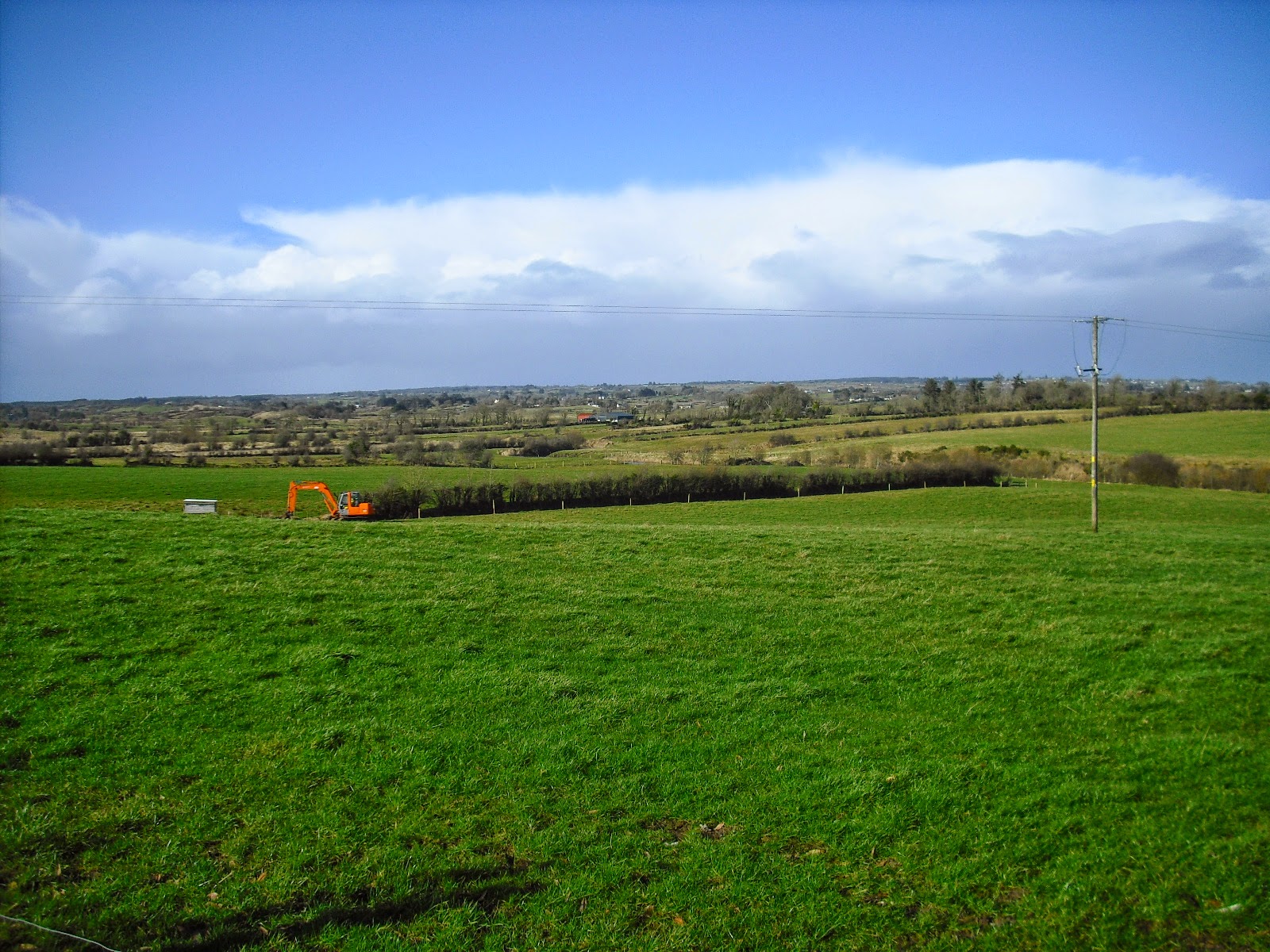
Blue skies in Creevy, Lisacul, Co Roscommon.
Irish weather: Four seasons in one day (more or less) ...
Plus, an Ireland with nicer weather might tone down that fine Irish cynicism; what a terrible shame that would be for the world.

Now, needless to say, it's not always raining here (I write from ‘home’, in case you’re wondering). The odd few visitors get lucky with the sun coming out to play. Predicting when that's going to happen, though, is anyone's guess.

Winter wonderland, in spring: Creevy, Lisacul, Co Roscommon.
... from green to white, and back to green again.
As an Irish expat living in Colombia, I do, on occasions, try and talk up Ireland as a go-to destination. With a rising middle class (so it goes anyway) more Colombians are taking foreign holidays. Although you’d have to say that promoting other locations when in Colombia seems a little pointless considering the extent of its own natural beauty.

It more or less has everything in one neat package, save for violent storms. These can be good to experience every now and again, from a safe perch of course. Do note we’re talking weather-related ones, not the human emotional variety you regularly get from some Latinas.

Yet, even if my talking up of Ireland raises the interest of a visit from Colombians, as it sometimes does, the practicalities of doing so make the reality of it happening less likely.

We're talking visa issues here. The hassle of having to go through the process of applying for a separate one, separate from other European countries and the UK that is, pretty much extinguishes any enthusiasm to make Ireland part of a European holiday.

OK, with a UK visa they can visit the north-eastern part of the island, the part that is not the Republic of Ireland that is. And they could risk a run across the fluid border and more than likely get away with it. But why potentially jeopardise future travel by doing that?

A fine, creamy pint of Guinness at Gieltys Bar, Achill Island, Co. Mayo, Ireland.
If the weather fails, there's always Guinness ...
Now, the powers that be in London and Dublin have changed the rules of engagement as regards a common tourist visa for the two states. However, this little arrangement is limited to the Chinese and Indians — lucky guys. That's a bit unfair, no?

Considering all European citizens who travel to Colombia for tourism don't need to get a visa in advance — up to 90 days is given on arrival, with the option of getting another 90 after that — shouldn't the same apply for Colombians who visit Europe? (As pointed out in Soft touch Colombia, it could be argued that authorities are a little too generous in some aspects.)

So come on Ireland, take the lead, give a little more genuine substance to the motto of being 'the land of a thousand welcomes' and allow the country's doors to be opened more easily by many more.

'Open it and they will come.' Weather permitting.

Monday, 20 October 2014

Colombia's best bank: And our winner is ...

Sometimes you have to accept that certain things are the way they are – at least for a specific moment in time. So while the Colombian banking system frustrates more than what I had been used to, you just have to deal with it.

However, depending on your circumstances and requirements, it is worth shopping around if you're looking for a safe place for your money here.

Banco Caja Social: Colombia's best bank?
Banco Caja Social: Wrong Way's kind of bank. (Image from Facebook.)

What’s more, reflecting the general lack of customer service in this country, banks don’t seem to care one iota if you decide to ‘take your money and run’, closing an existing account. A great business sense that, leaking clients at will. My ‘millions’ are better off in Ireland and the UK for now.

If you do, though, require a Colombian bank account, from my investigations, coming at it as an independent visa holder, without having to go to extraordinary lengths to prove your importance,* here’s the low-down on the lukewarm to the damn right cold:

Banking is Caring and Sharing: 

First place goes to Banco Caja Social or in its initialism form, BCS (hence the introduction, geddit?). 

This bank offers a standard savings account without any management fee, or so they say. 5,000 COP (Colombian pesos, roughly €1.90) is held in bolsillo (‘pocket’) and taken from your account each month. 

However, it’s your money, not theirs; you can access it whenever you want, apparently. You’re allowed up to five free ATM withdrawals per month – in BCS’s own cash machines that is, of course (there is a fee to use those of other banks, the standard practice in Colombia).
Banco Caja Social: The best bank for independent workers in Colombia.
Moreover, all you need is your Colombian immigration card (Cédula de Extranjería), and cash obviously, to open an account. That is to say you don’t need to show a certified proof of income, a requirement in many of the other banks and something that can be a bit of a hassle to get as an independent, non-contracted worker.

On top of all this, in a case of what’s seldom is wonderful for this country, the guy I dealt with in the bank’s 19th Avenue with Fourth Street (Calle 19 con Carrera 4) branch was extremely friendly and helpful and seemed genuinely interested in having me as a customer (cheers Oscar!).

Worthy of mention: 

A much smaller bank than Caja Social, Bancoomeva’s standard savings account comes free of charges for the first six months. Thereafter, there is no standard monthly fee, but you pay for every transaction. 

At their own ATMs the fee is minimal; 1,300 COP for each of your first four monthly withdrawals. However, it’s more than double that if you withdraw from other banks. This could prove costly considering the current small size of their network nationwide.

A newcomer to the market, the Ecuadorian Banco Pichincha, has a monthly management fee of a not-too-excessive 6,900 COP. Like Caja Social, it’s simple to open an account, with no proof of income required. On the downside, like Bancoomeva, the network is small.

Banco de Bogotá’s monthly fee is 6,500 COP, which allows up to five cost-free ATM transactions per month. The paperwork required to open an account there is somewhat off-putting, though.

It’s relatively straightforward to open an account with Davivienda but the monthly fee of 9,500 COP is at the higher end of the scale. Plus, in one of its branches at least, employees could do with some intensive customer-service training.

Best to be avoided: 

With a total monthly fee of a whopping 18,000 COP, broken down as 10,000 COP for management plus an 8,000 COP administration charge for good measure, Banco Popular is certainly not popular with Wrong Way anyway.

Three of the less favourable banks operating in Colombia, side-by-side.
Three of a kind: Disinterested, costly banks ...
Bancolombia charges 9,700 COP per month and requires proof of income. The Spanish bank BBVA is also one of the more expensive ones with which to do business.

I have it on good authority that Citibank’s priority in Colombia is at the upper end of the market; fee-wise it’s at the upper end of things in any case.

It must be said that some banks such as Banco Av Villas, Banco Occidente and Banco Agrario failed to provide me with information as requested (and promised in a couple of cases). 

Also, if anyone knows of any other bank operating in Colombia that can trump Banco Caja Social – bearing in mind this little study is based on an independent visa holder or somebody without contracted employment – please do tell.

For now, though, it’s off to Caja Social I go.
____________________________________
*By ‘extraordinary lengths’ I mean having to write, in a strong manner, to branch managers and indeed company directors to get any sort of positive attention. Even that doesn’t guarantee any improvement in conditions. 

Friday, 26 September 2014

Colombia: A banker's paradise revisited

There are a lot of things that can irk expatriates here in Colombia. After a time, most come to learn that the best way to deal with them is to, well, not deal with them. Either grin and bear them or laugh them off. Trying to find solutions to whatever may be bothering you is generally a futile exercise.

Colombia's Davivienda bank.
Davivienda; nice little bank... (Image from Facebook.)
However, like it is for the opposite sex (whichever that is for you) and pretty much all over the world, the majority of us have found – usually to our annoyance – that we can’t live with or, more pertinently, without banks.

Thus, I find it a little more difficult to simply "let it go" when it comes to banking in Colombia. This is a topic I wrote about before; the fact that I still have a bank account here shows that I have learnt to take the punitive hits somewhat. Every now and again, though, the red mist descends in relation to this whole area.

You see I still don’t understand why my bank, Davivienda, charges me 9,500 COP (Colombian pesos, just slightly under four euro) per month to have what is quite erroneously termed a savings account. Or maybe the savings refers to what Davivienda makes with my hard-earned cash? The title makes a bit more sense if you look at it that way.

Whenever I question Davivienda employees about this, some of whom I have worked with in a freelance capacity, they explain the fee as the cost of managing my account, along with the peace of mind that my money is secure. Fair enough on the second point, but don’t they use my deposited money to lend to other people, generating handsome revenue for themselves?

As for the management of my account, heck they must be flat out there. For one, the last time I used my debit card to make a transaction was in April of this year. When it comes to making deposits, I’m the one that does it, in person, standing in ridiculously slow-moving queues to do so. It should be me asking for a fee (or interest as we call it for savings accounts in Ireland and the UK).

Now, in fairness, I do get sent a text message each time there is account activity; that includes when I go on line to view the status of things (alas, it’s not that great). So perhaps the random figure of 9,500 COP is used to put credit into Davivienda’s pay-as-you-go mobile phone. They must be damn expensive text messages at that. Just don’t forget to send me a birthday text guys; it will all have been worth it then.

To add further insult to injury, I was told that if I had a nominated account i.e. one in which an employer deposits my wages, I wouldn’t be charged anything. The snag here is that I don’t have a full-time employer. 

So it seems if you’re a freelancer, trying to make it on your own minus all the relative security and benefits of full-time work, you get even more screwed by the system here. Of course, there’s a fair chance I’m missing a trick or two; for if there is a simple way to avoid these fees, the banks will be the last ones to tell you.


It must be said that it’s not just Davivienda that’s at this – it’s basically the same with them all. It’s the way things operate here. The international banks must love it.

Plus, for many hard-pressed, working-class Colombians it’s not an issue. They either have the aforementioned nominated account or just don’t have an account at all. Under the mattress is best for the majority.

Indeed, it appears banking in Colombia is either for the very rich (who tend to get fees waived) or idiots. At the moment I fall into that latter category.

I suppose somebody’s got to contribute towards those semi-comical Davivienda advertisements (see video above). Wrong Way, always giving.

Friday, 19 September 2014

'Flagtastic' result! Thanks Scotland!

Phew! They’ve pulled through, and with a little bit more to spare than it looked immediately beforehand. 

A huge section of Colombian society can breathe easy once more. The right decision has been made. Scotland is staying in the UK.

'Flagtastic' result! Thanks Scotland! The Union Jack hung proudly from a Bogotá city bus.
Why bother with the Colombian tricolour when you can fly the Union Jack?
You see, had our Tartan friends voted to leave, one of the possible changes made to a streamlined union would have caused a big headache here in Colombia.

I’m referring to a modified Union Jack, minus Scotland’s cross of St Andrew and the accompanying blue colour. This is because the most popular flag in Colombia is, it appears, not their own national tricolour but that of the UK.

The Union Jack colours on display in Bogotá. What a surprise -- not.
'Jack on the back.'
It’s everywhere. Taxis, buses, shop windows, pubs, clothing, dogs – the works. It’s a safe bet that the majority of those here who have this strange affinity with it have no real idea of the place it represents. 

For one, you’ll meet Colombians who think that London is a country, if they’ve actually heard of the place before that is.

In some ways I can see the attraction that this mixture of white and red crosses on a blue background has. As flags go, it’s aesthetically impressive. Plus, it did represent greatness and endeavour in the not-too-distant past.

Yet, at the same time, for others the flag is – or at least was – a symbol of repression and subjugation.

As an Irishman born into and brought up on the nationalist, separatist tradition, that latter interpretation was the one I was destined to follow. 

Nowadays, with what I hope is a more balanced, worldly view of things, I tend to be more relaxed when I see the good old Union Flag. Well during my sober, right-thinking moments that is.

Sure isn’t it just three colours put together in a particular pattern, after all? 

At times, though, it’s not just bulls that can have adverse reactions to flags and how they’re flown, or not flown as the case may be. (Check out the video below or click on the following link for an example of that: www.youtube.com/watch?v=_HkyokhX9Ag.)


In weaker moments, I do question Colombians who display the flag or wear it on their jeans, T-shirts and suchlike. A lot of them, as alluded to above, don’t know its origins. Plus, they tend to be a bit bemused as to why it should bother me. Fair enough; as I said, I’m learning to let it go.

However, when I don my Venezuelan football shirt – the country that is now Venezuela being the birthplace of Simón Bolívar, the chief liberator of South America from ‘old’ Spanish rule and thus a Colombian hero – it doesn’t go down too well with some here. 

Come on guys, the two peoples and national flags are practically the same, right?*

I guess we could all do well to retract from this rather abstract symbolism and focus on more concrete, practical things. Now, where did I put my Union Jack briefs?
__________________________________________
*For a more general piece on Colombian (and others') independence, read Whose land is it anyway?

Saturday, 13 September 2014

Scotland: Rising to be the nation again?

It is said that all good things come to those who wait. So, after a political union with its fellow British neighbours to the south, England and Wales, since 1707, Scotland may be about to, once again, go it alone. Well, that is go it alone insofar as any independent country can in today’s globalised world.

Scotland: Rising to be the nation again? The country is under the magnifying lens right now.
There's much focus on Scotland right now. Yes or no chaps? (Image from bbc.co.uk.)
Of course, whether making a break for autonomy from the UK will be a good thing or not for our Celtic cousins depends on who you speak to. In truth, nobody really knows how such a move would go.

In contrast to many other countries that are currently striving for self-determination and those that did so previously, the Scottish position isn’t exactly a case of running from an oppressive, unrepresentative regime.

In fact, it could be argued that Scotland, on the whole, has benefitted as much as any of the countries in the Union since its inception.

Looking at it with green-tinted eyes, it would be ironic that after countless deaths due to failed uprisings in the name of Irish freedom – followed by protracted violence and death when said freedom wasn’t achieved for some – Scotland gets full independence after a single, democratic act.

OK, different time, different context.

For one, in the Irish story, you had a majority on the island who were treated and maintained as, at best, second-class citizens due to their religion, culture and customs. This was the case throughout the period of English dominance there. In general, the Scots have enjoyed a much fairer deal since their union.

On the flip side, considering all that happened in the last century and the problems still existing regarding Ireland’s national question, perhaps it should have been the Irish revolutionaries who trusted in the all-good-things motto.

In purely economic terms, some say Ireland would have been better staying in the UK.

However, asserting one’s autonomy is more than just loot. At the time of partial Irish secession, there was a general feeling of ‘freedom from a repressive regime’ – we’ll leave the Catholic Church’s unchecked, iron-fisted rule out of this for now.* 

Also, thankfully, that freedom from led to a freedom to allow individuals to live their lives, speak their minds, state their own political party, etc. (for a greater discussion on this read Thomas L. Friedman’s Order vs. Disorder from The New York Times).

Moreover, after a shaky start, the new Irish state formed alliances, on its own terms, with old friends in Europe. Current financial problems apart, it can be said that the Irish spirit and confidence are stronger today than they were 100 years ago. This is despite (or maybe because of) our natural begrudgery and cynicism.

As for Scotland’s current run for freedom, it’s not, to restate, a case of trying to remove the shackles of a repressive regime. It’s a group of largely like-minded people attempting to reassert the full independence of an ancient kingdom.

The Scottish Saltire (or flag if you will!).
Is that an 'X' for yes or for no?
It’s what you might call benign nationalism, sought after in a democratic way. Should the people give it the green light, it’s highly unlikely "new" Scotland will embark on an expansionist scheme, trying to Tartanise the region. Well, there will be a few difficult issues to be needled out – maritime borders and currency to name just two – but they’ll be settled around the negotiating table, not the battlefield.

The point is you, only need to look at the Middle East to see the uglier, far more dangerous side to this: aggressive, undemocratic nationalism. Yes, there are a host of intertwined, complex reasons why this is so, with outside influences having as much culpability as those inside.

Much of it emanates from a succession of autocratic leaders followed by weak, quasi-democratic administrations. Legitimacy and order have been sorely lacking. Needless to say, the problems there won’t be solved after one or two elections. We’ll leave that discussion for another day.

Back in Scotland, if a yes vote is delivered it would serve to underscore that this once united, great – for it did many great deeds on this planet – Britain is now a fragmented, very ordinary shadow of itself. It would also be, at the very least, a blow to British, nay English, prestige.

In such an event, the door would be open for our Anglo-Saxon and Welsh neighbours to join what you might see as a restructured union, the ‘Alliance of Celts and English’, the ACE group of nations. A potentially powerful hand indeed.

So what'll it be Scotland?
______________________________
*If there are problems with the hyperlink to that light-hearted, but telling, take on the Catholic Church's assumption of power after the Irish Free State came into existence, check it out here: https://www.youtube.com/watch?v=e5Z1dqJzxNo.

For a more general piece on the whole area of nationalism and the accompanying problems with it, read Tribal warfare.

Thursday, 9 May 2013

Colombia: A banker's paradise

For the second time in a number of months here in Colombia we found ourselves snookered as to what to do with our cash. 

OK, it could be seen as a pleasant headache to have – better looking at it than for it, in a sense. The issue, though, on both occasions was that without a bank account, where do we put the cash we’ve (finally) built up over our time freelance English teaching in the country when we go travelling?
Colombia: A banker's paradise. The safest bank in the world — under the bed?
Safe haven: cash under the bed.
You see, it’s not a problem when we stay in Bogotá. We just keep it tucked away in safekeeping, accessing it when we need to. 

But going on the road with a relatively nice bit of "real money" – enough, in any case, that we certainly don’t want to lose – is not the brightest idea around these parts, or anywhere for that matter. It would be bringing ‘dar papaya’ to new levels of stupidity (see http://bit.ly/XLDyLg for an explanation of that).

Due to our visa situation and a lack of the foreigners’ version of the national identity card (a cédula extranjería as it’s known – it took Colombia immigration almost six months to get us one of those issued, getting it just six days before it actually expired) we couldn’t open a bank account back in January.

Our three-pronged cash solution for our travels back then was thus: we brought more than maybe advisable with us; we left some behind and; in an extremely generous gesture, a friend of ours gave us her bank card to use for the duration of the trip (cheers, Melissa) – so we put the remainder of our cash into that account as cover.

Now, all that worked out quite well in the end, but we didn’t feel fully in control of the situation. So for our latest voyage, one where we had to pop into neighbouring Venezuela for visa purposes,* we tried again to open a Colombian bank account. 

The game changer this time was that we had our cédula – the lack of it beforehand was the only obstacle preventing us doing business with Davivienda (the other banks, for the record, needed written proof of income, something Davivienda did not).

So cash and national identity card in hand, we go to open what they call a savings account – after all, all we wanted was somewhere to "securely" store our money while also having the ability to access it at some stage if needs be.
The Davivienda building in downtown Bogotá stands tall
Standing tall('ish') - Davivienda.
‘Right, what kind of benefits do we get?’ ‘Benefits? Well, you can use the debit card to withdraw your cash at any Davivienda ATM in the country (but use another bank’s machine and you’ll be nicely charged) – get this, free of charge!’ 

‘Wow! Tell us more.’ 

‘You can also make point-of-sale and internet transactions with your card without incurring a charge from us.’ 

‘Great. What about the interest rate?’ 

‘Well that’s minimal, less than one per cent.’ 

‘Ah, that’s OK, it’s better than zero – at least our money will make something.’ 

‘Well, you are, of course, charged $9,300 Colombian pesos (COP officially – roughly US$5) per month to have this account.’ 

‘Hold on, what? We leave our money with you, money you use to invest to make more and you charge us for our "generosity"? How can you do that?’ 

‘Bienvenidos to the banking world of Colombia.’

Yep, we get charged for letting the bank play around with our money. Indeed, if the interest rate was one per cent (it’s less) we’d need to leave a minimum of ten million pesos (about US$5,000) just to break even – that's if the interest was calculated monthly, which it’s not. 

This isn’t just Davivienda (a company where we, incidentally, teach many of its high-rolling staff) we must add – it applies to all the banks; Colombian law apparently.

In fact, it seems to be a cosy cartel between the banks and the country’s lawmakers – nobody seems willing or, more importantly, legally allowed to break ranks. From what we’ve been told, even the international banks play the same game. The likes of HSBC and Citi must love things here – easy money and all that.

We don’t make any secret of the fact that we’ve never been big fans of banks, wherever in the world, but the above practices are just plain wrong. 

How the ordinary Colombian can accept it is beyond us. And, of course, it is the working- and lower-middle-class Colombians that are most affected by it. The lower classes tend not to have bank accounts – they’ve enough problems without them – while the upper-middle and upper classes either don’t really care about such charges or, perhaps more likely, have their wealth elsewhere.
Another Bogotá protest
A popular protest, just not about the banks, though.

At least in the other two countries we’ve banked in – namely the Republic of Ireland and the UK – we don’t get charged just for leaving our money with them. The balance we’ve left in our UK bank account – the current account that is – hasn’t budged since we departed, only for the small sums of cash we’ve taken out.

What’s more, our instant-access savings account, where we can transfer funds from this to our current account in seconds via the internet, is making money for us – not a lot, but at least it’s moving in a positive direction. It’s more or less the same in the Republic of Ireland.

Yes, "proper" savings accounts do exist in Colombia, but from what we can gather they are highly restrictive and not very practical for the average worker. So with seemingly little or no public or political pressure to change their ways, why would the banks do so?

They are on a nice little winner here. After all, it is a banker's paradise.
___________________________
*We’ll have more on what turned out to be a very positive, highly enjoyable trip to Venezuela in the coming days.

Sunday, 29 July 2012

Dining with death

Dining with death: 'Wrong Way' outside the main door of Bogotá's infamous Pozzetto restaurant
Bright building with a dark past.
Contrary to popular belief, every now and again we don't mind spending a little more than the norm of our hard-earned Colombian pesos here. This is especially so if it seems worth it. 

That happened to be the case when the opportunity arose to dine in one of Bogotá’s most famous – well, infamous really – restaurants. Quality Italian food in a fairly luxurious setting (for us anyway) with a dark history was just too good an offer to turn down. 

Plus, we couldn’t let our departing Irish friend, from the UK part of the island albeit (no offence intended, Colin), feast on his own for his 'last supper' in Colombia.

Now, using such phrases as we have in that last sentence is moving into quite unsettling territory considering the place we’re referring to: Pozzetto restaurant. 

Why? Well, firstly we must say we were ignorant of its truly shocking past until we were invited to go there. For those of you in a similar position, here’s a brief account of one of the craziest days, and people, Bogotá has witnessed – and that’s saying something.

To start, a necessary background briefing on the man this all revolves around – Colombian native Campo Elías Delgado. A quick Google search will tell you that he, reputedly, served in Vietnam with the US army, after which he lived as a refugee in New York before returning to Bogotá, finding work there as an English teacher. 

His experiences in Vietnam were said to have made him antisocial and resentful, while he also blamed his mother for many of the problems he had in his life. His descent into what can only be described as utter madness reached its nadir on 04 December 1986.

A mugshot of Campo Delgado, the man responsible for 30 deaths in one crazy day in Bogotá
Mass murderer — Campo Elías Delgado.
His day of carnage started by stabbing to death one of his teenage students along with her mother in their apartment. From there he returned to the apartment he shared with his mother, arming himself for his next round of slaughter. 

That started by killing his mother with a single stab to the back of the neck. He then set her body alight, went out to the apartment complex corridor and alerted other residents to the fire. As his neighbours emerged he killed them one by one – one man with his knife, another five by gunshot.

Still blood thirsty – and seemingly hungry – Delgado headed to the aforementioned, exclusive Pozzetto restaurant. 

On arrival, he ordered spaghetti bolognese along with red wine and eight vodka tonics. He tucked into that for about an hour before beginning the final part of the slaying, opening fire on his fellow diners. 

Although one woman managed to quickly call the police, Delgado still had time to slaughter 21 people before they arrived. His method was to coldly corner his victims, shoot them in the forehead, then move on to the next.

When the police eventually landed Delgado held them off for about a minute before finally being shot dead himself.

In total he ended the lives of 30 people that day, the majority of them at Pozzetto.
'Wrong Way' and friend inside the upmarket Pozzetto restaurant
Fine dining — the stylish interior of Pozzetto.

As far as our experience at the same restaurant went, well needless to say, and thankfully, it was nothing like the above.

Indeed it’s hard to imagine that such a slaughter could have happened in such salubrious surroundings. 

The only shots taken were those from our camera, the majority coming courtesy of our enthusiastic but far-from-clinical waiter. If only Delgado had had such a hopeless aim.
______________________
*For those in Bogotá interested in checking out Pozzetto, it's located in the Chapinero district, Carrera 7 # 61-24.