Showing posts with label European. Show all posts

Wednesday, 4 March 2015

Promoting Ireland

'Ireland; a great little country, if only you could put a roof over it.'

It's difficult to go against that comedic summation of my homeland. Actually, you could add to it and suggest the construction of a few massive wind barriers as well.

Promoting Ireland: A view inland from Keel Strand, Achill Island, Co. Mayo, Ireland.
Ireland's practically ever-present cloud. It does let up every now and again, though. Really, it does.
You see there's a good reason it's dubbed 'The Emerald Isle'. There are plenty of, picturesque, rolling green hills that give it a sparkling look, especially when viewed from above. That's if you could actually see the land beneath the practically perpetual, thick, grey rain clouds that smother the place.

Therein lies the Irish problem; the dull, wet weather. If it was pulled a thousand miles further south, you could be talking about one of the world's greatest tourist spots. But then again, there's the risk it'd lose a bit of that greenness; the land that is anyway, whatever about the people (well, we'd get a little redder for one).
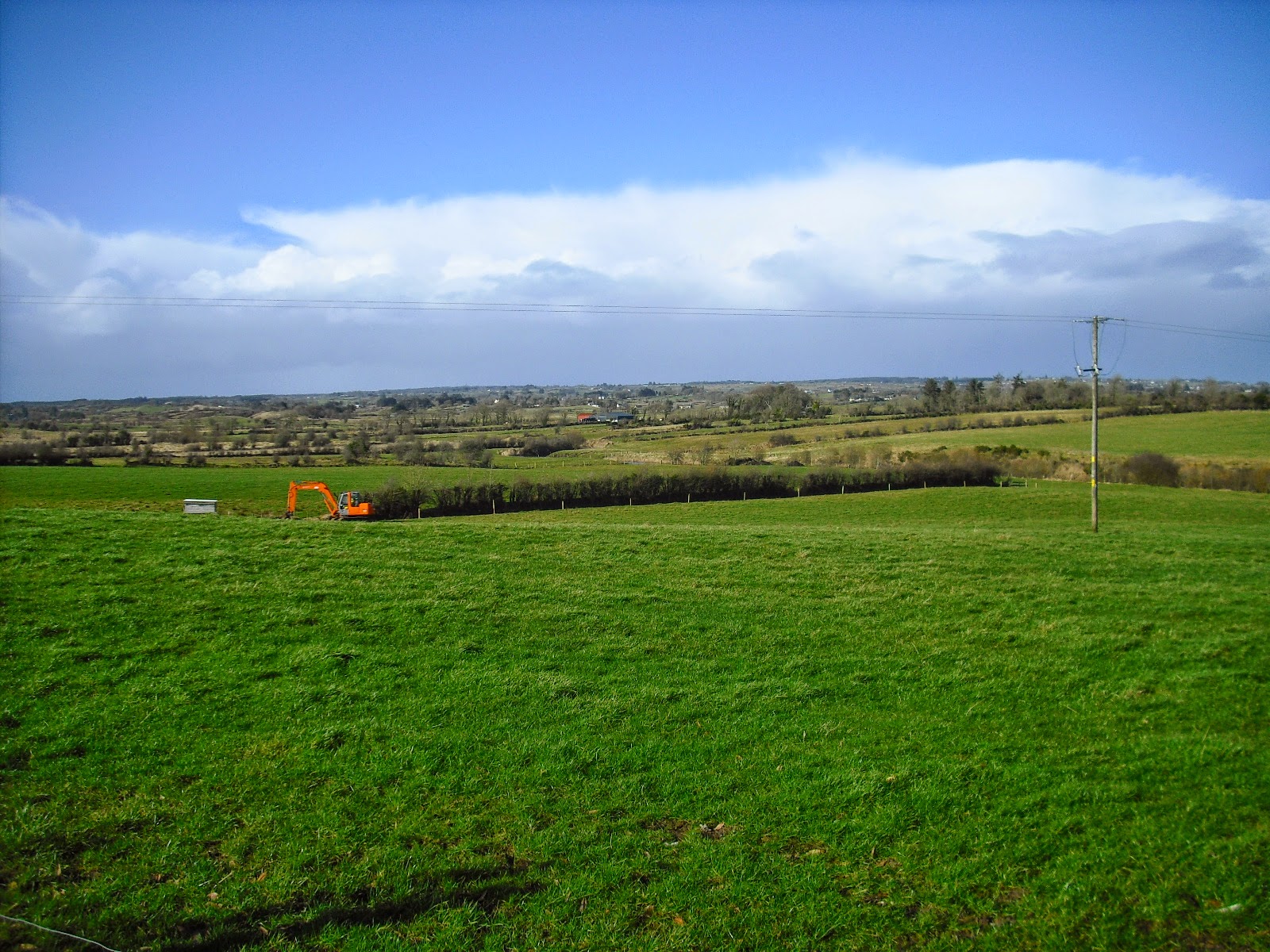
Blue skies in Creevy, Lisacul, Co Roscommon.
Irish weather: Four seasons in one day (more or less) ...
Plus, an Ireland with nicer weather might tone down that fine Irish cynicism; what a terrible shame that would be for the world.

Now, needless to say, it's not always raining here (I write from ‘home’, in case you’re wondering). The odd few visitors get lucky with the sun coming out to play. Predicting when that's going to happen, though, is anyone's guess.

Winter wonderland, in spring: Creevy, Lisacul, Co Roscommon.
... from green to white, and back to green again.
As an Irish expat living in Colombia, I do, on occasions, try and talk up Ireland as a go-to destination. With a rising middle class (so it goes anyway) more Colombians are taking foreign holidays. Although you’d have to say that promoting other locations when in Colombia seems a little pointless considering the extent of its own natural beauty.

It more or less has everything in one neat package, save for violent storms. These can be good to experience every now and again, from a safe perch of course. Do note we’re talking weather-related ones, not the human emotional variety you regularly get from some Latinas.

Yet, even if my talking up of Ireland raises the interest of a visit from Colombians, as it sometimes does, the practicalities of doing so make the reality of it happening less likely.

We're talking visa issues here. The hassle of having to go through the process of applying for a separate one, separate from other European countries and the UK that is, pretty much extinguishes any enthusiasm to make Ireland part of a European holiday.

OK, with a UK visa they can visit the north-eastern part of the island, the part that is not the Republic of Ireland that is. And they could risk a run across the fluid border and more than likely get away with it. But why potentially jeopardise future travel by doing that?

A fine, creamy pint of Guinness at Gieltys Bar, Achill Island, Co. Mayo, Ireland.
If the weather fails, there's always Guinness ...
Now, the powers that be in London and Dublin have changed the rules of engagement as regards a common tourist visa for the two states. However, this little arrangement is limited to the Chinese and Indians — lucky guys. That's a bit unfair, no?

Considering all European citizens who travel to Colombia for tourism don't need to get a visa in advance — up to 90 days is given on arrival, with the option of getting another 90 after that — shouldn't the same apply for Colombians who visit Europe? (As pointed out in Soft touch Colombia, it could be argued that authorities are a little too generous in some aspects.)

So come on Ireland, take the lead, give a little more genuine substance to the motto of being 'the land of a thousand welcomes' and allow the country's doors to be opened more easily by many more.

'Open it and they will come.' Weather permitting.

Wednesday, 4 February 2015

Just DON'T want to dance the night away

That old adage, 'If you can't beat them, join them', is pretty much contrary to what this blog is all about. However, for some things, putting up resistance can be personally damaging, both in the short and long term.

Just DON'T want to dance the night away: Wrong Way takes to the floor to show off his dancing moves.
To the victor (on the dance floor) go the spoils ...
You see in Colombia, as is the case throughout Latin America (Chile excepted, somewhat), a night out with the locals invariably involves dancing; and normally a lot of it. 

Not only that, but we're talking dancing with style and rhythm, the chief types being salsa and vallenato, along with what might be seen as the less stylish yet more erotic champeta.

So this isn't your skill-less, jumping-around tomfoolery that you typically see in most Western world clubs and pubs. No, there's a pattern to this and not to know it leaves you at a distinct disadvantage.

Now as a recognised 'wooden' northern European there is, thankfully, a little bit of leeway from the ladies on the rare occasions I do, reluctantly as it is, take to the floor. Heck, there are usually even words of praise as I awkwardly shuffle about the place.

Wrong Way Corrigan in action ...
Well, when in Colombia ...
The reality, however, is that they are humouring me. That's very clear when they match up with somebody who actually knows what he's at; their true joy at not having to move around with a log is disenchantingly (from my perspective, that is) palpable. (See video, below, for an example of the 'prize' for being able to dance 'properly'.)

Plus, having been based in Bogotá for over three years at this stage, the tolerance towards my lack of dancing nous is steadily decreasing. This is even more so the case considering I realised early on the advantages – in terms of picking up chicas anyway – of knowing at least the basic salsa steps. I should, so it goes, be able to move much better by now.

The reason why I can't or, more accurately, don't isn't puzzling. In fact, it's simple: I do not enjoy it. On the contrary, I pretty much detest it.

Yes, as noted, I've been 'forced' into it over the years, buoyed up with a little Dutch courage. But whenever I have engaged in it, the general feeling is I'd rather be shovelling thick concrete in a hot midday sun (um, in a figurative sense that is).

Before it's said I'm a complete statue, I do move to music. But the way I ‘feel’ it, Wrong Way style you might say. And as many Colombians have observed, I tend to move more in the shoulders than the hips, which certainly doesn’t complement the Latino style.


What’s more, dancing is not the focus of a night out for me; it’s a distraction if anything. I do it because I feel I must rather than having any real desire. I guess that’s why I generally avoid locations where dancing is an integral part of the place. OK, this is hard to come by in Colombia, but some social settings, such as most of my preferred tienda bars, are a little lighter on the dancing front than others.

Thus, as damaging as it may be in some ways, the partial resistance looks set to continue. In any case, I’ve always got my mock Irish dancing to impress the locals. ‘Hup ya boy ya!’

Monday, 5 November 2012

Bogotá's simple pleasures

It should come as no surprise to you that we’re far from high-maintenance here at Wrong Way. It’s the simple, small things in life that we tend to derive most pleasure from.

Keep it simple, stupid

That’s why, for example, we like to do our grocery shopping in Bogotá at La 14 – the supermarket that feeds you for ‘free’ while you stock up. 

It is said that you should never shop on an empty stomach but having something to eat before you hit for La 14 (on weekend afternoons anyway) will only spoil your experience. Between the various complimentary servings on offer – meat, pasta, biscuits, cereal, fruit, ice-cream, you name it – you generally leave there quite satisfied. 

We’d nearly (nearly that is) pay a little bit more for such customer service. But get this, it’s about the best value supermarket around – as close to a win-win scenario you’ll get in these parts.
Bogotá's simple pleasures: Service with a smile. Our local barman dishing out the booze
'Me regalas 'una grande' Servio, por favor.' Quality service with a smile.
When it comes to our favourite vice of alcohol we’re more than happy out knocking down a few 750 ml bottles of the national brews Aguila or Poker in a local tienda (‘old man’s bar’, as we’d refer to them in Ireland) for the very agreeable price of 2,300 pesos (about €1 or so). 

Go to the more upmarket Bogotá Beer Company (BBC) chains or the "Irish" Pubs and you’ll pay at least four times more for just three-quarters the quantity of booze. 
 
Plus, in those places you tend to be just another number. In our local tiendas, we’re greeted with a handshake and a smile each time we visit. It’s nice to feel welcomed (the fact we tend to polish off a nice few bottles plays its part in our being gleefully greeted. We do, after all, have to play up to the Irish stereotype).

The same goes for our regular café visits – we find the simple, rough-and-ready local ones far more agreeable in price, atmosphere and customer service (the latter we refer to in Latin American terms – the standards are pretty low on that front. See ‘Doing Business in SAhttp://bit.ly/LVpK8p for more). 

What’s more, we don’t tend to see a major difference in the quality compared to a "fancy" Juan Valdez or an Oma coffee house.
Bogotá's simple pleasures: Our bog standard local café - basic yet brilliant
Simple, cheap & very satisfying - the local café.
For many Bogotanos, though, it’s not hip to be seen in your bog-standard café – the same goes for drinking in the tiendas. Such an approach is usually fine for the women because they don’t expect to pay anyway. 

You would think, then, that they’d allow the men choose the location, but no. We, however, are quite principled on this one, usually. 

Forking out greater-than-European prices to drink in places where, firstly, you're treated no better than dirt and, secondly, the clientèle and environment are generally very fake is not our thing. We can happily live without the people who frequent such places.

The above simple pleasures are ones we now know and expect. They still, of course, do the trick but it’s always nice to get treated from an unexpected source every now and again. 

However, such unplanned random experiences can be hard to come by in this city. We had one, though, on a recent buseta/colectivo journey.

OK, we have expressed before (see ‘Bogotá’s Transport Truthshttp://bit.ly/N68gKL and ‘Dulling Down Bogotáhttp://bit.ly/XdUg5U) our preference for these old-school city transport buses but that was more because we felt they were the least-bad option, not because we found taking them overly pleasurable.

What made this particular commute to one of our classes a stand-out experience was the conduct of our conductor or bus driver, if you will. 

As it was initially unclear from the colourful but confusing route display (nothing unusual there) if this bus we’d flagged down was going in the direction we needed, we had to ask the driver to make sure. 

Once Señor Conductor realised we were native English speakers, he immediately ushered us into his screened-off zone – a place usually reserved for family members or very, very good friends. 

This is the business class/VIP section of Bogotá public transport. A front-row seat right next to the driver, out of view from the "commoners" in the back. How privileged we felt.
Bogotá's simple pleasures: The Colectivo VIP treatment - we were privileged to be invited to sit next to the driver
The 'special' bus seat next to the driver - usually only reserved for family.
The reason he invited us in to his sanctuary was because he has a desire to learn English (although, our conversation was all in Spanish). We’ll let the fact slide that he has so far failed to follow up on his offer of inviting us to dinner – sure you can’t win them all. 

In any case, the special bus journey was enough to put is in a positive mood for the rest of the morning.

So as you can see we tend to be easily pleased here - very much subscribers to the 'keep it simple, stupid' principle. Alas, it can be hard to get the ladies to sign up to the same programme. We'll keep trying, though.

Sunday, 12 February 2012

Phantom freedom

It’s a free world. Nice concept, isn't it? Indeed, some people would have us believe it's true. And depending on where you are coming from, perhaps, in relative terms, you do live in a "free" world. But that’s just it – it is relative. For an individual, you would imagine, the ideal "free world" is one where you can do anything you want, at any time, anywhere. 

Of course, such a world does not — nor could not — exist, unless you happened to be the only living creature in this utopia land, in total control of all other elements. Coming from that viewpoint, there are so many areas we could explore as to why we don’t live in a free world. For now, though, you’ll be glad to know, we’re just going to look at some of the more obvious, daily limitations on our freedom.

Phantom freedom: One of the few land crossings from Colombia into Panama — strangely enough at this border you don't need your passport.
'Tis my field.'
There is a general consensus that we live in a freer world now than ever before in human history. 

In many respects — putting on our relativity glasses once more (you’d be as well to leave them on throughout) – this is true. But for anyone engaging in even the slightest bit of travel, you soon realise just how restricted we are by outside forces. Anything from restrictions on personal belongings to — depending on your destination — visa requirements, the limits imposed on us are quite strict.

Now, cast your mind back to European explorers such as Columbus, Magellan et al. and imagine the sense of freedom they must have felt when they set off discovering those new worlds beyond the seas (of course, we emphasise discovering and new here in the European context. Apologies to all indigenous descendants of said new worlds, we’re just using these terms to underscore a point).

For those adventurers, there were no immigration checks on arrival, no stringent visa requirements and the like. Although, in hindsight, the native populations probably wished they had just given their visitors the standard 90-day tourist pass with a bar on re-entry. 

The irony here, of course, is that no sooner had our tourists to the new world arrived, than they started marking out and dividing these free lands up. And where boundaries exist, freedom is curtailed.

When you look at it from a broader context over an extended period of time, isn't it silly for us to say we, as individuals or groups, own parts of this planet? Every now and again Mother Nature gives us some very powerful reminders of who really is in control. 

The people of Japan, Christchurch in New Zealand and Haiti, to name but a few of recent vintage, can vouch for that. Now think of all the lives lost due to man’s desire to take ownership of land and resources — all usually to the detriment not just of his fellow man but nature in general. There are very few, if any, regions on this globe that have avoided such destruction. 

Yes, we all were born in specific areas of the planet, places we like to call home, places that have a special meaning for us. But whether we like it or not, we had very little control over that. 

Plus, considering the serious challenges we as a race face due to the rapid globalisation of the world in the last half-century or so — environmental issues, economic and suchlike — isn't it time we made a deliberate shift to think macro rather than micro? Aren't we all citizens of the globe first and foremost? 

Yet, reverting back to the travelling theme, the very instrument we require in these times to give us a modicum of freedom — our passports — can, in another light, offer us quite the opposite. 

They mark us out, categorise us into a certain group/nationality and depending on that labelling along with where in the world you want to go, they can be more of a hindrance than a help. 

For example, the freedom to travel you have on a Colombian passport is far more restricted than that of — if you are lucky enough to have one — an EU passport. 

A passport - a help or a hindrance to travel?
An instrument of freedom or repression?
So is it not time — if we truly live in a globalised world — that we started looking at issuing ‘global’ passports? Of course, the argument could be made do we need passports at all, but the evidence would suggest that as a race we’re not quite ready for that move just yet. 

However, anything that promotes freer movement for the vast majority of people on this planet — within reason — should be enhanced. After all, they do say travel broadens the mind, right? Then again, they do say we live in a free world, too. 

So why not pack your bags, prepare to broaden your mind and put that theory to the test.