Showing posts with label Aguila. Show all posts

Wednesday, 19 April 2017

Bogotá's new, 'big' microbrewery

*2023 update: Cervecería Gigante's bar is now located at Calle 63 #10-46, on Plaza de Lourdes.
When it comes to beer drinking in Colombia, the market is dominated by the bog-standard Bavaria beers. The nation's tipple of choice is generally a Poker, Aguila or Costeña, with some opting for the more 'upmarket' Club Colombia. They're far from amazing, but they're fine all the same.

Cervecería Gigante Cra 22 # 70a-60, Bogotá, Colombia.
Cervecería Gigante: Quality beer at reasonable prices ...
Yet for those looking for a better beer-drinking experience, there are other, quality options available. The most popular in this regard is the Bogotá Beer Company, but it could be argued that it has drifted a bit from its artisanal origins (if it ever really had such). It's also generally priced quite high in the venues where its brews are sold; the cost of just a couple of pints is equivalent to half a day's wages for many.

Thankfully there are more attractive alternatives. One of those filling this value-for-money versus quality/originality void is Cervecería Gigante, the brainchild of California native Will Catlett.

We caught up with him over a tasty pint (or two or three!) recently to find out what has him brewing beers down this side of the Americas.

Wrong Way: What made you start up a microbrewery in Bogota?

Will Catlett: Being from California, home brew and craft beer is a major part of our culture. My interest in craft beer started as a teen, and I got my first home brew kit when I was 15. Needless to say, my interests in drinking beer at that age were quite different from what they are now, but it was always a passion and something I enjoyed doing.

There's also a social aspect that I always enjoyed, as you can share experiences about beer with anyone from anywhere around the world, and brewing with other people is always a good time to connect and share interests. But being that there is so much beer in California, and in the US in general, I never considered it an option simply based on the price and the competition.

So when I came to Colombia, I saw the lack of good beer, and I realised that the craft beer scene here would kick off soon. I had a restaurant for a while in La Candalería, and that was sort of my icebreaker in seeing how business works here, but it was kind of both a dream and a nightmare so I closed it and began thinking about what I wanted to do.

In my boredom/planning, I went to the only local home-brew shop I knew at the time and bought some ingredients and started trying to make some of my recipes from back home. As the ingredients were limited, I worked with what I had and eventually got some pretty decent beer. I did a few events around Bogotá trying to promote my beer just to see how it would go, and we ran out faster than I expected every time.

From there I started thinking more seriously about the project and started looking around to find a warehouse where I could have both the brewery and the pub. And thanks to a ton of support from my family and friends, about a year or so later here I am with a brewery and pub, moving right along, living my dream.

WW: You say your restaurant was both a dream and a nightmare! How has setting up & running the warehouse/pub been different? And how is business going so far?

WC: So there were various factors that made the restaurant both a success and a failure. To start off, that was my first experience owning and running a business. I had two business partners who helped out, but it wasn't enough to get things moving.

Both my lack of experience and fear of dedicating to one idea made it difficult for us to succeed. But we were very well located and our quality food, beer, and wine kept us afloat for quite a while. But in the long run, it wasn't enough to continue, and we eventually had to close.

In a sense I feel like what I'd done with the restaurant was really more of a distraction from what I really wanted to do, which was beer. Since opening the brewery and pub, I am happier than ever, and surprisingly it's a lot easier to run.

It's a lot more streamlined as far as the concept goes and it's a lot easier to capture my target market. With the craft beer scene being so new here it's really easy to connect with different markets and practically everyone shows interest right from the start. There is a growing community here in the craft beer scene and that definitely helps.

Running the brewery is fairly easy but it's a lot of work, dedication and endless things to do, but I enjoy every minute of it. The pub on the other hand is a bit more complicated, surprisingly a lot more work. Things are starting off well, but getting our name out to the general public is really the hard part, since we get most of our clients by word of mouth.

Most of my job at the pub is showing people the difference between craft beer and commercial beer, and not only why it's better, but to explain what quality beer really is and to make them pay attention to what they are actually consuming, and most of all, who they are supporting with their hard-earned money -- a greedy monopoly or a local, hardworking, passionate, small business owner.
Cervecería Gigante Cra 22 # 70a-60, Bogotá, Colombia.
It's not all about the beer, there's good grub as well ...

With craft breweries only having one per cent of the market share in Colombia, it's a slow process, but in the last few years it's come a long way, and I hope to be a part of the growing scene and culture as it expands, overcoming the challenges of competing with giants like Bavaria and SABMiller (now Anheuser-Busch InBev).

That's why the brewery is called Gigante, because that is what we have to be, no matter how small or how big we are, we will always strive to be bigger and better.

WW: So if a lucrative offer was to come from one of the brewing giants, what would your response be?!

WC: As far as one of the brewing giants buying me out or having partial ownership, at this point absolutely not. But if someone came by as a private investor I might be interested, but everything would depend on the offer. 

For me it's not about the money, it's about the idea and philosophy, so it's a very fine line between what I would or wouldn't accept. Although in almost all cases breweries are subjected to looking for bank loans or investors of some sort, not necessarily for starting up, but for increasing capacity and production, so it's not a theme I'm afraid to talk about.

WW: Finally, in a few words, for Cervecería Gigante newbies, what can they expect on a maiden visit?

WC: Good beer, good food, good service, a proper gastropub, and a unique atmosphere.

(We can vouch for that, and all at pretty reasonable prices, too, which can be difficult to find in Bogotá.)

*[See address update above] Cervecería Gigante's bar is open Thursday through to Saturday from 5 to 11 pm. It's located on Cra 22 # 70a-60. Pints (500 ml) of beer start from 7.000 COP, with 330 ml glasses from 5.000 COP.
__________________________________
Facebook: Wrong Way Corrigan - The Blog & IQuiz "The Bogotá Pub Quiz".

Monday, 10 April 2017

Colombia decides 2018: What'll yours be?

After eight years of the good, the bad and the ugly with Juan Manuel Santos, next year the Colombian electorate will vote for a new president.

There's still a bit to go before we know the, um, range of candidates on the actual ballot paper, but there are a few who have already indicated their intention to run for the highest office in the land.

Plus, considering there's generally very little ideological difference among those who do put their names forward — due largely to an old policy of murdering any politician with just a hint of socialism about him/her — it's very much like choosing you're favourite, bog-standard Bavaria beer, the beer company of Colombia (owned by Anheuser-Busch InBev as it is now).

Colombia's former Inspector General, the conservative Alejandro Ordóñez ...
'Aguila' Ordóñez, what Colombia should be about ..
We all tend to prefer one over the other, but they're essentially the same not-very-classy poison that may leave us with a headache and regret if we get too involved and put too much faith in them as instruments of change in our mediocre lives. (OK, that's a bit harsh on the beer, and at least it's not the ridiculously overpriced Bogotá Beer Company.)

With that as a guide, here we look at some of those in the mix at this early stage (subject to much change):

Gustavo 'Poker' Petro

Poker Petro is at home in Bogotá, where it has held sway for much of the working-to-middle classes for some time, a few flat, controversial moments notwithstanding.

The problem is, this populism doesn't tend to transfer to the other major urban centres. The label is seen as a little bland elsewhere, a tad bitter even. Thus, we'd expect it to do well in Bogotá along with a smattering of other towns and could go close. Yet a decent volume of support doesn't always turn into votes. The Poker grande (750 ml) might be popular and look impressive, but it's just one bottle. Two standard 330 ml Aguila bottles appear better on the table in the minds of some Colombians.

Alejandro 'Aguila' Ordóñez

At this remove it's all a bit clustered and hazy on Colombia's right, where you'll find all the 'políticos Aguila'. Yet for the moment an Aguila Ordóñez fits this slot pretty well (as does any one coming out of the ideologically-similar Centro Democrático). That is to say, the beer of Colombia. It matches, in a typically paradoxical way, what the country should be about. Aguila has the Colombian colours, the chicas, the vibrancy; Ordóñez the old-school Catholicism, the traditionalism, the elitism. A perfect match.

Foreigners often fail to get the appeal; it's a Colombian thing, we wouldn't understand.

Jorge 'Costeña' Robledo

The beer that could be king. However, in a significant part of the country it's not even known about. Ask for a Costeña Robledo and you'll get a strange look. Where you can get it, it suffers from not sharing in the same sort of lofty limelight as our Pokers and Aguilas, even though it's just as good if not a bit better. Yet it's the black, 'potentially dangerous' sheep of the family, with its funny little shape. Knock back this brew and god knows what kind of crazy socialist path you might stumble down.

Sergio 'Pilsen' Fajardo

We're in Medellín/paisa country and surrounds with this one. In its own backyard, a Pilsen Fajardo more or less beats all the other Bavaria beers put together; it gets its people. The thing is, it doesn't travel well. In fact, it doesn't really travel at all.

Sure it's recognisable to those who aren't in its catchment area. Indeed many Aguila and Poker stalwarts have dabbled in it and spoken highly of it. Nonetheless, it's still a little different and a bit too regional, self-centred even. If Pilsen Fajardo broadens its horizons, it could be a force to be reckoned with.

Germán 'Aguila Cero' Vargas Lleras

This ticket has a strong name behind it, but it lacks any real punch and tastes rather odd. If you were going to pick a beer, you'd have to ask why would you go for this one? The other ones out there are more exciting and give you a little high, at least for a while before it all starts going downhill. An Aguila Cero Vargas might turn out to be the safest option (scientific research pending), but it seems a kind of a 'last resort' this. The dregs of Santos in a way.

Current Colombian senator & presidential hopeful Claudia López.
Aguila Light López tends to leave you disappointed ...

Claudia 'Aguila Light' López

It almost seems like a great deal. An alternative to the traditional 'Aguilistas', an Aguila Light López speaks for a new, brighter Colombia, but not in ridiculously radical ways. A sensible, middle-ground option we might say, yet refreshingly different enough from the old-school popular boys.

That's the theory anyway. The reality is, it generally leaves you a little disappointed. It promises a high, but you tend to get too tired and lose patience before you reach it. What's more, you end up with a bigger hole in your wallet than if you'd just stuck with the old normal ones.

So there we have it. The not-very-definitive guide to some of the potential candidates for the Colombian presidency. Merry times ahead indeed.
________________________________________

Monday, 31 December 2012

Six of the best in 2012 (well, kind of)

Despite the irrational and subsequently unfounded fear in some quarters that the world would end on 21 December just gone (remember all the hullabaloo?) because of a Mayan prediction, we’re still here, same as always, more or less. 

Of course, ‘officially’ the Mayans weren’t predicting the end of the world at all; it was just the end of their twelfth calendar and the beginning of number thirteen.

In any case, a large number of us use the Gregorian calendar these days, which sees us entering a new year. So, in keeping with our exceptional originality here, we’re going to look back at some of the things that we’ve derived most pleasure from in 2012. 

Well, at least we’re being outwardly positive for a change. And as you’ll see — in no particular order and far from exhaustive, by the way — there have been plenty of things that brought a smile to our face in the past year:

Six of the best in 2012 (well, kind of): A shot from the Miraflores Locks at the Panama Canal.
The Panama Canal.


Seeing more of the world

Considering it’s travelling that has us in Colombia in the first place, we’ll start off on this one. 2012 saw us add four more countries to our imaginary visited list — but far from done list (don’t get us started on that one. A very irritating turn of phrase used by far too many backpackers). 

Firstly, there were the ‘delights’ of Venezuela – it’s true, time is a great healer (for what we thought of the country at the time, see http://bit.ly/OLR2Ev).*

Then there was the very beautiful — if a little bit pricey for our modest and declining earnings — Barbados. That necessary trip to see a very good friend get married included a brief stop in Trinidad, enough, though, to take in a bit of Port-of-Spain, with its almost unbearable heat and quite friendly locals from what we encountered. 

We finished off our brief little Caribbean adventure with a longer return to Panama – we had actually walked into that country earlier in the year from bordering Capurganá in Colombia. This time around we actually got to stay a few nights; and it was well worth it.

On top of all this, we did take in more of the wonderful country that is Colombia itself, but there is still plenty more we want to see here. Time to get moving again pretty soon we reckon.

‘La Grande’ arrives

This may shock some of you, but we like a beer every now and again – the bigger (and cheaper) the better. 

For some unknown reason, though, since we first visited Colombia in 2009, all you could purchase in the majority of bars/tiendas were the small 330ml bottles. In most of the other South American countries 750 ml or litre bottles are the norm.

Thankfully this year saw Colombia get up to standard with both Aguila and Poker introducing the 750 ml bottles. Linked to this is the ‘discovery’ of cheap and cheerful tiendas with appreciative staff (are you listening Doña Ceci et al?) to consume said bottles. 

We thought we were doing well with $3,000 COP a bottle (roughly €1.20), but that’s been trumped by a lovely little place in Bogotá’s Belén district for $2,500 COP a bottle. It’s the little-big things in life that count. 

For a related article, which also details our perhaps dangerously addictive liking for value-for-money coffee and biscuits, see “Bogotá’s simple pleasures” http://bit.ly/Uzc3lk.
Six of the best in 2012 (well, kind of): A 'grande' poker - why would you go for the smaller one?
Game-changer.

A star is born

OK, not quite. But we did get a glimpse inside the telenovela (that’s utterly cheesy Latino soap operas) world with our work as an extra from time to time. Heck, we’re even due to appear prominently in some made-for-TV US movie, Left to Die, which is already out apparently. 

Although, we can’t help but think that we’ve already had our, precisely speaking, ’30 seconds’ of fame from this type of work. That came during our appearance in Colombia Tiene Talento (Colombia’s Got Talent), where we had to wave a flag all dressed in white for one of the acts. 

Such was the quality of our performance it made waves across the globe, with The Irish Daily Star giving us a spread in its pages. 

Alas, we failed to get the expected flag-bearer gig at the Olympics for either Team Ireland or Team Colombia. There’s always Rio in 2016... For more on this see Giving just a little bit ‘extra’ http://bit.ly/NrbPc3 and for our flag-waving extraordinaire see, http://bit.ly/TZsutM, from 2' 30".
'Wrong Way' in the Irish Daily Star
'Flagtastic'. indeed.

Teaching English

There are times when we wouldn’t feel like putting this down as a positive, but on the whole we’ve found it quite enjoyable. 

It’s helped us meet some very interesting, decent people, both in terms of the companies we’ve worked for (firstly Instituto Nordico, now BSR Idiomas and indeed our private classes) and the students we’ve taught. 

We’ve even managed to make a little bit of money out of the whole gig — just a little, mind you. For a more thorough look at this world, see our earlier piece, The ‘Money’ Tongue http://bit.ly/V8ELH4. 

Best Man for an old-time friend

As mentioned above, the reason we went to Barbados. It was a privilege and an honour to be at the side of one of our oldest (in length of time we've been mates that is, not age, lest we insult anyone) and best friends. 

Second time to be a best man, the chances of our own tying of the knot are a long, long way off, however. We’re happy to watch from the sidelines at this moment in time; horses for courses and all that.
A shot of the 'altar' for our friend's wedding in Barbados
Picturesque.

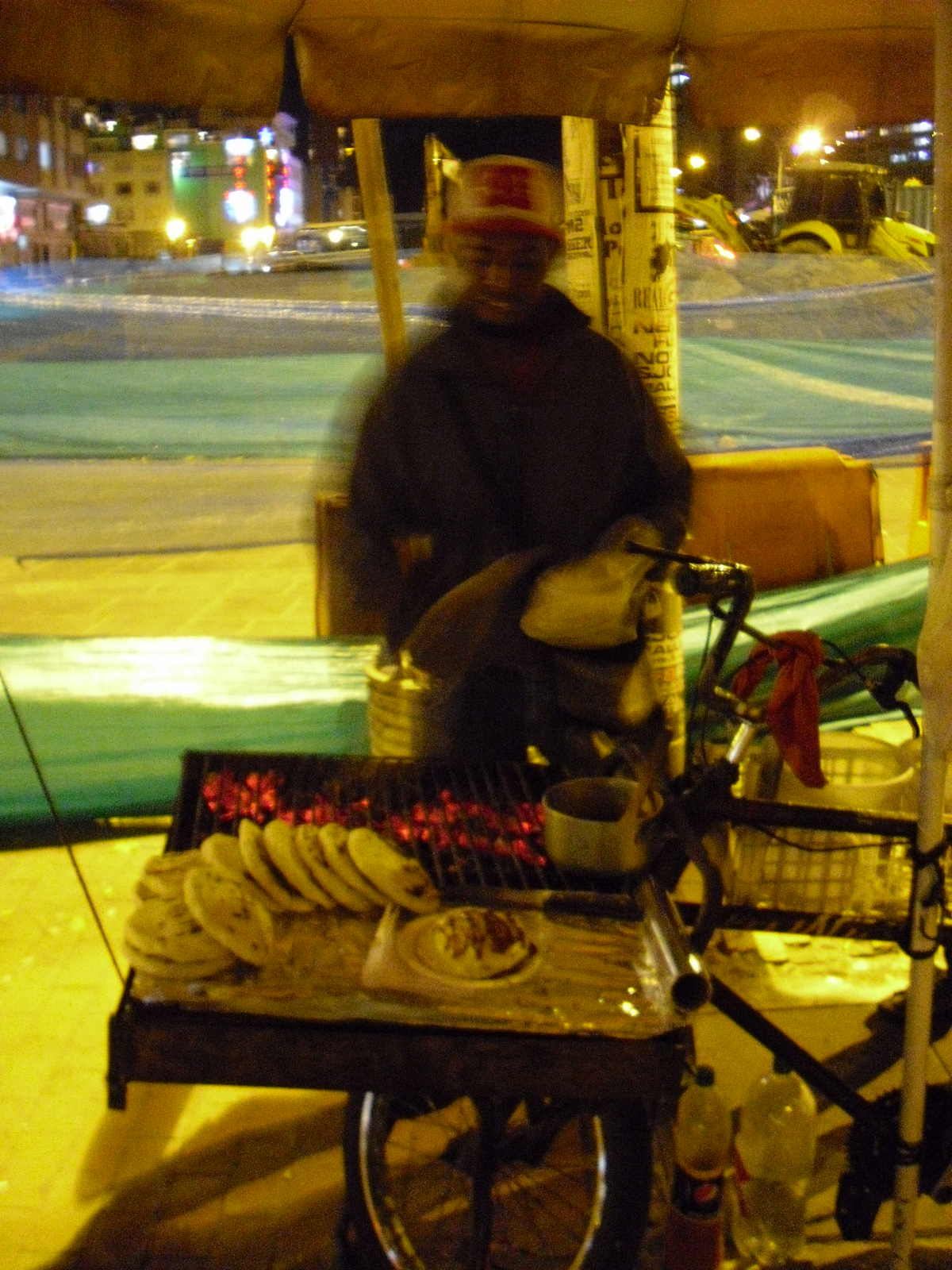
Street arepas

OK, we knew about these round corn-based delights before the start of 2012, but it was in this year that we really got to enjoy them; simple yet wonderful pleasures. 

The perfect hunger-buster on a chilly Bogotá evening, our preference has been the ‘carne con queso’ (that’s meat with cheese with a bit of BBQ sauce to boot) for a very agreeable $2,200 COP (roughly €1). 

For those of you who know the Colombian capital, our favourite place to consume these is from the vendor that operates outside the Colombo-Americano, Calle 19 with Carrera 3. We’ve missed them over the Christmas break — come back soon.
Street arepas - quite delicious
Quality grub.
So that's some of our highlights from 2012. All that's left for us to say for now is, Happy New Year to all; onwards and upwards in 2013.

 ________________________ 
*Please note, for an updated, more positive piece on Venezuela, see (for starters) see Venezuela: A necessary reappraisal.
 

Monday, 5 November 2012

Bogotá's simple pleasures

It should come as no surprise to you that we’re far from high-maintenance here at Wrong Way. It’s the simple, small things in life that we tend to derive most pleasure from.

Keep it simple, stupid

That’s why, for example, we like to do our grocery shopping in Bogotá at La 14 – the supermarket that feeds you for ‘free’ while you stock up. 

It is said that you should never shop on an empty stomach but having something to eat before you hit for La 14 (on weekend afternoons anyway) will only spoil your experience. Between the various complimentary servings on offer – meat, pasta, biscuits, cereal, fruit, ice-cream, you name it – you generally leave there quite satisfied. 

We’d nearly (nearly that is) pay a little bit more for such customer service. But get this, it’s about the best value supermarket around – as close to a win-win scenario you’ll get in these parts.
Bogotá's simple pleasures: Service with a smile. Our local barman dishing out the booze
'Me regalas 'una grande' Servio, por favor.' Quality service with a smile.
When it comes to our favourite vice of alcohol we’re more than happy out knocking down a few 750 ml bottles of the national brews Aguila or Poker in a local tienda (‘old man’s bar’, as we’d refer to them in Ireland) for the very agreeable price of 2,300 pesos (about €1 or so). 

Go to the more upmarket Bogotá Beer Company (BBC) chains or the "Irish" Pubs and you’ll pay at least four times more for just three-quarters the quantity of booze. 
 
Plus, in those places you tend to be just another number. In our local tiendas, we’re greeted with a handshake and a smile each time we visit. It’s nice to feel welcomed (the fact we tend to polish off a nice few bottles plays its part in our being gleefully greeted. We do, after all, have to play up to the Irish stereotype).

The same goes for our regular café visits – we find the simple, rough-and-ready local ones far more agreeable in price, atmosphere and customer service (the latter we refer to in Latin American terms – the standards are pretty low on that front. See ‘Doing Business in SAhttp://bit.ly/LVpK8p for more). 

What’s more, we don’t tend to see a major difference in the quality compared to a "fancy" Juan Valdez or an Oma coffee house.
Bogotá's simple pleasures: Our bog standard local café - basic yet brilliant
Simple, cheap & very satisfying - the local café.
For many Bogotanos, though, it’s not hip to be seen in your bog-standard café – the same goes for drinking in the tiendas. Such an approach is usually fine for the women because they don’t expect to pay anyway. 

You would think, then, that they’d allow the men choose the location, but no. We, however, are quite principled on this one, usually. 

Forking out greater-than-European prices to drink in places where, firstly, you're treated no better than dirt and, secondly, the clientèle and environment are generally very fake is not our thing. We can happily live without the people who frequent such places.

The above simple pleasures are ones we now know and expect. They still, of course, do the trick but it’s always nice to get treated from an unexpected source every now and again. 

However, such unplanned random experiences can be hard to come by in this city. We had one, though, on a recent buseta/colectivo journey.

OK, we have expressed before (see ‘Bogotá’s Transport Truthshttp://bit.ly/N68gKL and ‘Dulling Down Bogotáhttp://bit.ly/XdUg5U) our preference for these old-school city transport buses but that was more because we felt they were the least-bad option, not because we found taking them overly pleasurable.

What made this particular commute to one of our classes a stand-out experience was the conduct of our conductor or bus driver, if you will. 

As it was initially unclear from the colourful but confusing route display (nothing unusual there) if this bus we’d flagged down was going in the direction we needed, we had to ask the driver to make sure. 

Once Señor Conductor realised we were native English speakers, he immediately ushered us into his screened-off zone – a place usually reserved for family members or very, very good friends. 

This is the business class/VIP section of Bogotá public transport. A front-row seat right next to the driver, out of view from the "commoners" in the back. How privileged we felt.
Bogotá's simple pleasures: The Colectivo VIP treatment - we were privileged to be invited to sit next to the driver
The 'special' bus seat next to the driver - usually only reserved for family.
The reason he invited us in to his sanctuary was because he has a desire to learn English (although, our conversation was all in Spanish). We’ll let the fact slide that he has so far failed to follow up on his offer of inviting us to dinner – sure you can’t win them all. 

In any case, the special bus journey was enough to put is in a positive mood for the rest of the morning.

So as you can see we tend to be easily pleased here - very much subscribers to the 'keep it simple, stupid' principle. Alas, it can be hard to get the ladies to sign up to the same programme. We'll keep trying, though.

Sunday, 15 January 2012

Turbo living

There is a tired concept followed by a number of backpackers these days – the desire to do the "non-tourist" thing. Yes, it’s a bit of a paradox, trying to avoid being something you clearly are. 

Very often those looking to go to the non-tourist place end up so much out of the way that there is little, if anything, to do or see in said place. Or worse, they arrive in a location that is famous for one rather big attraction, for example, Cusco in Peru, the gateway to the ancient city of Machu Picchu, yet decide not to see the main draw because it’s too "touristy". Why bother going then, eh?

Sometimes, though, especially if you’ve been on the go for a relatively long period of time, it is nice just to take a break from the main tourist drag. To rock up in a place that gets very few outsiders. If that is what you are looking for, a good rule of thumb is to pick a location that is not mentioned in Lonely Planet - the bible for many nomads - or suchlike. 
Turbo living: The entrance into the port in Turbo, Colombia. It doubles up as the towns rubbish tip.
The entrance into Turbo's port-cum-rubbish tip.
Or else opt for a spot that gets a very negative write-up in the guidebooks. It’s the latter type we found ourselves staying in recently – the transit, coastal city of Turbo, on Colombia’s north coast.

It’s where you’ll find yourself if you’re either coming from or going to the remote, car-free beach resort of Capurganá, a choppy three-hour speed boat journey up the coast, just a short hop from Panama. 

If you follow Lonely Planet’s lead, you won’t stay in Turbo – in and out of the place as fast as you can is the advice you’ll get from that publication. 

Indeed, the actions of the locals seem to back this up. It’s one of the few places where on your arrival, by land or sea, you’ll instantly have the natives approaching you asking what part of the country you want to go to next. It nearly feels like you’re not allowed to stay. 

But keeping with the title of this blog, we decided to stick it out for a couple of days here. Sure why not? Let's be the ‘only tourist in the village’, to paraphrase the sketch show Little Britain

Now considering my own home place isn’t exactly a big tourist spot, maybe I have a natural affiliation with similar settings. Because, on the face of it, there is very little to do in Turbo. 

Yes, it’s a busy hub, even without the steady flow of passers-by. But it’s quite dirty – the hiving port doubling up as the local rubbish tip, replete with the accompanying smells. The nearest beach is a good twenty-minute bus drive away, so there’s not even a nice place to cool down and relax within walking distance.

Yet, in terms of what we wanted, it didn’t disappoint. Of course, when you have no expectations, even the slightest plus point means you’re up in the deal. 

So what does it have? Well, if you are looking for a break from fellow backpackers, you’ll get it here, especially at night once the coming and going of speed boats and buses ceases. 

Plus, once the locals realise you’re actually staying for more than a couple of hours, they’ll stop pestering you for a ticket to your next destination. And amazingly, unlike more well-trodden places, they won’t harass you for anything else. You’ll be left in peace. 

On top of all this – and importantly so considering we’re all watching our pesos these days – there’s value to be had in the place. An en suite private room with TV in a hotel overlooking the semi-attractive main square (about the nicest thing in the town) for less than €10 – as good a price you’ll find anywhere in Colombia. 

Equally just as important, we managed to find a bar that sold bottles of the very agreeable local brews Aguila & Pilsen for $1,300 Colombian pesos (roughly €0.50, yes 50 cents that is) – a price so far unmatched on our travels here. 

Also, considering not many tourists decide to stay here, you get a more genuine taste of things – a flavour, perhaps, of the real Colombia. Throw in what was a lively enough nightlife (granted it was a holiday weekend when we arrived) along with friendly, helpful locals and you’ve got a pretty decent mix.

Indeed, the perfect stop to engage in a bit of non-tourist living. Better just keep it to yourself, though.