Showing posts with label Barrio Santandercito. Show all posts

Thursday, 14 May 2026

A surprising side to Bogotá's boisterous Barrio Santandercito

@wwaycorrigan

[For an audio/vlog version of this story, click here.]

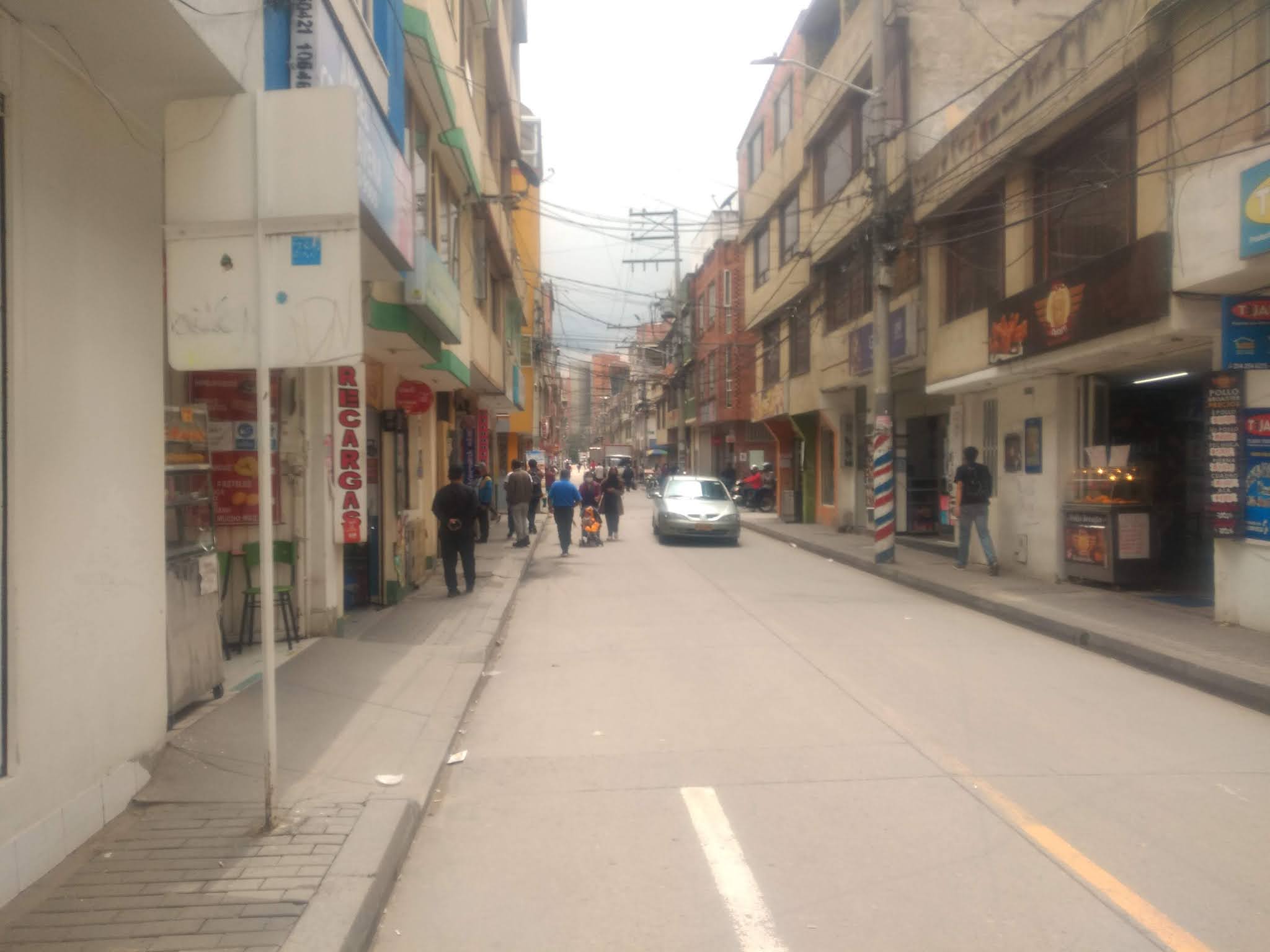
Of all the ways I could describe — and have described — my preferred Bogotá barrio, Santandercito, quiet is not the first word that comes to mind.

A rooftop view of Carrera 16, the main entrance into the northern Bogotá barrio of Santandercito.
Silent Santandercito: Well, not quite. But it does have a quieter side.
Boisterous and bustling. Yes. Tame and tranquil. No. It is, after all, a small and rather densely populated sector of a massive metropolis in a country where the locals' overall attitude to excessive noise levels appears indifferent at best, welcoming at worst.

When an individual or group in a private dwelling decides to listen to an arrangement of noises that, amongst some cohorts, is considered music and therefore enjoyable, this tends to come with a belief that the whole barrio wants to hear it. Thus, it is played to eardrum-damaging levels. One might see it as deadbeats banging out ludicrously loud beats, but I wouldn't go that far.

Now, as a somewhat sheltered cul-de-sac barrio, Santandercito is spared the regular roars from passing vehicular traffic. Yet, the motor vehicles that do enter its environs frequently do their best to make up for this absence. Exhaust sounds that range from booming to screeching are heard more frequently than one would like — which, admittedly, is never. Indeed, I can't understand how anyone tolerates such a racket.

'Experience of similar terrain and raucous raiders told me to prepare myself for something akin to Russia's current war against Ukraine. A stalemate.'

A tad more tolerable are the occasional wandering salespeople and scrap-metal collectors who ensure they are heard well before they are seen, thanks to the pumping out of a recording describing their services, usually supplemented with some cheesy tunes. At least these guys are working.

With such cacophonies, finding a quiet corner in the barrio is next to impossible. The single-course, hollow-brick walls in these parts are, after all, thin. Sounds tend to run through them with impunity. The same goes for the single-glazed, generously permeable windows.

Cacophony conflict

So it was with some trepidation that I willingly put myself into direct conflict with all this barrio noise. Before combat, my fanciful hopes were that it might be like the Anglo-Zanzibar War of 1896 — a 38-minute affair — with me victorious, of course. After all, I had been reconnoitring the battle zone weeks in advance and figured I could sweep to success. Yet, previous experience of similar terrain and raucous raiders told me to prepare myself for something akin to Russia's current war against Ukraine. A protracted stalemate.

As it transpired, it was practically a rout. Well, it wasn't quite as swift as the Brits in Zanzibar; it was about three times as long, but I simply couldn't complete my objective any sooner.

Advanced planning told me that Operation Record Quotes and Notes on James Boswell's Life of Samuel Johnson would need to be tackled from three fronts, a trio of attacks that would last, in the best-case scenario, roughly 30 minutes each. Quite amazingly, it went more or less to plan. The audio-blog-recording battlefield provided very little resistance in terms of a dreaded, damaging noise assault.

Yes, to my pleasant surprise, the room I occupy in my current abode proved to be a dependable recording studio for a project with close to two hours of script. I had been expecting constant interruptions from all the aforementioned noises. In San Martín, for example, just to record a mere five-minute audio blog, I regularly needed double that time.

Silent surprise

So how is it that this spot in a regularly boisterous barrio is something of a serene sanctuary?

It certainly helps that it's a room on the second floor (first floor for the Brits and Irish) of an apartment that is isolated from the main street.

However, it's not completely closed off from the outside. It has windows, my room included, looking out onto the open square space that is a common feature in Colombian apartment buildings.

This space, about two square metres in size, is for service pipes and suchlike, apparently. It often doubles up as a rubbish-collection spot, too. Various items that escape from the windows of the apartments above find a resting place on the plastic roof covering the first floor — or ground floor, if you prefer.

'It is a lively and regularly noisy spot, but this noise doesn't seem to be as pervasive as I had previously thought.'

Despite that, I'm glad of the space because it lets natural light into my room. I couldn't stay for any length of time in a room that gets no natural light. I find such rooms utterly depressing. Incredulously, some Colombians seem to prefer them.

Anyway, these welcome light-giving windows provide no real barrier to sound.

So that I managed to record in relative silence — a small bit of background noise doesn't tend to be picked up by my microphone — is rather surprising.

To repeat, the apartment's setting is a help. The barrio noises clearly don't travel as easily as I had thought or expected them to. I was also lucky with my timing.

On the three occasions that I recorded these lengthy scripts, the neighbours on the floor above were silent. This isn't a rarity, but it's not that usual either. Oftentimes, they're listening to Christian music at levels that are a little too high for my liking. Perhaps they're trying to send me a message? The good Lord is, literally, speaking to me from above.

Excessive dog barking, from both within the building and outside, was also absent during my recording sessions. Again, quite unusual that.

That there weren't downpours also worked to my advantage. Although the sound of heavy rain falling on the plastic roof next to my bedroom might have proved an attractive background track to my voice. Most likely, though, it would have drowned me out. How terrible that would be!

This whole lack-of-excessive-noise experience has led me to reappraise my perception of Barrio Santandercito. For sure, it is a lively and regularly noisy spot, but this noise doesn't seem to be as pervasive as I had previously thought. Equally as important, however, is the somewhat isolated, insulated nature of my lodgings: a serene sanctuary, of sorts, from Santandercito's unsolicited sounds.
__________________________________________________________
Listen to The Corrigan Cast podcast here.

Facebook: Wrong Way Corrigan — The Blog & IQuiz "The Bogotá Pub Quiz".

Friday, 11 April 2025

Colombia and a few of my favourite things

@wwaycorrigan

[For an audio/vlog version of this story, click here.]

I was looking back at previous blog articles — a blogger's version of going through old photos — when I found Introducing "our" Colombia, published in July 2017. In that piece, in an attempt to remind readers there's no "u" in Colombia, each letter from the word Colombia was used to refer to something that represented the country for me.

Now, while many things in that original story still hold, I feel it's time for an update.

Ergo, I present, in Sesame Street style, 'My Colombia 2025'. (Do note, other letters of the alphabet are available to list some of my favourite things in the country, but I have to follow the format here.)

Image shows a blend of some of the writer's favourite things from Colombia.
Our Colombian smorgasbord. Tasty and wholesome!

C is for Costeña (and cuajada)

In my earliest days living in Colombia, I was a fan of Costeña lager. While its taste was similar to the more popular Bavaria beers i.e. Aguila and Poker, it stood out from the others thanks to the form in which it came: a 350 ml short-neck, stubby bottle. The rest were in 330 ml long-neck bottles. Costeña was always competitively priced, too.

When Bavaria introduced 750 ml bottles in mid-2012, followed a few years later by litre bottles, the beer company shifted away from Costeña (initially, in some parts of Colombia anyway, 750 ml Costeña bottles had been available but were soon phased out).

The beer eventually disappeared from the tienda fridges. It was only available in 330 ml cans in some supermarkets.

But in late 2023, Costeña came back to liven up the market. OK, the standout stubby 350 ml bottle is no longer available — it's in the standard 330 ml long-neck — but its return in 750 ml bottles is very welcome. It's almost always cheaper than Aguila and Poker, sometimes up to 40 per cent less, and I don't think it's in any way inferior.

Many Colombians seem to agree with me. From my observations, Costeña is growing in popularity in cantinas and tiendas across the country. It is the economy of it, stupid. Why pay more for a similar brew that doesn't really offer anything different?

Another "c" I'm compelled to mention here is cuajada, a fresh cheese made from milk curds.

For most of my time in Colombia, I'd effectively given up on cheese because I felt the quality of most of it was poor while I also found it quite costly, relatively speaking (I was guilty, though, of not shopping around on this one — a rarity for me).

However, while in San José del Guaviare last year, I got into eating cuajada — and continue to do so. As it's practically salt-free and very mild, I find it a refreshing snack, particularly in warmer climes. And at an average of 9,000 COP per pound, it's not badly priced.

O is for oficinas

As a mostly independent operator in these parts (more on that to come), the ability to spend a few hours every day in Colombia's ubiquitous panaderías — cafés-cum-bakeries — is essential for me. They are my offices, oficinas, where I go to read and write whilst sipping on a competitively priced (yes, there's a theme here) tinto (black coffee) and the odd piece of fresh-from-the-oven bread.
'Before, when offered a bowl of soup with hens' feet protruding from it, I'd politely decline whilst silently thinking what sort of savages eat such tripe, or rather entrails and unsightly body parts of fowl to be specific.'
Yes, I could do this in my place of residence. But, as I explained in a previous post, the coffee shop effect is at play. I'm better able to focus in an establishment where people are coming and going and where there's light background noise. Light, that is. Such places do exist in Colombia, at least on occasions.

L is for los Llanos

Los Llanos, Colombia's vast plains and traditional cowboy (and girl) country. More by accident than design — as with most things in my life — over the last few months I've become well acquainted with the mild hustle and bustle of these plains. To be more specific, considering the enormity of the region in question, I've got to know how things roll in the towns of Granada and that of my current abode, San Martín de los Llanos, neighbouring municipalities in the Meta department.

With temperature highs around 30 degrees Celsius, the temptation for an evening ice-cold Costeña beer in one of my preferred cantinas/tiendas is difficult to resist. So, residing here may not be the best for my health. Nor is it good for doing computer work. I've little enthusiasm to turn on my laptop. It's the heat's fault.

Nonetheless, as a man born and reared on a cattle farm, I find the vibe of the place comforting, most of the time. Sure it wouldn't be true cowboy country without the odd drive-by shooting. And I'm warming to the ever-so-pretty tarantulas.

O is for on the road

OK, it would be helpful if there was a "u" in Colombia for the purpose of this exercise. Although, I'm not sure if I even have a favourite "u". Oh wait, of course I do. Former president Uribe. The people's president. Or the paisas president, at least.
'In some ways I feel that the Boyacá department is my spiritual home.'
Sticking to the rules, though, my second "o" is for on the road. This is when I usually feel most relaxed in this land, travelling around it. "B" and "i", below, expand a little more on this.

M is for menudencias soup

A sign, perhaps, of how much I've adapted to life in Colombia. Years ago, when offered a bowl of soup with hens' feet protruding from it, I'd politely decline whilst silently thinking what sort of savages eat such tripe, or rather entrails and unsightly body parts of fowl, to be specific.

Nowadays, I find this pick-and-mix delicacy hearty and wholesome, and, wait for it, competitively priced. It's better than ultra-processed rubbish in any case.

B is for Boyacá and Bogotá's barrios populares

While I'm currently based in los Llanos, in some ways I feel that the Boyacá department is more my spiritual home. One reason for this is that towns in its loftier and thus cooler locations have what I consider a more Irish countryside hue about them. And because of its mountainous terrain, there's more variety to it than the relative sameness of the plains.

For example, the low-lying town of San Luis de Gaceno, in the department's south, has a culture and climate similar to San Martín. Further north and high up in the Andes is the quaint colonial settlement of Güicán, close to one of Colombia's few remaining glaciers. There, goats and sheep are almost as numerous as cattle. Ovines are pretty much non-existent in los Llanos.

What I'll call my Boyacá bromance really got going once life started moving again after the pernicious covid-19 lockdowns. From my base in the far north of Bogotá, within walking distance of the city's northern bus terminal, it was easy for me to escape to the myriad towns further north. And this I happily and regularly did between 2021 and 2023.

As for Bogotá's barrios populares, especially Santandercito in the far north, I feel at home there. Yes, Santandercito and surrounds have their rough edges, yet there's a sense of community that I feel is lacking in other, more affluent neighbourhoods in the capital. Many barrios populares are like small, welcoming towns in a big, impersonal city.

I is for independence


Colombia has allowed me to avoid working a full-time job, save for one uninspiring experience as a copywriter/translator at a marketing agency from December 2018 to January 2020. Thus, I have been able to move around the country pretty much when I want to.

An employer would have to pay me quite an amount of money for me to sacrifice this employment independence, largely economically inactive as I currently am, albeit. As I've said before, I prefer to work with people rather than for people. Or work on my own, when and where possible.

A is for Amazon

Few people in the world haven't heard of the Amazon (no, I don't mean the company, which I've never used). And I'm sure many would love to get the chance to visit it. So, having been on its doorstep for years, it had always been in my plans to go there.

Now while San José del Guaviare, a town I first visited in 2017, is technically in Colombia's Amazon region, it's not in the Amazonas department. And I always felt that I couldn't call time on my days in Colombia without visiting Amazonas.

This, I finally did in 2024. Very loosely following in the footsteps of Roger Casement, I travelled to the indigenous reserve of La Chorrera, which you can read about here. As I say in that piece, I'm in no rush to return to La Chorrera itself. However, it was quite an experience and I wouldn't mind exploring other parts of the Amazon in the months and years to come.

So that's it. My latest spelling out of what C-O-L-O-M-B-I-A means to me. Until the next time.
__________________________________________________________
Listen to The Corrigan Cast podcast here.

Facebook: Wrong Way Corrigan — The Blog & IQuiz "The Bogotá Pub Quiz".

Friday, 29 October 2021

The barrio banker

@wwaycorrigan

[Listen to an audio version of this blog entry here.]

Strange as this may seem considering my current less-than-robust financial situation and lack of a steady income, but I have become the chief moneylender for one barrio friend over the last number of years.

The barrio banker: Cash is still king in Colombia, as long as one has it, that is.
Easy money — when it comes from the Wrong Way Bank, that is.
It breaks with a long-standing rule of mine to not give money to anyone here. 

Previous experience has taught me that while some may ask for a dig-out using the verb 'prestar', literally 'lend', what they usually have in mind is the more common Colombian word when looking for something: 'regalar', 'gift'. (I recall asking for a drink in the Spanish capital Madrid using 'regálame'. The barman's retort was that they didn't 'gift things' in that establishment.)

'I'm good for it'

Of course, it's just an expression. Few if any people who utter it on a daily basis here actually expect to get what they want for free. Rather wishful thinking if they do. 

It could be argued, however, that when addressing a native of a high-income country, the more literal meaning is very much in mind for some locals. 'These rich foreigners can easily afford to give things away.'

Whatever the case, actions speak louder than words. So whether my now regular client uses 'prestar' or 'regalar' when he comes looking for a loan matters little, it's his ability to pay back that counts.

Barrio banking: Santandercito in North Bogotá. Not quite a traditional banker's paradise.
Barrio banking: Money's too tight to mention.
The first time I agreed to lend him a relatively substantial sum of money, my thinking was that it would double up as a way to test the strength of the friendship. If he defaulted, well I'd have to take the hit but be somewhat comforted by the fact that I'd unmasked a false friend.

Not only did he not default but he paid back the amount in full ahead of the stated due date. Punctuality is a rarity in Colombia in all walks of life, never mind doing something ahead of schedule. I was both relieved and impressed.

So the next time he asked for financial assistance I was more relaxed when handing over the cash. And yes, these are real cash transactions — notes still dominate here for the masses, something I'm not at all averse to.

Now,  considering I've known him since 2016 and for at least the last four years I've rated him as a trustworthy friend, I view this money-lending akin to helping out family.

One must be very selective in this regard, even if those who seek handouts aren't in anyways shy in doing so. In fact, it never ceases to amaze me how people I barely know appear to have no reservations about asking for money.
'I'd soon be relieved of my money-lending duties if I were employed in the House of Rothschild. Interest-free, verbally agreed loans won't put one on the road to riches.'

OK, I've been fortunate enough in my life so far that I've never been in a terribly tight financial position but if I were to need emergency funds, it would most likely be family and/or really good, long-standing friends I'd ask first, not some person I hardly know.

The fact of the matter in most of Colombia is that other family members probably don't have the resources to help out so it's worth chancing the arm with the seemingly 'flush gringo'. Nothing to lose, really.

Barrio banking: Beware of Colombia's infamous fake-note swindle.
'Your fake notes are no good here.'
However, I'm certainly no Rothschild or, in a more sinister sense, Shylock, for better or for worse. I'd soon be relieved of my money-lending duties if I were employed in the House of Rothschild. Interest-free, verbally agreed loans won't put one on the road to riches. 

Although, I do get interest paid in-kind via the occasional meal or beer it must be said. Also, similar to those infamous Jewish moneylenders, I am an outsider in the barrio, no matter how much I feel — and am made feel — part of it.

A genuine fake

It is, somewhat paradoxically, these more substantial loans that have proved to be less risky. Getting back on-the-spot payments of up to 20,000 pesos can be next to impossible. And all those small amounts do soon add up.

There is also the issue of a fake-note swindle when dealing in cash, a fate I had the displeasure of suffering recently.

Having given a 20,000-peso note to a lad with whom I consider I have a decent relationship, he returned a few minutes later with the note ripped, telling me it was fake.

There are three possibilities here: I had a fake note of which I was unaware; my friend was tricked by the street vendor from whom he attempted to make a purchase; my friend pulled a fast one on me.

Weighing all these up and taking into account the reaction of others in the tienda bar where I gave this friend the money — including close family of his — the last seems the most likely.

That being so, no doubt many will ask how can I call this guy a friend? It basically comes down to his all-round behaviour. He may be unreliable when it comes to money yet on most other fronts he's a likeable "marica".

It's why, as the old saying goes, one shouldn't mix business with pleasure. And it's why my barrio banking isn't a business but more a case of helping out friends whose needs appear greater than mine.

I just hope I don't end up doing some similar, desperate asking in the future.  
_______________________________________________________________
Listen to Wrong Way's Colombia Cast podcast here.

Facebook: Wrong Way Corrigan — The Blog & IQuiz "The Bogotá Pub Quiz".
 

Wednesday, 10 March 2021

Home is where the barrio is

@wwaycorrigan

[Listen to an audio version of this blog entry here.]

Before my adult days, I remember being rather puzzled about my father's strong desire to get back to his local haunt(s) whenever we'd be out and about.

Home is where the barrio is: A street that I call the Middle East in Barrio Santandercito, in the north of Bogotá. There's rarely a dull moment here at the weekends.
Calm after the storm: The at times action-packed Barrio Santandercito.
In fact, even when I started my own beer-accompanied socialising and on the rare occasions I'd be with my Dad in an unfamiliar setting, this itchy-feet tendency to return to his stomping ground bemused me.

Where everybody knows your name

'Just relax and enjoy the new surroundings', I'd think to myself. 'What's the panic?'

Now, however, and perhaps with the pandemic serving as a catalyst, I better understand this fondness for "home" comforts. Similar to my father, this isn't an eagerness to be back where I sleep — I've never been able to truly call home any place I've rented. It's a case of being in the environment where I socialise the most, with my Bogotá buddies.

This is at odds with many an adage. Take your pick from, to name but three, variety is the spice of life, familiarity breeds contempt, a change is as good as a rest. I'm sure there are more.

Yet, forced for months on end to not really being allowed to venture outside my part of Bogotá, now that one can officially travel unrestrictedly around Colombia, my enthusiasm to do so is somewhat lacking.
'Thrifty tendencies do also have their mental rewards.'

In fact, it's at a stage where visiting the first barrio popular that I called "home", La Perseverancia, 18 kilometres south of my current abode, now seems like a holiday. I haven't brought the overnight bag there yet, but it might be an option next time after the hassle I had trying to get home on the previous occasion I visited. One can never rely on public transport in Bogotá.

Break free

What's more, the few times that I haven't been able to call into my panadería "office" throughout this pandemic, I've been left a little ill at ease. The panadería owners, acting in good faith, of course, play their part in this, chastising me for my sporadic absences, accusing me of being a traitor. 'If Brendan's not here this morning, where the heck is he?'

What all this basically amounts to is that I've become comfortable in my routine. Comfortable in mediocrity, in the unspectacular one could say.

Linked to this is a feeling, to a certain extent, that I'm undeserving of a holiday because I haven't had steady work — or at least work that puts pesos in my pocket — throughout the pandemic. You know, one shouldn't be spending money recklessly when one isn't sure from where the next meaningful payday is going to come.

That whole live-each-day-like-it's-your-last mentality is wonderful in theory. However, if I were to let the handbrake off and truly live as I wish, well then I'd want to be in my last few days on this planet — it would be financially unsustainable as things stand at present. Thrifty tendencies do also have their mental rewards.

Nonetheless, a break from the Bogotá barrio is coming. It must.

Experience lets me know that I can find as much joy — if not more, for a time at least — in a more tranquil setting. Every town has its panaderías, tiendas and streets to wander after all. Same, same but different.
_______________________________________________________________
Listen to Wrong Way's Colombia Cast podcast here.

Facebook: Wrong Way Corrigan — The Blog & IQuiz "The Bogotá Pub Quiz".

Friday, 15 January 2021

Where's Archie? The curious case of Bogotá's Cuban cardiologist and the phantom smartphones

 @wwaycorrigan

[Listen to an audio version of this blog entry here.]

After more than nine years based in Colombia, I've learnt, slowly albeit, not to be so trustworthy of anybody, at any time, in any situation. The default mode is to think somebody's trying to swindle you until you have concrete proof he/she is not. Guilty until proven innocent, basically.

Where's Archie? The curious case of Bogotá's Cuban cardiologist and the phantom smartphones: Archie Silva, Bogotá's Cuban cardiologist.
O Archie, Archie! Wherefore art thou Archie?
Every now and again, however, one drops the guard. Or better said, somebody comes along who sounds so believable, comes across as so genuine, that you effectively buy his/her horse manure.

Now, I must say that in this particular fraud it wasn't that my friends and I were completely naïve. We didn't just dive in head first without initially testing the murky waters.

A rat in a cardiologist's clothing

We did weigh up the pros and cons of what was on offer. Suffice to say my partners, nay main players, in the deal were Colombians — they can generally smell a rat before it's even born.

It just didn't make sense to us that a seemingly respected Cuban cardiologist working at Bogotá's Cardio Infantil — he, Archie Silva, has a LinkedIn profile "confirming" this (see photo above) — would feel the need to rob a few pobrecitos (poor folk, that is) of what is, in the great scheme of things, an insignificant sum of money. (350,000 pesos in case you're wondering, about 84 euros.)

What's more, when I first met Archie in late November 2020 through a mutual contact, he wined me — well, Poker-beered me to be precise — all day while he, stereotypically enough, downed rum and another substance which shall remain unnamed. 

He even put credit in my phone as I had none and I needed to send a few emails explaining away this impromptu session.

So I had few reasons to doubt him when he told me he could source factory-price smartphones in Germany, a country in which he studied, through a friend there. 

Whatever the case, it didn't pique my interest at the time as I was, and remain, happy with the phone I have.
"He told me he couldn't ask for new phones regularly as 'it would be a breach of trust' with this German friend. That made sense to me."

About a month later, however, a couple of good friends in "my" Barrio Santandercito were in the market for new phones. The Cuban entered my head.

We sent him a WhatsApp message. He could get us ridiculously cheap Samsung S20 Plus models. After much toing and froing of messages, getting clarification on everything, my friends were confident enough to go ahead with the deal. I figured if these working-class, streetwise Colombians were willing, then fair enough.

As the middleman and without work to go to on the following Monday, 28 December, it was up to me to meet Archie to give him the first payment to put in motion the purchase. It was half the overall price, the aforementioned 350,000 pesos, 200,000 of which was my own money.

I met him at the entrance of Barrio Santandercito on Calle 183 with Carrera 15. We grabbed a coffee in a nearby panadería, for which he paid.

Too good to be true

Before I handed over the money, I did ask him if he'd heard of the old expression, 'If it sounds too good to be true, it probably is.' He assured me that this was legitimate, that it was a favour from his friend in Germany who worked for Samsung. Archie had apparently carried out life-saving surgery on this man's mother years ago.

As for the remarkably quick delivery time which I doubted could be realised — they were due on the Wednesday, just 48 hours later — he said they'd be sent by DHL that very Monday.

What's more, he told me he couldn't ask for new phones regularly as 'it would be a breach of trust' with this German friend. That made sense to me.  

So I handed over the money. A final step was for me to send Archie my friend's personal details 'for the guarantee', which I did later that day.

'See you Wednesday. It's also my day off, so we can have a few drinks', he suggested as we parted ways. I wasn't too enthusiastic for a mid-week session, I just wanted the phones.

I left it until the afternoon on Wednesday to reach out to Archie. 'They haven't arrived yet, hermano, but don't worry, they're on their way. I'll let you know.'

I had thought that it would be remarkable if they arrived in such a short period of time, especially over the Christmas period. My friends waiting for the phones weren't in a major panic either. We could wait.

The last messages I exchanged with Archie were on Saturday, 2 January. That day he told me the phones were already in Colombia, at DHL's office by the airport. He told me to contact him the following Monday and we'd take it from there.

Since then, nothing. WhatsApp messages remain unseen, phone calls go straight to voicemail.

Maybe, just maybe, something untoward has happened to him. Perhaps I'm wrong to think that we've been had.

After all, if you can't trust a Cuban cardiologist, who can you trust?
_______________________________________________________________
Listen to Wrong Way's Colombia Cast podcast here.

Facebook: Wrong Way Corrigan — The Blog & IQuiz "The Bogotá Pub Quiz"


Saturday, 20 June 2020

The Bogotá nomad

It has been said that the first item on the agenda of a newly formed Irish political party is the split. Ireland just doesn't do unity very well, it seems.
The Bogotá nomad: A housing estate in north Bogotá, Colombia.
Houses, houses everywhere but none that suits Wrong Way ...
Borrowing from that, after over eight years of Bogotá as my base, it would seem the first item on my imaginary agenda when I move into new accommodation is, 'Where will I live next?'

A moving target

I count 16 room rentals, excluding hostels, that I've had in the Colombian capital. That is to say, two house moves a year on average, although, somewhat embarrassingly, I've just completed move number three in as many months. Come on, we are living in, wait for it, unprecedented times, so this year's upheaval is excusable.

(I'm pretty sure I would have stayed where I was from June 2019 to March of this year had there been no lockdown, coming as it did with the prospect of sharing a house with a noisy six-year-old boy — the rules of engagement changed and I didn't like what I was facing into.)

Also, it's important to note that in the period from September 2016 to September 2018 — when I returned to Ireland for a family event, uncertain as to my Colombian future — I stayed in the same place.

You could say I found something resembling comfort in that apartment share on the city's northern reaches, 175th Street just off the motorway (autopista norte). Indeed, that greater area, especially Barrio Santandercito/San Antonio, remains my "stomping ground" of sorts.

Granted, it's quite far away from the centre and "hip" Chapinero and its surrounds, parts of town that could be said to be a little more cosmopolitan — they certainly have more foreign faces about in any case.
'My Colombian life has never really felt that real.'
Despite that, or perhaps because of it, I certainly don't miss living in the historic centre, La Candelaria, for one. In terms of city living, I want for little in the far north — bar my own place of course.

So, you ask, why haven't I got that after all this time? For starters, had I known back in 2012 that Bogotá would be my home for this long, it's fairly likely I would have made finding my own place a priority, thus nipping this housing headache in the bud.

Alas, like a garden bush you keep promising yourself to trim back but never get around to it, this issue has grown rather wild over the years. Now it just seems overwhelming to tackle.

And every time I'm reminded of it i.e. I have to move again, I usually think I won't be in the city too much longer so a short-term solution is the best approach, especially from a financial perspective (that's not only the more expensive rent but also the cost of making a vacant property a home for what may only be a couple of months).

The Colombian dream

You see, I've never been at a stage here where I've said to myself, 'Yea, this is it. I'm happy with what I'm doing so if nothing changes over the next while I see no reason to leave.'

Basically, if somebody had asked me that highly annoying, completely unoriginal interview question, 'Where do you see yourself in five years' time?', from a what-part-of-the-world perspective, at no time over the last eight years would I have answered 'Bogotá'. (In fairness, my general response to such a question is, 'Sorry, my clairvoyant skills just aren't what they used to be.')

At the risk of getting somewhat philosophical here, the thing is my Colombian life has never really felt that real. I came here on a bit of an adventure, to 'give it a lash'. A return to real living, you know, a proper, relatively well-paid job, maybe even settling down, having children, that kind of stuff, that's for somewhere else, not here.

That's been my thought process in any case. Nothing this year has changed that. In fact, it's only been reinforced.

The question is, what next? Now, if I can find a satisfying answer to that in the coming months, great. To borrow from one Irish "party" that has managed to avoid the inevitable split, I still haven't found what I'm looking for (that's the band U2, in case you're wonderin). Of course, one has to define what one is looking for before it can be found.

With that in mind, I'm as confident as I can be that having my own place is a necessity. It's a start, at least.
___________________________________________________________
Listen to Wrong Way's Colombia Cast podcast here.

Facebook: Wrong Way Corrigan — The Blog & IQuiz "The Bogotá Pub Quiz".

Friday, 12 June 2020

Coming clean on my Colombian addiction

OK. I admit it. I'm addicted.

For over a year, I thought I had it under control. The discipline and routine that a full-time job gave me saw my dependence on this reduce dramatically.

However, then came the double hit. The first was self-inflicted: resigning from said gainful employment. That was followed shortly by coronavirus and the resultant quasi-lockdown.

Crossing the line

In my bid to maintain some sort of routine in such uncertain times I once again found myself drifting, nay motoring at top speed, back to this old daily comfort. 

For sure, it's as Colombian (although, not exclusively so) as coffee — indeed, the two work well together — yet for some locals, the mere utterance of its name brings forth utter revulsion. 'Is that all this country means to you these days? You disgust me.'

Of course, it's not the only thing that I enjoy — if enjoy is the right word to use here — about Colombia, but I've only ever had it in this country. And no, I didn't come here specifically for it.

In fact, and you may not believe this, but I'd never heard of it before relocating to this part of the world. I first tried it out of pure, innocent curiosity. Unlike other "firsts", I don't fully remember where I was introduced to it. I think it may have been in one of my original local haunts in the La Perseverancia neighbourhood, although I can't say with any certainty.

What I do know is that it became much more of a habit when I moved to the northern reaches of Bogotá and started socialising in Barrio Santandercito. In one particular establishment, it was especially popular and readily available, at a very reasonable price.

You could have it on the premises — no questions asked, no one would take any notice bar the odd incredulous look if you were overindulging — or take it home to have later. I preferred to have it there and then, it's just not the same doing it at home alone.

That Santandercito outlet has since changed hands and the new administrators no longer sell it — they told me, rather surprisingly, that the profit margins were quite small compared to other, more "mainstream" products that require less preparation time.
'It gives me a kick at the moment of consumption but I do feel guilty, even a little shame, afterwards.'
Nonetheless, you generally don't have to go far in Bogotá to find another place where you can get it. My current dealer is based in Barrio Nueva Zelandia. It's a little pricier here compared to what it used to be in Santandercito, but you get a slightly bigger offering.

Ideally, it'd be best sold by weight as at times you think you've been handed a big one but once you start consuming it you realise there's a lot of air in it. It still goes down well all the same.

Perhaps some bigger operators sell it — if they have it at all that is — by weight, I'm not sure. Truth is, I've never looked for it in such places, I prefer to deal with independent, family-run providers.

Snorting like a pig

I've been trying to cut down on the amount I have these last couple of weeks but it hasn't been easy. I mean I don't even have to ask for it now, it's just handed to me. When I say I don't want that much, those selling it to me typically say, 'Sure go on, it'll do you no harm. Get it into you.'

Thing is, with the doses I'm consuming, I'm pretty sure it is doing me harm.

If I could get out of Bogotá for a few days, I could at least get a break from it. Out of sight, out of mind kind of thing. But, of course, with the measures in place to combat the spread of coronavirus, I can't leave the city.

For sure, I get a kick at the moment of consumption but I do feel guilty, even a little shame, afterwards.

Another pull factor is that in its purer form it's not actually that bad — studies even suggest it can be good for our health (see item number eight on this list). How I take it, though, it's mixed with stuff that is, to say the least, not great for one's body.

It is said the first step in solving a problem is admitting you have one. I'm crossing that hurdle.

I won't let pan chicharrón (for the ignorant amongst us, this is basically bread filled with pork scratchings — or pork cracklings as some may call it — best served straight out of the oven) control me. I shall control it. There is a way.

Coming clean on my Colombian addiction: Pan chicharrón, or mogolla chicharrona (bread filled with pork scratchings) with a dark (very dark!) perico (coffee with a dash of milk). Pure bliss!
Pan chicharrón with a dark perico (coffee with a dash of milk), pure bliss!
______________________________________________________
Listen to Wrong Way's Colombia Cast podcast here.

Facebook: Wrong Way Corrigan — The Blog & IQuiz "The Bogotá Pub Quiz".