Showing posts with label Santiago de Chile. Show all posts

Thursday, 18 November 2021

On this day, 2011: Plan Colombia begins

@wwaycorrigan

On this day, 2011: Plan Colombia begins. (Are you coming or going? Wrong Way Corrigan's entry and exit stamps into Colombia.)
Are you coming or going?
Nefarious nostalgia, eh?! The above photo shows my 18 November 2011 entrance stamp into Colombia — the tenth anniversary of a somewhat significant personal event.

As you can see, I did a lot of entering and exiting the country that year — one clearly wasn't as concerned about one's carbon footprint compared to today.

Give Colombia a lash!

I flew into Bogotá in June for a couple of weeks en route to take a voluntary journalist position in Santiago de Chile, then came back in September for another brief visit as part of my journey back to Ireland for a family wedding.
'Right now, I'm unsure where I'll be in ten days, never mind 10 years, as my current visa expires on 27 November.'

Yet the decision to come back to Colombia on this day in 2011 to, as I put it at the time, give living a lash here, was a game-changer.

It perhaps wasn't as ground-breaking a moment as that when a very verdant version of myself landed in Rio de Janeiro almost exactly three years earlier, 25 November 2008 (see 'Wrong Way' begins for more on that), but it was an important milestone nonetheless.

In effect, it was the start of this current Plan Colombia. I couldn't really hazard a guess as to where I will and want to be ten years hence, if I'm still lucky enough to be alive and kicking.

Indeed, as I write, I'm unsure where I'll be in ten days' time, with my current visa expiring on 27 November. Siempre hay algo, there's always something (to be done), as they say in these parts.
_______________________________________________________________
Listen to Wrong Way's Colombia Cast podcast here.

Facebook: Wrong Way Corrigan — The Blog & IQuiz "The Bogotá Pub Quiz".  

Tuesday, 31 January 2017

Rediscovering the joie de vivre

Back in late 2007, during my first full-time radio job, the general manager of the station in question, a recently-appointed Portuguese man, took to me one side and said, "Brendan, you've lost your joie de vivre."

While he mightn't have been totally correct that at 22 years of age I wasn't happy with life in general, I was certainly dissatisfied with some, largely work-related aspects, and this obviously showed in my behaviour. Like many, I wear my heart on my sleeve.
Rediscovering the joie de vivre: Colombia may remain the base, but a few tweaks to the way things are going are needed.
Contemplating the future. The answers lie within ...
In many ways, that period marked the beginning of a new departure. In a few months I had left that radio station to take up an ill-fated editor position at another one. Before 2008 was out, I'd my backpack in tow, embarking on a 10-month adventure that took me around South America, New Zealand, Australia and parts of South-East Asia.

A return to broadcasting and Ireland followed, before, once again, wanderlust took over. South America was calling. After an initial three-month stint in Santiago de Chile, it was Colombia that became the base in late 2011. That's pretty much how it has been since.

Of course, starting off in a new country from scratch, that is to say moving without a job already secured or any clear plan, makes things a little more difficult. It takes time to get established. 

What's more, in many developing countries such as Colombia, working freelance in an unstable sector and earning the local currency means it's not easy to get into a comfortable situation financially speaking.

Personally, the first two to three years here had enough adventure and excitement, as well as a trickle of cash flowing in, to keep me relatively content. Heck, there was even (and still is, minus the same excitement) the odd TV 'super extra' gigs. The joie de vivre was there.

However, in the last couple of years, this has been on the wane. Again, the root cause seems more job related than anything else. The accidental teacher has become tired with his lot. 

The mediocrity has gone on a few years too many truth be told. On that score, the ante has been upped of late to find something more fulfilling, whatever that may be and wherever that may take me.

It must be pointed out that it's not exactly the location that I've grown tired of; Colombia and even Bogotá itself still excite. However, once you become mired in one important element, even if it is not exactly place specific, it can be difficult to focus on the many other positives. The grey cloud darkens all.

That notwithstanding, another, not-insignificant aspect that isn't exactly a roaring success is in the dating game (yes, here we go yet again).

The Colombia, nay Bogotá, I feel compatible with, at home in, is the tienda, what you might call more campesino/country style of life. Now, this isn't just from a price perspective, as has been explained before.

Unfortunately, in terms of most of the Colombianas I've been attracted to and tried to have something with, going out in such places is anathema to them. The ridiculously overpriced, fancier but fake locations are anathema to me. Plus, as someone who likes to try to be honest from the get-go, it tends to work against you here.

Yes, I've wasted time and money with too many interesadas, but it's generally the nature of the fauna in these parts.

Unlike the work situation, the above is more a problem of place, an incompatibility of sorts (but not in all cases, it's just 'compatibility' has been harder to find of late; you could say I've become more stubborn, not less!).

Looking at it all together, it's not that things aren't working or the joie de vivre is gone, it's just that it's not going exactly how I'd like. Of course, many people live their whole lives that way, a reluctant acceptance of their lot.

As long as you're still breathing, though, there's always time to change and explore other options. For a singleton without children to care for, this is even more so the case.
________________________________
Facebook: Wrong Way Corrigan - The Blog & IQuiz "The Bogotá Pub Quiz".

Tuesday, 19 August 2014

Time to Sitp — but how?

It’s now almost two years since Bogotá’s Sitp (Sistema Integrado de Transporte Público, Integrated Public Transport System) buses started rolling out. 

Unlike Santiago de Chile, authorities here went for a gradual process of replacing the old private, cash-in-hand system of busetas/colectivos with the new ‘streamlined’, public-private, card-based model.

Time to Sitp — but how? An empty Sitp bus, generally par for the course.
Come on people, don't be shy; jump right on. (Photo from Facebook.)
However, we’re fast approaching Sitp domination time. Well, according to those calling the shots we are. 

Speaking on the introduction of an exclusive Sitp bus corridor on one of the capital’s main thoroughfares, Carrera Septima (7th Avenue), the city’s mobility secretary María Constanza García said that by the first week of September they hoped to have “retired 100 per cent the routes of the old buses that are on the corridor.”

Experience lets us know that such an aspiration might be a just a tad ambitious; especially judging by the first few days of the new ‘exclusive’ lane way. It’s difficult to see the old, fume-spluttering buses meekly retire in the coming weeks when demand for them seems as high as ever.

Despite all the efforts to wean people off their previous way of commuting, it’s still a common sight to see – a few routes aside – a near-empty blue Sitp bus crawling alongside an old school one with people hanging out the doors.

This lack of enthusiasm among the city’s inhabitants to change their ways is not surprising when you consider the current state of play. 

Firstly, the lack of easy-to-find route information is a major hindrance. OK, there is an app, Moovit, which serves somewhat as an on-line route finder. Yet it nearly tries to be too clever, telling people where to walk, for what distance and what shops you can find along the way (yes, I made that last one up; could be an idea, though). Most people just want to know which bus goes where. On that, it scores badly.

Some physical maps at the actual bus shelters and a little more detailed information on the stops for each route would come in handy, rather than some irrelevant bus number with just the final destination.

Regardless of that, there doesn’t seem to be a ready-made replacement for the Calle 19 (19th Street)/Carrera Tercera (3rd Avenue), Septima north-bound route; a popular, busy run that has been generally well served under the old operators.

What’s more, the private system – in typical Colombian contradictory fashion – still seems more user-friendly, even if this ‘user-friendliness’ is often a major inconvenience not only for other road users but fellow passengers also. 

Indeed, what you might think is good one day about the old buses’ way of doing things can be a source of frustration the next.

An old school colectivo, still hard at it...
Old school: They haven't gone away, you know.
For example, that you can flag down or get off one of them from any location is great. However, if you’re on a bus in a rush to get somewhere and it’s stopping every second to pick up and drop off people, breaking like a rally car, it’s damn right annoying.

Then you have what is probably one of the busetas/colectivos biggest pull factors: The fact that you can get on even if you don’t have the full fare. 

Just wave a 1,000 peso note at the driver to signal your lack of funds and more often than not he (for it’s rarely a she) will let you on. 

On the downside, in contrast to the more regulated, ‘cold’, Sitp, the old system is still awash with the not very washed, usually unwelcome, bus vendors and wannabe rap artists.

So while Bogotá’s bus future may be Sitp blue, there’s still a bit of life in the old operators yet. 

Let’s see how things unfold over the next two years. Sure what’s the rush guys?

Saturday, 14 July 2012

Taking stock

Every now and again it can be prudent to take stock of your current situation. Reflect on what has happened and look ahead to what might be in store for you. 

We believe that second part isn’t as beneficial as the first as you never know with any certainty what life will throw at you next. That aside, we’ve been analysing the state of play for Wrong Way and associates in the last few weeks.
Taking stock: 'Wrong Way' et al backstage at 'Colombia Tiene Talento' after giving it all on-stage!
Who'd have thunk it? Wrong Way on-stage in Colombia.
We feel like it’s a good time to do so: The one-year mark has passed since we took the decision to leave a relatively steady yet limited job behind on the island of Ireland and take a semi-gamble to make what we’ve termed our ‘Second Coming’ to South America. 

So how has it been thus far? What, if anything, have we learned?

As opposed to the ‘First Coming’ to South America, which was solely travelling, this time around the aim was to see if we could source some work in order to settle for a longer term. Considering we’re still in the continent almost 13 months later, a few necessary departures apart, that first aim has gone relatively well. 

Aside from our initial, far from humanitarian, slave-like voluntary media gig in Santiago de Chile, any paid employment we’ve engaged in here in Colombia to date – from the standard hostel work and teaching English to the more unusual TV extras work (see: http://bit.ly/NrbPc3) – has been largely enjoyable and, at times, even profitable.
'Wrong Way' teaching a few Latinos how not to win, Roscommon style
'In Ros Trust' — well, at least in the classroom.

If we were to pick a negative from the most profitable and reliable of those, the English teaching, it’s that our use of the Spanish language has decreased as our class hours have increased. But a lot of that is down to pure laziness on our part – we’ve plenty of time in between classes to be using and (hopefully) improving our Spanish. It comes down to desire and need in the end.

Like any place you stay in for a while and as regular readers of this blog will know, you begin to see the warts nestled among, at first glance, the more obvious beauty. 

We’ve touched on many of these ‘ugly spots’ before, from public transport manners (see http://bit.ly/N68gKL) and business dealings (see http://bit.ly/LVpK8p) to relationship attitudes (see http://bit.ly/NsJyB5) and friendships (see http://bit.ly/LbcE9V) to name but a few. 

On that latter one, outside of some notable mostly expat (although, thankfully, not exclusively) exceptions, the ability to build trustworthy friendships is disappointing. Once bitten, twice shy and all that.

Wrong Way surfing some very 'wild' waves on Australia's Gold Coast
Not much left to play with (above) - time to spice things up like below?
As negative, though, as all the above may seem, it’s appropriate at this stage to state we still like it here, for now anyway. Heck, if we didn’t, we wouldn’t be here. 

We can leave at any stage – well, at least we think we can. Yes, there are times when we might get frustrated with certain things or even feel a little bored – but we’ve experienced enough to know that these are emotions that can happen anywhere at anytime. Life, after all, is as exciting or as dull as you want to make it.
'Wrong Way' tandem sky-diving over New Zealand's Lake Taupo

Possibly one of the best things that our second stint in South America – and Colombia specifically – has further reinforced for us is the adage not to take yourself, or indeed life, too seriously. 

We’re trying not to sweat the small stuff. OK, now and again, the infamous Wrong Way temper goes off; a blow-out here and there is healthy, right? But on the whole we’re concentrating on remaining positive, working on the things we can control while trying not to worry about those we can’t. 

Weighing it all up, we have to be reasonably happy with the current state of play. 

Perhaps, though, we’ve just about rode out this particular wave. The time might be fast approaching to catch another, wherever it may take us.

Monday, 4 June 2012

Bogotá's transport truths

In every country, there are things that you get great pleasure from and things that utterly frustrate you. Some of those in the latter category are uncontrollable, such as weather and geographical features. 

Others though, especially human-related, can be altered in a positive way. That is, of course, if the desire exists. 

Bogotá's transport truths: An orangutan 'chilling out' in Malaysian Borneo
"I tried, but they just don't get it." Mrs Orangutan.
On all of the above, Colombia is no different to any other place. We have written on many occasions about a difference in attitude as regards relationships, in both friendship and romance, that exists here – a less honest one, perhaps, than what we are accustomed to (see http://bit.ly/LbcE9V & http://bit.ly/NsJyB5). 

This time around we’re looking at an area far less emotional but just about as frustratingly baffling. Let’s call it Colombia’s – or more specifically Bogotá’s – transport etiquette or lack thereof.

Now, before we get into it, we must state that we’re coming at this from, in the main, a country, rural perspective. So the impersonality and one-upmanship of a metropolis is still something we’re getting used to, if we ever do. 

That’s not to say, though, we’re ‘green’ on this front – far from it. We’ve seen enough of busy transport networks in both Medellín and Santiago de Chile, amongst others, to know it doesn’t have to be the ‘Bogotá Way’.

Take the Transmilenio (TM for short), the city’s pretty tame version of a metro. On the face of it this trams-on-wheels service should work sufficiently. 

It’s straightforward to use, serves a decent area of the city (the airport and its main artery apart – give it time, though, it’s in the pipeline, seriously) and is relatively cheap. The fact that it’s severely under-capacity, even at off-peak times, doesn’t help things, but that’s not something we’re discussing right now. 

In any case, that it’s struggling to cope with current passenger numbers is no excuse for the lack of basic manners by a large number of its users. Borneo’s orangutans would put many of these commuters to shame. Sorry, you’re right, that’s a bit unfair to our intelligent primate cousins.
 
There are two related behavioural patterns by TM users that irk us. 

Firstly, while waiting at the station, people will stand in front of the entry/exit doors in a bid to be in a prime position when their bus arrives. 

The fact that there might be at least five arrivals before the bus they need pulls up doesn’t seem to bother them. No, they just stand there like dummies, making the fluid movement of other passengers extremely difficult. Cattle mart stuff. Their obvious lack of intelligence means they mustn’t realise the inconvenience created by their frozen-like stance.
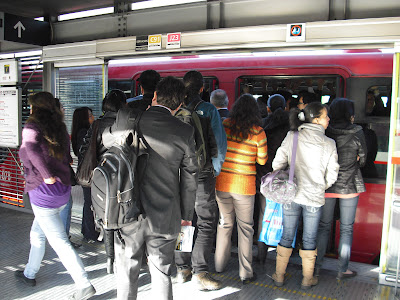
Passengers getting ready to board a pretty crowded Transmilenio
'Going nowhere fast' - passengers waiting to board a Transmilenio.

So while it can be an almighty struggle just to get on the bus when/if you squeeze in, you’re faced with the on-board version of the muppets at the station. 

People – we use that word loosely here – who will not move away from the TM door. 

Again, they may not be actually getting off until later stops, but they ‘must’ stay right at the door, even when there is space further inside, for fear that they’ll miss their destination. Some even take umbrage if you politely ask them to move aside while you’re battling to board. Wonders never cease.

Bogotá’s other main public transport system – colectivos and busetas, the standard South American city buses – is perhaps more representative of Colombian life in general. That is, it’s a contradictory muddle of the delightful and the truly irritating. 

For one there exists this strange habit for local commuters to opt for the aisle sit. Not a big deal you might say, but when you consider that there’s more room to manoeuvre in a rugby scrum than in many of these buses, things can get tricky. 

Throw in the reluctance of many aisle-seat occupiers to stand up to allow you pass to the window seat and it all gets a bit messy. It’s much easier to either move in or stand up to let someone by but it seems some Bogotá bus users love to have random people’s bums shoved in their faces. It’s not something we’re keen on, however. 

Rush hour in Bogotá - colectivos packed bumper-to-bumper. And this was a Sunday
Usually it's better to take a colectivo. Sometimes, though, it's best to walk.
Contrast that with the very honest (no, that’s not a typo) practice when the bus is packed, as frequently happens. Passengers will board via the exit door at the back, passing their fare via a chain of people to the bus driver. If there’s change to be given, it will come back down along the chain to the passenger. Wonderful.

Then there are the bus ‘drivers’ – themselves not immune to such paradoxes. That they speed around like rally drivers high on cocaine can be both a good and bad thing. 

If you’re in a hurry, it can feel like they’re trying to get you to your destination asap. But the constant sharp breaking and swerving – well, let’s just say it puts some of the world’s best roller coasters to shame. 

Add in the occasional road-rage exchange with a counterpart and the result is a potent mix. Passenger safety how do. When these guys’ blood is up, their vehicle becomes a weapon. You’ve just got to hope that your driver comes out on the winning side.

Yet despite all this, most of these conductores still have the heart to allow you jump on their bus for just two-thirds of the standard fare. All you have to do is wave a 1,000 pesos (less than €0.50) note at them, the recognised sign that you can’t afford more, and usually you can jump on, no hassle. This we very much like. 

Indeed, all things considered, we find the colectivo experience far more acceptable – and cheaper – than the Transmilenio one. Just mind your bum when taking that window seat.