Showing posts with label Australia. Show all posts

Monday, 21 February 2022

Lest we forget

@wwaycorrigan

[Listen to an audio version of this blog entry here.]

Sitting unhidden in one of my barrio tiendas sipping on a litre of Poker beer, it dawned on me that less than a year ago such behaviour was officially prohibited and had been for the guts of 12 months.

Lest we forget: Lads on the lash, facemasks in force. A tienda bar in Barrio Santandercito, Bogotá, Colombia.
Saving face: Colombians seem particularly keen on facemasks.
I'm not sure about you, but as things gradually return, for the most part anyway, to how they were pre-pandemic, I've nearly forgotten how absurd those "lockdown"/restricted-movement days were (it's good to have my various blog posts during the period as a reference point. See, for example, https://wwcorrigan.blogspot.com/2020/03/coronavirus-collateral-damage.html and https://wwcorrigan.blogspot.com/2020/06/coronavirus-auxiliary-killers.html. Here's hoping the internet's Ministry of Truth doesn't get at them).

Failed estate

This isn't to say that my tried-and-trusted Bogotá tiendas are devoid of signs of those crazy times. Clientele's wearing of facemasks under the chin is one rather inane reminder. There's also the odd sign to wash one's hands (a tad difficult in establishments without adequate facilities in this regard), to wear aforementioned masks and even notices to disinfect your footwear, a practice that was found early on to be rather ineffective in combatting contagion in most settings.

As for the facemasks, Colombians seem quite happy to wear them, anywhere and everywhere. Whatever about their efficacy in terms of reducing the spread of respiratory infections — the jury is still very much out — they may at least offer some protection from Bogotá's contaminated air. Although, when worn around the chin, it's unlikely they'll be of much help.

Nonetheless, it's good to have some reminders of what we've just gone through — as long as they're kept at a safe physical distance that is.

Of course, people still afflicted by coronavirus monomania will not only say that all draconian measures introduced were necessary but they are also likely to argue that they didn't go far enough nor last long enough.

Again, the evidence that strict lockdowns work in combatting a disease such as covid-19 is far from conclusive. And when viewed solely through the lens of Sars-CoV-2, one is guilty of inflicting other causes of pain and death on those who would otherwise be fine. It's a delicate balance, one that many countries appear to have got shockingly wrong.
"Those who have been most faithful to the creed, if they're not quite rewriting recent history their changing tack is explained as 'we weren't to know.' Really?"
As we begin to accept that we must learn to live with covid rather than stop living and as we move our focus onto the next global cause for concern, any proper, unbiased analysis of the last two years must critically examine the role of much of the media in unquestioningly following the official line.

A majority in the Fourth Estate, not for the first time and it certainly won't be for the last, decided to take refuge elsewhere.

A dubious narrative was established and followed with fervour. "The Science" — the one that promoted heavy-handed containment measures and has coerced people into taking covid vaccines even when it is clear that some have robust natural defences against the infection — became the true faith.

Signs of the time: Hygiene recommendations aimed at reducing the spread of coronavirus on display in Bogotá, Colombia.
Signs of the time. Careful now ...

Those of us who dared ask fair and reasonable questions were blasted as heretics. We were selfish, content to needlessly let people die, so the attacks went. Very early on in this collective, dangerous insanity I called out what was for the most part nauseating, hypocritical virtue signalling (see https://wwcorrigan.blogspot.com/2020/03/coronavirus-fallout-virtue-signalling.html).

We now have some of those who were most faithful to the creed backtracking. If they're not quite rewriting recent history their changing tack is explained as 'we weren't to know.' Really? They seemed utterly convinced of their righteousness at the time, trying to rubbish those of us who went against them.

Centre fight

In any case, it's quite easy for them to shrug all this off now. Vaccine certs proudly in hand, life is pretty much back to normal. (More power to the countries that are doing away with jab passes — little by little, society appears to be taking a more reasonable, rounded approach to this. Let's not mention atrocious Australia, crazy Canada or nefarious New Zealand, though.)

Thus, some people tell me I should get over all this, 'hum a different tune'. For the most part, I am doing that.

However, the agents of coercion and control who were given a new lease of life with the arrival of the novel coronavirus continue to try to make life difficult for us "infidels". 'Just conform, goddamn it!'

Many appear quite happy to have the state overseeing more aspects of their lives, often falsely believing that it's for the greater good of society. It generally means a little less personal responsibility, too, so they'll acquiesce.

Yet, an all-powerful state with much of the media in tow, doing its best to silence — or cancel, if you will — dissenting voices, painting any opposition as conspiracy theorists and so refusing to engage with it, is not something to be endorsed.

It's why I won't simply let this go, not while we still have what is effectively nothing more than official opinion or debatable science being peddled as unquestionable fact.

As we've seen over the last couple of years and as history has repeatedly shown us, giving free rein to such forces rarely leads to positive outcomes.

The centre can hold for a little while longer. We have to be prepared, though, to battle hard to keep it together.
_______________________________________________________________
Listen to Wrong Way's Colombia Cast podcast here.

Facebook: Wrong Way Corrigan — The Blog & IQuiz "The Bogotá Pub Quiz".
 

Thursday, 27 January 2022

A reinvigorated fun police

@wwaycorrigan

[Listen to an audio version of this blog entry here.]

And just like that, it's all over — kind of. Within a couple of days of each other, both England (just England initially that was, not the other UK nations) and, more shockingly, a heretofore extremely cautious — officially, anyway — Republic of Ireland announced that they were ending most of the coronavirus pandemic restrictions.

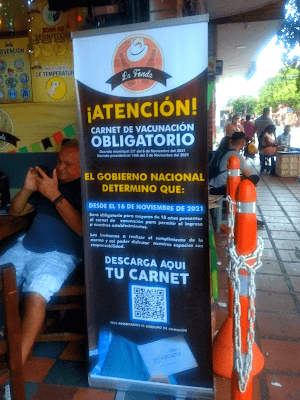
A reinvigorated fun police: Compulsory vaccine passes to try to combat an infection, covid-19, to which many have natural immunity is nothing short of control and coercion by the state.
Thou shalt not pass without a covid-19 vaccine pass: The social credit system in action — comply or be ostracised.

Learning to live again

Of course, I don't (currently) reside in either jurisdiction but I was somewhat optimistic on hearing the news. I'm not, however, expecting a domino effect around the globe in the coming weeks.

It does, nonetheless, give one hope that other nations will start to accept that we have to learn to live with covid-19 rather than stubbornly and damagingly maintain a suppression strategy.

As has been said oft-times before on this blog, we're not talking about an indiscriminate killer here, despite the efforts of many governments and media groups to portray Sars-Cov-2 as such. This covid monomania comes at a price — not just economically but in lives lost as well — and that price is something we're set to live with for some time to come.

I wrote previously (see https://wwcorrigan.blogspot.com/2021/09/rocking-in-fear-world.html) about the irrational fear that has been instilled in the masses over the last two years. 

Thus, for people to return to their pre-pandemic lives — as much as they want to, that is — it was always going to take more than just an address from our esteemed leaders simply telling us that it's all pretty much back to normal and "away with you".

What's more, all the various rules and recommendations aimed at saving lives have empowered what one could call a citizen's army of do-gooders and virtue-signallers. Well-intentioned they may be but, as is often the case in such affairs, they are potentially doing more harm than good — and most likely to themselves than to anyone else.
'"Recklessly" going against the doctrine puts us all in jeopardy. So, à la Novak Djokovic in authoritarian Australia, an example must be made of these apostates.'

You see, many of us at the receiving end of such unsolicited help to save ourselves and humanity at large can, to a certain extent, shrug it off. The preachers, on the other hand, are so worked up about it that it appears to consume them.  

In effect, they almost stop living because they become so concerned about avoiding death.

Pernicious pretenders

Raised as an Irish Catholic, I see something quite familiar here. The top brass who issue the orders largely ignore them in their private (and not-so-private) lives — vide the No. 10 Downing Street parties and Golfgate in Ireland — but the foot soldiers follow the commands with zeal.

In other words, the plebs are the ones who do the donkey work, pay the biggest price, yet they'll never see the green pastures, the promised land.

For these covid crusaders, the non-believers, the heathens, must equally — or, preferably, to a greater extent — suffer. In fact, it's those who question the gospel who are the problem. They must be brought into line.

"Recklessly" going against the doctrine puts us all in jeopardy. So, à la Novak Djokovic in authoritarian Australia, an example must be made of these apostates.

The Catholic Church — together with other such institutions — has done a great job at convincing folk through the ages that having fun in the here and now only leads one to the depths of hell. Not only is living fundamentally a struggle but you must also suffer whilst going through it. (I must say, these days I do move to a more ascetic beat — I'm certainly no party animal anyway — but I don't expect everyone to follow my lead. I'm happy for people to mix, mingle and live as they see fit as long as they don't inconvenience me too much.)

Where religion has lost its (often malignant) influence we have plenty of pernicious pretenders to step into the vacuum.

This coronavirus pandemic has given such fanatical forces a shot in the arm, literally and metaphorically. The fun police have been reinvigorated. The officers won't go away quietly.
_______________________________________________________________
Listen to Wrong Way's Colombia Cast podcast here.

Facebook: Wrong Way Corrigan — The Blog & IQuiz "The Bogotá Pub Quiz".


Tuesday, 31 January 2017

Rediscovering the joie de vivre

Back in late 2007, during my first full-time radio job, the general manager of the station in question, a recently-appointed Portuguese man, took to me one side and said, "Brendan, you've lost your joie de vivre."

While he mightn't have been totally correct that at 22 years of age I wasn't happy with life in general, I was certainly dissatisfied with some, largely work-related aspects, and this obviously showed in my behaviour. Like many, I wear my heart on my sleeve.
Rediscovering the joie de vivre: Colombia may remain the base, but a few tweaks to the way things are going are needed.
Contemplating the future. The answers lie within ...
In many ways, that period marked the beginning of a new departure. In a few months I had left that radio station to take up an ill-fated editor position at another one. Before 2008 was out, I'd my backpack in tow, embarking on a 10-month adventure that took me around South America, New Zealand, Australia and parts of South-East Asia.

A return to broadcasting and Ireland followed, before, once again, wanderlust took over. South America was calling. After an initial three-month stint in Santiago de Chile, it was Colombia that became the base in late 2011. That's pretty much how it has been since.

Of course, starting off in a new country from scratch, that is to say moving without a job already secured or any clear plan, makes things a little more difficult. It takes time to get established. 

What's more, in many developing countries such as Colombia, working freelance in an unstable sector and earning the local currency means it's not easy to get into a comfortable situation financially speaking.

Personally, the first two to three years here had enough adventure and excitement, as well as a trickle of cash flowing in, to keep me relatively content. Heck, there was even (and still is, minus the same excitement) the odd TV 'super extra' gigs. The joie de vivre was there.

However, in the last couple of years, this has been on the wane. Again, the root cause seems more job related than anything else. The accidental teacher has become tired with his lot. 

The mediocrity has gone on a few years too many truth be told. On that score, the ante has been upped of late to find something more fulfilling, whatever that may be and wherever that may take me.

It must be pointed out that it's not exactly the location that I've grown tired of; Colombia and even Bogotá itself still excite. However, once you become mired in one important element, even if it is not exactly place specific, it can be difficult to focus on the many other positives. The grey cloud darkens all.

That notwithstanding, another, not-insignificant aspect that isn't exactly a roaring success is in the dating game (yes, here we go yet again).

The Colombia, nay Bogotá, I feel compatible with, at home in, is the tienda, what you might call more campesino/country style of life. Now, this isn't just from a price perspective, as has been explained before.

Unfortunately, in terms of most of the Colombianas I've been attracted to and tried to have something with, going out in such places is anathema to them. The ridiculously overpriced, fancier but fake locations are anathema to me. Plus, as someone who likes to try to be honest from the get-go, it tends to work against you here.

Yes, I've wasted time and money with too many interesadas, but it's generally the nature of the fauna in these parts.

Unlike the work situation, the above is more a problem of place, an incompatibility of sorts (but not in all cases, it's just 'compatibility' has been harder to find of late; you could say I've become more stubborn, not less!).

Looking at it all together, it's not that things aren't working or the joie de vivre is gone, it's just that it's not going exactly how I'd like. Of course, many people live their whole lives that way, a reluctant acceptance of their lot.

As long as you're still breathing, though, there's always time to change and explore other options. For a singleton without children to care for, this is even more so the case.
________________________________
Facebook: Wrong Way Corrigan - The Blog & IQuiz "The Bogotá Pub Quiz".

Friday, 6 November 2015

The future is All Black

So another Rugby World Cup is put to bed and with it the team that has always been described as the globe's greatest has officially cemented its number one status — for now at least.

The New Zealand All Blacks' triumph takes their World Cup winners' tally to an unmatched three, they are the first to claim back-to-back successes and this time, unlike the previous ones, they did it on foreign soil.
The future is All Black: New Zealand, Rugby World Cup winners 2015. Who can stop them in 2019?
The All Blacks: champions once more. Photos from Facebook.
There can be no denying their superiority in the game right now. The final did give us the two best teams in the world at this moment in time, but New Zealand were just that bit better than Australia in practically every facet.

The stream of rugby talent flowing into the All Blacks shows no sign of abating. For sure, big guns are leaving the scene in the shape of Dan Carter, Keven Mealamu, Tony Woodcock, Ma'a Nonu and Conrad Smith (with captain fantastic Richie McCaw still to make his mind up about his future). 

Yet the rugby-playing culture in New Zealand, where it is true to say the game is a religion, has ensured very abled successors are ready to fill the huge voids left.

The man who crossed the line in clinical fashion for the All Blacks' final try in the decider, Beauden Barrett, is sure to be one of those. 

Others who should maintain the side's frighteningly (frightening for the other nations that is) high standards include Sam Whitelock, Ben Smith, Brodie Retallick, Sam Cane and Aaron Smith. Already people are pencilling them in to make it three-in-a-row in Japan 2019. We'll give it a little time yet.

The question that is regularly asked, though, is, 'Why New Zealand?' In terms of overall numbers playing the game, it's well behind the leading nation in this regard, England. This is obviously understandable considering the small population of New Zealand compared to England — 4.47 million versus 53.01 million.

What much of the All Blacks success comes down to, as alluded to earlier, is culture. The outgoing Irish captain Paul O'Connell touched on this in an interview earlier this week. 

Looking at the rugby-playing differences between Ireland and New Zealand, two countries with similar numbers of registered players, O'Connell noted how in the latter country the sight of children getting together to play with the oval ball at school breaks or whenever is commonplace. Rugby is bred into them.

The future is All Black: If any team can find a suitable replacement for the great Dan Carter, it's the All Blacks.
The perfect 10: Dan Carter drops for New Zealand.
By contrast, in Ireland, you're more likely to see young lads mimicking the moves of their heroes who play our national games of Gaelic football and hurling, or soccer, during their downtime. In many areas of Ireland — as happens in other top rugby-playing nations — rugby isn't the first, or even the second, sport on the list.

Of course, that's just one element to it. The support structures and player management in New Zealand are second to none. Plus, while we see the likes of Richie McCaw and Dan Carter as superstars, the modesty instilled in each All Black player is to be admired. It's a cliché in most team sports these days, but the idea that no one player is bigger than the team truly holds for the All Blacks.

Whatever they may have just won, or on the rare occasion lost, on the field, these guys are still expected to sweep up their dressing room after each game. Becoming an All Black may be the pinnacle for many New Zealanders, but it comes with responsibilities and high standards that must be maintained.

The All Blacks are certainly standard-bearers, not just for Rugby Union or sport in general but for many other walks of life, too. They set an example that you could do worse to follow.

It's not always about winning, either; the All Blacks have just found the right formula to ensure they invariably do. Contenders for Japan 2019, the work starts now.
________________________________________________
Facebook: Wrong Way Corrigan - The Blog & IQuiz "The Bogotá Pub Quiz".

Monday, 7 September 2015

"Put the 'rucking' rugby on, ¡por favor!"

The bars/tiendas are stocking up. Replica jerseys of the competing nations are being sold on the street. There's giddy excitement in the air. Yep, Rugby World Cup 2015 is almost upon us and Colombia is gearing up for it with gusto.

OK, I might be in dreamland there. Yes, the tiendas are stocking up, but that's a never-ending process. Yes, replica jerseys are being sold on the streets, but they always are and there's not a rugby one to be found. And yes, there's giddy excitement (or is that nervousness?) in the air — in a land with so many gorgeous (flaky as some may be) women about, that's inevitable.

Paul O'Connell (and son) after his last home game for Ireland.
Ireland's talismanic leader, Paul O'Connell. (Photo from Facebook.)
Considering there isn't a Colombian link to rugby union's showcase event — not one that I know of anyway — that the tournament will pass off without registering much of a beat in these parts isn't surprising. 

There's also the fact that rugby is very much a minority sport here. It is played in some universities and elsewhere but it's generally expat-led. The vast majority of football-mad locals have no idea of what rugby is about nor, understandably enough, do they have any interest in it; indeed even those who actually play it here don't seem to get it.

Thankfully, via ESPN Latin America, the battle for the Webb Ellis trophy will be broadcast on TV in the region. The only snag is convincing my local tienda owner to put it on; a Spanish football second division match would take precedence over the likes of Ireland-France. Perhaps I can arouse the locals' curiosity sufficiently enough to get them slightly interested (and supporting Ireland, of course) in order to watch the games.

There's always the internet or an interested party's house (somebody who has a TV, that is), but it can be nice to watch these things in a bar/tienda, if you could just get people not to interrupt your viewing.

As for the competition itself, well despite the genuine effort that will come from the other nations involved (20 in total), you can be pretty certain that the winner will come from one of the top-seven ranked teams in the world. Those are, in current order; New Zealand, Australia, South Africa, England, Wales, Ireland and France.

There are those who say you could narrow it down even further, to simply one — New Zealand. That's being a little disrespectful to the others, especially previous winners South Africa, Australia and England, but there's no doubt that the All Blacks, like always, are the team to beat.

What makes them more formidable this time around is that what had been a recurring theme for them in renewals prior to 2011 — cracking under the pressure of expectation — doesn't appear to be part of the equation this time around. Winning on home soil four years ago, their first global triumph in the professional era, has only added to their aura of invincibility.

Yet, the bookmakers aren't about to pay out on them just yet. Of the chasing pack, it could be argued that the big Northern Hemisphere sides come into this as strong as ever. And that it is being held in England and Wales, this should be a help to both those sides, as well as Ireland who go into the tournament as the best team in Europe for the past two seasons.

The All Blacks perform the Haka before the 2011 World Cup final.
Formidable: the All Blacks. (Photo from Facebook.)
Indeed, expectations for the latter — although tempered somewhat by previous demoralising experiences when hopes were high as well as warm-up defeats to Wales and England which have left some doubts — are that at least a maiden semi-final can be reached. In this regard, defeating France in the pool stage and thus avoiding a potential last-eight clash with the All Blacks could be key to attaining that goal.

That brings us to the South American powerhouse in the mix, Argentina, Ireland's other possible quarter-final opponents. Los Pumas in many ways have been world rugby's breath of fresh air in recent years. While they have long been producing top-class players, it had been difficult for them to maintain consistency against the more traditional rugby-playing nations.

A lot of this was down to their geographical isolation and relatively poor organisational structures back home, meaning their most talented plied their trade miles from Argentina. 

Both drawbacks still exist but their merited inclusion in the Rugby Championship (formerly the Tri-Nations) in 2012 has seen them play Australia, New Zealand and South Africa on an annual basis.

Such tests have only helped to improve their competitiveness — note their historic first-ever win over South Africa this year. Were they to meet Ireland in the last eight, they'd certainly fancy their chances of another World Cup success against their old foes.

South America has another representative in the shape of Uruguay. Their best hope will be to keep losing margins respectable in what is the toughest pool in the tournament with England, Australia, Wales and an unpredictable Fiji expected to lead the charge, perhaps in that order.

So who can we expect to see going head-to-head in the Halloween final? Well, at this stage it would be a shock if the All Blacks weren’t there. Who will join them is a far trickier prediction. Depending on how the pools go, we could end up with an Australia-New Zealand final.

Ireland had been touted as potential finalists, but as mentioned their lead-in games have watered down such thoughts. The smarter money might be on hosts England, with fortress Twickenham giving them an extra edge, making the final cut.

But as anyone who has ever kicked a rugby ball knows, it can bounce in strange ways. Perhaps France have been saving themselves for this moment; a coup de foudre of sorts, on enemy territory? The next six weeks or so will tell a tale.
__________________________________
Facebook: Wrong Way Corrigan - The Blog & IQuiz "The Bogotá Pub Quiz".

Sunday, 12 August 2012

Punching back

Amid all the justified euphoria of the Irish, at home and abroad, celebrating Katie Taylor punching her way to gold-medal success at London 2012, a few less celebratory side-stories were played out in the media. 

The first came when our boxing champ was — in error we’re told, although some people think differently —  called British by a journalist in The Telegraph

Now, she may be from the historic Pale area of Ireland and have a Liverpool-born father but that does not make her British by definition — despite what some Irish from other parts of the island might have you believe. 

Punching back: The Australian National flag, replete with Union Jack in the top-left corner
'Is that a Union Jack I see on the Aussie flag?'
Sure if she had been brought up British at 26 years of age she’d probably have at least two children by now and be living in some rough council estate at the state’s mercy. (What's that you say? This happens nowadays in good old Catholic Ireland? No way!) 

Nevertheless, colonial tendencies die hard (hence, so many Colombians love pilfering) so we’ll let our neighbour across the Irish Sea off on this one.

It’s a little bit harder, though, to be as lenient towards the Australian sports pundit Russell Barwick. Not because we’re offended — we tend not to let a few misinformed utterances upset us — but more because of the pure ignorance of a man in his position. 

For a prisoner – sorry, I mean an Aussie – to say Ireland ‘is a joke’ for not joining Team Great Britain at the Olympics is a bit rich to state the least. 

Without going into our own cultural, geographical or political situation, the very fact that Barwick comes from Australia is more than likely because of the British. His country’s flag proudly displays the Union Jack, its currency has the head of the British Queen while, lest we forget, he also happens to be one of her subjects. 

Surely, then, his dependency has a much stronger argument to join up with the British for sporting and other events than the Irish. Just let the Aborigines go it alone.   

A host of nationalities boozing it up in Laos, with 'Wrong Way' leading by example
A world of drinkers with the Irishman leading them — the 'Wrong Way'.
Then we had a couple of episodes bringing us back to the old drunken-Irish stereotype. The harshest if you will (again, not that we get too offended) of these came from, once more, an Australian. One, coincidentally enough, with a very Irish sounding surname, Hanlon (Peter). 

What he penned was deemed so offensive in this politically correct world (Survival of the Dumbest http://bit.ly/NNg2E8 has more on that subject) that the Irish Ambassador to Australia was moved to write a letter of complaint to Fairfax Media, the group which ran with the story. 

Come on, one of the better Irish traits is usually our ability not to take ourselves too seriously. 

Plus, what he wrote was semi-amusing and semi-accurate in some regards, such as: “For centuries, Guinness and whiskey have sent the Irish off their heads. Now all it takes is a petite 26-year-old from Wicklow.” 

In fairness, we probably still need at least a smidgen of Guinness or whiskey to really get us going.

The Yanks, too, got in on the ‘have a go at the "alco" Irish’ jibe, with USA Today chief sports columnist Jon Saraceno writing, “Back home on the emerald-green isle, pints of Guinness flowed freely, perhaps enough to replenish the Irish Sea.” 

Fair enough really, it’s just we’re not too sure if the Irish Sea needs replenishing.
A young Peruvian boy familiarises himself with beer
'Get it into you, son.' They like beer in Latin America, too.

One of the biggest problems with this entire drunken-Irish stereotype is that we’re really not the world masters at drinking we — secretly or otherwise — like to think we are. 

We’ve encountered plenty of non-Irish across the globe who can drink copious amounts of booze yet they fail to get lauded for it. 

Sticking with the Aussies, sure our friends ‘Down Unda’ habitually have a stubby or whatever they call it for breakfast, followed by another few for lunch before ‘warming up’ with some more in the evening prior to a night on the lash. 

The Colombians, too, know how to drink, they usually just sweat it off much quicker than us with all that needless salsa dancing (for more on that see ‘Lord of the Dance’ http://bit.ly/S7A8eS). 

Heck, we’ve also witnessed a healthy drinking culture in South-East Asia – it’s just the poor buggers’ bodies there physically won’t allow them consume as much as us. If they could hold out longer, we’ve no doubt they would.

In truth, we’re happy to keep our world-renowned drinking reputation in tact. For one, it helps keep the global Irish pub business thriving – the same cannot be said for the national market.*

Plus, in order to overcome a perceived problem you must first realise you have one. 

So while we know we like to drink, other nationalities are still deluding themselves that they don’t. 

____________________ 
*Check out our previous ‘An Irish lament’ http://bit.ly/MmS5bm for a detailed look at that. 

Saturday, 14 July 2012

Taking stock

Every now and again it can be prudent to take stock of your current situation. Reflect on what has happened and look ahead to what might be in store for you. 

We believe that second part isn’t as beneficial as the first as you never know with any certainty what life will throw at you next. That aside, we’ve been analysing the state of play for Wrong Way and associates in the last few weeks.
Taking stock: 'Wrong Way' et al backstage at 'Colombia Tiene Talento' after giving it all on-stage!
Who'd have thunk it? Wrong Way on-stage in Colombia.
We feel like it’s a good time to do so: The one-year mark has passed since we took the decision to leave a relatively steady yet limited job behind on the island of Ireland and take a semi-gamble to make what we’ve termed our ‘Second Coming’ to South America. 

So how has it been thus far? What, if anything, have we learned?

As opposed to the ‘First Coming’ to South America, which was solely travelling, this time around the aim was to see if we could source some work in order to settle for a longer term. Considering we’re still in the continent almost 13 months later, a few necessary departures apart, that first aim has gone relatively well. 

Aside from our initial, far from humanitarian, slave-like voluntary media gig in Santiago de Chile, any paid employment we’ve engaged in here in Colombia to date – from the standard hostel work and teaching English to the more unusual TV extras work (see: http://bit.ly/NrbPc3) – has been largely enjoyable and, at times, even profitable.
'Wrong Way' teaching a few Latinos how not to win, Roscommon style
'In Ros Trust' — well, at least in the classroom.

If we were to pick a negative from the most profitable and reliable of those, the English teaching, it’s that our use of the Spanish language has decreased as our class hours have increased. But a lot of that is down to pure laziness on our part – we’ve plenty of time in between classes to be using and (hopefully) improving our Spanish. It comes down to desire and need in the end.

Like any place you stay in for a while and as regular readers of this blog will know, you begin to see the warts nestled among, at first glance, the more obvious beauty. 

We’ve touched on many of these ‘ugly spots’ before, from public transport manners (see http://bit.ly/N68gKL) and business dealings (see http://bit.ly/LVpK8p) to relationship attitudes (see http://bit.ly/NsJyB5) and friendships (see http://bit.ly/LbcE9V) to name but a few. 

On that latter one, outside of some notable mostly expat (although, thankfully, not exclusively) exceptions, the ability to build trustworthy friendships is disappointing. Once bitten, twice shy and all that.

Wrong Way surfing some very 'wild' waves on Australia's Gold Coast
Not much left to play with (above) - time to spice things up like below?
As negative, though, as all the above may seem, it’s appropriate at this stage to state we still like it here, for now anyway. Heck, if we didn’t, we wouldn’t be here. 

We can leave at any stage – well, at least we think we can. Yes, there are times when we might get frustrated with certain things or even feel a little bored – but we’ve experienced enough to know that these are emotions that can happen anywhere at anytime. Life, after all, is as exciting or as dull as you want to make it.
'Wrong Way' tandem sky-diving over New Zealand's Lake Taupo

Possibly one of the best things that our second stint in South America – and Colombia specifically – has further reinforced for us is the adage not to take yourself, or indeed life, too seriously. 

We’re trying not to sweat the small stuff. OK, now and again, the infamous Wrong Way temper goes off; a blow-out here and there is healthy, right? But on the whole we’re concentrating on remaining positive, working on the things we can control while trying not to worry about those we can’t. 

Weighing it all up, we have to be reasonably happy with the current state of play. 

Perhaps, though, we’ve just about rode out this particular wave. The time might be fast approaching to catch another, wherever it may take us.

Monday, 28 May 2012

"Dangerous" Colombia Part III

We witnessed a rare occurrence here in Bogotá the other day. It was certainly something far from uncommon for us but for this city, indeed Colombia in general, it was an event you don’t see everyday. 
"Dangerous" Colombia Part III: Knocking back a few beers with some of the locals in Maicao, Colombia. All good, honest, safe fun!
Drunken Colombian fun without the fights — well, until the Irish lad arrived that is.
No, don’t be silly now, it wasn’t one of the locals admitting he/she was at fault or being totally honest about something. We don’t expect to see such happenings anytime soon. 

What did catch our eye, though, was a good old-fashioned bar brawl amongst a number of natives. Somebody said something they shouldn’t have – or at least that’s what some of the people that heard it thought – and next we had about half a dozen lads exchanging blows. 

Fair enough, what transpired wasn’t of the highest calibre, but it was sufficient enough to make memories of home come flooding back. 

We have to admit, we got a strange warm feeling from being a live spectator. Growing up or, more pertinently, socialising in Ireland has seen us become accustomed to regular, drunken punch-ups. 

Instead of some salted peanuts or a similar style snack accompanying your beverage, as is the case in many countries, back in the homeland you get free, front-row seats to bare knuckle boxing. Indeed, if you’re lucky enough, you might even get to take part.

Alas, here in "Dangerous" Colombia, you’ll be hard pressed to find such riveting entertainment on a night out. 

'Wrong Way' learning to dance with the help of a Playstation. You just can't teach an old dog new tricks!
Why fight when you can, er, 'dance' instead?
You see unlike the Irish, as well as the Brits and the Aussies (we can throw in a few more nations here, too, such as Poland and some other eastern European countries) the addition of alcohol into most Colombians' systems – and Latinos in general – doesn’t usually result in an overly aggressive streak developing. 

It’s not that they don’t get drunk, they certainly do, but alcohol tends to transform them less into Incredible Hulks and more into Snow Whites. It’s probably because they’re too caught up in dancing than to think about engaging in a scuffle with the other half-wit at the next table.

The bottom line here is that you are more likely to find yourself in an A&E department with a brawl-related injury after a night out in Britain or Ireland than you are in these parts. But which place is seen as less safe? 

Of course, people will point to muggings and other such "petty" crime as being far more prevalent in Colombia compared to most Western countries. Yes, they happen. 

In fact, we were unlucky enough to be the victims of a knife attack in Bogotá recently – our first such experience in South America it must be added. 

Such things, though, come with the territory in most big cities across the globe, wherever they’re located. What’s more, a lot of the time here in Colombia, these unsavoury incidents are utter opportunism by the perpetrators, pure and simple. 

From our experiences, there lacks an in-built thuggish nature that you find in many of the lowlifes from the countries we were brought up in and know best. 

As a good Italian friend mused about his experience living in Manchester, many of the locals there just seemed to have a desire to fight all the time. No matter how much you keep yourself to yourself , you’ll invariably find trouble in such places – or trouble will find you, to be more accurate. 

For many of the boys from these more "developed" locations, a night out just wouldn’t be complete without a bit of a fisticuff. A lot of the time it’s a mentality that exists in sobriety, so throw in a cocktail of drink and drugs and you could be, quite literally, on a hiding to nothing. 

A shot of the border between Colombia & Venezuela, just outside Maicao. A passage from relative friendliness to none at all
Oh Venezuela, how we miss you & your quirky ways.
Thankfully, we haven’t really encountered this kind of a threatening environment in these parts. Now maybe that’s just down to the fact that we’re usually slightly inebriated on our way home after a night out – you can’t beat a bit of Dutch courage, eh?

In any case as our "Dangerous" Colombia series has hopefully shown, how dodgy a place is depends very much on how you look at it. 

As with everything, it’s relative. Colombia’s negative reputation certainly precedes it, but there are worse places you could be. For one, it’s no Venezuela.
__________________
For the related articles see: http://bit.ly/Je5pxC & http://bit.ly/K57gG5

Sunday, 6 May 2012

'Wrong Way' begins

We’re taking a bit of a step back in time this week. Below is a reproduction of an article we put together after returning from our first bout of travelling in 2009, when we were a little less cynical compared to now.

And while much has happened since it was penned, both personally and universally, you should find that the majority of what is expressed still holds true today. You could, in a sense, call it 'The Making of Wrong Way'.

“Our doubts are traitors and make us lose the good we often might win, by fearing to attempt.”

While I can't take credit for the above quotation, the plaudits there must go to the late American Nobel Peace Prize winner and activist Jane Addams, they are words, however, that have a deep resonance with me.

It was just over a year ago when I plucked up the courage and finally decided to 'take flight', leaving what was my comfort zone of this island.

It wasn't a decision that I took lightly, indeed I was procrastination personified before I eventually called Trailfinders and got the ball rolling so to speak. But once that was done, I purposely gave myself as little time as possible before R-Day (that’s 'Rio de Janeiro' day, in case you're wondering, my first port of call), so there could be little room for u-turns. Three weeks in fact was the time between booking my flights and hitting off.

'Wrong Way' begins: An aerial shot of Rio de Janeiro
Rio from a high - not a bad town.
It was enough time, nonetheless, to read a very apt article in The Sunday Times Magazine which opined that the hardest part about heading off on one's long-term travels — to clarify 'long term', what I mean here is an unspecified/indefinite period of travelling, as mine was — is closing the front door of your own house and hitting for that first airport.

Never truer words written, although I must admit it was my mother who closed the front door because it's not really my house, though it is home. Anyway, looking back at it now, I was a very nervous individual the morning I was escorted to Dublin airport. The fear of the unknown I suppose.

It was a deliberate choice, though, to go to a continent where I don't speak the language — well, not when I first arrived anyway. The destination of choice for most Irish people around my age is Australia, or at least it has been, but despite my fears about leaving Ireland on my own I was looking for somewhere slightly different for the first stage of my global adventure. 

(Although I must qualify this and say that if you're looking for a place free of fellow Irish people, from my experience, your best bet is the Moon or Mars because we certainly get around. Plans for 'Murphy's authentic Irish lunar pub experience' have hit a stumbling block for now, thankfully. Where's developer Sean Dunne when you need him? What? Bankrupt!)

Anyway, where were we? Ah yes, the trepidation of the unknown. Another part of the fear of leaving is, paradoxically, the fear of coming back — this oddity being, it appears, a particularly male phenomenon.

It's that bravado thing, when you tell your mates in the pub that 'I'm sick of this feckin' country of ours and I'm off, possibly never to return and ye're all stupid for staying around', while in the back of your mind you're wondering what are you doing leaving and how stupid you'll look when you return home after three weeks, if you last that long.

I did temper the possibility of that happening to me by telling friends and family that I could be back in three weeks, three months or three years. I didn't put any minimum count on how long I'd be gone for. Doing so could have come back to haunt me on my return to "the local". Anyway, I'm above such trivial stuff, am I not? That's why I only devoted a few lines to it, see.
An aerial shot of Peru's Machu Picchu.
Picture perfect - Machu Picchu.
That leaving fear, to move on, did just that, leaving me almost the minute I said goodbye to my sister and was left in Dublin airport to fend for myself.

However, I must admit I do have a fetish for the whole airport rough and tumble. I've just always liked the buzz of the place for some reason. Even by the time I reached Heathrow to get my flight to Rio, I was already walking with a swagger, enjoying my new-found freedom.

And while I say now, after the event, that had Baghdad been the first stop I would have loved it because anywhere was going to seem better than Ireland in November in a recession, the setting and the amazing people — both locals and not-so locals — that I met in Rio where I spent my first ten days set the tone for what was — with no exaggeration — a life-changing experience.

We won't go into details here, but suffice to say that what was initially meant to be a ten-week sojourn in South America before departing for New Zealand and Australia turned into over four months and would have been more if it hadn't kept on costing me to put back my flights.

From the scantily-clad ladies on the Copacabana in Rio, the amazing Iguazú Falls and magnificent Machu Picchu to the warmth and beauty of both the people and land of Colombia and the breathtaking sights of Chile, South America has a lot going for it. I suppose the mark of a place is your willingness to return to it and, in that respect, since I left 'América del Sur', I've been planning my return (it only took about 18 months to get back).

A small section of the stunning Iguazo Falls on the Argentina-Brazil border. No visit to South America is complete without seeing these natural wonders.
The Iguazú Falls - simply stunning.
That's not to say that the remainder of my travels in New Zealand, Australia and South East Asia were not as noteworthy.

On the contrary, all those places are amazing in their own right and I have much good to say about all of them, some more so than others, naturally. However, it was South America that laid down the marker and gave me that first glimpse of the world "out there" for an extended period of time, and for that I am eternally grateful.

So as the Irish economy gets worse by the day, with the relatively young — well, those remaining — asking the question, 'Should I stay or should I go?', we can take comfort in the following: Even with just a few euros in the back pocket, there are numerous countries on this planet where we can make those last much longer than they would at home — that's the benefit of being, ahem (no sniggering down the back there), a First World country.

Also, there are flights leaving this country every day to far flung places and, what's more, there are always ones coming back.

So, if you're thinking of your next move, my advice, for what it is worth, is to go and discover the world and in the process yourself. As for everything in this life, don't let the doubts hold you to ransom. Don't fear to attempt.