Monday, 10 February 2014

The end of 'we' as we know it

It is with great sadness that I must bring to you the end, as you have become accustomed to here at Wrong Way, of 'we'. Yes, the 'we' that so many of you (two on the last count, including me) know, love and even feel part of, is departing the scene.

The end of 'we' as we know it: The Wrong Way trademark photo.
Me, myself, and I; 'I think we're alone now...'

You'll be glad to know that it has been an amicable separation. It's just it had become more and more difficult to defend the continuance of 'we' when 'I' would have sufficed. The fact that Wrong Way recently opened up a new front where 'I' has led the way, has been a factor in this sudden decamping.*

This is not to say that I haven't valued 'we's' contribution to this blog over the past two years plus, it's just I feel it's time to get back to me. 

'We' did serve its purpose, allowing a certain candidness at times that 'I' perhaps wouldn't have been able to express. However, rightly or wrongly – the latter being more appropriate considering who's writing – I'm feeling more brazen these days, so 'we' is taking an indefinite rest.

There are times when 'we' will return, more than likely in an all encompassing sense. So rest assured all you 'we' fans, this is not terminal; it's just the beginning of a new departure here. A change being as good as a rest and all that. Or the beginning of the end?

Whatever the case, for now it's just me (and hopefully you). Heck, I'm feeling a bit exposed. Stick with me here.

____________________
*Outside of the El Tiempo gig, there is also this for GoAbroad.com, where it is all 'me'.

Wednesday, 29 January 2014

'Que pena con usted; but at least I got my way'

It's not always best practice to take sayings/phrases from a non-native language, translate them into our own, and then take them literally. 

There are many examples in English where taking a word-for-word translation of certain expressions just doesn't make sense in other languages; 'the hair of the dog', 'beat about the bush', and so forth.
'Que pena con usted; but at least I got my way': Does the vulture show a little more respect towards others than some Colombians?
'Que pena Mr Cayman, but at least I'd the decency to wait until you died.'
Yet, the Colombian-Spanish saying of 'que pena con usted' doesn't fall into this bracket – not as far as we're concerned anyway, owing to our experiences of its use. The literal translation is 'what pain/embarrassment for (with) you'. 

This tends to be used in many scenarios in Colombia when, in the English speaking world, in any case, the more appropriate response would be 'Sorry' or 'Is there anything I can do to help?'

Now, you might say that que pena for Colombians is their 'sorry' and that's what they mean when they utter it (leaving aside the fact that there is in existence a perfect Spanish equivalent of 'sorry', namely 'lo siento', – literally 'I feel it' – which many other Spanish-speaking countries have no problem using). However, as is so often the case, actions speak much louder than words.

For example, an all-too-often 'que pena' usage is when you're in the middle of asking for something at a bar or café or the like and somebody else comes along and starts barking out his (or her – and perhaps it's more likely to be a woman) order ahead of you. 

You politely inform him that you were there first and in the middle of ordering; cue the que pena (without making eye contact) and the out-of-order order continues without a second thought for the 'displaced'. In other words, to fit the translation, “what a pain for you indeed. But I'm happy, I've got what I want, that's the most important thing.”

You could argue that there is a freshness and even honesty in this compared to much of the English-speaking world where people sometimes use 'sorry' when they don't really mean it. However, it's fair to say, in comparison with the example above for one, our behaviour in queues is generally a little more courteous and, dare we say, correct.

Moreover, an indifferent que pena is used in so many contexts where for us 'lo siento' should be the more appropriate reply backed up by a genuine acceptance of an error or misjudgement. 

In its absence, it really only leaves one conclusion; they don't care that their actions have impeded you.

It does seem like a case of 'sorry being the hardest word'; or just not in the vernacular, full stop.
Bart Simpson -- the 'I didn't do it kid'. He has plenty of followers in Colombia.
The 'Bible' for some Colombians?
We can't highlight all this without touching on another, what appears to be from our experiences and those of others we've met in any case, national trait. That is an inherent inability to admit culpability to anything, even if there is irrefutable damning evidence to the contrary.

In some places, putting your hand up to say you were at fault is seen as a brave, courageous step in many incidences, a display of honesty. Not so, for the most part, in Colombia. There's always some sort of excuse available, even if it happens to be about as watertight as a teabag.

Yet this doesn't mean that you can't be at fault (well somebody has to be, right?). If something unfortunate happens to you, a typical question here is 'what did you do wrong?' for it to have occurred. 

For example, 'it's your fault that the 'ladrones' (thieves) robbed you, you allowed them to.' No 'dar papaya' and all that (and we hasten to add, the few run-ins we've had have generally been down to our own stupidity – it's not the case for everybody though). 

This, perhaps, gives some explanation as to why there appears to be at times a laissez-faire attitude towards petty crime among the locals. It happens, and if you're the victim you probably did something to allow it to happen.

'Que pena con usted' indeed. Continue to throw it our way, however, and the bigger 'pena' might be with you. We're too nice for that though. 

Plus, as we learned some time back, it's best not to take such things too seriously in these parts; nobody else appears to.

Sunday, 19 January 2014

Born to run (or at least wander)?

Most of us, those who have the luxury to do so that is, experience times when we question the direction our life is going in. Are we doing the right thing? In the right place? With the right people?

Born to run (or at least wander)? The majestic Andes — they would make any person want to travel.
Always out of reach?
These have been things very much on our mind of late. Much of this is down to the fact that we have that aforementioned luxury to ponder about them. 

In other words, owing to our rather simple, independent lifestyle over the last number of years, we've managed to live relatively cheaply and keep a little balance of cash in reserve. 

Enough, that is, to make us feel like we can take the time to discover something in life that we find truly enjoyable/fulfilling, yet not enough, contradictory as it may seem, to allow us take some risks that may provide the key to the former.

One of the things we've discovered we like doing, at this stage of our life in any case, is moving; seeing new places, exploring, observing how people live in different locations. The reality is that since 2008 this is how, more or less, our life has been.

We even put the 20 months we spent working full time in Belfast into this category. This was because the city was new to us, somewhat different from the places in Ireland we were used to, with that novelty taking some time to wear off. 

Also, as our job was poorly paid, trying to put money aside was a challenge, something that we took on with gusto in many ways (well, we had no other choice). 

Despite that, and another reason our Belfast period can go onto the adventure list, we went overseas for holidays on a number of occasions during our stint there — as many times (and for longer) than our 23 years pre-2008.

So, it seems our first global adventure between 2008 and 2009 released the wanderer in us. Before then, an easy(ish) life in an Ireland that appeared awash with opportunities (or so we were told) coupled with decent enough full-time employment at a young age in a professional field that we generally liked, had kept this wanderlust at bay. 

Oh, how things change! Now, especially in the absence of a fulfilling, full-time, well-paid job (if there is such a thing for us), there exists an insatiable desire to move after a time in one place.

Yes, it is true we willingly returned to Bogotá, a city we had already lived in, on and off, for over 18 months, after a three-month spell back in Ireland last year. 

Yet, at a loose end in our birthplace*, Bogotá still seemed an adventure and, paradoxically in a way, a place where we had built up a good number of professional contacts, somewhere we knew we could find some work, sporadic as it may be. And we were (are) slightly concerned about money. Who isn't?
Born to run (or at least wander)? The outskirts of the the Sahara desert — where we belong?
The world is our oyster http://bit.ly/1icklNw?
Now, however, not even three months back, those wanderlust feelings have returned. Yet they are tempered by concerns for the future; our professional progression, our financial well-being. You might call it adventurism constrained by conservatism, an old head on young(ish) shoulders.

Our background has a lot to do with that; the old settling down mentality and way of life of which most of us are products. Find a partner, build a house, start a family, and, hopefully, have a steady job. 

The last (and for us, the first also) of those is quite difficult to pin down these days, which makes the others more difficult to achieve (especially so here in Colombia where the link between money and women runs deep**). That is, of course, if we wanted to settle at this moment in time.

In any case, history is full of explorers and adventurers, those who shunned that settling-down life. It's because of such men (and the odd few women) that the world is how we know it today — for good and bad. 

OK, there aren't too many places left to be newly discovered on this planet, in a land context anyway, but that doesn't stop the personal human desire to explore and to see new things.

So if we could just make a living out of a nomadic lifestyle that should assuage our conservative side and allow us wander (and wonder) worry-free

At least for a time anyway; this might be just a phase we're going through. That fanciful million dollar contract might make us stop and think.

_______________________
*For more on that somewhat 'restless' state back home see both Any which way but lose... and No country for young men.

**Our début post, Wages of love, touched on this.

Wednesday, 8 January 2014

In defence of hoping (and fighting) for, at least, a 'Freer Bogotá'

We came in for a bit of criticism in the wake of our Fighting for 'Free Bogotá' piece a few weeks back. 

Now, this didn't come from Colombians but from fellow expatriates. The main grievance was that we were painting a stereotypical negative, dangerous picture of Bogotá and Colombia in general. The fact that we were writing about particular incidents in one notorious barrio of the country's capital seemed to go over our critics' heads.
In defence of hoping (and fighting) for, at least, a 'Freer Bogotá': Entering one of Bogotá's 'darker sides', La Perseverancia
The darker side -- entering La Perseverancia.

We did, of course, point them in the direction of previous posts we've written, detailing how we find the external perception of Colombia and how dangerous it is a little frustrating and very often inaccurate, to say the least.* 

Also, the amount of solo travelling we've done around this physically stunning country, most of it detailed on this blog, is, we hope, sending out a positive message that this country is very much open for tourism (and, for some, business) and generally safe.

However, as pointed out in Fighting for 'Free Bogotá', it would be remiss of us to write that there is nothing dangerous at all about this country. A message some of our detractors seemingly wish we would portray. 

There are, though, plenty of other English language websites and blogs about Colombia that set out from the onset not to include one negative word about the place, even if that means bending reality at times.

In any case, what we wrote wasn't inherently negative about Bogotá. In every big (and small) city in the world there are dangerous neighbourhoods where, as a taxi driver once told us about a particular part of Dublin, 'even the dogs hang around in packs and watch each others' backs.' 

Also, we tend to, especially owing to the types of places we like to drink in, take more risks than most other visitors/foreign residents who come to this city.**

We are where we are, we do what we do, and we have our beliefs, likes and dislikes. Right now, for convenience, price but above all, the friendliness of the locals (part of that being the free beers we often get) we find ourselves socialising regularly in La Perseverancia. As stated in previous posts this area is, at this moment in time, as the locals put it, 'muy caliente' (literally 'very hot' i.e. dangerous).

In the last number of weeks, this view has only been further reinforced in our minds. For if we're being honest, we put the minor early morning incident mentioned in Fighting for 'Free Bogotá' down to stupidity on our part. 

Plus, very often when Colombians tell us certain areas are dangerous our first reaction is to shrug it off, believing that they're still thinking of rougher times in the not-to-distant (but distant all the same) past.

However, the kind of things we've encountered over the last few weeks give an idea of this 'darker side'. 

There was the pretty lame attempt – but an attempt all the same – by two young thugs to rob us in broad daylight in the area; the friendly locals insisting they escort us home for our own safety at night; police officers standing guard outside a tienda we were drinking in, in the afternoon, because we were foreigners and 'at risk' (we find this a little hard to believe, but it's what we were told); plus, being witnesses to two local women getting mugged, again in the middle of the day. 

All of the above have firmly illustrated the real dangers that exist in this part of the city, day and night.

In defence of hoping (and fighting) for, at least, a 'Freer Bogotá': Officer 'Wrong Way'. Any takers?
Officer 'Wrong Way'.
That last incident was particularly annoying, angering even. We figured had we been a little closer and quick-thinking that we may have been able to intervene in some way. Then again, perhaps it was better we didn't? 

There were people closer to it than us who seemed content enough to let the damn delinquents get their booty; a 'thank god it's them instead of us' kind of thinking and certainly not unique to Colombia.

Yet, this could be one area to, literally speaking, start a fightback. If enough people, particularly the locals, those who might be seen as community leaders (it's debatable if such figures exist in certain lower-class barrios, or if they do, to what extent they encourage a law-abiding lifestyle), confronted such scum rather than turn a blind eye, it might evoke some sort of change of behaviour, for the better.

From what we've witnessed and anecdotally, few assailants, especially in these daytime raids, are carrying firearms. Usually, if anything, they just have knives. And, usually, you don't have to look too far on Bogotá's streets to find some sort of a stick that could be used to confront anyone carrying a blade; something to put more than an arm's length between you and the would-be attacker.

More police on the beat is another deterrent and at times they can be hard to come by in La Perseverancia, but it's not a panacea.

Of course, there are a range of social issues that must be tackled as to why some people get involved in criminality and, for one, with such a huge disparity in incomes in this city and questionable priorities by the ruling classes, Bogotá and Colombia in general have a long way to go in addressing those.**

We're not looking for an unattainable utopia (although it's not a bad goal to aspire to), we just want things to improve; and there's certainly scope for that.

Those who would like us to believe that Bogotá/Colombia is a peaceful paradise are plain delusional. Nowhere is. They're also helping nobody by peddling such a notion.

______________________
*For a start see Dangerous Colombia Part III.

**On both fronts i.e. an idea of the places we like to socialise in and the inequality issues, check out No somos Colombianos, pero... (We're not Colombian, but...).

For some other issues that need addressing in Bogotá read Bogotá's 'broken windows'.

Monday, 30 December 2013

Reasons to be cheerful

It has, by all accounts, been somewhat of an indifferent return to our second home of Colombia. Indeed, you might say — but we won't — that it has been bordering on negative. 

The time of year we returned has played a factor in terms of us getting saddled up again with any significant work — well before the 25th of December this country goes into holiday mode, with English classes generally being the last thing on most people's minds.
Reasons to be cheerful: The (hopefully) prosperous trek on the year 2014 begins.
Where does the road lead in 'our' year of 2014? Pic from hdwallpapersinn.com.
Now, not racing around Bogotá playing the part of the on-call, 'flying' teacher has left us with time (too much time in some ways) to explore other, more fulfilling, employment options, something that was (and is) one of our chief goals for this latest stint in the country.* 

Alas, little progress has been made thus far on that front — again, the prevailing ambience among the masses right now of 'leave it until next year' is, we hope, a big reason for this.

So we will be looking for an upturn in fortunes when things get back into full swing (or the Colombian equivalent of that) in the coming weeks. 

In this regard — and also in an overall context — we do, we think, have reasons to be cheerful looking forward to 2014 and beyond. Sure 'tis the season to be positive (and, in writing, to make barely relevant lists to pass as acceptable articles); and we can do that from time to time, contrary to what some believe. Right, here goes:

2014

Let's start with the new year itself. The numbers 2 and 14 resonate deeply with us, for birthday reasons. So having both together in the one year, it's got to be a positive sign, right? 

A cynic might say that it means nothing at all, 2014 simply representing the number of years since the birth of a highly contested/controversial saviour. Eternal damnation for such cynics, we say. And no, we're not engaging in a process of seeing a straw and clutching desperately. One mustn't ignore the obvious.

On another point, this year sees us enter the last of our 20s. So we're just coming nicely to the boil. Or so we'll tell ourselves.

Pieter and his 'wonderful' selfie
Looking, eh, good there Pieter.

Independence

While there were many good reasons to be back home in Ireland earlier in the year, a sense of being slightly trapped and 'dependent' was not one of them.** 

We feel we have a little more freedom here, whether that's actually real or imagined. It may all just be in the head (and the pocket, too; when resources are tight, we can make our money last a little longer here while not severely damaging our 'revered' social life). 

An important caveat: For the majority of our time since coming back we've had a lovely apartment all to ourselves. That's due to change shortly. Change can be good, though.

Goodbye to 'The Year of the Selfie'

Apparently, 2013 was 'The Year of the Selfie' — that is, for the uninitiated, a photo taken of yourself, by yourself and subsequently posted to social media (well, it's silly keeping it to yourself, right?).

The thing is, the looking-in-the-mirror selfie while making a ridiculous pose has been all the rage for Colombian women for the last number of years. Just take a peep at most Colombianas photos on their Facebook page to get an idea of what we're on about. A rare moment where Colombia was, um, 'ahead' of the posse on the global stage. Here's to 2014 signalling the end of this craze. See, we are being positive.

A star is born

Since returning to Bogotá, we've reacquainted ourselves with some TV extras work.*** 

Not only that, but we managed to land a brief speaking role, i.e. no mere 'extra', but a 'super extra' with an actual, ahem, meaningful part, on the hit production 'El Capo' (the third series, which is due to be aired from February 2014). 

Our performance as a San Diego airport control tower guy is sure to make headlines across the Latino world. Hollywood, take note.
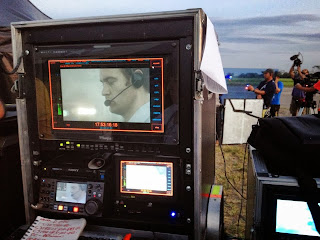
'Wrong Way' -- the consummate acting professional hard at work...
The 'pro' at work. Pic credit: Christopher Allbritton.

New York, New York?

Whether Hollywood takes the lead or not we may, in any case, find ourselves New York bound in a few months. It's just a case of taking the flight, it's already paid for. 

We like to explore new places, so the chance to visit 'The Big Apple' and catch up with family would be very much up our street. It all just depends on how our Colombian plans are progressing. 

Failing that, or maybe in addition, there's always the World Cup in Brazil. Sure it's only a stone's throw away from our current abode – anyone fancy joining us on a boat ride through the Amazon to get there?

6 Nations

Mentioning the World Cup, while it will be a great spectacle and we wish Colombia all the best, that Ireland won't be there means we won't be overly engrossed in it. Rugby's 6 Nations Championship, on the other hand, always gets our emotions up. 

We saw glimpses, specifically in the November test match against New Zealand — the one (another one) that got away — that Ireland, under new management, could have a big impact in the 2014 tournament. As we stated from the onset, we're being positive. February and March might put paid to that; here's hoping not, though.

So there you have it; our 'Reasons to be cheerful', kind of. It's simply a case now of 'let the good times roll'. Happy New Year to all!

___________________
*For an idea of what our English teaching work in Bogotá has been like, see The 'money' tongue.

**For more see Any which way but lose....

***Oh the glamorous world of TV extras work in Colombia is explored more at http://bit.ly/NrbPc3.

Friday, 20 December 2013

Simply having an indifferent (Colombian) Christmas time

This time of year is, of course, very family-orientated, especially for those from a Christian background. 

So the fact that we decided, yet again, to leave our clan with the Christmas period within earshot has left many here in our second home wondering why. And it hasn't just been the Colombians who have asked us this, but even fellow expats: 'Why didn't you wait until after the holiday season to return?'
Simply having an indifferent (Colombian) Christmas time. Some of Bogotá's Christmas lighting -- credit where credit is due.
Some of Bogotá's Christmas lights are pretty impressive.
It's not that we're anti-Christmas, far from it. Indeed, back home we really do enjoy the festive period and we always have. Even when we've had to work through some of it, as was the case in our most recent ones spent in Ireland, we've generally liked the whole atmosphere it generates.

Yet, this is perhaps the crux of the matter; Christmas for us is about home and everything that goes with it. 

Not being in the place where we spent 23 uninterrupted years merrily munching through turkey and ham dinners every 25 December (plus the very satisfying second, third and even fourth servings in the subsequent days) means we have a slight indifference towards it now that we're not there. 

Here in Bogotá, it just doesn't feel the same as we gear up for our third consecutive holiday season (we like to be politically correct every now and again) outside of the homeland.

In one sense it's a case of out of sight, out of mind. That is, while Colombia does obviously 'do Christmas', it's not the Western, winter version we know and love. 

(OK, credit is forthcoming for trying to replicate the winter scenes. Some of the lighting displays are impressive enough and accompanied by the odd relatively chilly night in Bogotá it can at times seem semi-Christmassy, but in the end, we just don't buy it. For starters, the daytime temperatures are just too mild.)

A large part of the Christmas ambience we like is the tried-and-trusted, cheesy as some may be, tunes; Fairytale of New York being one of our favourites (and, we hasten to add, it's far from cheesy).* 

Yes, Colombia has its Yuletide melodies, but again, as we haven't grown up with them, they just don't resonate; although this little radio advertisement for Café Aguila Roja, http://www.youtube.com/watch?v=egtQozVh50A, akin, perhaps, to the Irish clothing retailer Penneys' 'whole lot of things for Christmas' is beginning to grow on us (pickings are slim).** 

This year, we state without shame, we've found ourselves listening online to Ireland's Christmas FM just to get us in the mood – we even got ourselves a shout-out on it from across the waves.

So with all this, let's call it mild yearning for a traditional home Christmas in mind, why exactly didn't we stay? Well, we left just before the season got into full swing, so that helped. 

Plus, we had to balance any desire to remain with the fact that we had already spent longer in Ireland this year than we had envisaged, especially so when there were, and are, very few decent job opportunities around. 

We figured the money we'd spend during an Irish Christmas would easily pay, with a bit to spare, for flights back to Colombia, or anywhere for that matter.
Last year's remake of Bethlehem proved a hit with Bogotanos; we got in for free, honestly.
Never mind a live crib, how about a live Bethlehem, Bogotá style?
Also, there is the case that we're perhaps being overly nostalgic, looking back on past Christmases a tad too fondly compared to what the reality was. For sure, it's better to have happy memories than sad ones. 

More significantly, though, some of those things that signalled Christmas to us have now gone and can't be replaced. 

This year we said goodbye to an uncle and good friend, somebody who was as much a part of our festive memories as those aforementioned turkey and ham dinners, the songs or, in our earliest years, Santa Claus.

Thus, as we all know, things are constantly changing, evolving – sometimes for better, sometimes for worse. With time we might come to embrace a Colombian Christmas. Or maybe we've just moved on from getting too engrossed in it, no matter where we are.

One positive thing about being indifferent is that we don't have to face those January blues; there's no big low if you don't have the high. Steady as she goes and all that.

____________________
*Any excuse for a blast of Fairytale of New York: http://www.youtube.com/watch?v=j9jbdgZidu8.

**Not exactly the Penneys ad version we're looking for but it gives an idea: http://www.youtube.com/watch?v=HP9hgpj0za4.

Finally, and regardless of your thoughts of the shenanigans at this time of year, we'd like to wish everybody a happy and peaceful Christmas/Holiday Season!

Tuesday, 10 December 2013

No somos Colombianos, pero ... (We're not Colombian, but ...)

An old Colombian flame of ours used to suggest that we’re just not compatible with her country; with a large proportion of the people that is, not the actual land. 

In fairness, it didn’t take her to get us thinking that way, whether it’s completely true or not.
No somos Colombianos, pero ... (We're not Colombian, but ...): A bog-standard, satisfyingly simple Bogotá tienda bar.
Unlike some 'exclusive' spots, locals actually talk to you in tiendas such as this one.

We’ve tinkered around this topic before.* Plus, we tend to be very honest and forthright; no, you’re right, let’s not go down that road just now.

In terms of finding love (uh-oh, here we go again), where we do a large part of our socialising – see http://bit.ly/17yN8HH for what we’re on about – are not the type of places you’re likely to find the most ‘sought after’ girls in Colombia. 

We won’t go into the whole argument that such a search is fanciful in this country; or any for that matter. We’re not complete romantic cynics, just yet.

The fact is that for much of our socialising we gravitate towards modest, value-for-money, friendly, venues. You see, we do like to regularly get out and meet people but this also has to be balanced with living within our means. 

Thus, when you’re in a city/country with such a disparity in prices between different neighbourhoods, from the relatively cheap to the ridiculously expensive, and your own income is pretty average, visits to the swankier ends have to be frequently curtailed.

In contrast, most Colombian women around our age, ones with comparable backgrounds/education to ourselves, in any case, tend not to like the satisfying simplicity of the tienda bars we regularly frequent. No, they enjoy more the lavish locations – it helps, of course, when they don’t expect to put their hands in their oversized handbags for much, if not all, of the night. 

We, however, are such fans of equal rights where possible that the idea of paying far more than our fair share is anathema to us (for more see The wages of love).

Yet the question remains, are we incompatible with Colombia? Our Costeña ‘friend’ answered this one in the affirmative.** 

However, putting aside her Colombian nationality, we may be more ‘acceptable’ to, and compatible with, the masses of her country than she is. 

Her hangouts of choice align with the ‘elite’ minority of the country. Tienda drinkers are the norm, the majority. All understandable, really, considering the wage difference and accompanying social scene discrepancy between the top earners and the rest.
The 'delightful' La Perseverancia, our new hangout spot in Bogotá.
Our new home, La Perseverancia: no one even tried to rob our camera.

Change may be brewing on this front. With a rising middle class, places that are now seen as upper class will in time, perhaps, become more accessible to a greater number of citizens and expats alike. Such a change, though, is unlikely to happen at any discernible rate, not in these parts.

We may be a long way from the day when a Colombian parliamentarian and the local unemployed alcoholic drink in the same bar and share a conversation, something that you’ll often witness in Ireland. Although, that may not be the best example; they’re both similar types in many ways. You get the point, though.

One other feature that draws us back time and again to our watering holes, outside of the price, is that we tend to find that the locals there get that almost indescribable thing, the ‘craic’ (or ‘crack’, depending on your spelling preference). A word (not a substance) used in Ireland and elsewhere to describe many scenarios.

In this context, the craic is understanding and being able to engage in various bouts of slagging/pub banter. Lest there be still any confusion about the word and its meaning, the only drug that is usually consumed in the presence of craic is alcohol, although it’s not a prerequisite. 

Not only do they get the craic, but we find that they're usually very good at handing out free beers. Oh, they know how to 'play' us!

So while you can point to many areas where we don’t ‘fit in’ with Colombia and her people, we’ve found enough comforting similarities to keep us coming back.

You could say, like the country itself, we’re still a work in progress here, without a fixed completion date.
_________________________________
*For a run through some of the things we've found 'uncomfortable' here, see Lord of the Dance and Colombia’s false friends. The Irish and Colombians do, however, have that strong Catholic background, manifested in different ways albeit.

**'Costeña' ('Costeño' for a man; literally 'coastal' in English) is the term used for women from Colombia's — and Venezuela's — Caribbean coast. It's also the name of a beer in Colombia. (We won't go into the whole 'a beer is better than woman because ...' spiel; we could, but we won't.)