Showing posts with label World Cup. Show all posts

Thursday, 10 August 2017

Colombia's comedown?

For the last 12 months or so Colombia seemed to be on the crest of a wave somewhat. This was mostly down to the implementation of the peace deal signed between the government and the country's largest rebel group, Farc.

Heady times, albeit superficially and in just some areas. The bounce Colombia got internationally was apparent in numerous foreign media reports naming it as one of the must-see places in 2017. 

Add to this President Juan Manuel Santos' scooping of the Nobel Peace Prize and the grounds for optimism were clearly there.

However, considering Colombians can be as cynical as the best of them (amongst themselves that is, not normally to outsiders) coupled with a belief in many quarters that the Farc peace accords change very little in practice, the optimism certainly appears to have waned. (It should get a small shot in the arm with Pope Francis's upcoming visit here in September.)

Colombia's comedown? Bogotá from a high: Is it, and Colombia in general, a work progressing or regressing?
Bogotá and Colombia in general: A work progressing or regressing?
Indeed, for some, the place is getting worse. A well-to-do Scotsman who has called Colombia home for the last 27 years believes this to be the case. He says that for the first time in his almost three decades here, he feels things are regressing. That seems quite a statement bearing in mind that when he first came here Pablo Escobar was still wreaking havoc.

So why, at a time when Colombia seems as open and welcoming as it ever has been, the negativity? The following sheds some light on things:

Cocaine high

Cocaine. Its mere utterance gives most Colombians a sinking feeling; the scourge of the country for decades.

Of course, the substance is ingested just as much, if not more so, in North America, Europe and Australia as it is in these parts, but here is the source.

As long as the external demand and enormous profits to be made from it continue to exist, cocaine production won't slow down any time soon. In fact, the opposite has been the case of late, it has increased.

The money in the white powder offers a route to riches that legitimate Colombia can't come anywhere close to. Thus, it's mob rule where cocaine is king with officialdom either turning a blind eye or being implicated in it.

A not-so-well-oiled machine

In contrast to Venezuela, Colombia's oil revenue looks set to fall substantially in the coming decade.

Unsurprisingly, sources in the industry here say the government lacks any sort of plan for a not-too-distant future when the country will have to import the resource.

We'd expect Venezuela to have its house in more normal order in 10 years' time than it is now, so maintaining good relations with the oil-rich neighbour is key. Welcoming fleeing Venezuelans with open arms during this current crisis might just be the right strategy.

Short-term gain, long-term loss

As for the lack of planning in terms of resources, so it is for practically every other area, especially in the likes of education and infrastructure.

Unfathomable and often contradictory legislation enforced arbitrarily combined with rampant corruption mean progress is slow or there's none at all.

In such an environment there are few signs that the vast inequality is being reduced. This ensures continued envy and justification for crime from the have nots.

Reasons to be cheerful?

Notwithstanding the above, we're not running away from the place just yet. The fact that the country is in a state of flux, a tad chaotic if you will, both excites and frustrates many foreigners based here.

Plus, with La Selección (the men's national football team) on the verge of World Cup qualification, the powers that be can rest assured that the football-mad masses will forget all their daily strife, at least for a time.

And that's how things tend to roll here. Live for the moment, to heck thinking about the future.
__________________________________
Facebook: Wrong Way Corrigan - The Blog & IQuiz "The Bogotá Pub Quiz".

Thursday, 26 May 2016

Crazy Copa América

It's fair enough to assume that most of us like at least a little stability in our lives. The comfort of knowing, barring absolute disasters, that you can rely on certain things.

Crazy Copa América: The stars expected to light up Copa América Centenario USA 2016 ...
Copa América: Embracing its unpredictability. (Image from Facebook.)
Even in the world of sport where stability, nay predictability, might not be what we always want, we do have certain bankers. 

You know, like in rugby where the All Blacks always win and in football where you can never write off the Germans. Sticking with the round-ball game — but something that is pretty much true of most sport — you also have the regularity of its main tournaments. The World Cup comes every four years, the same with the European Championships, on the even-numbered years between the global contest, as in this year.

Yet, as tends to be the wont in South America for many things, the Copa América arrives at any old time. It doesn't appear, or at least hasn't heretofore, to follow any plan. Well, if it does, it's not a straightforward one. (Maybe they're right on this one?)

Fair enough, this year's renewal, hot on the heels of Chile 2015, is marking the competition's centenary. Yet, it's not even being played on South American soil. No, it's taking place in the grand old US of A. 

At least it means that none of the Conmebol teams will have home advantage; but the USA will. It wouldn't exactly be the best of etiquette to throw a party in somebody else's gaff without inviting them, now would it?

Indeed, the venue choice has raised eyebrows among some of the participants, with Uruguay manager Óscar Washington Tabárez questioning the United States' suitability on this occasion, especially as games are going to be played all over the vast nation. His side, for example, will be travelling from west (Glendale) to east (Philadelphia) and back west (Santa Clara) again for their three group matches.

Whatever about the merits of this edition — the inclusion of six invitees, namely Costa Rica, Haiti, Jamaica, Mexico, Panama and hosts US, could be seen as weakening its credibility further — there is still a 'copa' to be won.

Looking at it from adopted-Colombian eyes, the competition gives José Pékerman's selection the opportunity to continue their unbeaten ways in competitive matches, having won two on the bounce in the World Cup qualifiers. It also represents a chance to erase the memories of a rather mediocre showing 12 months ago.

La Selección Colombia: How far can they go at Copa América Centenario USA 2016?
How far can Colombia go in the Copa this year? (Picture from Facebook.)
Their game with the United States on 03 June gets the tournament under way. Home advantage is usually a big help in the Copa América, but considering it is not the States' 'baby' so to speak, Colombia might be just that little more up for it (although the bookmakers, perhaps tellingly, see it differently).

A result in that one could set them up for a bit of a run, as Paraguay should be dispatched and Costa Rica, as one of the invited nations, mightn't be overly pushed. Yet making positive predictions about Colombia, as last year showed, is risky business.

That aside, it's likely the winner will come from one of South America's heavyweights. Take your pick from Argentina, Brazil, Chile or Uruguay (yep, we're going all out there). We'll be, um, 'patriotic' and include Colombia as well, but with a semi-final against Argentina, Chile or Uruguay on the cards should they get that far, making the decider might be just beyond them.

But hey, whatever the outcome, at least the Colombian team will have a few weeks in what is a second home for most of their fellow countrymen. Plus, there's always another Copa not too far away.
_________________________________________
Facebook: Wrong Way Corrigan - The Blog & IQuiz "The Bogotá Pub Quiz".

Monday, 23 June 2014

Ley seca — Bogotá's deprived spit back

This blog tends to look out for the underprivileged. So when the have nots strike a blow against the haves, especially in a place riven with inequality such as Colombia, it's usually something to support. It's not often that happens here, of course.

Ley seca — Bogotá's deprived spit back: Millonarios fans 'celebrate' the club's birthday.
'I predict a riot.' Millonarios fans. (Photo from deportes.terra.com.co/futbol/.)

However, Bogotá's unwashed masses have come up with a cunning plan to fight back against their wealthier superiors. In fact, it's rather ingenious considering the power to use this weapon isn't directly at their disposal. 

What they've mastered is akin to confronting a serial killer face to face and getting him to turn the gun on himself. Wonderful.

You see, some of my more hard-pressed Bogotá brethren have discovered a way to deprive the rest of us of the chance to occasionally, in a legal way, let our hair down.

This is how it works: Come up with a reason to have either a celebration or a protest, take to the streets en masse, let things become a little boisterous, violent even (attack public transport vehicles, vandalise buildings and suchlike), and then wait for the authorities to play their part. 

That latter step is the key one. For once the city authorities act, and act they will, the standard response – what they see as a panacea it seems – is to introduce ley seca, that is alcohol prohibition.

With that, all law-abiding citizens (there are some, I have been told) must make alternative plans, had they previously been thinking of socialising with a tipple or two in a bar or club. 

Meanwhile, those whose actions managed to get ley seca kicked into gear toddle back to their lightly policed barrios to enjoy a few beers practically as normal.

It's not a case of everybody being punished for the crimes of a few; it's a case of the wrong people being punished while the perpetrators' lives are barely impinged.

Like many things in Colombia, the law in theory operates very different in practice. As regards ley seca, it's one of those rare occasions when something here works against the more affluent sectors of society. 

In the wealthier parts, breaches are unlikely as licensed premises fear sanctions. Moreover, in more exuberant locations it's not easy to operate clandestinely, as opposed to a small tienda bar with only one entrance/exit, where the owner very often lives in the same building.

Also, in a country where there is a healthy underground market for a wide range of drugs and many of those involved in it come from working-class neighbourhoods, adding alcohol to the list isn't a major inconvenience for those in the know.

The idea behind this alcohol prohibition is to aid in maintaining public order when the powers that be feel some people may lose the run of themselves. 

It's introduced on a national scale for elections, while local authorities also have the power to enact it when and where they see fit. It's in the latter instance that we've had it most recently in Bogotá.

Celebrating in a non-violent way after Colombia's opening World Cup win.
'Celebrating in peace.'
There are a number of reasons why city officials felt it was warranted. After Colombia's opening World Cup game, the victory over Greece, celebrations for some people got a little bit out of hand – besides the fact there was an election ley seca in place a few hours after the game. 

Nine deaths were attributed to the over-zealous football revelling. Of course, at least nine people die in this city most weekends for various reasons, but we tend not to hear about them.

Then, a day before Colombia's second match, fans of Bogotá's Millonarios football club took to the streets to celebrate its 68th birthday – hey, when you're going through a tough time on the field of play, you have to find something to cheer about. That these celebrations got out of control is putting it mildly.

Thus, it was to the tried-but-not-very-well-trusted ley seca that city mayor Gustavo Petro turned to, allowing Bogotanos to, 'celebrate in peace', or so the slogan went. 

Did it work? Well, it depends on who you ask and what part of the city you're referring to. 

You kind of get the feeling that authorities are happy with themselves for being proactive (just don't tell them they're being reactive) and taking effective measures. Meanwhile for a nice chunk of the population the drinking continues, just in a slightly different manner.

Of course, we're not condoning breaking the law, nor the thuggery and vandalism that a small number of citizens engage in, all in the name of celebrating. But, to reiterate, ley seca misses its intended target.

Properly, rigourously enforcing current permanent legislation is one approach in the short term.

Longer term, education is the answer.

Wednesday, 11 June 2014

Soccer, some sun and samba; it's over to you, Brazil

'If you can't beat them, join them.' So considering our own crowd, that is to say the Republic of Ireland, couldn't beat them, the choice for most Irish, even those with just a token interest in soccer (football, if you will), is to join them and get roused up in this year's World Cup.

Soccer, some sun and samba; it's over to you, Brazil: Past World Cup winners. Who will it be this time around?
Who's it going to be this time around? (Pic: Fifa World Cup Facebook page.)

This is made much easier, too, when you're in a country that is taking part – one that's not England that is. 

Plus, from this perspective, it's not just any country, it's Colombia. That rather odd but at the same time enjoyable game of tejo may be seen as the more authentic, national 'sport' for some, but there's no disputing what the real passion is.

Indeed, such is the importance of the game to the masses, had La Selección's (the national team) luckless superstar, Radamel Falcao, known a few months ago that he wouldn't make the finals, he could have ran for president where he would, without much doubt, have been elected at a canter. 

There'd be no need for this upcoming second round of voting, and with it Ley Seca, which we now have to 'suffer' through on the World Cup's opening weekend.

Colombia's luckless superstar, Radamel Falcao.
President Falcao? (La Selección Col.)
Of course, it could be argued that without Falcao leading Colombia's line in Brazil, fans could be set for more suffering watching events on the pitch. Time will tell on that one. For now, hope springs eternal.

So as we ready ourselves for four weeks of what will hopefully be a memorable football feast, here's the Wrong Way 'sideways' take on things.

'This World Cup, I'll be mostly supporting ...'

I'd probably be doing Colombia a service by not supporting them, given how most teams I want to see win never actually do. But it is my second home these days, so one must do one's patriotic duty.

Outside of Colombia, I've always had a soft spot for Italy, Uruguay and Costa Rica – oddly enough these three teams happen to be in the same group as England.

Put your money where your mouth is

If you are going to bet thinking about how much you're going to win rather than what you might lose, then lumping, significantly, on the winner coming from South America, at odds of about 10/11, looks a nice option. 

That's going by the fact that European teams have never won the tournament when it's been held in the Americas.

Nice colours: The Ivory Coast flag.
Looks familiar... (featurepics.com.)
More specifically, for many this is Brazil's tournament to lose, so you could just cut to the chase and take the 3/1 on the Samba Boys lifting the trophy on 13 July.

All those might seem a little boring, aimed more at the professional, heavy punting gamblers. 

So for a fun bet, where a small stake could win big, an each-way dabble on Ivory Coast at 150/1 might give you a run for your money; there's something about the national flag that resonates. The 40/1 about Colombia is also interesting. Yes they must face Ivory Coast, but both teams can emerge from the group. Plus it gives an added incentive to feverishly support my adopted country.

Brazilian babes; not bad...
'Very good.' (futbolwallpapers.com.)

Battle of the anthems

While football/soccer national teams rarely sing their respective anthems with the same gusto as their rugby equivalents, it's still nonetheless very much part of the build-up to kick-off. 

When it comes to this side of things, I'm very much a traditionalist and stick with the tried and trusted. So in the absence of the Celtic nations, it's hard to beat either France's La Marseillaise or Il Canto degli Italiani for the Italians

Whisper it, but due to constant exposure over the last couple of years, even the Colombian anthem is beginning to sound semi-decent these days.

Brazilian babes

World Cup cameramen are usually pretty adept at picking out the attractive ladies watching in the stands. Down through the years the majority of these have tended to be Brazilian. So what a tough assignment those working behind the lenses will have this year. Who do you leave in, who do you leave out? 

If any TV company needs assistance in this area, I'm willing to lend a hand – on the ground, in person, of course, it's the best way. Wrong Way – always here to help.

Right, time to let the football do the talking.

Wednesday, 21 May 2014

Four more years: The least-bad option?

Right. The time for posturing and talking is almost over. We've known the participants for some time, now we're about to find out which one has what it takes to go all the way. 

Most of us, more or less, have a pretty decent idea of who the genuine contenders are versus the no-hopers, but in these final days minor hiccups could have a detrimental effect on the eventual outcome. Nobody can take anything for granted.
Four more years: The least-bad option? Colombia's presidential election 2014 — a shoot-out between Santos and Zuluaga?
So, is it to the right or to the not-so right? (Photo from caliescribe.com.)
Yes, it certainly promises to be some spectacle in neighbouring Brazil when the World Cup kicks off next month. But before we become engrossed in that, there is the 'small', more imminent matter of Colombia's presidential election to keep us semi-entertained.

In fact, it's pretty much assured that the Colombian electorate will be asked to go the polls twice before it knows who its new top man is (for, if the opinion polls are to believed and barring some almighty surprise, it's going to be a man). 

That's because the incumbent seeking re-election, Juan Manuel Santos, has let what was by all accounts a rather healthy lead at the beginning of the year slip as polling day (25 May) approaches. Thus, none of the five candidates is set to get more than the 50 per cent of the votes required to win without the need for a second round.

Santos' nearest challenger has turned out to be, somewhat surprisingly, the Centro Democrático's (Democratic Centre that is; but generally more right of centre) Óscar Iván Zuluaga. 

His surge in popularity has been surprising given the fact that a few months ago the running joke was that when he arrived home each evening, the security guards at his apartment complex had to ask him for ID because he was so unknown.*

However, a mixture of the Centro Democrático getting its political machine into gear and some Santos failings has seen the gap between the two close considerably. 

On the former, the presence of the divisive yet still hugely popular figure for some, ex-president Álvaro Uribe, has been a major help. A dollop of hacking also seems to have worked wonders. 

Indeed, in what could be seen as a measure of the pigheadedness of many Centro Democrático supporters, the sight of Zuluaga 'talking business' with a hacker about delivering a blow to Santos doesn't appear to have done him much harm (see http://www.semana.com/nacion/articulo/el-video-del-hacker-con-oscar-ivan-zuluaga/388438-3).

For his own part, how the current president handled – or not, as it appeared to be – the what-turned-out-to-be-temporary sacking of Bogotá mayor Gustavo Petro was problematic. His lack of leadership in what was a farcical period in Colombian politics has left people from all sides questioning his ability to govern.

In a contest where there is no stand-out choice, small things matter.

It's also effectively a first-past-the-post system. The stipulation that there must be a second vote between the top two candidates should no one receive more than 50 per cent first time out is just a delay on that. 

So bearing in mind the conservative nature of Colombia's electorate (those who vote that is, anyway), reflected in the opinion polls, this election is a straight shoot-out between Santos and Zuluaga.

President Santos on the campaign trail.
President 'As Cool as it Gets for Now'? (Photo: juanmanuelsantospresidente.com.)
The others at this stage are just also-rans. In any case, the only one who is arguably offering any real alternative to the type of president Colombia has consistently returned is the (mild) leftist Clara López. The rest are very much 'as you were' with really only superficial differences.

Thus, Colombia, is it to be four more years of the 'devil you know', best described, at a push, as steady? Or do you go with the slightly unknown, but of the arrogant, brash Uribe school and party, Zuluaga?

Now, the argument can be made, with reason, that all in the running have Uribe links (as mentioned, for some Colombians that's a good thing). Even 'the darling of the left' López is tainted in this regard; and in a much more intimate way than the other candidates.

But old romances apart, the Zuluaga ticket represents the most potent political link to Uribe. In power, that basically means more division and discord, much less consensus.

Santos' decision to open up peace talks with the country's guerillas – the inherent problems in them apart – shows he is willing to compromise and make sacrifices. 

After more than 50 years of internal, zero-sum strife, 'the exterminate rather than communicate' line still favoured by many in the Uribe faction needs readdressing.**

There is also the theory that a second and final-term president has a little more freedom and can be more daring when released from the re-election straitjacket. Perhaps the best is yet to come from Santos?

Finally, taking it as a given that this election really is just a Santos-Zuluaga head-to-head, there is another strong reason to opt for Santos first up. 

The date for the second round, should it be required, is fixed for the weekend Colombia gets its World Cup campaign under way. And with elections here comes the 'dreaded' Ley Seca ('Dry Law' i.e. a ban on selling alcohol).

Perish the thought of having to watch the opening salvoes in Brazil from the mundaneness of an apartment.

Colombia, the choice is yours.
____________________
*See the earlier Colombia's presidential election: The candidates (and their Irish 'equivalents') for a more of an 'understanding' of all the hopefuls.

**For more on the peace talks, check out An unwanted peace?

Monday, 30 December 2013

Reasons to be cheerful

It has, by all accounts, been somewhat of an indifferent return to our second home of Colombia. Indeed, you might say — but we won't — that it has been bordering on negative. 

The time of year we returned has played a factor in terms of us getting saddled up again with any significant work — well before the 25th of December this country goes into holiday mode, with English classes generally being the last thing on most people's minds.
Reasons to be cheerful: The (hopefully) prosperous trek on the year 2014 begins.
Where does the road lead in 'our' year of 2014? Pic from hdwallpapersinn.com.
Now, not racing around Bogotá playing the part of the on-call, 'flying' teacher has left us with time (too much time in some ways) to explore other, more fulfilling, employment options, something that was (and is) one of our chief goals for this latest stint in the country.* 

Alas, little progress has been made thus far on that front — again, the prevailing ambience among the masses right now of 'leave it until next year' is, we hope, a big reason for this.

So we will be looking for an upturn in fortunes when things get back into full swing (or the Colombian equivalent of that) in the coming weeks. 

In this regard — and also in an overall context — we do, we think, have reasons to be cheerful looking forward to 2014 and beyond. Sure 'tis the season to be positive (and, in writing, to make barely relevant lists to pass as acceptable articles); and we can do that from time to time, contrary to what some believe. Right, here goes:

2014

Let's start with the new year itself. The numbers 2 and 14 resonate deeply with us, for birthday reasons. So having both together in the one year, it's got to be a positive sign, right? 

A cynic might say that it means nothing at all, 2014 simply representing the number of years since the birth of a highly contested/controversial saviour. Eternal damnation for such cynics, we say. And no, we're not engaging in a process of seeing a straw and clutching desperately. One mustn't ignore the obvious.

On another point, this year sees us enter the last of our 20s. So we're just coming nicely to the boil. Or so we'll tell ourselves.

Pieter and his 'wonderful' selfie
Looking, eh, good there Pieter.

Independence

While there were many good reasons to be back home in Ireland earlier in the year, a sense of being slightly trapped and 'dependent' was not one of them.** 

We feel we have a little more freedom here, whether that's actually real or imagined. It may all just be in the head (and the pocket, too; when resources are tight, we can make our money last a little longer here while not severely damaging our 'revered' social life). 

An important caveat: For the majority of our time since coming back we've had a lovely apartment all to ourselves. That's due to change shortly. Change can be good, though.

Goodbye to 'The Year of the Selfie'

Apparently, 2013 was 'The Year of the Selfie' — that is, for the uninitiated, a photo taken of yourself, by yourself and subsequently posted to social media (well, it's silly keeping it to yourself, right?).

The thing is, the looking-in-the-mirror selfie while making a ridiculous pose has been all the rage for Colombian women for the last number of years. Just take a peep at most Colombianas photos on their Facebook page to get an idea of what we're on about. A rare moment where Colombia was, um, 'ahead' of the posse on the global stage. Here's to 2014 signalling the end of this craze. See, we are being positive.

A star is born

Since returning to Bogotá, we've reacquainted ourselves with some TV extras work.*** 

Not only that, but we managed to land a brief speaking role, i.e. no mere 'extra', but a 'super extra' with an actual, ahem, meaningful part, on the hit production 'El Capo' (the third series, which is due to be aired from February 2014). 

Our performance as a San Diego airport control tower guy is sure to make headlines across the Latino world. Hollywood, take note.
'Wrong Way' -- the consummate acting professional hard at work...
The 'pro' at work. Pic credit: Christopher Allbritton.

New York, New York?

Whether Hollywood takes the lead or not we may, in any case, find ourselves New York bound in a few months. It's just a case of taking the flight, it's already paid for. 

We like to explore new places, so the chance to visit 'The Big Apple' and catch up with family would be very much up our street. It all just depends on how our Colombian plans are progressing. 

Failing that, or maybe in addition, there's always the World Cup in Brazil. Sure it's only a stone's throw away from our current abode – anyone fancy joining us on a boat ride through the Amazon to get there?

6 Nations

Mentioning the World Cup, while it will be a great spectacle and we wish Colombia all the best, that Ireland won't be there means we won't be overly engrossed in it. Rugby's 6 Nations Championship, on the other hand, always gets our emotions up. 

We saw glimpses, specifically in the November test match against New Zealand — the one (another one) that got away — that Ireland, under new management, could have a big impact in the 2014 tournament. As we stated from the onset, we're being positive. February and March might put paid to that; here's hoping not, though.

So there you have it; our 'Reasons to be cheerful', kind of. It's simply a case now of 'let the good times roll'. Happy New Year to all!

___________________
*For an idea of what our English teaching work in Bogotá has been like, see The 'money' tongue.

**For more see Any which way but lose....

***Oh the glamorous world of TV extras work in Colombia is explored more at http://bit.ly/NrbPc3.

Wednesday, 24 July 2013

Putting Colombia right, the 'Wrong Way'

As has been well documented, the Wrong Way crew is a modest bunch. Sometimes, though, we have to go against our natural instincts and give ourselves a modicum of praise (it’s unlikely anyone else will). 

So as we prepare to depart Bogotá for what at this remove is an unspecified period of time, we’re going to take a look at some of, ahem, our achievements in the region over the last 20-plus months.*
Putting Colombia right, the 'Wrong Way': Sunset in Bogotá
The sun is setting on this latest (but perhaps not last) stint in Bogotá.

Peace talks

Considering the bridges we built during our time living in divided Belfast (a nice little chat with the Reverend Ian Paisley outside City Hall being one of the highlights), it was only a matter of time before President Juan Manuel Santos called on us to set the Colombian peace process in motion. 

Cynics out there may say that the whole thing is just an expensive talking shop that’s going nowhere – the violence hasn’t stopped, for one – but at least they’re talking, right? (For an earlier account of this, see http://bit.ly/13IIUKr).

‘Revitalised’ Bogotá

Where do we start with this? There’s the partially pedestrianised Carrera Séptima (7th Street) in the capital’s centre – a rare victory for humans over vehicles (kind of). 

We stood shoulder-to-shoulder with Mayor Gustavo Petro during the controversial change in rubbish collection that has revolutionised waste collection in the city (well, maybe not quite revolutionised, but it sounds good – for background see http://bit.ly/WFOPsW).

What's more, we finally initialised the programme to rescue the metropolis’ overworked horses – it’s taking time to get them all off the streets, but we’re getting there (see http://bit.ly/15IZQPz).

It’s not only the equines we’ve saved but also some human beings. Our cleaning up of Bogotá’s notorious Bronx barrio (and other dangerous barrios in other cities across Colombia) has been a roaring success – we just haven’t been there in a while to check on progress (it’s too dangerous).

A rally for peace in Bogotá City Centre
Carrera Septima –take away the cars & the people will come (and march).

Transport matters

An ever-extending (it goes to the airport now, almost) efficient (at times) Transmilenio service linked up with an integrated public bus system (SITP – OK, hardly anybody uses it yet and its operation is divvied up between nine companies, but change takes time, you know) is something we’re pretty proud of. 

We’re not resting on our laurels, though. Metro Bogotá is more than just a pipe dream, it is on the way, trust us. (For more on transport in the city, check out http://bit.ly/N68gKL)

La grande

Las Grandes; The BIG beers
Las grandes in our favourite tienda ...
For some reason, the big beer revolution that swept through the rest of South America some time back passed over Colombia. That was until we arrived and got Bavaria – the country’s main beer producer – moving on this front. 

Since the introduction of La grande (750ml bottle), through hard work, dedication and repetition, we’ve been persuading the locals to take up the big habit. Come on guys, above all it makes economical sense.

Vamos a Brazil

There’s no doubt Colombia has produced some exceptional football (soccer, if you will) players through the ages, but La Selección – the national team – has very often flattered to deceive. Thanks to our, um, support that has all changed. 

All they need is a couple of points from their final four games of the South American World Cup qualifiers and Los Cafeteros will be on their way to Brazil next year – their first World Cup finals appearance since 1998. Chévere.

Thespian talent

Before our arrival, Colombian telenovelas (soap operas) were renowned for their cheesiness, terrible acting, ridiculous storylines and just all-round bad quality. 

Now, however, with our help, they are, well, um ... Right, let’s just say we did some interesting extras work from time to time. The gory details of those can be found here http://bit.ly/NrbPc3.
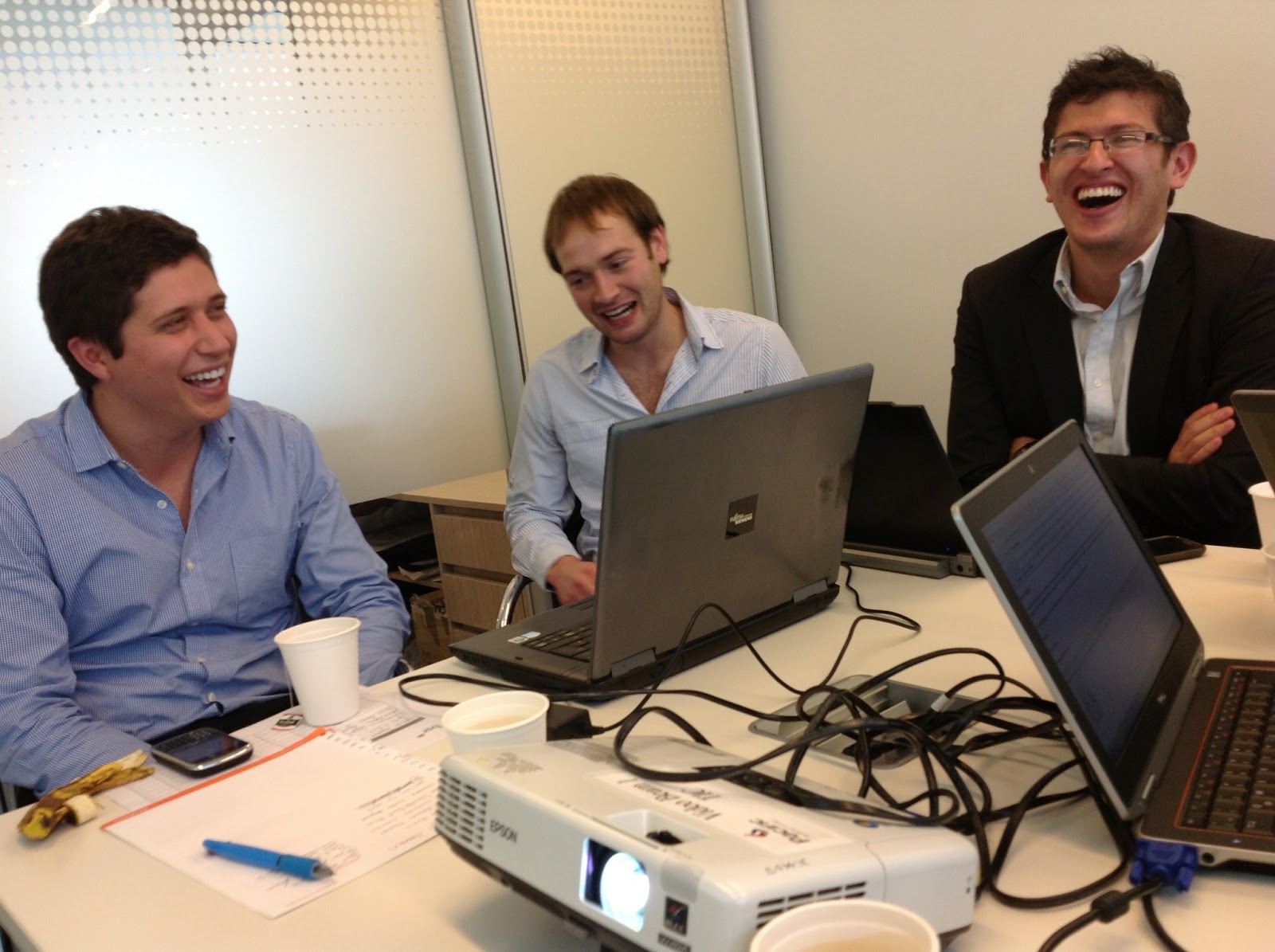
'Wrong Way' hard at work...
Hard at it; but whose is that banana skin?

Educating excellence

While we may have occasionally showcased our acting skills on Colombia’s small screen, the arguably more lasting, beneficial legacy we’ll leave behind has been our ability to pass on the English language – with an Irish twist, albeit (more detailed thoughts on our teaching talents can be read here http://bit.ly/V8ELH4). 

Whether any of our alumni actually learned anything is open to debate. At the very least, though, some of them have a better understanding of Irish history and culture, Wrong Way style. 

We'll miss imparting that knowledge; as well as all the free coffees and the odd free lunch. Heck, those latter treats are enough to entice us back (we're easily pleased here, you know). Time will tell on that one.

*Disclaimer: We would like to point out that some of these achievements may not be directly attributed to us. But ...