Wednesday, 21 October 2020

Colombia's tough love

@wwaycorrigan

[Listen to an audio version of this blog entry here.]

'Sure this lad will clearly do anything to stay in Colombia. Just look at his record. Nine visa applications in the last seven years plus three salvoconductos. We could ask him to submit a big, juicy papaya next time, and no doubt he'd do it.'

Colombia's tough love: Wrong Way's love for Colombia, although not unconditional, has been apparent these last few years. Colombian officialdom is putting a big strain on the relationship now.
Alas, it appears to be unrequited love. (Image from Facebook.)

Social media diplomacy

It's stretching it somewhat to think that officials at La Cancillería Colombia have actually ever uttered words similar to the above. 

It's highly unlikely that there's a red line under my name at the country's visa-issuing authority — well, I'm pretty sure there wasn't, that might have changed now in light of recent, unsolicited media coverage.

Nonetheless, and at the risk of coming across as a "victim" here, I'd wager that throughout these seven years since getting my first Colombian visa few other independent foreigners based here have handed over as much hard-earned cash as I have in terms of visa applications and related processes.

Events of the last few weeks have reminded us that obediently and quietly following the visa/immigration rules in Colombia, especially if you're having difficulties in obtaining exactly what you want, doesn't always work in your favour.

No. The more advantageous route, for certain individuals, is to kick up a public fuss, rally the masses to your cause — if you can, that is — and Colombian officialdom will cave in to your needs. You do this while at the same time repeatedly say how much you love and respect the country.

You could equate it to a man telling a woman everything she wants to hear in order to sleep with her. In truth, with just the gentlest of scratching below the surface, his actions show how he cares little for her. She is no more than an object to be used and abused.

Yet, mesmerise your target with public displays of affection that conceal a threat, appear as a caring, loving, selfless individual and in no time the putty shapes itself exactly how you want it.
'No serious foreigner thinking about visiting or living in the country would seek out the advice of these Colombia-can-do-no-wrong types.'
Dishonesty is the best policy. Respect is only forthcoming if the other party loses respect for itself. It's not a relationship of equals, it's one of domination, built largely on false premises.

Forbidden fruit

In the specific case of Colombia's love affair with its foreign-born influencers — influencers whose business model is to say practically nothing negative about their adopted place — submissive Colombia believes it is getting something in return: The positive promotion of the country abroad.

The reality is more a case of Colombia being sold to Colombians. No serious foreigner thinking about visiting or living in the country would seek out the advice of these Colombia-can-do-no-wrong types.

Again, you're telling your sleeping partner exactly what she wants to hear yet both you and her know it's an act, a fantasy. And what you tell her doesn't really go any further than the bedroom. 

If it does happen to reach a wider audience, most observers are intelligent enough to understand it's little more than sweet nothings whispered at the moment of passion.

I've never been great at these exaggerated displays of affection — not too many Irish people are really, it's safe to assume. 

However, my attempts to stay in Colombia since the independent visa application became more complicated in 2018 have, it could be argued, smacked of desperation.

It reminds one of the old saying here, 'Él que muestra el hambre, no come,' 'He who shows hunger, doesn't eat.' It's time I started devouring that life-giving papaya myself rather than foolishly giving it away.
_______________________________________________________________
Listen to Wrong Way's Colombia Cast podcast here.

Facebook: Wrong Way Corrigan — The Blog & IQuiz "The Bogotá Pub Quiz".

Tuesday, 13 October 2020

Colombia's Migración mess

@wwaycorrigan

[Listen to an audio version of this blog entry here.]

In September, Migración Colombia, the body responsible for granting extensions to temporary tourist passes, announced that the grace period for foreign visitors who found themselves stranded in the country was coming to an end.

Colombia's Migración mess: Migración Colombia offices are now open on Saturdays in the country's three biggest cities. Will this be enough to deal with the backlog of cases? Probably not.
Opening on Saturdays is a help, but is it enough? (Image from Facebook.)

Escape from limbo land

From the 21st of the month, days spent here would, in effect, start to be counted again, having been frozen when lockdown was introduced in March. 

For tourists, the deadline is 01 November to either apply for another 90-day permit or leave. 

If you're leaving within the time period, well that's straightforward enough. However, it gets trickier if you're looking for an extension as this requires an in-person meeting at a Migración office.

The initial communication from the government body stated that all appointments must be booked online. Those who turned up at Migración without one would be turned away. 

However, facing into a six-month backlog and reopening at only 30 per cent capacity, securing an appointment any time this year quickly became next to impossible for many. 

You see, it's not only tourists Migración deals with. All foreigners based here who aren't currently residents or citizens have to use its services at least once a year. 

Those who, during lockdown, were granted a visa or residency — a fully online process done with a different entity, La Cancillería — are expected to have these registered at Migración. This is one side of the same coin for the issuing of an ID card — cédula extranjería — corresponding to said visa/residency.

As far as I'm aware, this process must be begun on or before 21 October. (In old-normal times you had 15 days to register a newly-issued visa.)
'I've been told of incidents where people with such emergencies were refused entry to a Migración office because they didn't have an appointment reserved online. This is completely at odds with the official line.'
That deadline also applies to foreigners living here who had a visa/residency application deemed inadmissible or whose visas have expired or who find themselves in the country as an "irregular" for whatever reason. 

How I initially understood it was that those in such a position had only to register their intent to legalise their status, which in most instances means applying for an emergency stay called a salvoconducto. (Another option is to leave the country at the earliest possible opportunity — that usually means no more than 30 days after a visa expiry date.) 

If these people in limbo can't get an actual in-person appointment before 21 October because the system is overwhelmed, surely they can't be held responsible for that?

It now appears, however, Migración expects such cases to have reached a conclusion by the deadline. 

The latest advice on its website states that if your appointment is after the date your document expires or you simply can't get an appointment and yours is a case that needs urgent attention, you should go immediately to one of its offices, preferably, I'm guessing, the one closest to you. 

But for the grace of Duque?

That's the official line. As is often the case with such things, though, what's happening on the ground is different. I've been told of incidents where people in such dilemmas were refused entry because they didn't have an appointment reserved online. 

I'm also aware of a number of Bogotá-based foreigners being forced to travel to Migración offices in cities hundreds of kilometres away to resolve their situation before they became irregular. Great in these coronavirus times, isn't it?

One of these was somebody applying for residency. A day before his latest visa expired he received notification from La Cancillería that his application was deemed inadmissible — something that seems to be happening to a lot of folk requesting visas or residency these days.

Thus, faced with losing the continuity of five years of visas, the most crucial, time-consuming requirement for a residency bid, he had to hightail it from the capital to Neiva in order to seek a salvoconducto from the Migración office there, effectively buying time to sort out the issue with his original residency application. 

It worked out for him, he got what he needed. However, this is the exact type of case where I would have thought flexibility would be forthcoming from both La Cancillería and Migración. 

The applicant didn't want to test that, hence his last-minute dash south to Neiva. It must be said, the fact these processes involve two different government entities doesn't help.

The chief press officer at Migración did tell me in a WhatsApp message that they were being flexible. I've no reason to doubt that. I must also state that I've always found officials at that body reasonable and informative. 

Nonetheless, potential arbitrary flexibility and understanding aside, one immediate solution to all of this would be an extension to the grace period. We're still in the middle of this pandemic after all. Forcing people into unplanned travel in such times doesn't seem like best practice. 

So, President Duque, you have it in your power to tidy up this messy situation. Or are the conspiracy theorists on to something? Is Colombia systematically forcing foreigners out? Surely not. _______________________________________________________________
Listen to Wrong Way's Colombia Cast podcast here.

Facebook: Wrong Way Corrigan — The Blog & IQuiz "The Bogotá Pub Quiz".

Wednesday, 7 October 2020

Caveat emptor with Localiza

@wwaycorrigan

[Listen to an audio version of this blog here.]

One of the biggest annoyances for foreigners from higher-income countries settled here in Colombia is the constant risk of being charged the 'gringo tax'.

Caveat emptor with Localiza: Buyer beware with Colombia's Localiza rent-a-car company.
Not worth the paper it's written on? Apparently not.
Basically, there's a belief, not without foundation in some cases, that we have more money and greater access to resources than the locals, thus it's fine to charge us more when the opportunity arises. 

Going loco with Localiza

This plays out in many different ways across a range of sectors. However, in my own experience, I find it happens more so in smaller, family-run type businesses than in bigger companies. 

This is not to say, though, that those larger operators are more honest — it's just a reflection of where the majority of my interactions occur.

A friend's recent experience with an apparently reputable car hire company suggests the "big boys" will also try to extract as much as they can from you if they feel they can get away with it. 

Of course, this is not exclusive to Colombia, it happens the world over. Nonetheless, I tend to find that the culture here means there is, unfortunately, little pushback against such practices. 

It's why I feel the need to share my friend's woes with the aptly named Localiza (my emphasis, but perhaps they'll consider it in future marketing campaigns — always here to help, guys). A buyer, nay renter, beware cautionary tale.

On hiring a car from the company for a few days, the employee who delivered it to him wrote down on the receipt that the return time was between 15:00 and 16:00, and not the official 14:00 owing to the time of day he was receiving it (see photo above). 

So it was to my friend's unpleasant surprise that when he dropped back the car around 15:00, he was told he was an hour late and would be charged accordingly. 
'There's a general rule in Colombia that if you feel you've been hard done by, the last thing you should do is get angry with the source of your ire.'
He argued the point all the way to the office, leaving the car parked up without doing a final check with Localiza staff (never a wise move). 

He was then told there was a scratch on the windscreen which happened under his watch. My friend says it was there the day he picked up the car but because it was so minor (see below) he let it go. 

The company charged him 1,400,000 COP — about 310 euros — for that defect. Following the lodging of an official complaint, Localiza has agreed to give back 600,000 COP of that fine, inside the next 30 to 60 days. No rush, lads. 

A lost cause

A cynic might say that because he protested over the return-hour discrepancy — this set him back a mere 16,000 COP (3.50 euros) but it was the principle of it that annoyed him — Localiza staff decided to 'go after the cheeky gringo' for much more. 

(There's a general rule in Colombia that if you feel you've been hard done by, the last thing you should do is get angry with the source of your ire. Try, as difficult as it might be, to play it cool, even bring humour into it, and you might get a more satisfactory result.)
Perhaps Localiza Colombia saw the gringo coming with this one.
The offending scratch.
Whatever the case, considering how the company behaved over the return time, one can't rule anything in or out over the windscreen-scratch debacle. Also, that they've now decided to refund almost half of what they charged for that damage, it appears they were more than covering any potential additional costs on their part.

The whole episode is an apt reminder to always be on your guard when entering into a lease or sale. This is even more so the case in these straitened times.

One can never be too careful on such matters, especially as a foreigner who may be out of his/her comfort zone and ripe for the picking. Caveat emptor indeed. 
_______________________________________________________________
Listen to Wrong Way's Colombia Cast podcast here.

Facebook: Wrong Way Corrigan — The Blog & IQuiz "The Bogotá Pub Quiz".

Friday, 2 October 2020

Beware of the (Dominic) Wolf warrior, Cancillería

Listen to an audio version of this blog entry here.

And so it continues. The grave injustices perpetrated by the Colombian state show no signs of abating. Those who were thinking that the pandemic would result in a fairer country, think again.

Beware of the (Dominic) Wolf warrior, Cancillería: Influencer Dominic Wolf is taking on Colombia's La Cancillería. With the backing of the masses, he'll probably win.
Dominic Wolf: More Colombian than the Colombians? (From Dominic's Facebook page.)

Each time it seems as if we've had a watershed moment, we're met with news of a new low but on the same trajectory.

A wolf in sheep's clothing

The killing of unarmed civilians by police is one thing, but the country's Foreign Affairs Office, La Cancillería, failing to give residency to Dominic Wolf, a 26-year-old German-Russian who has managed to sell the many great things Colombia has to offer back to Colombians, that's an absolute travesty. Something must be done, and quickly.

Never mind the fact that his application for residency was deemed inadmissible for valid reasons — if you don't do the time and all that. They're silly requirements anyway. Dominic's a German-Russian for goodness sake, he's above these trivial things. '¡Qué vergüenza!' for Colombia to even consider subjecting him to such conditions. 

Let's not focus, either, on the fact that he erroneously thinks he is the only one who has been singled out for harsh treatment by the big bad boys at La Cancillería. 

For the record, Dominic, not every foreigner who is granted an M visa gets it for the maximum permitted time of three years. The first M visa I got, after having had four consecutive TP 7 visas under the old system, was for one year. The second, two years. Anecdotally, it would seem getting a three-year M visa is the exception, not the rule.
'Should Dominic get his way, the door will fling open to the rest of us with even greater grounds for unfair treatment, to the point of it possibly being unconstitutional, to take on Colombian officialdom.'
Also, as Dominic pleads for 'fair treatment', we shouldn't say too much about the change.org campaign launched following his public protestations via his YouTube channel, recorded thousands of miles away from the country he loves dearly (that's Colombia he loves by the way, in case you haven't picked up on that). 

Sure don't all of us currently struggling to get visas or residency here have recourse to such tools? Dominic's just our trailblazer. What a champ.

Due to the consternation his case has caused here, there's every chance La Cancillería will do an about-turn and grant him at least residency. There's a precedent to this. Another influencer who has been pulling the wool over the eyes of many gullible Colombians, US native Zach Morris, was given citizenship a couple of years back after experiencing a similar episode to Dominic's.

The initial response from La Cancillería has been to stand firm, reminding Dominic that he can apply for another visa, that it is just his request for residency that has been deemed inadmissible. The visa office might just find, however, that the less stressful solution is to give in to public pressure.

Should Dominic get his way, the door will fling open to the rest of us with even greater grounds for unfair treatment — unfair to the point of possibly being unconstitutional — to take on Colombian officialdom.

At least we can rely on Dominic to fight our corner, the justice warrior that he is. Mayor of Bucaramanga in 2024 perhaps? Why not? Nobody knows Colombia better than he does. It's why he's not even here right now, he doesn't need to be.
_____________________________________________________________
Listen to Wrong Way's Colombia Cast podcast here.

Facebook: Wrong Way Corrigan — The Blog & IQuiz "The Bogotá Pub Quiz".

Thursday, 1 October 2020

No and behold

[Listen to an audio blog of this entry here.]
'Say "yes" and think of a way to do it after.' That was the advice of an Israeli acquaintance a few years back as doubts about my suitability held me back from committing to a project on which I'd been asked to collaborate.
No and behold: A large sign with 'no' written on it in north Bogotá, Colombia. Actually hearing somebody say 'no' isn't too common in the country.
A rare 'no' in Colombia. Do they mean it?
Years later, I can't even remember what the work was and whether I got involved or not — it clearly wasn't that life-changing — but it was the advice from my friend that stuck.

Know your limits

You see, at times I have — or certainly had, in any case — this tendency to think about all that could go wrong, to focus on my unsuitability for new tasks, rather than look to my existing skill set and see how I could adapt it to meet new challenges.

Other, perhaps even less-qualified people would just jump in without hesitation.

Both approaches do have their downsides. It is prudent to give some proper thought before committing. Yet the overly defensive, negative if you will, reaction is probably, in the majority of cases, the most damaging for the responder. Nothing ventured and all that.

Of course, there are times when you just know that what's on offer isn't for you. It might be a case that it's not the right time — 'not now, but not never' — or you're simply not interested. 

In these instances, a swift 'no' is the best course of action. All parties involved can then move on with no harm done (as long as, to paraphrase Don Corleone in The Godfather, the other's interests don't conflict with yours).

Saying no, however, appears to be a very hard word for many to utter (eh, sorry Sir Elton, but I wager it's even harder to say than 'sorry'!).
'The Dutch generally have no problem in giving a blunt "no" when needs be.'
Now, the natural course to take here for a foreigner living in Colombia is to highlight that the inability to say no is particularly acute in these parts. That might be so — I've frustratingly experienced it many times over — but I'm not sure if folk in my home country, Ireland, are much better on this, to name just one other nationality.

As I've written about oft-times before, I do notice some cultural similarities between Colombia and Ireland. Perhaps we can add to this the practice of saying yes when we really mean no. (In fairness, my own "weakness" on this is being non-committal, giving neither a yes nor a no.)

Yes means no

Others, such as the Dutch, generally have no problem in giving a blunt no when needs be. For those of us used to a more softly-softly approach, hearing such a response might seem rude. 

For the most part, however, it's the best way forward, clear and unequivocal. What's more, it doesn't need to be followed up by a raft of excuses or mitigating factors. As the old drug slogan went, 'just say no'. Full stop.

I must mention another aspect to this equivocalness: when somebody wants to keep all options open. It's understandable. 

Again, though, it's best to be upfront with those awaiting a response. For example, 'I can't commit right now, but in a month's time I may be in a position to do it.' At least it gives some clarity.

This is where Colombians — yes, I am generalising — tend to score badly. Many will give what seems like a definitive yes when their subsequent actions clearly show that this wasn't exactly what they had in mind. Time, energy and, at times, money is wasted in finally reaching this conclusion.

That Colombian yes is quite distinct from my Israeli friend's suggestion. His referred to a situation where there was an interest and an honest intention to do something, it just came with some doubts and fears. A case of 'give it a lash and see how it goes'.

If that's not where your mind is at, it's best to give a Dutch no — qualified if needs be — allowing us to get on with our respective businesses with little harm done or time wasted.
_______________________________________________________________
Listen to Wrong Way's Colombia Cast podcast here.

Facebook: Wrong Way Corrigan — The Blog & IQuiz "The Bogotá Pub Quiz".

Wednesday, 23 September 2020

Colombia's independent work visa: ¿Vale la pena?

[Listen to an audio version of this blog entry here.]

Pathetic. When thinking of a one-word summary for it all, that's what comes to mind. No, I'm not referring to the content of this blog — it's not all bad, is it? And no, it's not my assessment of President Duque's administration, although I'm sure some of you would use that particular adjective.
Colombia's independent work visa: ¿Vale la pena? Applying for an independent visa in Colombia isn't that straightforward.
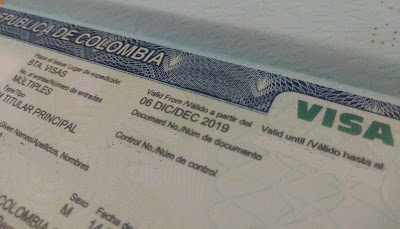
Vis-à-visas: Wrong Way has faced nine Colombian visa applications.

Nein, nein, nein

What is pathetic is the fact that in the space of just seven years I've made nine — yes, nine — visa applications in Colombia. Surely, most other self-respecting individuals would have thrown away the ruana and sombrero vueltiao and said a firm 'adiós' well before this. It's not like I've been on to a winner here, rolling in a bed of pesos, living the high life.

In fact, it could be said this is one of the main reasons why I still stubbornly stay here. I'm able to make the few pesos I've managed to earn since 2012 last longer in this country compared to opting for a 'risky' return to Ireland, the homeland always being the default option. 

Basically, while I await that Universal Basic Income — it's on its way, isn't it? — I can get by on much less in these environs.

That and a feeling that in certain ways I've more independence here, left to my own devices so to put it. 

For sure, the one and only full-time, contracted job I took on from December 2018 to January 2020 put a temporary hold on 'being my own boss', relative as that has always been, but it also helped me build up some funds for the drought periods. And things have been pretty dry from an income perspective for months now. 

Therein lies the problem. The struggle to survive as an independent, a freelancer if you will, coupled with the difficulty of actually trying to stay in Colombia legally as such an 'actor' (no, I'm not referring to my under-appreciated thespian talent).

For me, from 2014 to 2018 getting an independent visa for Colombia was a relatively straightforward affair. These days, it's quite the opposite. In fact, it seems as if La Cancillería — the body in charge of these things — would prefer if no independents applied.

'Oh, we forgot to mention we need this.'

Well, it clearly doesn't mind picking up the study fee one has to pay seeing how on first inspection it makes it seem rather uncomplicated. 

It's only after submitting 'draft one' that you invariably — the many comments on Facebook groups vouch for this — get hit with a host of other requirements, a number of which can take some time to organise. 

Why not mention all these at the beginning so a potential applicant can weigh up all the pros and cons before paying for the study? 

To talk specifically, there is no mention in the initial application of uploading a copy of your Colombian-issued ID (cédula). Nor does it say you must provide proof of health insurance and other social security payments. (If you're a first-time applicant, I take it international health insurance will suffice but as for the other social security payments, I've no idea what's acceptable. Also, what if you're in Colombia but not currently in gainful employment?)

What's more, it explicitly says there is no need to issue a copy of your previous visa if it was issued electronically, as mine certainly was. Surprise, surprise, but in response to my latest application, I was asked for a copy of same. With that, unsurprisingly, the guys at La Cancillería are contradicting themselves.
'What rankles is the constant moving of the goalposts. Also, as it's an online process, it's very difficult to get specifics about the exact requirements for your own application. Replies are generic: 'This isn't acceptable', but there's no reason as to why.'
Here's another sign of regression for the once slick Cancillería system. In all previous applications where additional material was requested — mostly because of perceived document illegibility and/or my mugshot not meeting the specifications — I got an email informing me of this. This time around, nothing. I had to log on to the system to find this out. Whisper it, but it's almost like they didn't want me to know.

On the plus side, it seems that the translation, authentication and legalisation of my degree has been accepted. In May 2018, the last time I applied for an independent visa, this was the stumbling block. I ran out of time/salvoconductos (30-day emergency passes to stay in the country, two-in-a-row being the limit).

However, as far as I'm aware, the Cancillería doesn't provide information on all the steps that are needed for the above. Let me help. 

In the following order, here's what has to be done: 

Get apostilles on both your degree and diploma supplement from the country where you studied; get these translated and signed by an officially recognised translator in Colombia; authenticate the translator's signature at the notary office where he/she is registered; then get these translations legalised — an online process — by the Cancillería. (This is when journalism is your independent activity. For other professions you may have to get your degree validated at the Ministry of Education.)

Unrequited love

While all this may seem like a bitter rant against La Cancillería, I must state I have no issues whatsoever with Colombia tightening its requirements. Needless to say, the visa authority can request from applicants whatever documentation it deems necessary.

What does rankle is what seems like the constant moving of the goalposts with absolutely no prior notice. This and the fact that, as it's a fully online process, it's very difficult to get specifics about the exact requirements for your own application. Replies are generic: 'This isn't acceptable', but there's no reason as to why. Little wonder one loses confidence when it all appears rather arbitrary.

In some ways — again, one can say it's only right — things have gone from one extreme to another. While I never got the benefit of La Cancillería's previous lax approach, I know of a number of foreigners who blatantly stayed in the territory illegally for years and then sweet talked their way to a visa and even residency. Can you imagine Colombians getting the same treatment in Europe or the US? They'd be fined, sent packing and barred from returning for life.

There's also the odd sycophantic influencer who is given citizenship for effectively selling Colombia to the Colombians. A perfect representation of the national insecurity and the-US-knows-best mentality.

Then there are others who try to do things by the book, have given La Cancillería plenty of money over the years through numerous applications and shown their commitment to the country, yet they face new obstacles at every turn.

It brings to mind an Irish phrase from my secondary school days that has stayed with me: Grá éagmhaise, unrequited love. Yes, I truly am the pathetic one in this one-way relationship with Colombian officialdom.

Sad as it is, but perhaps I need La Cancillería to give me the knock-out blow. It might just be doing me a favour.
_____________________________________________________________
Listen to Wrong Way's Colombia Cast podcast here.

Facebook: Wrong Way Corrigan — The Blog & IQuiz "The Bogotá Pub Quiz".

Tuesday, 15 September 2020

Helpful today, harmful tomorrow

[Listen to an audio version of this blog entry here.]
It's generally accepted that there's a fine line between genius and insanity. The distinction, fortunately you might say, only applies to a fraction of humanity.

The majority of us tend to fall somewhere in the middle, for better or for worse.
Helpful today, harmful tomorrow: A police Immediate Attention Centre, or CAI in its Spanish initials, burns after anti-police protests in Bogotá, Colombia.
'Rather than defund the police, let's just destroy them.' 'Great idea!' 

The narrow corridor

That being the case, there's another set of more pertinent opposites where the balance is also quite delicate: the line between being helpful and being harmful. 

One's life, consciously and unconsciously, mentally and physically, is, for the most part, spent traipsing the helpful/harmful middle ground.

But, you might say, being deep in helpful territory is a good place to be, so just try to manoeuvre yourself there. 

Well, the thing is, you can't be deep in it. It's a narrow corridor where you're never too far away from crossing into harmful ground. 

In other words, while you might think that being uberly helpful is nothing but good, there's a high chance you'll end up inflicting harm on not only the recipients of the "kind" act, but on yourself as well. 

It's like the old adage, 'Give a man a fish and he has food for a day, teach a man to fish and he has food for life.' (In this particular instance, the potential trouble for the giver is future resentment from the receiver — 'What?! You've no more fish to give me!' — which could result in conflict.)

Dissecting that saying further, very often it's the short-term help that, if not immediately harmful, ends up leading to even bigger problems down the line.

For a pertinent example in light of the times, take the anti-police, Black Lives Matter protests in the US. Data show that they tend to be accompanied by an increase in civilian-on-civilian homicides in the black communities from which they emanate. 

So go ahead, have less policing, but be prepared for the nasty consequences.

Considering recent events in Bogotá, Colombia would do well to take note — this is not to make little of the many problems with policing and other state law-enforcement agencies in this country.

On a macro level, despite the fact that today most of us can expect to live longer compared to our predecessors, this hasn't resulted in 'playing the long game'. On the contrary, in our on-demand society, it's a case of 'now, now, now'.
'The pandemic has only reinforced the on-demand way of life and, it can be argued, increased societal polarization, as well as inequality.'
It makes sense, in some ways. As most of our needs — from a Western world perspective in any case — can be satisfied by the mere touch of a button, many people appear to have lost the virtue of patience. If there's not an instant solution, forget about it. 

So we really only have ourselves to blame when our leaders react accordingly. Any visionaries soon learn that the real trump card (an innocent turn of phrase, honestly) is expediency. Never mind the next election, the latest opinion poll matters just as much.

In these coronavirus times, hope has been expressed that the enforced pause on our "normal" lives will see us taking the time to reflect on how we've been living. We'll identify the more malignant practices and amend them accordingly.

Cruel kindness

Alas, if anything, the pandemic has only reinforced the on-demand way of life and, it can be argued, increased societal polarization, as well as inequality. What's more, it has underscored the short-term "gain", long-term loss tendency.

In the rush to do all that could be done to help those most at risk, very little if any thought appeared to have been given to the unintended consequences

Only now, months later, are we seeing some of our leaders finally listening to the dissenting voices who have been at pains to highlight the problems we're creating.

Again, this isn't that shocking when seen through the myopic lens that society as a whole tends to use. 

To use football parlance, we've sacrificed a few playmakers to hold on to a questionable lead. The strategy has backfired, we've been pegged back and we need to go on the offensive. 

However, our star attackers are now out of the game. Most can, thankfully, be reintroduced. The question is, what sort of shape are they in?

When they re-enter the fray, they might be more like madmen than geniuses, more harmful than helpful. The margins, you see, are very tight indeed.

The temptation to choose, innocently perhaps, perceived kindness today, often results in a cruel tomorrow.
___________________________________________________________
Listen to Wrong Way's Colombia Cast podcast here.

Facebook: Wrong Way Corrigan — The Blog & IQuiz "The Bogotá Pub Quiz".