Showing posts with label Cúcuta. Show all posts

Friday, 10 December 2021

Cosying up to Cúcuta

@wwaycorrigan

[Listen to an audio version of this blog entry here.]

Considering Cúcuta is my most-visited Colombian city — with Bogotá being home — it's been a bit of an oversight that I've never written a dedicated piece about the Norte de Santander capital.
Cosying up to Cúcuta: Parque Santander in the centre of Cúcuta, Colombia.
Cúcuta's Parque Santander.

Anytime ladies

The thing is, as much as I find the place welcoming and enjoyable, if a tad chaotic (hey, it's a Latin American city after all), Cúcuta has never been the actual destination in all the trips that have seen me spend time there.

Bordering Venezuela on Colombia's eastern frontier, the first time I visited was back in early 2012, using it as a pitstop returning from a less-than-inspiring maiden visa run to the neighbours. (Let's just say I've never been bothered about going back to Maracaibo — first impressions and all that — as much as I now have a far more positive opinion of Venezuela.)

In fact, all of my numerous stopovers in Cúcuta have been the result of visa runs. Why seek Colombian residency when one can go on an adventure every year or so? My annual visa/cédula payment does also double up as my tax contribution. The gift that keeps on giving.

What's more, posting stories about lesser-visited, "crazy" Venezuela has always seemed more appealing, more inclined to get those much sought-after clicks. 

Thus, I've tended to neglect to recount my "tamer" Cúcuta experiences. We'll right that 'Wrong Way' now, especially considering that I wasn't actually allowed to cross into Venezuela this time, despite getting my exit stamp from Colombia — 48 hours in no man's land of sorts, ask for details in the comments!

Cosying up to Cúcuta: Puente Internacional Francisco de Paula Santander, the bridge that connects Cúcuta (Colombia) with Ureña (Venezuela).
'Thou shalt not pass.' As close as I got to Venezuela this time.
The average traveller will most likely take the bus to Cúcuta — flights are far cheaper today than they were years ago thanks to the arrival of low-cost carriers to the region but they usually only compete with bus prices if you buy well in advance. 

If one isn't on a tight schedule, road travel allows for much more (affordable) flexibility. (For the record, a one-way bus ticket with Omega cost me 80,000 pesos.)
'There's something about the hustle and bustle from the terminal to Parque Santander — no, I don't mean the sex trade, I'm referring to the commercial and mild revelling activity — that has an enticing energy to it.'
From Bogotá, the winding 16-hour plus spin passes through some impressive páramos — one would miss out on those on a flight. In the next few years, that journey time should decrease somewhat with some major road infrastructure works in progress on the Cúcuta end.

As is often the case in these parts, the least attractive side of the city is what greets you first.

For about half of the 1.2 km walk from the bus terminal to the picturesque, well-kept city centre at Parque Santander, the route is lined with, well, not exactly ladies of the night, but ladies of any time of the day or night.

From memory, this has been so since I first visited but I don't think I'm wrong in saying that it's more intense these days, somewhat similar to what I witnessed in Medellín in late 2019. Indeed, it wouldn't surprise me if Cúcuta was the per capita prostitute capital of Colombia.

One big reason for this is the humanitarian crisis next door in Venezuela. Cúcuta is often the first and only port of call for a number of desperate individuals who cross over illegally.

Cosying up to Cúcuta: The steps up to Cúcuta's Christ the King (Cristo Rey) statue.
Jesus is the way, the truth and the light. He's up there, somewhere.
While aesthetically unpleasing and unsettling for those of us of a more reserved nature in sexual matters, there is nothing really threatening about it.

In fact, it's the part of town I've always stayed in. The reason being that — wait for it — it's where you get the cheaper hotels. 

When all you need is a bed, bathroom facilities and WiFi, you can't go too wrong with 15,000 pesos per night. Some might say one is taking a security risk in such places. Perhaps so, but that hasn't been my experience.

A view with Jesus

In terms of what to do there, the short answer is, 'not a lot'. Living in Bogotá, my escapes from the capital usually involve going to quieter retreats. Cúcuta is certainly not that.

However, there's something about the hustle and bustle from the terminal to Parque Santander — no, I don't mean the sex trade, I'm referring to the commerce and mild revelling — that has an enticing energy to it.

Whether it's sipping on a cheap and cheerful borojó fruit smoothie — a highly refreshing beverage in heat of over 30 degrees Celsius — from one of the ubiquitous street vendors or munching on an equally cheap and cheerful papa rellena (a deep-fried, mashed-potato pastry stuffed with egg, chicken or minced meat) from the equally ubiquitous fast-food carts as you watch people go about their business, the lively vibe makes one feel alive.

The pace is far more relaxed around the city's standout attraction, a statue of Christ the King (Cristo Rey) perched on a hill to the south of the centre. Think of it as a miniature version of Rio de Janeiro's Christ the Redeemer. 

While in situ since the late 1940s, the monument and immediate surrounds, like Cúcuta in generally over the last decade, have been refurbished in recent years.

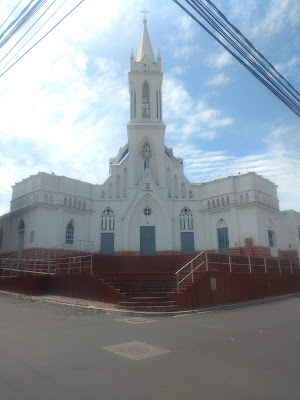
Cosying up to Cúcuta: Cúcuta's Iglesia del Perpetuo Socorro (Church of Perpetual Help).
Religious views. The picturesque Iglesia del Perpetuo Socorro.
The viewpoint now has a cleaner, more welcoming feel to it. Just don't expect to watch the sunrise from there. Apparently, it's only open to the public from 10 am. I arrived at 9.40 and had to wait, although the security guy did let me pass at 9.50. What a rebel. 
I'm not sure what time it closes, but one would like to think it's after sunset, which is always around 6 pm in these parts. By the way, there is no entrance fee, it's free thankfully.

In general, the southern part of the city appears more tranquil, mostly residential as it is.

Speaking of slower-paced living, I did get the chance to briefly take in the nearby town of Chinácota, about an hour's bus drive south of Cúcuta. At 1,175 metres above sea level, it's slightly fresher than the at-times stifling heat in Cúcuta, which is about 800 metres lower.  

By all accounts, Chinácota is a popular weekend escape for Cúcuta residents. From my 24-hour stint there, I can see why. Next time I'll make it my business to spend a little more time in the town.

For if there has been one constant throughout my years in Colombia, it's that a trip to Cúcuta is never too far away. And that's perfectly fine with me.
_______________________________________________________________
Listen to Wrong Way's Colombia Cast podcast here.

Facebook: Wrong Way Corrigan — The Blog & IQuiz "The Bogotá Pub Quiz".

Thursday, 9 August 2018

Backpacking in 'no-go' Venezuela

During my recent 16-day visit to Venezuela, I had a host of people asking me, "What's it like 'for real'?" I'm still getting asked that since my return.

Via an article in The Irish Times I did touch on a number of the everyday issues that Venezuelans are currently facing.
Backpacking in 'no-go' Venezuela: Crossing from Colombia into Venezuela at Puente Internacional Simón Bolívar near San Antonio.
Party border.
Here, I want to describe things from the point of view of entering the country overland as a tourist, which is effectively what I did.

Visa issues in Colombia meant I had to do a border-run and while I could have opted for Ecuador, Venezuela appealed far more to the adventurer/journalist/reporter in me. From that perspective it was like having the World Cup on my doorstep. I couldn't not go, especially now that I had the visa excuse.

Don't go

For sure, it wasn't a decision I took lightly. Not only was I strongly advised against it by a high-up diplomat friend at our Irish embassy in Mexico, but even some Venezuelan acquaintances here in Bogotá thought it wasn’t the best idea.

On top of that, there were the daily news reports on Colombian media that made the place seem akin to hell on earth. Only a lunatic would consider a holiday there, especially doing it overland.

What made me feel a little bit more relaxed about going were the messages from my friend Yessi in Caracas. I'd stayed with her and her family for my previous visit back in December 2015.

This time Yessi told me that while the situation for Venezuelans on the ground was more desperate due to, amongst other things, the hyperinflation and food shortages, in terms of security it wasn't much different. And it was this, safety, that concerned me most.

So with Yessi's somewhat reassuring messages and, more importantly in terms of giving me the final push to go, an arrangement that her cousin living in the Venezuelan border town of Colón would accompany me from Cúcuta across the wild frontier, it was, 'Venezuela here I come'.

A cash-laden sitting duck

I was, I have to say, quite nervous thinking about what lay ahead during the 15-hour bus journey from Bogotá to Cúcuta. Arriving in Cúcuta, that apprehension worsened on receiving WhatsApp messages from Yessi's cousin informing me that she couldn't meet me in Cúcuta.

What's more, she asked me to go to a different border crossing to the one I was familiar with in San Antonio. It all sounded a little too complicated.

In any case, Erika from the money exchange office I used at the bus terminal in Cúcuta wasn't sure if I could get my passport stamped at this other border crossing.*

I decided I'd go it alone to San Antonio.

Just about to officially enter Venezuela, waiting for the entry stamp at San Antonio.
Getting the Venezuelan entry stamp.
The 'What am I doing?' thoughts ramped up further still at the money exchange. On discovering I had emergency US dollars and euros on me, alongside a decent amount of Colombian pesos, Erika told me I'd have to hide everything exceptionally well.

She relayed stories of Venezuela's infamous Guardia Nacional (National Guard) recently strip-searching people, looking for their hidden foreign currency, pretty much essential for any visitor to survive economically in Venezuela. I'd faced the intensity of the Guardia Nacional before, but the way Erika was speaking, it seemed like things were far worse.

My suggestion to hide the cash in my shoes, as I'd done before, was "too obvious" she said.

Thus, for the good part of an hour we carried out surgery on the Lonsdale tracksuit bottoms I was wearing in order to make places to hide the cash.

Incidentally, based on Yessi's advice, I only changed a small amount of cash, 50,000 Colombian pesos (COP), into bolívares. I received slightly less than 10 million, about 60 per cent of the value you'd get for doing a black market bank transaction, which is what most Venezuelans exchanging foreign cash do. 

They send the money to a Venezuelan bank account. Due to the shortage of bolívares, you don't get the full value making cash-for-cash exchanges. 

That aside, with the foreign currency hidden on my body as best we could, I took a shared taxi to the border.

Fiesta frontier

The first thing that struck me on arrival was how lively it was. Street vendors and tiendas blaring out music catering to thousands of people. It was like a little city of its own. 

This was completely different to the last time I crossed. It was more like a funeral procession back in 2015. The liveliness of it put me at ease, even if I did seem to be the only foreign face about.

After queuing for about 90 minutes to get my Colombian exit stamp — unfortunately on the Colombian side it's the same queue for those entering and exiting, so I was lumped with all the Venezuelans going the opposite way — I walked across Puente Internacional Simón Bolívar, the bridge over the River Táchira, the divide between Colombia and Venezuela.

On my previous visits, the office to get the Venezuelan entry stamp was in the middle of the town of San Antonio. Keeping myself to myself, I headed that way, but not before a Guardia Nacional checkpoint. I mentally readied myself for a very thorough inspection.

To my pleasant surprise, the rather pretty lady officer barely opened my backpack. A more chilled-out Guardia Nacional, I couldn't believe it. She was even quite friendly! 

When I asked her about my entry stamp, she told me that I'd already passed the place, and I better hurry as it would soon close (it was getting late). The office is now right on the border, just as you come off the bridge; much more conveniently located.

On the Venezuelan side there is a separate queue for those entering as opposed to those leaving. There was, unsurprisingly, nobody in the queue for entering, so I got my stamp in seconds. (It's important to note here that there wasn't much of a queue for leaving either. Two weeks later, when I was leaving, this had dramatically changed.)

With my passport stamped, I passed by the Guardia Nacional checkpoint again where my friend waved me on. OK, I'd only just entered the country, but I was already beginning to think, 'What was all the fuss about?'

On failing to reach Yessi's cousin from a minutos stand (a person on the street with a mobile phone you can use, charged per minute) I decided I'd go to San Cristóbal that night, a place I knew relatively well.

All this time, the fears I'd had about visiting Venezuela were decreasing. As in previous visits, a big factor in this was down to the friendliness and helpfulness of the locals.

For example, the minutos guy helped me board the right bus to San Cristóbal and told me exactly how much I had to pay. Laden down with over ninety 100,000 bolívar notes, I was still trying to figure out its value. (As it turned out, the bus from San Antonio to San Cristóbal cost 250,000 bolívares. Using the exchange I got, that worked out at about 1,200 COP, or 35 cents in euros. Pretty cheap for a 90-minute bus journey.)

Crazy currency

It was well into darkness, about 9 pm, when I reached San Cristóbal. Bus terminals pretty much anywhere aren't the safest places, especially at night, but I'd always stayed close to the one in San Cristóbal on previous visits and I'd had no problems.

Considering the time, I took the first place I found. "How much?" "5,000,000 bolívares." 

With the exchange I got in Cúcuta, that was over 25,000 COP, expensive for what was a very basic place. I'd basically spend more than half my bolívares on one night and I still needed cash for my bus ticket to Caracas. "How much is it in Colombian pesos?" "5,000." "What?!"

I obviously paid with my pesos! I'd soon discover that when paying in cash with your Colombian pesos, one million bolívares equals 1,000 pesos. So it was much better for me to use my pesos for everything save transport, which was either cheaper in bolívares or more or less the same.

Take a 222 ml Polar, the tipple of choice for Venezuela's beer drinkers. It costs between 800,000 and 1,000,000 bolívares. With the exchange I got, that would make a bottle cost about 5,000 COP, pretty expensive for a small beer. Yet paying in pesos, it's just 800 to 1,000 COP. Madness.

Once I'd got my head around the money, knowing my pesos made me rich in San Cristóbal and meeting yet more friendly locals, I ended up staying three nights there. Even though many employees in the food stands and bars around the terminal told me to be careful, I never felt anything untoward.

On the contrary, I was having a great time being the 'only foreigner in the city'. At least it felt that way anyway.

Facing down the Guardia Nacional, Irish style

In fact, the most, nay the only, intimidating, uncomfortable experience I had was on the overnight bus from San Cristóbal to Caracas. 

I was preparing myself for it in fairness. Experience had taught me that Guardia Nacional checkpoints on busses heading deeper into Venezuela are where you tend to meet the meanest officers.

Thus, just after the city of Barinas, half-way on the journey to Caracas at about 2 am, came the Guardia Nacional treatment I'd been expecting. You might avoid them on the street, but there's no hiding on a bus.

Being a foreign-passport holding man (I'm not sure how women fare) means automatic selection for a bag and body search. Unlike other times, I actually had Venezuelan company on this occasion. With the other four lads, it kind of felt like safety in numbers.

Wearing the remodelled, money-laden Lonsdale tracksuit bottoms again, before alighting from the bus, I hid a 'dummy' 40,000 COP in my boxers. The reason: I figured the young officer would expect to find foreign cash on me, so I thought I'd let him do so with some relatively easily.

After meticulously revising all our bags followed by an equally thorough frisking, especially around the groin and hip areas (but not my shoes, damn Erika!), the officer let the other guys back on the bus. I was held back.

"What's the money you've got hidden around your boxers?", he asked. "Has he felt my neatly concealed dollars and euros?", I wondered, the heart beating a little more intensely. "Surely not, but they are in that area."

I pulled the 40,000 COP from my boxers, explaining that I live in Colombia and this was left over cash.

He walked me to a different area, where another two guards, one clearly being the head honcho, were waiting. I felt like it was a scene from a Tarantino movie. All the seated sergeant was missing was a fat Cuban cigar. I was asked yet again to empty my pockets.

"What do you think of President Trump?" the boss man asked with a grimace. "I'm Irish. Trump means nothing to me." "Ah, you're Irish. Ireland is a friend of Venezuela, isn't it?" "Of course!"

With that, he let me on my way, but not before taking a small packet of chewing gums I had. I didn't protest about that. 

My next Guardia Nacional experience would come at the border back in San Antonio, where I stayed for two nights waiting, in vain, for the ridiculously long (a 10-hour wait at least) exit-stamp queues to die down. And I can happily say that those who I dealt with there were cordial. One even let me film the queues on my phone on my first evening there (officially, recording was prohibited). 

On the return journey from Caracas to San Cristóbal there was a Policía Nacional, National Police, checkpoint. 

This arm of Venezuelan law enforcement was far more even-handed than the Guardia Nacional. Everybody on our overly-crowded minibus (transport options departing Caracas were thin on the ground; it was a case of taking whatever you could find), women included, was asked to get off and we all had our bags searched, but not our bodies.

Beer: Payment in kind

As for Caracas, staying with my family in their working-class barrio, I had a great time. The only inconvenience was not really being able to spend my own money.
Enjoying some sun, sea and sand at La Guaira, Vargas, Venezuela.
It wasn't all hard work in Venezuela.
The Colombian peso is less accepted there compared to the border regions. Also, with hardly any bolívares available, alongside needing bag loads of them to pay for just the cheapest of items, the majority pay for things by card. Without a Venezuelan bank account, that option wasn't open to me.

So my hosts pretty much paid for everything. On departure I paid them in dollars, money they can get very good value for on a street market transfer or the like (one dollar is currently at 3.8 million bolívares on the black market).

I did also buy three crates of beer — to share, of course — from the local tienda, the owner there was happy to take my pesos. 60,000 COP in Colombia is just one good night out in the local barrio. The equivalent price of the beers in bolívares, 60 million, is twelve-times the monthly minimum wage.

In terms of security in the capital, I never felt uneasy. 

Now, it is important to note here that at practically every moment I had someone from my Caracas family by my side. It might be a different experience for a foreigner wandering around the place on his/her own, taking public transport, availing of the free metro, that kind of stuff. But maybe not.

Of course with no end in sight to Venezuela's major problems, there are similar, less complicated places to visit. There's Colombia, for one. It's just the Venezuelans are friendlier. Relax, it's a joke!

*Erika's money exchange office, located in Cúcuta's main bus terminal at Local N1-90, is called 'Luna' and she can be contacted on +573163228453.
__________________________________________
Facebook: Wrong Way Corrigan - The Blog & IQuiz "The Bogotá Pub Quiz".

Thursday, 17 December 2015

Venezuela: Killing with kindness

If you're to take your lead from most Western — including Colombian — media, going to Venezuela these days without solid reasons is a very risky undertaking. 

Throw in a hotly contested and potentially era-ending national election, as we just had, and the advice is to give the place a wide, wide berth.
Venezuela: Killing with kindness. Puente Internacional Simón Bolívar on the Colombian-Venezuelan border is a much quieter border crossing these days compared to just a few months ago.
This used to be packed with cars on a daily basis ...
Yet, having had a pleasurable experience visiting the country in 2013, the constant invites to return from a Caracas-based friend mixed with a curiosity to see if the current situation was as bad as some would have you think, led me to return. 

Well, that and the desire to spice things up a little by venturing, for the first time, into 'dangerous' Caracas with that aforementioned election looming.

It might sound a little devil-may-care, but the fact that my friend would be hosting me in the Venezuelan capital reduced, I figured, the risk factor considerably.

The first major difference from 30 months ago was encountered before actually entering Venezuela. 

From previous experience, to get the best price for my Colombian pesos to bolivares (or so it used to go anyway), I changed the best part of my cash in Cúcuta.* The number of notes I got this time for a similar exchange as before was at least 10 times more. Hyperinflation placed right before your eyes. I felt uneasy to say the least, like a walking cash machine.
Venezuela: Killing with kindness. With 100 bolivares the biggest note denomination, you need plenty of them for cash transactions in Venezuela right now.
You need big pockets in Venezuela these days ...
Then at the border itself, the hustle and bustle of what had been the busiest frontier crossing between Colombia and Venezuela has been replaced, for now anyway, by an almost eerie silence. (Puente Internacional Simón Bolívar, as it's known, has been closed to vehicular traffic for months following this year's border dispute.)

For any tourists making the journey either way this is great; it must rate as the least time-consuming nation-state crossing in Latin America. In fact, the most inconvenient thing is trying to find the office to get your entry stamp in San Antonio, Venezuela; it's not done right on the border as it is in Colombia.

The lack of human traffic might be good from a personal viewpoint, but for merchants on either side of the divide, it's having an adverse effect.**

With the inflation, I expected my big bundles of notes to disappear quite quickly. In reality, while everything appears to have an extra zero added to it compared to 2013, the converted pesos seemed to last longer, a good bit longer. 

In fact, with the almost unfathomable black market exchange rates, it turns out I could have got even more bolivares for my pesos. I'll get it right yet.

I'd also prepared myself for the usual heat foreign visitors to Venezuela can expect from the military and police, especially at checkpoints. This time around only once did I have to step off a bus, along with all the other passengers and have my stuff searched, half-heartedly as it was.

In one lapse, what you might call a testament to the regard I hold Colombian police in, I asked state police in San Cristóbal for directions. Not the best idea. I was escorted to the nearest station where officers went through everything I was carrying. Pleasantly surprising, they didn't take any of the wads of cash stashed in my bag.
Venezuela: Killing with kindness. Some of the views from up in Parque Nacional Warairarepano in Caracas.
Impressive sights abound around Caracas ...
It does, however, seem a little ironic that the police told me to be careful after it was them who, without wanting to sensationalise this, semi-interrogated me whilst making jokes about robbing me and calling me rich. 

They generally made me feel uncomfortable and more at risk — with a smile albeit — when all I'd done was ask for directions. And you couldn't but be bemused by some of the things they asked: 'What's this?' 'Um, bread.' 'What do you have a camera for?' 'Eh, you're asking what now?' 

It's a case of, as many of the locals will tell you, trusting more those not associated with the upkeep of law and order. Playing the innocent gringo/foreigner doesn't get you far.

To add to this, a friend of the family I stayed with told me of an incident that happened in a downtown shopping centre the week I was there where two police officers robbed a couple of foreigners of all their belongings in the middle of the day.

No doubt there are decent, trustworthy police and military but, in general, it seems the nation's 'protectors' could learn a thing or two from the civilians. 

The friendliness of the ordinary Venezuelans I dealt with was up there with the best of them. 

Little things like the bus company employee in San Cristóbal phoning my friend in Caracas to tell her what bus I was on and what station I'd be arriving at. 

Then, when I got to Caracas, a stranger lending me his phone to call my friend to say I'd arrived. 

In some other Latin American countries, even friends are reluctant to hand over their phones for a quick call.

My hosts, who live in a part of Caracas where a Western face is seldom seen, were, to say the least, hugely accommodating. It very much felt like a home from home.

Venezuela: Killing with kindness. The measures you've to take to get around election-day Ley Seca (alcohol prohibition) in Caracas!
Getting around election-day prohibition, Caracas style ...
Yet, even though I was staying in a potentially dangerous barrio (you might ask, with reason, where isn't in Caracas?), with locals by my side I pretty much felt oblivious to any dangers, dangers that my friends were quick to tell me do exist — gunshot fire was a regular enough sound. 

Even on election day, passing by fanatical Chavistas (supporters of the current 'socialist revolution'; my host family are not), it felt more like a carnival than a country experiencing political polarisation that is crippling it in many ways.

Tellingly, though, I went nowhere without one of my Caraqueño (Caracas natives) friends by my side. For the nine days I was in the city that was fine, but I generally like to wander about places on my own. With my foreign face, I was told that's not the wisest move to make in Caracas. 

In any case, the tienda-drinking culture you get in Colombia that I enjoy is largely lacking in Caracas' barrios. It's more a style of home drinking or on the street outside your house or nearest tienda.

With political change potentially in the air following the opposition's victory in the parliamentary elections, Venezuela's officialdom might start becoming a little less insecure and seemingly suspicious of all outsiders.

There's a lot of work to be done on that front. For the time being, there's always the friendliness of the locals to fall back on for those willing to visit this beautiful country.

*To get a fair idea of what your pesos are worth against the bolivar on street exchange bureaus, a good website to check is bolivarcucuta.com. For the street price of dollars and euros versus bolivares, see dollartoday.com.

**Alas, it was far from an efficient border crossing on the Venezuelan side on the return journey; the Christmas rush had begun.

To listen to a radio interview I did on the situation in Venezuela, check out this link: http://bit.ly/22iwq97 (the interview starts about 10 minutes into the playback service, a couple of minutes after the news and sport).
_____________________________
Facebook: Wrong Way Corrigan - The Blog.

Wednesday, 15 May 2013

Venezuela: A necessary reappraisal

Back in 2009, on our first visit to the Ecuadorian capital Quito, we heeded the well-intentioned advice of some fellow travellers and opted to stay in the ‘safer’ north of the city – an area home to many backpacker hostels.
Venezuela: A necessary reappraisal. Crossing back (somewhat reluctantly at the exact time of the photo) into Venezuela
"Do you want to go ahead with this?"
What we encountered there, however, was anything but a feeling of security, reinforced by hostel and restaurant owners’ warnings not to venture out alone, if indeed at all, after dark. 

The fact that the majority of people we spoke to in the hostel we stayed in had been mugged on the streets right outside our lodgings obviously did nothing to ease concerns.

As a result, our stay in the city was short-lived; we were quite happy to leave in all honesty.

Two years later, in a less-planned stop in the city and being led by an Argentinean bus companion, we found ourselves camped up in a mediocre ‘hospedaje’ (hostel/hotel) in the historic centre of the city – dodgier territory than the north of the metropolis according to many.

This time, though, we experienced a completely different, far friendlier side to the place. Within hours after arriving (we got there late in the evening, in darkness, at that) we found ourselves drinking beers in a rough-and-ready house of some local. In another context, considering the area we were in, these guys would be seen as people to be avoided. 

This set the tone for what turned out to be a hugely enjoyable, trouble-free few days in Quito.

So while first impressions of a place or a person can at times be a good guide to the whole picture, this isn’t always the case. Very often such things are context and time-dependent.

Bearing that in mind, we made no secret of our negative introduction to Venezuela last year (see: http://bit.ly/OLR2Ev). 

In many ways, our experiences back then sat nicely with the accepted Western narrative that the place is dangerous, politically insecure and best avoided – even though we did enter the country rather excitedly and with an open mind.

Thus, this time it was with a bit of nervousness, tempered by stubbornness and a sense of some adventure, that we hit for Colombia’s eastern neighbour for a visa run. The rough plan on departing Bogotá was to get in and out of the place as quickly as possible.

Our anxiousness increased when, on arrival in the city of Cúcuta on the Colombian side of the border, the guys who exchanged our pesos for Venezuelan bolivares gave us plastic bags and told us to stow our cash in them and put them in our shoes for safety. (The biggest problem in the end was that this practice almost rendered the notes unusable from the damage inflicted by being wrapped up in our sweaty runners.)

Yet practically from the get-go, the coldness of the citizens and feelings of insecurity that prevailed during our first visit were replaced by very helpful, friendly people and a relaxed general atmosphere.

The 'Maduro' quarter of San Cristóbal
To the left ...
A Henrique Capriles supporter proudly displays his election poster over his little street stall
... and to the right
Yes, the physical signs of the recent, highly contentious general election (for a recap, see: http://bit.ly/Yy86zJ) narrowly and controversially won by the late Hugo Chávez’s successor, Nicolás Maduro, are there to be seen. 

But it’s not – at least openly and at ground level amongst the populace (at a political level and below the surface for some citizens we spoke to, deep divisions are apparent*) – a case of a dangerously divided country where opposing sides don’t mix.

What we found in the two places we stayed, firstly San Cristóbal and then Mérida**, were easy-going people (the small bar brawl we witnessed on our first night aside – sure a beer bottle being hurled at somebody is nothing unusual to us) going about their daily business.

Wherever we stay we like to be able to venture out at night feeling relatively safe, sampling a few beers and chatting to the locals in little ‘tienda’ bars. Thankfully, that was no problem this time, unlike Maracaibo last year. 

OK, our hotel in San Cristóbal did have a 10.30 pm curfew, but that was more an individual choice rather than a rule from what we could gather. Plus, considering the times we tend to retire at night nowadays, this lights-out policy wasn’t a big issue.

Of course, we did learn from our first experience in the country as regards the currency. 

So this time we had plenty of cash to convert into bolivares as opposed to going to ATMs where the value is at least four times less than on the street (Colombian pesos are fine to exchange along the border and that’s where you’ll get the best price). Hence, in most aspects, it’s much cheaper to get by compared to Colombia.

On that theme, practically every shop/restaurant displays the prices of its goods – prices that are trustworthy and accepted across the board from our observations. In other words, haggling isn’t really done or needed in the majority of places – the price is the price and it’s usually satisfactory. 

Now, we don’t mind haggling, but in many street stores in Colombia you can’t help but wonder if they are charging you a foreigners’ price no matter what you pay. The aversion here to publicly displaying prices always leaves you in a bit of doubt.

A typical day at a Venezuelan supermarket
"Sorry, where would we find some chicken?"
You will still find what seems to be official Venezuelan suspicion towards foreigners – again in sharp contrast to the usual Colombian experience. 

On the internal bus journeys where the National Guard did ID checks, as foreign passport holders we were the only ones taken off and given a pretty decent interrogation with our bags thoroughly checked. With nothing to hide it wasn’t something that bothered us really.

That was, of course, taking for granted that the officers were genuine – in this case, they seemed to be. Considering, though, the pronouncements coming from the country’s leader as regards some foreigners’ intentions in Venezuela (mostly aimed at the USA, albeit), you can never rule out a bent military official doing something untoward in the name of patriotism.

If, however, at heart they are in the same mould as the vast majority of civilians we met in San Cristóbal and Mérida, such a scenario is unlikely. 

In any case, going by our adventures this time around, the rewards far outweigh the risks.

___________________
* Some Venezuelan politicians take very seriously the idea of ‘fighting’ for your country, as this video shows: http://www.youtube.com/watch?v=jKUVdw9mgeY

**Mérida is something of a hidden gem from what we experienced. We plan to bring you more on that next.