Showing posts with label Maracaibo. Show all posts

Friday, 10 December 2021

Cosying up to Cúcuta

@wwaycorrigan

[Listen to an audio version of this blog entry here.]

Considering Cúcuta is my most-visited Colombian city — with Bogotá being home — it's been a bit of an oversight that I've never written a dedicated piece about the Norte de Santander capital.
Cosying up to Cúcuta: Parque Santander in the centre of Cúcuta, Colombia.
Cúcuta's Parque Santander.

Anytime ladies

The thing is, as much as I find the place welcoming and enjoyable, if a tad chaotic (hey, it's a Latin American city after all), Cúcuta has never been the actual destination in all the trips that have seen me spend time there.

Bordering Venezuela on Colombia's eastern frontier, the first time I visited was back in early 2012, using it as a pitstop returning from a less-than-inspiring maiden visa run to the neighbours. (Let's just say I've never been bothered about going back to Maracaibo — first impressions and all that — as much as I now have a far more positive opinion of Venezuela.)

In fact, all of my numerous stopovers in Cúcuta have been the result of visa runs. Why seek Colombian residency when one can go on an adventure every year or so? My annual visa/cédula payment does also double up as my tax contribution. The gift that keeps on giving.

What's more, posting stories about lesser-visited, "crazy" Venezuela has always seemed more appealing, more inclined to get those much sought-after clicks. 

Thus, I've tended to neglect to recount my "tamer" Cúcuta experiences. We'll right that 'Wrong Way' now, especially considering that I wasn't actually allowed to cross into Venezuela this time, despite getting my exit stamp from Colombia — 48 hours in no man's land of sorts, ask for details in the comments!

Cosying up to Cúcuta: Puente Internacional Francisco de Paula Santander, the bridge that connects Cúcuta (Colombia) with Ureña (Venezuela).
'Thou shalt not pass.' As close as I got to Venezuela this time.
The average traveller will most likely take the bus to Cúcuta — flights are far cheaper today than they were years ago thanks to the arrival of low-cost carriers to the region but they usually only compete with bus prices if you buy well in advance. 

If one isn't on a tight schedule, road travel allows for much more (affordable) flexibility. (For the record, a one-way bus ticket with Omega cost me 80,000 pesos.)
'There's something about the hustle and bustle from the terminal to Parque Santander — no, I don't mean the sex trade, I'm referring to the commercial and mild revelling activity — that has an enticing energy to it.'
From Bogotá, the winding 16-hour plus spin passes through some impressive páramos — one would miss out on those on a flight. In the next few years, that journey time should decrease somewhat with some major road infrastructure works in progress on the Cúcuta end.

As is often the case in these parts, the least attractive side of the city is what greets you first.

For about half of the 1.2 km walk from the bus terminal to the picturesque, well-kept city centre at Parque Santander, the route is lined with, well, not exactly ladies of the night, but ladies of any time of the day or night.

From memory, this has been so since I first visited but I don't think I'm wrong in saying that it's more intense these days, somewhat similar to what I witnessed in Medellín in late 2019. Indeed, it wouldn't surprise me if Cúcuta was the per capita prostitute capital of Colombia.

One big reason for this is the humanitarian crisis next door in Venezuela. Cúcuta is often the first and only port of call for a number of desperate individuals who cross over illegally.

Cosying up to Cúcuta: The steps up to Cúcuta's Christ the King (Cristo Rey) statue.
Jesus is the way, the truth and the light. He's up there, somewhere.
While aesthetically unpleasing and unsettling for those of us of a more reserved nature in sexual matters, there is nothing really threatening about it.

In fact, it's the part of town I've always stayed in. The reason being that — wait for it — it's where you get the cheaper hotels. 

When all you need is a bed, bathroom facilities and WiFi, you can't go too wrong with 15,000 pesos per night. Some might say one is taking a security risk in such places. Perhaps so, but that hasn't been my experience.

A view with Jesus

In terms of what to do there, the short answer is, 'not a lot'. Living in Bogotá, my escapes from the capital usually involve going to quieter retreats. Cúcuta is certainly not that.

However, there's something about the hustle and bustle from the terminal to Parque Santander — no, I don't mean the sex trade, I'm referring to the commerce and mild revelling — that has an enticing energy to it.

Whether it's sipping on a cheap and cheerful borojó fruit smoothie — a highly refreshing beverage in heat of over 30 degrees Celsius — from one of the ubiquitous street vendors or munching on an equally cheap and cheerful papa rellena (a deep-fried, mashed-potato pastry stuffed with egg, chicken or minced meat) from the equally ubiquitous fast-food carts as you watch people go about their business, the lively vibe makes one feel alive.

The pace is far more relaxed around the city's standout attraction, a statue of Christ the King (Cristo Rey) perched on a hill to the south of the centre. Think of it as a miniature version of Rio de Janeiro's Christ the Redeemer. 

While in situ since the late 1940s, the monument and immediate surrounds, like Cúcuta in generally over the last decade, have been refurbished in recent years.

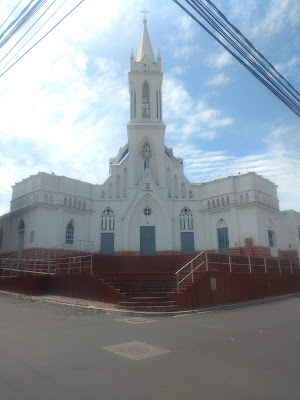
Cosying up to Cúcuta: Cúcuta's Iglesia del Perpetuo Socorro (Church of Perpetual Help).
Religious views. The picturesque Iglesia del Perpetuo Socorro.
The viewpoint now has a cleaner, more welcoming feel to it. Just don't expect to watch the sunrise from there. Apparently, it's only open to the public from 10 am. I arrived at 9.40 and had to wait, although the security guy did let me pass at 9.50. What a rebel. 
I'm not sure what time it closes, but one would like to think it's after sunset, which is always around 6 pm in these parts. By the way, there is no entrance fee, it's free thankfully.

In general, the southern part of the city appears more tranquil, mostly residential as it is.

Speaking of slower-paced living, I did get the chance to briefly take in the nearby town of Chinácota, about an hour's bus drive south of Cúcuta. At 1,175 metres above sea level, it's slightly fresher than the at-times stifling heat in Cúcuta, which is about 800 metres lower.  

By all accounts, Chinácota is a popular weekend escape for Cúcuta residents. From my 24-hour stint there, I can see why. Next time I'll make it my business to spend a little more time in the town.

For if there has been one constant throughout my years in Colombia, it's that a trip to Cúcuta is never too far away. And that's perfectly fine with me.
_______________________________________________________________
Listen to Wrong Way's Colombia Cast podcast here.

Facebook: Wrong Way Corrigan — The Blog & IQuiz "The Bogotá Pub Quiz".

Wednesday, 15 May 2013

Venezuela: A necessary reappraisal

Back in 2009, on our first visit to the Ecuadorian capital Quito, we heeded the well-intentioned advice of some fellow travellers and opted to stay in the ‘safer’ north of the city – an area home to many backpacker hostels.
Venezuela: A necessary reappraisal. Crossing back (somewhat reluctantly at the exact time of the photo) into Venezuela
"Do you want to go ahead with this?"
What we encountered there, however, was anything but a feeling of security, reinforced by hostel and restaurant owners’ warnings not to venture out alone, if indeed at all, after dark. 

The fact that the majority of people we spoke to in the hostel we stayed in had been mugged on the streets right outside our lodgings obviously did nothing to ease concerns.

As a result, our stay in the city was short-lived; we were quite happy to leave in all honesty.

Two years later, in a less-planned stop in the city and being led by an Argentinean bus companion, we found ourselves camped up in a mediocre ‘hospedaje’ (hostel/hotel) in the historic centre of the city – dodgier territory than the north of the metropolis according to many.

This time, though, we experienced a completely different, far friendlier side to the place. Within hours after arriving (we got there late in the evening, in darkness, at that) we found ourselves drinking beers in a rough-and-ready house of some local. In another context, considering the area we were in, these guys would be seen as people to be avoided. 

This set the tone for what turned out to be a hugely enjoyable, trouble-free few days in Quito.

So while first impressions of a place or a person can at times be a good guide to the whole picture, this isn’t always the case. Very often such things are context and time-dependent.

Bearing that in mind, we made no secret of our negative introduction to Venezuela last year (see: http://bit.ly/OLR2Ev). 

In many ways, our experiences back then sat nicely with the accepted Western narrative that the place is dangerous, politically insecure and best avoided – even though we did enter the country rather excitedly and with an open mind.

Thus, this time it was with a bit of nervousness, tempered by stubbornness and a sense of some adventure, that we hit for Colombia’s eastern neighbour for a visa run. The rough plan on departing Bogotá was to get in and out of the place as quickly as possible.

Our anxiousness increased when, on arrival in the city of Cúcuta on the Colombian side of the border, the guys who exchanged our pesos for Venezuelan bolivares gave us plastic bags and told us to stow our cash in them and put them in our shoes for safety. (The biggest problem in the end was that this practice almost rendered the notes unusable from the damage inflicted by being wrapped up in our sweaty runners.)

Yet practically from the get-go, the coldness of the citizens and feelings of insecurity that prevailed during our first visit were replaced by very helpful, friendly people and a relaxed general atmosphere.

The 'Maduro' quarter of San Cristóbal
To the left ...
A Henrique Capriles supporter proudly displays his election poster over his little street stall
... and to the right
Yes, the physical signs of the recent, highly contentious general election (for a recap, see: http://bit.ly/Yy86zJ) narrowly and controversially won by the late Hugo Chávez’s successor, Nicolás Maduro, are there to be seen. 

But it’s not – at least openly and at ground level amongst the populace (at a political level and below the surface for some citizens we spoke to, deep divisions are apparent*) – a case of a dangerously divided country where opposing sides don’t mix.

What we found in the two places we stayed, firstly San Cristóbal and then Mérida**, were easy-going people (the small bar brawl we witnessed on our first night aside – sure a beer bottle being hurled at somebody is nothing unusual to us) going about their daily business.

Wherever we stay we like to be able to venture out at night feeling relatively safe, sampling a few beers and chatting to the locals in little ‘tienda’ bars. Thankfully, that was no problem this time, unlike Maracaibo last year. 

OK, our hotel in San Cristóbal did have a 10.30 pm curfew, but that was more an individual choice rather than a rule from what we could gather. Plus, considering the times we tend to retire at night nowadays, this lights-out policy wasn’t a big issue.

Of course, we did learn from our first experience in the country as regards the currency. 

So this time we had plenty of cash to convert into bolivares as opposed to going to ATMs where the value is at least four times less than on the street (Colombian pesos are fine to exchange along the border and that’s where you’ll get the best price). Hence, in most aspects, it’s much cheaper to get by compared to Colombia.

On that theme, practically every shop/restaurant displays the prices of its goods – prices that are trustworthy and accepted across the board from our observations. In other words, haggling isn’t really done or needed in the majority of places – the price is the price and it’s usually satisfactory. 

Now, we don’t mind haggling, but in many street stores in Colombia you can’t help but wonder if they are charging you a foreigners’ price no matter what you pay. The aversion here to publicly displaying prices always leaves you in a bit of doubt.

A typical day at a Venezuelan supermarket
"Sorry, where would we find some chicken?"
You will still find what seems to be official Venezuelan suspicion towards foreigners – again in sharp contrast to the usual Colombian experience. 

On the internal bus journeys where the National Guard did ID checks, as foreign passport holders we were the only ones taken off and given a pretty decent interrogation with our bags thoroughly checked. With nothing to hide it wasn’t something that bothered us really.

That was, of course, taking for granted that the officers were genuine – in this case, they seemed to be. Considering, though, the pronouncements coming from the country’s leader as regards some foreigners’ intentions in Venezuela (mostly aimed at the USA, albeit), you can never rule out a bent military official doing something untoward in the name of patriotism.

If, however, at heart they are in the same mould as the vast majority of civilians we met in San Cristóbal and Mérida, such a scenario is unlikely. 

In any case, going by our adventures this time around, the rewards far outweigh the risks.

___________________
* Some Venezuelan politicians take very seriously the idea of ‘fighting’ for your country, as this video shows: http://www.youtube.com/watch?v=jKUVdw9mgeY

**Mérida is something of a hidden gem from what we experienced. We plan to bring you more on that next.

Sunday, 29 January 2012

Venezuela: South America's North Korea

The main problem with first impressions, as they say, is that you only get to make one. Alas, for Venezuela – not that the many seemingly myopic locals will care – what we witnessed on our admittedly brief and limited sojourn into the country will not have us rushing back. 
 
In theory, there shouldn’t be a major difference between the Colombian and Venezuelan cultures. 

Heck, the two countries were once together – along with other territories - in a greater Gran Colombia. On the ground, though, they seem worlds apart. 

The warmth and friendliness that you’ll instantly get on arrival in Colombia is replaced by a coldness bordering on hostility from a significant proportion of the population in Hugo Chavez’s Bolivarian Republic. Of course, El Presidente is perhaps one of the main reasons for this - we won't go there just now, though.

Making the overland crossing into the country, it doesn’t take long to notice the more negative vibe to the place. 

From the border crossing a short drive outside the Colombian town of Maicao to Venezuela’s second city of Maracaibo – no more than a two-hour drive – you’re likely to be asked for your passport and visa stamp at least ten times. Fantastic use of resources that. 

What difference in your circumstances are they expecting to find 10 kilometres down the road from the last check? 

Possibly it is a siege mentality thing derived from the top – ‘the foreigners are coming to infiltrate us, make them feel ill at ease’ sort of thinking. If as a nation it’s that paranoid, why not just follow the North Korean lead and don’t let them in? It might just make life easier for everybody concerned.

Venezuela: South America's North Korea.A selection of notes & coins of Venezuela's unfathomable currency — the Bolivar Fuerte.
Bolivar Fuerte - what's it worth?
Then you have the currency – the "old" Bolivares or "new" Venezuelan Bolivar Fuerte (VEF). The two are still used in pricing, but it’s the ‘Fuerte’ you’ll be physically using – it’s basically the old money put into more basic units from what we can gather. 

Go to an ATM machine and you’ll get at best five VEF for your one euro. Go to one of the numerous cambios – currency exchange operators – on the street and one euro will get you, at least, a very nice 9.5 VEF. Almost double the value than what you’ll get via official means at an ATM/bank. 

So depending on how you’re getting your money in Venezuela, the country can either be pretty economical or quite damn expensive compared to its neighbours. 

Knowing what we know now, the best thing is to bring in with you large volumes of a foreign currency to exchange on the street during your time there. Of course, such a strategy comes with its own security problems, but it’s probably worth the risk.

Mentioning money, Venezuelan business people we encountered seemed overly obsessed with it – and that’s saying something considering the continent we’re in. Everything must be paid up front – even at an internet cafe. 

The advice here is to only give the bare minimum required for whatever you’re getting or using. That’s because – for the most part – once you hand over your cash, you won’t be getting it back if the circumstances of what you originally paid for change. That’s a quick lesson to learn, especially if Venezuela happens to be your first Latin American experience or indeed if you’re visiting the country from Colombia, where they tend to have a far more relaxed, reasonable approach in this regard.
Venezuela: South America's North Korea. A sing at the Venezuelan border with Colombia, asking us to come back soon. Not so sure about that one.
Adiós Venezuela. 'Come back soon' - we'll think about it.
Then you have the dirt. Now, as the last few weeks have highlighted, this is something that doesn’t tend to overly bother us.

However, a rubbish tip of a place – as is much of what we saw of the country – coupled with a sour ambiance does not make for a good mix. Throw in the most aggressive drivers we’ve come across on the continent – another big statement for Latin America, but here they will knock you down if you get in their way, no question – and you begin to wonder why you bothered coming.
 
Like everything, though, you will find exceptions to the prevailing disposition of the populace, but they seem very hard to find. 

Also, it must be said again that our stay in Venezuela was short-lived – there is much more to the place than what we witnessed. It just became too costly to keep going to the ATM. 

So maybe with more time it might be possible to discover a lighter side to the country. Some would argue this does, in fact, exist – it’s called Colombia.