Showing posts with label Britain. Show all posts

Wednesday, 26 June 2024

From Cool to Fool Britannia | Letter to the editor

@wwaycorrigan

Oh those heady days of 1990s Cool Britannia. The Oasis-Blur rivalry, Girl Power one could genuinely believe in with the Spice Girls, and Western innocence that we'd reached the end of history.

How wrong we were. Specifically for Britain, nay the United Kingdom, ahead of its general election on 04 July, the choice is a full return to the Blairite Revolution started in 1997 or continued Conservative Party incompetence.

My latest letter, published in the Irish Examiner on Wednesday 26 June, looks at this bleak choice for the UK through a pop lens. Pop goes Britannia, so to put it.

The letter is at https://www.irishexaminer.com/opinion/yourview/arid-41423608.html or see the copy of it below.

From Cool to Fool Britannia | Letter to the editor
Fool Britannia


Thursday, 18 August 2022

A Hack(ett) job on Britain

@wwaycorrigan

Oh, how one can be irked by what are to all intents and purposes rather inconsequential matters.

This happened to me with a Ms Alison Hackett after reading two similar-themed letters she had published in Irish dailies over the last few days. They can be found at https://www.independent.ie/opinion/letters/if-we-have-a-minimum-wage-why-not-a-maximum-one-41917129.html (fourth one down) and https://www.irishexaminer.com/opinion/yourview/arid-40939784.html.

Her utter vitriol for the way Britain runs its affairs and her apparent Gallic glorification is rather misplaced.

Indeed, this sentiment that exists in some quarters in Ireland that the EU can do no wrong while Britain just blunders is worryingly myopic, particularly so as it seems to dominate official policy and media coverage. It would be best to focus on the myriad shortcomings in one's own backyard before attacking the neighbours.

I did write a reply to Ms Hackett's Irish Independent letter which is published online here, https://www.independent.ie/opinion/letters/investing-in-renewables-will-guarantee-returns-for-all-41919458.html (third one down). The letter is also in the images below.


Wrong Way Corrigan's reply to Alison Hackett's letter in the Irish Independent, a woman who seems to have a deep hatred of Britain.
Right of reply. 

_______________________________________________________________
Listen to Wrong Way's Colombia Cast podcast here.

Facebook: Wrong Way Corrigan — The Blog & IQuiz "The Bogotá Pub Quiz".

Wednesday, 13 July 2022

'Death to dissenters. It's for your own good.'

@wwaycorrigan

[Listen to an audio version of this blog entry here.]

I do find it somewhat perplexing — and occasionally amusing — how self-proclaimed freedom-loving liberals demand that others follow their path. At times, this is seen in a passive-aggressive manner. However, more frequently these days it's simply done aggressively; there's nothing passive about it whatsoever.
'Death to dissenters. It's for your own good.' 'Just say what everyone wants you to say, Bart.' Bart Simpson as the 'I got multiple covid jabs kid!'
'That's my boy, Bart. Just comply. Life shall be easier then.'
It's no longer a case — as at least it seemed to be only a decade or so ago — of being open to alternative views when there is no conclusive evidence that one belief is the real truth, with all others simply wrong. No. The tone of this pugnacious proselytising wouldn't be out of place in the days of Europe's Reformation and subsequent Counter-Reformation.

Only EU can make the darkness bright

From an Irish perspective, more understandable as it is with its quite incestuous media and politics, we've seen it with Brexit and the coronavirus pandemic. I have tried, from afar, to provide a little bit of balance as regards the latter (see https://wwcorrigan.blogspot.com/2022/01/covid-19-anti-vaxxers-immunity-my-chat.html).

With Brexit, OK, there is the old quip that Britain's, nay England's, difficulty is Ireland's opportunity. There is, after all, a long bloody history between the two islands (there's been much intermingling of a more peaceful variety, too). So, despite the better relations that have developed between them over the last couple of generations, many Irish still have a deep-rooted desire to see England fail.

Add in the fact that most of Ireland's agenda-setters naively see the European Union as a rock of rectitude and it's not surprising to find such a hostile attitude towards Brexit. (If I had to choose one over the other, seeing the direction of travel of the EU and playing the long game, I'd opt for Britain over a Europe dominated by France and Germany. For one, the traditional common law approach tends to defend the individual more so than civil law.)

Coming back to the pandemic and zooming out from Ireland to a global level, to go against the narrative of lockdowns being a necessary evil, that they were the 'only viable option', was akin to blasphemy. As early as March 2020 I questioned this wisdom in Coronavirus' collateral damage.
'These facemask fascists, rather than castigate others for not "complying", should stick a sock in it, quite literally.'
Some commentators who submissively went along with all this back then are now, however, trying to rewrite their own history.

Some, that is. Others, those who seem to think that covid-19 is the only threat to human life, appear to want to have indefinite lockdowns. 'Can't everybody just work from home?' Eh, no, they can't.

Such types also tend to be facemask fascists. 'I care about others, that's why I wear a facemask.' Wonderful. The snag here is that there is no conclusive evidence that a piece of cloth wrapped around one's mouth and nose is truly effective in reducing the spread of coronavirus.

Indeed, there are so many variables at play that any study showing a benefit in this regard comes with numerous caveats. (For a detailed breakdown of such studies carried out so far, see https://brownstone.org/articles/more-than-150-comparative-studies-and-articles-on-mask-ineffectiveness-and-harms/. Also, https://emilyburns.substack.com/p/no-masks-dont-help-keep-kids-in-school).

Thus, if people want to wear a facemask because it makes them feel safer or more virtuous, fine. However, this castigating of others who don't wear them, well, such facemask fascists should stick a sock in it, quite literally.

'A jab a day keeps Pfizer in play'

Then there are the covid-19 vaccines. Considering the number of breakthrough infections we've seen, this idea that prevails in significant quarters that an unvaccinated person is more of a risk to him/herself and society in general compared to a vaccinated person just doesn't stand up to scrutiny.

Personally, and so far it seems to be holding true, my immunity or whatever natural defences I have against covid may be stronger than that of many of those who have had multiple vaccines.

Yet, the covid-19 vaccine-mandate brigade continues to exert a significant influence across the globe. They insist that the benefits outweigh the risks in all cases, when there is strong evidence that suggests otherwise, particularly the lower down the age cohorts one goes. (For more on that, see https://brownstone.org/articles/are-the-covid-mrna-vaccines-safe/.)

Now, while not all who endorse compulsory vaccination and mask-wearing are woke, illiberal leftists, there does certainly appear to be a substantial crossover.

These attempts at control, to force submission and/or destroy the credibility of the dissenters match nicely with the woke ideology.

Such types talk of equality and freedom but on their highly prejudiced terms only. (I went into more detail on this in Drunk almost to death on the culture wars.)

Putting an optimistic spin on it, it would appear the ordinary Joe and Josephine don't really go along with those who follow a more militaristic line on the above and other similarly contentious issues.

The average, informed citizen seems to realise that these matters are more nuanced than they are often portrayed. It's not, so to put it, 'everything black, good; everything white, bad.'

The problem, particularly in the West, is that in the traditional media and politics — spheres that exert much influence of course — there's an over-representation of these illiberal liberals.

Thus, it's incumbent on those of us of a more balanced nature to push back at every opportunity. Death awaits us regardless, so we might as well go down putting up a fight.
_______________________________________________________________
Listen to Wrong Way's Colombia Cast podcast here.

Facebook: Wrong Way Corrigan — The Blog & IQuiz "The Bogotá Pub Quiz".

Wednesday, 25 March 2020

Coronavirus' collateral damage

A sure-fire way to ensure you get the blood up of a large section of readers is to start off a blog post quoting Donald J. Trump.

So here goes. The US president tweeted the other day about coronavirus and the measures being taken to control it that 'We cannot let the cure be worse than the problem itself.' 
Coronavirus' collateral damage: Empty streets in Bogotá as people are told to stay at home in a bid to contain the spread of the novel coronavirus.
Coronavirus: Things will never be the same again?
Of course, true to form, Trump's discourse since this 'Chinese virus' emerged has read like a dark comedy. He's gone from 'we have it under control' to 'it will be gone by April' to 'the US is in great shape to tackle it' to 'this is a pandemic and I felt it was a pandemic long before it was called one.' 

What ails you?

Nonetheless, he does have a point about the cure potentially becoming worse than the viral infection itself. 

In this regard, we're talking about the cure being self-isolation and strictly imposed countrywide lockdowns, the approach being taken by many states battling covid-19 right now. Basically, it's a degree or two less severe than the Chinese model of tackling "their" virus. 

The idea in the short-term is not to eradicate it completely (although if that did happen, great), it's to, as most are well aware by now, flatten the curve in terms of the rate of infection. In that way, the health systems of the many countries trying to deal with this crisis will be in a better position to cope. 

The nightmare scenario is hundreds of thousands of cases in a short period of time. Hospitals just wouldn't be able to cope with those in a critical condition. 

Of course, as experts readily admit, in countries that were slow to enforce self-isolation and social distancing, the majority of the population is likely to get infected. On the plus side, the majority of that number should make a full recovery. 

So, at this remove, we could end up with the same number of coronavirus-related deaths regardless of the measures taken. Even with the best medical care in optimum conditions, the sick and vulnerable who contract the virus might die. 
'The global death rate in the coming years could be lower due to coronavirus.'
To use an analogy from a history professor from my university days when talking about the demise of Britain's Liberal Party, World War One was the bus that gave it the knockout blow but the postmortem revealed it was in terminal decline in any case, on "borrowed time" so to put it. 

There is the possibility, once we get on top of this, that the global death rate in the coming years could be lower than would be normally expected, as coronavirus ended some people's lives a few years earlier than they would have departed the scene.

Death by association 

Thus, coming back to the "cure" currently being implemented, leaving aside the severe financial heartache and associated problems it will cause for millions of people across the globe, especially in developing countries such as here in Colombia, could it turn out that it ends up being responsible for a good number of deaths in its own right? Or, better put, coronavirus' collateral damage. 

With the panic and chaos being caused by these lockdowns, there's a fair chance that people who get struck down with other life-threatening conditions are either neglected or choose not to seek medical attention due to all the fear that abounds. Of course, this is going to be next to impossible to calculate. 

For the moment, we have to trust that the measures currently in place are the best option. We have no other choice. 

Nonetheless, from a Colombian perspective, if this 19-day lockdown we've entered proves successful in terms of keeping cases down, the hard-pressed masses will look for a prompt easing of restrictions. 

On the other hand, if it doesn't work, if cases skyrocket between now and 13 April, there's a fair chance those same people will ask what's the point? Why all this extra hardship for nothing? 

They might just decide that they have to carry on regardless. 

The next few weeks will tell a tale.   
________________________________________________
Listen to The Colombia Cast podcast here.

Wednesday, 6 November 2019

Colombia's and Ireland's eastern troubles

Making comparisons between Colombia and Ireland is about as useful an exercise as sweeping leaves in a hurricane. 

Even where there are similarities, something previously touched on by this blog, their day-to-day relevance would seem fairly minuscule. Colombian-Irish ties, while apparently growing, are still pretty weak.
Colombia's and Ireland's eastern troubles: Just when things were looking up for both Colombia and Ireland, the neighbours to the east throw a spanner in the works.
Colombia and Ireland: Dealing with 'nasty' neighbours.
Nonetheless, as an Irishman based in Colombia for the last eight years, becoming aware of these similarities has been rather interesting, insightful even.

While the posts referenced above made internal comparisons, here we're going to add an international dimension.

Nasty neighbour to the east

Basically — stick with us here — Venezuela could be seen as Britain, and that's not just because of its geographical position to Colombia's east. 

Historically, Venezuela was seen as the more advanced, organised and cosmopolitan country. In contrast, Colombia was (is) a violent backwater, insular and conservative. Friendly folk for sure but untrustworthy schemers of sorts. (See where we're going with this?)

A lot of the locals with any get-up-and-go did just that. They left. What's more, a not-insignificant number of them went to that more developed neighbour to the east for a better life. Well, either there or to the US.
"The political problems next door could see the old inferior nations return to their inglorious past."
However, over the last few years these violent backwaters, Colombia and Ireland, have found their mojos, of sorts, while the eastern neighbours appear to have hit the self-destruct button. 

Now, not only are those who had emigrated coming back but people from other countries are keen to give the current 'cool kids' a try, including many from the near east, reversing long-standing migration flows. (The influx of Venezuelans to Colombia needs no elaboration while there has been a significant rise in the number of Brits applying for Irish passports pre-Brexit).

Uncomfortable at the top

Added to this, of late, have been the neighbours' current political problems and the risk of contagion to the now, um, flourishing 'cool kids'. 

As the latter harbour men who have a proven track record at subversion, there is a belief that it will only take a little bit of instability to plunge them and their centre-right administrations right back into the bad old days of violence and economic decline. 

Of course, outside 'help' isn't a prerequisite for this but it can be an important catalyst.

The eastern guys, for their part, have leaders who seem hell-bent on getting their way or, as some view it, are being unfairly hindered from doing their job. 

Now, while a Jeremy Corbyn victory in the UK's December election would work wonders for this analogy from a left-right perspective, it's not completely necessary. 

Bungling Boris Johnson, while politically poles apart from Nicolás Maduro, fits the narrative here in so many other ways. For one, you've both men's penchant for putting their foot in it.

As the problems to the east show no signs of easing, there's a bit of schadenfreude on display in some quarters of the once inferior nations. 

However, looking down from a lofty position not only doesn't sit well with them but it also tends to be followed by a swift, painful comedown. 'Back in your place with you.'

When that comedown has well and truly landed, by their own doing or otherwise, assistance from the eastern neighbours will yet again be badly needed. After all, these countries have more in common than they may like to admit.
__________________
Facebook: Wrong Way Corrigan – The Blog & IQuiz “The Bogotá Pub Quiz”.
Listen to The Colombia Cast podcast here.

Friday, 22 April 2016

Recalling Ireland's 'terrible beauty'

For many occurrences in life, it is easy to be wise after the event. Yet, while this Sunday, 24 April marks the passing of 100 years since the start of Ireland’s 1916 Easter Rising, no one can say with any certainty what the men and women behind it should or should not have done. 

‘A terrible beauty is born’ is how the great Irish poet, William Butler Yeats, summed up the contrasting emotions of the time. In many ways, it continues to be viewed thus.
Recalling Ireland's 'terrible beauty': Dublin, Ireland, during the Easter Rising of 1916.
Knocking down the old structures to start anew. (Photo from Facebook.)
It's probably fair to say that had there been a national plebiscite at the time to rebel or not, the latter would have won the day. This is not to say that a majority on the island did not want a change in how the country was governed, more that past experiences of failed uprisings had surely left the populace sceptical that a new attempt would succeed. 

The lack of popular support and indifference that history records when the rising broke out suggest this. (On the democratic front, one can also point to the many occasions when the concerns of the Irish masses were ignored by their colonial masters.)

Yet, it didn't take long for that to change; vindication for the actions of the Rising’s leaders in a sense. However, their stated aim was to achieve an all-island republic; this, of course, did not happen and has not happened.

Taking into account the political developments at Westminster at the time, it seems that some sort of Home Rule would have been granted once World War One was over, with perhaps separate parliaments for both Dublin and Belfast, considering the vehement opposition to the idea in the north-east. 

In other words, something very similar to the agreement actually reached between Britain and Ireland in the years after 1916. Or it may have even led to a devolved parliament for a united Ireland, remaining part of the United Kingdom albeit.

Therefore, it could be suggested that the rising and subsequent guerrilla war were unnecessary. Moreover, these further deepened the north-south divide.

On the other hand, we can only assume that a solely political path would have led to Home Rule. Diplomacy had failed in the past, which led some to believe that a forceful ‘stick’ approach was needed to get any meaningful concessions from Britain.

It is in this light we have to judge the actions of those who carried out the 1916 Rising. They did what they felt was necessary at the time.

With the benefit of hindsight, you could argue, as some do, that it was the wrong move. 

Be that as it may, respect must be given to those who made what was for many akin to a suicidal attack on the forces of what they viewed as an oppressive regime.
__________________________________________
Facebook: Wrong Way Corrigan - The Blog & IQuiz "The Bogotá Pub Quiz".

Saturday, 2 January 2016

The art of darts

The online edition of the Oxford English Dictionary defines sport as 'an activity involving physical exertion and skill in which an individual or team competes against another or others for entertainment'.
The art of darts: Streaming the William Hill PDC World Championship; proper darts!
The home theatre for the last couple of weeks.

The amount of 'physical exertion' required to make something a sport isn't specified and, ergo, it's open to debate as to what classifies as one and what doesn't.

For many, darts does not fall into the sport category. 

This is the game — the chief version of it anyway —  where you throw metal arrows (darts) at a circular board numbered randomly from one to 20 with double and treble segments on each number, and a red 'bull' at its centre worth 50, surrounded by a narrow green ring valued 25.

In general, the main place you'll find people playing this, outside of the trade's professionals, is in a pub — that is to say in an alcohol-selling, (usually) laid-back venue.

So to describe it as a sport just doesn't sit well with many people's perceptions of such. 

For one, when most think of sport and those who practice it, they imagine well-ripped bodies, a picture-book image of ultimate fitness. Darts' leading lights don't exactly, erm, fit that description.

Yet, to come back to the dictionary definition, darts is certainly something that requires skill. 

Yes, anyone can throw a metal arrow at a board, in the same way that anyone can kick a football. But to throw it with accuracy and consistency over a period of time in a contest is something completely different. It is the quintessential game of millimetres. 

In terms of physical exertion, well there is a continuous throwing action required and you don't exactly get the chance to sit down and relax.

However you view it, the game/sport and the whole show around it appears to have grown significantly in popularity and exposure, as well as prize money for the players, in northern Europe — Britain, Ireland and the Netherlands especially — over the last decade or so.

'Fernando the Great' demonstrates his tejo skills in La Perseverancia, Bogotá DC, Colombia.
Tejo — Colombia's 'darts' ...
That 'show' element has been crucial. A night out watching the globe's top darts players — something I've had the pleasure to do twice — is great craic (fun) as we say in Ireland. 

What's more, even with limited knowledge of the game, not that it's that hard to comprehend, it generally makes for compulsive viewing on TV. Real-life drama, as we've had on numerous occasions at the PDC World Championship over the last few days. (For the record, there are two rival world governing bodies, the other being the BDO, both of which host world championships.)

OK, I'm writing as one of the converted and once I understand any sport I tend to appreciate it, even if I don't play it. (However, I must state that I did win a darts doubles tournament in my local pub in Ireland years back; it was more thanks to my playing partner but a win's a win!)

It's why that over this Christmas period, although I'm thousands of miles away from the action, in a country where darts doesn't register a beat — though Colombia does have versions in tejo and bolirana, minus the professional organisation/glamour — I've been like a hermit, in a positive way methinks, streaming the world championship action in my apartment.

Some sort of normality, whatever that is, will resume when the PDC World Championship ends this Sunday. Like those who love Christmas, there'll be an empty feeling for a while, but there’s always next year.
_________________________________
Facebook: Wrong Way Corrigan - The Blog & IQuiz "The Bogotá Pub Quiz".

Friday, 8 May 2015

United Kingdom, divided Europe

Well, that was pretty clear cut. Not only did the British Conservative Party get re-elected, but it did so in rather impressive fashion, securing an overall majority in the House of Commons. There's no need for a messy coalition with those annoying Liberal Democrats, something the Tories had to endure for the last term.

United Kingdom, divided Europe: The UK, soon to the missing star in the EU?
The UK: Breaking the EU circle? (Image from eucentre.sg/.)
No, this time the party led by David Cameron can govern as it sees fit – well, as much as it can inside the realms of a constitutional monarchy and a parliamentary system of governance. 

You can't argue too much against the mandate that Cameron and co have received (unless you're from Scotland, where the Scottish National Party secured 56 of the 59 seats up for grabs there).

In one sense, you could argue, the result changes little. The Conservatives are back in, just this time with a little more force. Yet, what's to come could have much greater significance, especially in terms of the UK's political and trade relations with its European neighbours.

This is because of the referendum that will be put – unless the Tories do a dramatic, unexpected U-turn – to its electorate over the country's future in the European Union. 

And if Cameron sticks to his word, the question will be straightforward, along the lines of: 'Should the UK remain part of the EU; yes or no?' The implications of a 'no' win, however, may not be so straightforward.

Of course, that Britain has been more of a Europhobe than Europhile since joining what was then the European Economic Community in 1973 won't come as a surprise to most. 

The legacy of having one of the greatest empires the world has ever seen doesn't go away quickly or quietly. Compromising with former enemies such as France and Germany has never gone down well with the British psyche.

Its decision not to join the euro, while not unique among EU-member states, served to further the belief on the European mainland that the UK was and is just paying lip service to the idea of greater integration of the 'Old Continent'. (That staying out of the European Monetary Union was probably a wise move considering the current state of play is something we won't fully go into right now.)

So with the traditionally Euroscpetic Conservatives in power, the wind in the party's sails thanks to securing an overall majority and with the much-talked-about referendum upcoming, that the UK may finally cut its official ties with Brussels seems almost inevitable.

This could be the opportunity to make 'Great Britain greater', as David Cameron vowed in his victory speech. In any case, a clear decision about British EU membership, one way or the other, could be just what both sides need.

David Cameron: The UK's future in the EU is practically in his hands.
Cameron cool: Is this the man to lead the UK out of Europe? (Photo from FB.)
A strong 'no' win and the UK can leave behind what at times has been a turbulent political union with its European counterparts and go about creating new alliances and arrangements. 

Sure, things could be awkward for a while as the country re-finds its feet, but it need not be disastrous. Britain only needs to take a glance north to Norway for a template on how a life outside the EU works.

On the other hand, a 'yes' victory, akin, and perhaps ironically so, to Scotland's rejection of independence from the UK last year (Cameron, after all, has work to do to keep his own union together), would (or at least should) mean a shot in the arm for a flailing EU project. The odd couple, the United Kingdom and the European Union, agreeing to give it another go, for old times' sake.

In the backdrop to all this is next year's 100th-anniversary commemoration of the bloodiest confrontation of World War One, the Battle of the Somme. And while Britain emerged victorious from that war, in many ways it marked the beginning of the end of the Empire, as new forces to the east and west began to crank up their vast influence and power.

Is Britain now, however, set to emerge from what could be described as, to borrow from a book title of Colombia's late, great writer Gabriel García Márquez, its own '100 Years of Solitude'?

That might be overstating things, but at the very least the lead-up to the referendum and the fallout from it, whichever way it goes, should cause a bit of giddy excitement in Europe and beyond.

Saturday, 13 September 2014

Scotland: Rising to be the nation again?

It is said that all good things come to those who wait. So, after a political union with its fellow British neighbours to the south, England and Wales, since 1707, Scotland may be about to, once again, go it alone. Well, that is go it alone insofar as any independent country can in today’s globalised world.

Scotland: Rising to be the nation again? The country is under the magnifying lens right now.
There's much focus on Scotland right now. Yes or no chaps? (Image from bbc.co.uk.)
Of course, whether making a break for autonomy from the UK will be a good thing or not for our Celtic cousins depends on who you speak to. In truth, nobody really knows how such a move would go.

In contrast to many other countries that are currently striving for self-determination and those that did so previously, the Scottish position isn’t exactly a case of running from an oppressive, unrepresentative regime.

In fact, it could be argued that Scotland, on the whole, has benefitted as much as any of the countries in the Union since its inception.

Looking at it with green-tinted eyes, it would be ironic that after countless deaths due to failed uprisings in the name of Irish freedom – followed by protracted violence and death when said freedom wasn’t achieved for some – Scotland gets full independence after a single, democratic act.

OK, different time, different context.

For one, in the Irish story, you had a majority on the island who were treated and maintained as, at best, second-class citizens due to their religion, culture and customs. This was the case throughout the period of English dominance there. In general, the Scots have enjoyed a much fairer deal since their union.

On the flip side, considering all that happened in the last century and the problems still existing regarding Ireland’s national question, perhaps it should have been the Irish revolutionaries who trusted in the all-good-things motto.

In purely economic terms, some say Ireland would have been better staying in the UK.

However, asserting one’s autonomy is more than just loot. At the time of partial Irish secession, there was a general feeling of ‘freedom from a repressive regime’ – we’ll leave the Catholic Church’s unchecked, iron-fisted rule out of this for now.* 

Also, thankfully, that freedom from led to a freedom to allow individuals to live their lives, speak their minds, state their own political party, etc. (for a greater discussion on this read Thomas L. Friedman’s Order vs. Disorder from The New York Times).

Moreover, after a shaky start, the new Irish state formed alliances, on its own terms, with old friends in Europe. Current financial problems apart, it can be said that the Irish spirit and confidence are stronger today than they were 100 years ago. This is despite (or maybe because of) our natural begrudgery and cynicism.

As for Scotland’s current run for freedom, it’s not, to restate, a case of trying to remove the shackles of a repressive regime. It’s a group of largely like-minded people attempting to reassert the full independence of an ancient kingdom.

The Scottish Saltire (or flag if you will!).
Is that an 'X' for yes or for no?
It’s what you might call benign nationalism, sought after in a democratic way. Should the people give it the green light, it’s highly unlikely "new" Scotland will embark on an expansionist scheme, trying to Tartanise the region. Well, there will be a few difficult issues to be needled out – maritime borders and currency to name just two – but they’ll be settled around the negotiating table, not the battlefield.

The point is you, only need to look at the Middle East to see the uglier, far more dangerous side to this: aggressive, undemocratic nationalism. Yes, there are a host of intertwined, complex reasons why this is so, with outside influences having as much culpability as those inside.

Much of it emanates from a succession of autocratic leaders followed by weak, quasi-democratic administrations. Legitimacy and order have been sorely lacking. Needless to say, the problems there won’t be solved after one or two elections. We’ll leave that discussion for another day.

Back in Scotland, if a yes vote is delivered it would serve to underscore that this once united, great – for it did many great deeds on this planet – Britain is now a fragmented, very ordinary shadow of itself. It would also be, at the very least, a blow to British, nay English, prestige.

In such an event, the door would be open for our Anglo-Saxon and Welsh neighbours to join what you might see as a restructured union, the ‘Alliance of Celts and English’, the ACE group of nations. A potentially powerful hand indeed.

So what'll it be Scotland?
______________________________
*If there are problems with the hyperlink to that light-hearted, but telling, take on the Catholic Church's assumption of power after the Irish Free State came into existence, check it out here: https://www.youtube.com/watch?v=e5Z1dqJzxNo.

For a more general piece on the whole area of nationalism and the accompanying problems with it, read Tribal warfare.

Monday, 25 February 2013

'Horse it into ya'

For Westerners travelling in what you might call developing countries, one of the many pieces of advice they’ll get from home is to be careful about what they eat. ‘You can never be too sure that what’s on your plate is what the locals might say it is’ is a common refrain – particularly so when it comes to meat. 

Well, in a ‘shocking’ reversal of fortunes, it seems a large portion of developed Europe has been, not quite ‘taken for a ride’ on a horse, but actually eating one – or more than one, it would seem.
'Horse it into ya': Living horses in the flesh, as we're used to seeing them.
Holy horses.
For instead of the meat content of some packaged products consisting of only beef as they were meant to, it turns out a little bit of horse meat was thrown in, too, to give it a bit of a ‘kick’, we can only guess. 

Now, for some people, depending perhaps on their country of origin, this isn’t that big of a deal. But for others, especially those in Ireland and Britain, not only is the thought of eating a horse a little unsettling, it’s actually illegal. 

Back in the old country, we do just about everything else with horses except eat them. In one sense this might be seen as a little unfair: Why single out the horse for special treatment? But that’s just the way it is.

Whatever your own thoughts on eating horse meat – we’re not fussy in this regard as any meat is a rare ‘treat’ these days – the bigger issue here, of course, is the breakdown in trust between the consumer and the supplier. 

When people buy packaged meat, they expect it to be what it says on the packet – regardless if the actual true meat content is minuscule. 

There is also the problem of quality assurance and standards. As most horses are not raised for human consumption, they and their meat are not treated as a foodstuff in the same way that cattle, pigs and sheep are (or at least should be) and therefore generally not subject to the same standards. This is especially so in terms of what injections and medication they receive throughout their life.

The fact, however, that this ‘scandal’ has been limited, so far at least, to relatively cheap packaged meals – ready-made lasagne, meat pies and suchlike – has seen the debate also centre on the people who buy them and why. 

Regardless of whatever kind of meat is in these meal-in-a-minute style products, many of them firmly fall into the junk-food category, despite what the manufacturers might say; high in fat, salt, carbohydrates, sugar even and loaded with other ‘enhancers’ while the protein levels are pretty low.
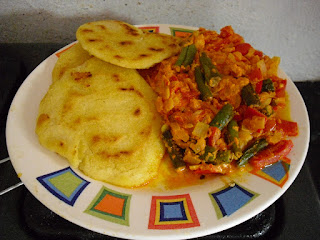
A satisfying vegetable dish - we don't always have to have meat with our main meals
Healthy, home-made grub.

People who buy them – and from what we’ve witnessed in the past it’s not just those from the poorest backgrounds – point to the fact that they are cheap and extremely convenient. No labouring in the kitchen required. 

Both aspects are true, but you can get many different types of fresh fruit and vegetables (both root and over-ground) for similar, if not cheaper prices. 

As for the convenience, it doesn’t take that long to put together a tasty vegetable stir-fry where you control what kind of flavours are added. Heck, chop up a few spuds and put them on the boil and they’re ready in less than 30 minutes. OK, it’s not as quick as five minutes in the microwave but when your health and well-being are at stake, what’s half an hour? We tend to find, too, that if you wash the pots and pans you used in cooking before you sit down to eat, it makes the meal all the tastier.

‘Ah, but what about the meat?’, you ask. Well, for one, as pointed out earlier, there’s not much of that in the majority of those all-in-one meals – at best the scratchings from a butcher. Plus, do we really need to eat meat every day of the week or even at least twice a day as it is for some? No, is the simple answer, we don’t.

Many of us have become so accustomed to having some sort of meat with most of our snacks that anything we eat without it just doesn’t seem right. It’s a safe bet, though, that if we all had to personally kill our own animals there’d be plenty more vegetarians about – and no one would be any the worse off. 

Indeed, there might be a reduction in obesity because of it, considering the quality of meat, or lack thereof as the case is, that many consume these days.

There’s a lot of satisfying, healthy fun you can have with cooking an array of different vegetables that can be ready to eat in minutes. Yet, even in times when in many parts of the world the abundance of a variety of ‘green’ foods has never been greater, our willingness to experiment with them is quite low in general.
The horseradish plant - not to be confused with the 'horse', the animal
HorseRADISH (pic from theherbcottage.com).
Our native land often comes in for criticism on this front. Climatically and historically, though, we Irish have an excuse – the land naturally isn’t brimming full of different types of fruit and veg all year round. 

This is far less the case, however, here in our adopted country of Colombia. Most of the locals, though, seem unwilling to embrace a varied vegetable diet, even though plenty of them are available and at very cheap prices. 

In fact, the standard plate here generally comes with three starchy carbohydrates – rice, potatoes and pasta – mushy beans or peas, a token piece of meat or fish and a bit of a salad that a snail would devour in seconds. You’d find more colour and variety at a Ku Klux Klan meeting compared to the offerings on a standard Colombian dish.

That’s not to say we don’t like what they eat here, but they could be a little more ‘adventurous’ in the kitchen at times*. 

For example, a little more horseradish and less, erm, horse. Are you listening, Europe?

_________________________
*For our like of the 'famed' arepas in particular, check out 'Six of the best in 2012 (well kind of)' http://bit.ly/VQGxxo

+In case you're wondering, the 'inspiration' for the title of this post came from this particular 'gem' of a song: https://www.youtube.com/watch?v=yhILr70yKQU

Tuesday, 18 September 2012

The damned Irish question

For Winston Churchill it was ‘the damned Irish question’. Fast forward the guts of a century later and for Rory McIlroy it’s the damned – although perhaps not in the same venomous way as Sir Winston – Irish or British question. 

And it appears, unsurprisingly in some contexts, that the United Kingdom resident is siding with the latter. Although, he has been at pains to state in recent days that he is yet to fully make up his mind.
The damned Irish question: Rory McIlory doing what he does best — playing golf
Mean in green. Or not? Rory McIlroy.
For those of you in the dark on the above, we’re referring to where Northern Ireland-born Rory McIlroy – the number one golf player in the world right now and arguably the sport’s biggest superstar – will pledge his allegiance for the Rio de Janeiro Olympics in 2016. 
 
As he correctly pointed out in a recent open letter on this subject via his Twitter account, no matter which side he opts for, he is going to upset some people. 

By the tone of that correspondence it seems this whole subject is one he wishes he didn’t have to deal with. Or at least if it was one that was taken out of his hands. He’s certainly not in an enviable position.

Of course, it shouldn’t need to be stated that as a UK citizen he is fully within his right to plump for Team GB. Hailing from Northern Ireland, he can choose to have either a British or an Irish passport – as yet there is no separate one for NI. 

So, the fact that he holds a British passport is a pretty strong guide to his preference. 

However, we are aware of some Northern Ireland residents considered to be more in the green sphere than orange who hold British passports for the simple fact that they are cheaper to obtain. What price your nationality, eh? About £20 it seems, for some. 

The whole political position of Northern Ireland is one that we regularly get questioned about from locals here in Colombia. Most of them assume that it is British, confusing Great Britain – the island to the east of Ireland consisting of the countries England, Scotland and Wales – with the UK, the sovereign state that is Great Britain and Northern Ireland. 

So looking at this from a purely geographical perspective, if you are born on the island of Ireland – be it in the Republic or the North – you are Irish. 

For most people, though – Rory McIlroy included – nationality is much more than just where you were born. It’s about where you come from in a background sense – your blood, your heritage. 

For McIlroy and many of his kin in Northern Ireland, their roots on the island date back to Britain’s Ulster Plantation in the early 1600s. 
 
These new settlers – mostly Scottish Presbyterians although there were also English Anglicans – remained fiercely loyal to their motherland of Britain. 

Also, chiefly because of religious, political and indeed language differences, they did not end up mixing with the dispossessed ‘old Irish’ as happened in other parts of the island where British settlers had been previously planted. 

This divide was only made deeper after the Battle of the Boyne in 1690 where the Protestant King William defeated the Catholic King James, ensuring the Protestant succession for the English, Scottish and Irish thrones and thus the religion’s ascendency in Ireland.
The 'Irish' Union Jack
Perhaps even the Brits are Irish at heart?
In the following years, up to and including the creation of the Irish Free State in 1921 and its subsequent declaration as a Republic 27 years later, the political and cultural differences between the settlers in the north-east of Ireland compared to residents in most of the rest of the island sharpened further.
 
In this context, what it meant (and still means in many ways) to be Irish was completely at odds with the customs and mindset of the planted stock in what is now the state of Northern Ireland. 

Namely, to be Irish usually meant Catholic, anti-British (here you can include British sports such as cricket, rugby and soccer versus the Irish sports of Gaelic football and hurling) and anti-royalty, to name just the most relevant in this regard. 

Now, while many of these differences were unavoidable from the get-go, they were given further legitimacy by the direction taken by the early leaders of both states. 

Northern Ireland’s first Prime Minister, James Craig, summed this up in his response to Éamon de Valera’s (his southern counterpart at the time) declaration in 1934 that the Irish Free State was a Catholic one, stating: 'They still boast of Southern Ireland being a Catholic State. All I boast of is that we are a Protestant Parliament and a Protestant State.'

So bearing all this in mind, for Rory McIlroy, while geographically he may be Irish, or Northern Irish if you will, culturally he may feel more British – or at least the Northern Ireland version of what it means to be British. 
 
It may feel more natural to him to march behind the Union Jack rather than the tricolour – even allowing for the fact that the green, white and orange of the Irish flag signifies the hope for peace, understanding and harmony between the Irish nationalist and British nationalist/Orange traditions that exist on the island. 

Indeed, it could be argued that the flag has more significance today for the North considering the uneasy peace process it is going through than it has for independent Ireland.

All this begs the question, is it possible to be Irish if you come from a Northern Ireland Protestant/Orange tradition? This really depends on how you define what being Irish is. 

It also depends on what you want to be yourself. If you can be British and Scottish, British and Welsh or British and English, than surely you can be British and Irish? 
 
Many past and present rugby players, from a similar stock to McIlroy, have donned and continue to don the green jersey of Ireland when it comes to representing their "country". There is, however, an important difference here: there is no British rugby team (it’s the British AND Irish Lions remember). The Olympics, on the other hand, forces a choice.
'Wrong Way' in his Northern Ireland soccer shirt - a gift from his friends in Belfast
What's in a shirt? C'mon 'Norn Iron'!
Perhaps, though, there is still time for a compromise – one that may be closer to being a reality than most people think. That is representing the fully-fledged, independent Northern Ireland at the Olympics – not Irish, not British, but Northern Irish. 

From our highly enjoyable time living in Belfast, we encountered a number of locals – from both sides of the divide – who expressed such a desire.

Considering the arrogance, ignorance and indifference that many citizens of both Britain and Ireland have towards Northern Ireland, this might be the best solution for all. For one, we’re sure Rory McIlroy would like it if that were the case right now.
______________________
*For a somewhat related piece, see Punching back.

Sunday, 5 August 2012

National interest?

To coincide with the London Olympics, Britain’s The Telegraph newspaper published a list of what it considers to be the ten worst national anthems in the world. 

Now, amazingly – well, perhaps not given the publication – ‘God Save The Queen’ didn’t make the cut. Come on, of all the people in the world who need saving, old pampered Elizabeth is not the top priority. Her British subjects, however, seem to think differently. 

One country’s national song that did make it onto the list – at number six, in case you’re wondering – was that of our current home, Colombia. 

This is something that hasn’t gone down too well with a number of the locals we met in the past week – that is those ones who feel part of this ‘Republic’ (see our ‘Whose Land Is It Anyway?’ at http://bit.ly/NQIsTr for more on that particular topic).
National interest? 'Wrong Way' fitting very comfortably in the judge's chair
'Did you just criticise my country?' 'Sorry, I thought you wanted my opinion.'

In truth we can, sort of, understand the annoyance of some Colombians at this apparent affront to their national anthem (its name by the way is ¡Oh Gloria Inmarcesible!, Oh Unfading Glory!). It’s not that bad. 

Indeed, after you’ve heard it a few hundred times – by law it must be played on all the state’s radio and television channels at 6 am and 6 pm every day – the tune becomes quite catchy. 

Maybe, though, that’s just a result of intense exposure to it. We might begin to have similar feelings for the North Korean ditty – it topped The Telegraph’s list – if we heard it as often. OK, possibly not.

Outside of all that, this whole story has served to remind us of how passionate many Colombians are about their country. 

In many respects, this can be seen as a good thing, being proud of your nation, defending its honour. But like everything, it’s best in moderation. In its mildest form, nationalism can be blinkered and biased, in its extremist form it can be crushingly deadly – Nazism is all we need to mention here. 

Needless to say, Colombian patriotism is thankfully in the former category as is the case in most countries across the globe. But we should be at least open to a bit of constructive criticism from time to time. 

For some Colombians, however, just the slightest negative remark about their country is taken as a massive insult (for an example of what we mean, see, http://bit.ly/PxO5R8). The same can be said for many US citizens – the existence of this blinkered and biased nationalism.
A rainbow somewhat brightens up a dark Irish sky - we just don't see it
'Never mind the rainbow, just look at that grey sky.'

In contrast, you’ve got the attitude of the majority of us Irish. Speaking positively about our country is practically frowned upon. 

We love to tell people how much of a mess it’s in – and it’s in a pretty big one. It’s not that we’re not proud of where we are from or don’t like it, it’s just we tend not to do hyperbole as the Yanks have perfected. 

In fact, we’re skilled in the exact opposite, making things seem far worse than they generally are. We talk down achievements rather than talk them up. Indeed, to that last sentence, our natural cynicism would ask, ‘What achievements?’ 

We are our own worse critics. To us, that’s a natural way to be. Anything else just smacks of arrogance – too North American or English. 

In a sporting context, for the fans at least, we believe this pessimism or cynicism or whatever you want to call it works well. Because our expectations are so low, when we do inevitably fail, we don’t get terribly upset. We just drink more and sing. Much better than the standard English reaction of rioting — isn't that right, Master Roy Keane?
It all got a bit too much for 'Wrong Way'
Down & out, yet again.
Putting on, though, our ill-fitting ‘positivity hat’, we Irish, you have to say, have done quite well across the board, in relative terms. We just don’t brag about it. While this is a trait we tend to like, at times it can be self-defeating – especially when we go abroad, going up against other nationalities for jobs or whatever. 

Thus – if only for a time and for show – we have to learn to be a bit more boastful as to what we’re about. 

In fairness, we’ve done that pretty well through the years. Our international sporting excellence remains a work in progress, however.