Showing posts with label Italian. Show all posts

Monday, 29 April 2013

More than words: Colombia's useful-to-know gestures

It’s not just Spanish you need to have a decent grasp of to be in a position to truly get by in Colombia. OK, there are lots of things outside of the language that are necessary to understand before you can attempt to get it here. 

Some of those, such as relationships, we’ve discussed on many occasions and we’ll probably never figure out. But on a quirkier note we’re going to take a look at what you might call Colombia’s ‘speechless language’ (use of gestures, hand signals and facial expressions that all have special meanings) that we’ve seen used daily here. 

This list isn’t exhaustive but it details the ones we like the best:

More than words: Colombia's useful-to-know gestures. Pedro demonstrating 'tacaño'
Tight-arse.

Tacaño(a) – Mr Scrooge

This signal is done by raising one of your elbows and slapping it with your other hand. It basically describes a person who is tight-fisted with money. Of course, our mantra has always been there is a big difference between being mean and wise with your cash – we like to think we fall into the latter category. Nonetheless, some Colombians don’t agree it would appear.

Paila - it ain't going to happen
Not good.


Paila – something’s wrong

The open hand or one finger cutting to the neck gesture signifies that something is wrong or not going to happen. Well, in fact, we’ve seen it used in many circumstances, but it’s always in a negative sense, such as some place is closed so you can’t go. If it’s used for your ‘delectation’, then you need to revise your plans.


Full-up, tetiado
Italianate but Colombian.

Llena/tetiado – ‘No space in here tonight, buddy’

For those who follow Italian hand signals, this means something completely different – that is something is really good we believe. Here in Colombia though it means a place is packed full of people.


Ladron/ratero - a thief is on the prowl...
Watch your stuff.


Ladron/ratero – ‘Beware, there’s a thief about’

Don’t misread/ignore this one, it could save you a peso or two. When you’re on the Transmilenio* and you see a guy staring at you lightly scratching his cheek, it isn’t just that he has an itch. It’s more than likely a warning that there’s a thief about, so hold on tightly to your stuff. This is not the time – as if there ever is one – to ‘dar papaya’ (see http://bit.ly/XLDyLg for more on that).


'Lipping' the way...
Over there.

Lip-synced

Why point directions when you can use your lips? It works for many Colombians anyway. They’re not being rude, they’re telling you the way to go (we’ll let the fact slip that the directions they give tend to be wrong – it’s the thought that counts, right?).


Demonstrating the height of a person
'He was this high.'

‘My child is not a dog’

We never gave much thought about demonstrating the height of somebody until we got to Colombia. Etiquette exists though and if you get it wrong you might upset somebody. To show the height of a person, you put your hand out vertically; for an animal, horizontally. It’s best not to confuse the two. Regardless of the behaviour of someone’s child, you don’t want to give the impression that you think they’re not human – well then again...


Not the brighest in the world
You're stupid, boy.

Tonto/idiota/gueva/marica – ‘You amadán’ (Irish language one, that) or fool

Two can work for this. The first is a dumb facial expression with hands out like you’re holding a ball under your chin, slightly shaking them. The second is just one of your hands, palm side up, again waving it a little directly under your chin.


'You're not a person, are you?'
Uhh-eeee.

Que cagada – ‘What a b****cks!’

When you notice somebody not being very sincere with another person – being two-faced for one – you can express your displeasure (or approval as the case may be) by loosely shaking your floppily held hand at the side of your head.


Montada - back-off please
'Back-off lad.'

Montada – scissor fingers

If somebody’s in your face a bit too much or giving you hassle, use your index and middle fingers as scissors ‘cutting’ the wrist of your other hand to let them know you want them to back off and cut you some slack. If that doesn’t work, make a fist shape out of your strongest hand and aim it with force at the person’s face.


Wow...
Ushhhh!!!

‘Feckin’ hell’

A floppy shake of the hand in front of your body is used when something happens that surprises or shocks you. We’ve got to the stage in this country where we hardly ever feel the need to use this – unless of course somebody turned up on time for an event. So no, we haven’t used it.


Marica - he's a bit gay
'He's a bit camp.'

Marica – queer/gay

Covering your nose with your hand and gently rubbing it with your thumb and index finger signifies that you think somebody is gay or ‘marica’ as they say in Colombia. Do note that the word marica is used in an affectionate way too; you’ll hear people addressing good friends with it. It’s also used in contexts that may surprise you or for something daft as listed above. 

Basically it’s used for practically all situations from what we can gather (sure we’re all gay at heart) – so if you really want to point out somebody is gay, use the gesture.

________________________
*If you need reminding what the Transmilenio is, see: http://bit.ly/N68gKL

 A big thanks to Pedro for demonstrating these gestures - Colombia's next top model perhaps?

Sunday, 29 July 2012

Dining with death

Dining with death: 'Wrong Way' outside the main door of Bogotá's infamous Pozzetto restaurant
Bright building with a dark past.
Contrary to popular belief, every now and again we don't mind spending a little more than the norm of our hard-earned Colombian pesos here. This is especially so if it seems worth it. 

That happened to be the case when the opportunity arose to dine in one of Bogotá’s most famous – well, infamous really – restaurants. Quality Italian food in a fairly luxurious setting (for us anyway) with a dark history was just too good an offer to turn down. 

Plus, we couldn’t let our departing Irish friend, from the UK part of the island albeit (no offence intended, Colin), feast on his own for his 'last supper' in Colombia.

Now, using such phrases as we have in that last sentence is moving into quite unsettling territory considering the place we’re referring to: Pozzetto restaurant. 

Why? Well, firstly we must say we were ignorant of its truly shocking past until we were invited to go there. For those of you in a similar position, here’s a brief account of one of the craziest days, and people, Bogotá has witnessed – and that’s saying something.

To start, a necessary background briefing on the man this all revolves around – Colombian native Campo Elías Delgado. A quick Google search will tell you that he, reputedly, served in Vietnam with the US army, after which he lived as a refugee in New York before returning to Bogotá, finding work there as an English teacher. 

His experiences in Vietnam were said to have made him antisocial and resentful, while he also blamed his mother for many of the problems he had in his life. His descent into what can only be described as utter madness reached its nadir on 04 December 1986.

A mugshot of Campo Delgado, the man responsible for 30 deaths in one crazy day in Bogotá
Mass murderer — Campo Elías Delgado.
His day of carnage started by stabbing to death one of his teenage students along with her mother in their apartment. From there he returned to the apartment he shared with his mother, arming himself for his next round of slaughter. 

That started by killing his mother with a single stab to the back of the neck. He then set her body alight, went out to the apartment complex corridor and alerted other residents to the fire. As his neighbours emerged he killed them one by one – one man with his knife, another five by gunshot.

Still blood thirsty – and seemingly hungry – Delgado headed to the aforementioned, exclusive Pozzetto restaurant. 

On arrival, he ordered spaghetti bolognese along with red wine and eight vodka tonics. He tucked into that for about an hour before beginning the final part of the slaying, opening fire on his fellow diners. 

Although one woman managed to quickly call the police, Delgado still had time to slaughter 21 people before they arrived. His method was to coldly corner his victims, shoot them in the forehead, then move on to the next.

When the police eventually landed Delgado held them off for about a minute before finally being shot dead himself.

In total he ended the lives of 30 people that day, the majority of them at Pozzetto.
'Wrong Way' and friend inside the upmarket Pozzetto restaurant
Fine dining — the stylish interior of Pozzetto.

As far as our experience at the same restaurant went, well needless to say, and thankfully, it was nothing like the above.

Indeed it’s hard to imagine that such a slaughter could have happened in such salubrious surroundings. 

The only shots taken were those from our camera, the majority coming courtesy of our enthusiastic but far-from-clinical waiter. If only Delgado had had such a hopeless aim.
______________________
*For those in Bogotá interested in checking out Pozzetto, it's located in the Chapinero district, Carrera 7 # 61-24.

Monday, 28 May 2012

"Dangerous" Colombia Part III

We witnessed a rare occurrence here in Bogotá the other day. It was certainly something far from uncommon for us but for this city, indeed Colombia in general, it was an event you don’t see everyday. 
"Dangerous" Colombia Part III: Knocking back a few beers with some of the locals in Maicao, Colombia. All good, honest, safe fun!
Drunken Colombian fun without the fights — well, until the Irish lad arrived that is.
No, don’t be silly now, it wasn’t one of the locals admitting he/she was at fault or being totally honest about something. We don’t expect to see such happenings anytime soon. 

What did catch our eye, though, was a good old-fashioned bar brawl amongst a number of natives. Somebody said something they shouldn’t have – or at least that’s what some of the people that heard it thought – and next we had about half a dozen lads exchanging blows. 

Fair enough, what transpired wasn’t of the highest calibre, but it was sufficient enough to make memories of home come flooding back. 

We have to admit, we got a strange warm feeling from being a live spectator. Growing up or, more pertinently, socialising in Ireland has seen us become accustomed to regular, drunken punch-ups. 

Instead of some salted peanuts or a similar style snack accompanying your beverage, as is the case in many countries, back in the homeland you get free, front-row seats to bare knuckle boxing. Indeed, if you’re lucky enough, you might even get to take part.

Alas, here in "Dangerous" Colombia, you’ll be hard pressed to find such riveting entertainment on a night out. 

'Wrong Way' learning to dance with the help of a Playstation. You just can't teach an old dog new tricks!
Why fight when you can, er, 'dance' instead?
You see unlike the Irish, as well as the Brits and the Aussies (we can throw in a few more nations here, too, such as Poland and some other eastern European countries) the addition of alcohol into most Colombians' systems – and Latinos in general – doesn’t usually result in an overly aggressive streak developing. 

It’s not that they don’t get drunk, they certainly do, but alcohol tends to transform them less into Incredible Hulks and more into Snow Whites. It’s probably because they’re too caught up in dancing than to think about engaging in a scuffle with the other half-wit at the next table.

The bottom line here is that you are more likely to find yourself in an A&E department with a brawl-related injury after a night out in Britain or Ireland than you are in these parts. But which place is seen as less safe? 

Of course, people will point to muggings and other such "petty" crime as being far more prevalent in Colombia compared to most Western countries. Yes, they happen. 

In fact, we were unlucky enough to be the victims of a knife attack in Bogotá recently – our first such experience in South America it must be added. 

Such things, though, come with the territory in most big cities across the globe, wherever they’re located. What’s more, a lot of the time here in Colombia, these unsavoury incidents are utter opportunism by the perpetrators, pure and simple. 

From our experiences, there lacks an in-built thuggish nature that you find in many of the lowlifes from the countries we were brought up in and know best. 

As a good Italian friend mused about his experience living in Manchester, many of the locals there just seemed to have a desire to fight all the time. No matter how much you keep yourself to yourself , you’ll invariably find trouble in such places – or trouble will find you, to be more accurate. 

For many of the boys from these more "developed" locations, a night out just wouldn’t be complete without a bit of a fisticuff. A lot of the time it’s a mentality that exists in sobriety, so throw in a cocktail of drink and drugs and you could be, quite literally, on a hiding to nothing. 

A shot of the border between Colombia & Venezuela, just outside Maicao. A passage from relative friendliness to none at all
Oh Venezuela, how we miss you & your quirky ways.
Thankfully, we haven’t really encountered this kind of a threatening environment in these parts. Now maybe that’s just down to the fact that we’re usually slightly inebriated on our way home after a night out – you can’t beat a bit of Dutch courage, eh?

In any case as our "Dangerous" Colombia series has hopefully shown, how dodgy a place is depends very much on how you look at it. 

As with everything, it’s relative. Colombia’s negative reputation certainly precedes it, but there are worse places you could be. For one, it’s no Venezuela.
__________________
For the related articles see: http://bit.ly/Je5pxC & http://bit.ly/K57gG5

Sunday, 26 February 2012

Back to the future

We can all be wise after the event – most of us, anyway. In an Irish context, we’ve had plenty of politicians and economists claiming that — after the wheels so dramatically and disastrously came off our false little boom — they knew the bust was coming well before it arrived. If so, the majority of them did a very good job of keeping this valuable information to themselves. Publicly making predictions or at least sharing your thoughts on the future direction of events is something many of our modern-day politicians shirk from. 
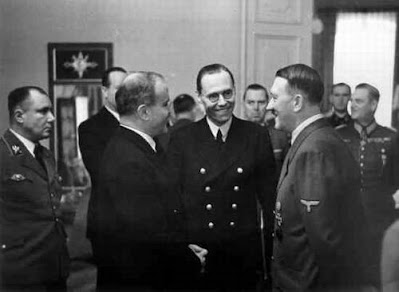
Back to the future: Vyacheslav Molotov with Adolf Hitler.
'So, which part of Poland can we have?' - Molotov, left, with Hitler.
The same, however, cannot be said for the former Soviet Union Foreign Minister Vyacheslav Molotov. Below is a speech he made in Paris on 10 October 1946, on the policy of ‘equal opportunity’ or the ‘open world’ economy that was beginning to take shape in the West. 

Considering how things have panned out in the 60-plus years since he uttered these words, you would have to say he wasn’t that far off the mark on much of what he foresaw here. Of course, depending on where you’re coming from, this ‘equal opportunity’ that Molotov feared is either good or bad. 

Like most things, it’s probably a mixture of both. Right now many of the ‘liberated’ former Soviet states are probably quite happy to be in bed with, so to speak, the USA rather than Russia. There might come a time, though, when that stance will change. Whatever the case may be, you can make up your own mind on what ‘Prophet’ Molotov had to say:

“We know that the United States made a very great effort in this war, in defence of its own interests and of our common aims, for which we are all grateful to that country. But for all that, it cannot be said that the United States is one of those states which suffered grave material damage in the Second World War, which were ruined and weakened in this war. We are glad that this did not happen to our ally, although we ourselves have had to go through trying times, the consequences of which will take us long years to heal.

Now that you know the facts, place side-by-side Romania, enfeebled by the war, or Yugoslavia, ruined by the German and Italian fascists, and the United States of America, whose wealth has grown immensely during the war, and you will clearly see what the implementation of the principle of ‘equal opportunity’ would mean in practice. Imagine, under these circumstances, that in this same Romania or Yugoslavia or in some other war-weakened state, you have this so-called ‘equal opportunity’ for, let us say, American capital – that is, the opportunity for it to penetrate unhindered into Romanian industry or Yugoslav industry and so forth: what, then, will remain of Romania’s national industry, or of Yugoslavia’s national industry?

It is surely not so difficult to understand that if American capital were given a free hand in the small states ruined and enfeebled by the war, as the advocates of the principle of ‘equal opportunity’ desire, American capital would buy up the local industries, appropriate the more attractive Romanian, Yugoslav and all other enterprises and would become the master in these small states. Given such a situation, we would probably live to see the day when in your own country, on switching on the radio, you would be hearing not so much your own language as one American gramophone record after another or some piece or other of British propaganda. 

The time might come when in your own country, on going to the cinema, you would be seeing American films sold for foreign consumption – and not those of better quality, but those manufactured in greater quantity and circulated and imposed abroad by the agents of powerful firms and cinema companies which have grown particularly rich during the war.

Back to the future: A shot of a typical day's offering at the cinema in Colombia — Hollywood top-heavy.
'Eh, Minister Molotov, let's give the cinema a miss today.'
Can anyone really fail to see that if, as a result of the application of the principle of so-called ‘equal opportunity’ in small states, unrestricted competition begins between the home products and the products poured out by the factories of the United States or Great Britain, nothing will remain of the sovereignty and independence of these states, especially considering the post-war conditions? Is it not clear that such unrestricted application of the principle of ‘equal opportunity’ in the given conditions would in practice mean the veritable economic enslavement of the small states and their subjugation to the rule and arbitrary will of strong and enriched foreign firms, banks and industrial companies? 

Is it not clear that if such ‘principles of equality’ are applied in international economic life, the smaller states will be governed by the orders, injunctions and instructions of strong foreign trusts and monopolies? Was this what we fought for when we battled the fascist invaders, the Hitlerite and Japanese imperialists?”

Well there you go. A visionary or what, eh?

__________________________
Speech taken from: McCauley, Martin, ‘Seminar Studies in History – The Origins of the Cold War’, PP 119-121, Longman, New York, 1990