Monday, 27 April 2015

And now for something a little bit different ...

This blog tends not to do blatant advertising, but there are exceptions to that from time to time. And when it’s for a fun and, um, worthy cause, you could say that it’s almost obligatory to do so.

And now for something a little bit different: IQuiz, The Bogotá Pub Quiz.
IQuiz Bogotá: Coming to a The Pub venue near you soon!

You see, a few months back I had to make a ‘dash’ home to Ireland for a family event. While there, I had the pleasure of going to a good old pub table quiz, a regular event back in the old country (it’s why the Irish are so knowledgeable!). Having been based in Bogotá for well over three years now, I’d almost forgotten about such simple delights.

So with a bit of pep in my step on my return to Colombia, I decided to look into having a quiz night here. And after a few weeks of planning, having found a willing, able partner in my good Dutch friend and an obliging venue, the Irish-styled The Pub, we’re set to go with our first ‘grand table quiz night’ this Wednesday 29 April. (This inaugural one takes place in The Pub’s Zona T headquarters.)

For the uninitiated, the format is quite simple. Teams from four to six people, eight rounds of ten questions quizzing you on a range of topics in a mixture of audio, verbal and picture formats. All you have to do is try to answer correctly (and honestly; leave the smartphones in your pocket) as many as you can. The winning team wins some excellent prizes courtesy of the venue and our sponsors.

If you’re still not that sure about it, our promotional video (below) should see you right. It’s open to all, so we hope to see you there!


Follow IQuiz Bogotá on Twitter and like us on Facebook.

Saturday, 18 April 2015

Forlorn Falcao

You have to admire, in some ways, Colombian patriotism. Among each other, they may bad mouth their country and criticise its many ills, but when it comes to outside 'attacks' they seem pretty good at closing ranks and rallying behind Colombia's cause, whatever that might be.

Forlorn Falcao: Falcao looks all but certain to say 'adiós' to Old Trafford in the summer.
Falcao: Time to say goodbye to Manchester United? (Photo from Facebook.)
This is especially the case in the sporting arena. In last summer's Fifa World Cup, for example, the nation focused its wrath on the Spanish referee who 'robbed' Colombia's football heroes of what would have been a historic semi-final spot. Not much, however, was said of the rather timid first-half display from a team that up to that point had set the tournament alight.

Of course, Colombia made it to the last eight without the man who had been their talisman in qualifying for the tournament, a certain Señor Radamel Falcao. As we all know, a new star and national, nay international, hero announced himself on the world stage at Brazil 2014, James Rodríguez. But much adored as he is, Falcao is still hugely respected and revered here.

So Colombian pride has been hurt by the way he has been treated at his loan club this season, Manchester United. The Dutchman at the helm at Old Trafford, Louis Van Gaal, is very much the villain in these parts. And if Colombians needed justification for such a view, they got it recently from none other than the great Diego Maradona, who on a visit to Bogotá called Van Gaal 'the devil'. A strong endorsement that. A united Latino front or more a case, perhaps, of the crafty Argentinian playing to the gallery.

But the English club's manager may not be the one in the wrong here, if anyone is at fault at all.

OK, it can be argued with good reason that Falcao hasn't been given sufficient opportunities to prove himself in Manchester. Game time has been limited, even when he has been fit to play.

Maradona, strutting his stuff in Bogotá recently and standing up for Falcao against "the devil" Louis Van Gaal.
Diego Maradona: Who ate all the pies? (Photo credit: Amy Farrell.)
Yet, of the chances he did get to show us his undoubted quality, the latest coming in the recent league defeat at Chelsea, he hasn't been that impressive, to say the least. What's more, United have found a system and — more importantly — winning form without him. For a manager who was under the cosh just a few months ago, with the non-deployment of Falcao a regular stick to beat him with, Van Gaal now has solid results to throw back at his critics.

For sure, it appears the relationship between the striker and gaffer isn't great and at times it seemed like Van Gaal wasn't playing the Colombian purely out of stubbornness. Whether that's the case or not, you can't find too much fault with the manager's selection of late (the Chelsea game excepted); and the reality is that Falcao is, at this moment in time anyway, a bit part in the United revival.

The goals he recently netted on international duty show he still has his predatory instincts, while they also added more fuel to Colombian annoyance at how he is being treated in England. Although scoring against Bahrain and Kuwait in friendly fixtures isn’t the greatest yardstick on which to judge a top-class striker.

At this remove, it's unlikely he'll hang around Manchester once this current loan spell expires at the end of the season. The best move for all concerned, you'd have to think.

A trip back to club football on the European continent, after what both he and Colombia will hope to be a successful Copa América, might be just what El Tigre needs to rediscover his mojo.

Tuesday, 14 April 2015

With O'Leary in Bogotá

It’s pretty much well known that the Irish are migrants. Coming from a small island, yet at the same time close to a host of the world’s old superpowers, it was pretty much inevitable that we’d wander outside our shores to see ‘what’s out there’.

With O'Leary in Bogotá: General Daniel Florence O'Leary's bust in Bogotá D.C., flanked by guys from Roscommon and Louth.
The Irish-Colombians: O'Leary still stands the tallest though.
Indeed, in the early days of Ireland’s human history, its inhabitants took on the role of travellers with gusto, regularly raiding the neighbouring island of Britain. 

Subsequent generations would pay a hefty price for such daring. But before total British interference, in our early Christian days, our brightest and best traversed the European continent in what you might call an Irish-Christian educational enlightenment.

Subjugation to our English neighbours didn’t change that; the only difference was that emigration wasn’t seen as a choice for many, but more of a necessity. 

It meant the masses went on the move, rather than just the privileged few. And for most of those early movers to the 'New World', leaving the homeland didn't guarantee any great improvement in conditions. It would be a few generations down the line before those of Irish descent started being treated as equals with their superiors.

However, some of those who left did find instant success, or at least had a big influence in their new abodes.

In South America, that tended to manifest itself in the military sphere. For one, you had Admiral William Brown, the County Mayo man regarded as the father of the Argentinian navy. 

On the other side of the Andes there was Bernardo O'Higgins, Chile's founding father and the bastard child of a County Sligo man. The signs of that Irish interaction, and others, can be seen today in street names and the like across Argentina and Chile.

Yet, one place where the Gaels didn't seem, at least I had thought, to leave a mark was in the north of South America. OK, a few Irish lads had a recent, less than positive run in with Colombian officialdom in the early part of this century, but that was about the height of links between Ireland and the land that is now called the Republic of Colombia I'd known about.

General Daniel Florence O'Leary: Somewhat of a trailblazer for the Irish in Colombia?
Irish charm: A dapper, young O'Leary. (Image from wikimedia.)
'There's always one', though, and that more positive association comes in the face of a Mr Daniel Florence O'Leary. The County Cork-born general was an aide-de-camp under the great liberator (that's a loaded title) from Spanish rule of these parts, Simón Bolívar.

In his later years, as a historian and diplomat, he wrote important memoirs documenting what was a landmark period in South American history. He also played a part in securing Venezuelan independence from what had been Gran Colombia.

In between all that, he found the time to father nine children; that might help to explain the odd few ginger-haired Colombians knocking about.* (Now, while this writer hopes to leave a positive mark on Colombia, replicating the reproductive exploits of O'Leary isn't part of that; not right now anyway.)

It's fair to say that he doesn't get the same recognition in Colombia as his aforementioned contemporaries in Argentina and Chile — perhaps for valid reasons — but there is, at least, a bust honouring him in a Bogotá city park. He did, after all, breathe his last breaths here, as well as leaving a decent gene legacy. (For the record, his remains lie in Venezuela’s National Pantheon.)

That’s something the rest of us Irish in Colombia, 127 at the last official count, will do well to emulate. Perhaps in time, though, a bust of ‘Wrong Way’ will be erected in La Perseverancia?
__________________________________
*If anyone knows of living descendants of Daniel O’Leary, it would be much appreciated if you could let us know here.

A special thanks to the staff at Bogotá's Instituto Distrital de Patrimonio Cultural for providing me with valuable information.

Monday, 6 April 2015

Corrupt Colombia

There’s an old, but still seemingly very relevant, joke that does the rounds in Colombia. It goes something like this:
Corrupt Colombia: Bogotá — it might look well from the air, but there are plenty of problems within. One of the biggest of those is corruption.
'Eh, where's that bridge?' (Photo: Pieter Hupkes.)
A prominent Colombian politician is invited to a major Canadian (insert any First World country here) city by its mayor. 

On arrival, the visiting official is transported in style to the mayor’s residence – an impressive, three-storey mansion hidden away on the outskirts of the city. The esteemed guest is treated to a grand meal served with the finest of cutlery in splendid surroundings.

Somewhat amazed at all the luxury on display, the Colombian politician asks his host where he got all the money to finance such opulence. 

The Canadian invites his visitor to the balcony: “You see that bridge over there” the mayor says, pointing to a spectacular construction spanning a nearby river, “well 10 per cent of the cost of that is in my pocket.” The Colombian nods appreciatively.

A year later, the favour is returned, with the Canadian mayor invited to the Colombian politician’s homeplace. 

Not expecting much, the North American is pleasantly surprised to be picked up from the airport in a top-of-the-range, German stretch limo and transported to a quite stunning, castle-like residence. In the wining and dining department, no expense is spared.

Puzzled as to how this developing world politician could afford all that was on show, the mayor quizzes the Colombian about it. 

The host escorts his guest to the top-floor viewing deck and tells him to look out at the bridge down in the city below. The visitor looks hard for a time, then turns and in bemusement says, “But I can’t see anything.” “Well, you see,” the Colombian informs his new friend, “100 per cent of the cost of that ‘bridge’ is in my pocket.”

So there you have it. A case of, you might say, ‘all politicians are corrupt, but some are more corrupt than others.’ 

This is generally how most Colombians view those pulling the strings in this country. And, considering all that has happened and continues to happen here, such as the apparently ubiquitous phantom public projects highlighted in the 'joke', you couldn’t blame them.

Now, I must state that previously I’d been impressed with how Colombian courts dealt with those found guilty of corruption. 

For example, last year you had a former agriculture minister, Andrés Felipe Arias, sentenced to 17 years imprisonment and fined some 12 million euro for embezzlement. (Ireland, take note; although do note said minister is still 'enjoying' his freedom on the run in the USA.)
'Power corrupts; absolute power corrupts absolutely.' Throw in money and those greedy for it, and you've got a very toxic mix.
Briefcase politics: Still going strong in Colombia. (Photo: dw.de.)
However, in light of recent scandals, it appears that even some of the watchdogs, that is to say the courts and their top judges, are not free of the ‘briefcase influence’. Thus, the justice system has now been called into question.

In a country with a number of under-the-counter, illegitimate businesses on the go, many of those linked to powerful, illegal drug lords, that corruption seems to be endemic perhaps isn’t too surprising. Money is rather vociferous in these parts, regardless of where it comes from.

Yes, there are, at least at face value, genuine forces working to try and combat this culture. The task at hand, though, is monumental.*

Plus, considering it's difficult to know who exactly is straight, it begs the question, 'Who can you trust?' 'Not many' is the most prudent answer.
______________________________________
*For a previous piece giving an example of Colombian double standards, see Soft touch Colombia.

Friday, 27 March 2015

Honouring honesty

A friend asked me the other day, 'What makes you angry the most?' I chewed on it for a while and spat out a few things. There was, though, a common thread to them all: People not being honest. For I believe that I am, largely speaking, an honest person and I expect others to be the same with me.
Honouring honesty, Benjamin Franklin: 'Honesty is the best policy.' Was he right?
Benjamin Franklin: 'Honesty is the best policy.' (Image from FB.)
It’s pretty accurate to say that you’ll find dishonesty at the root of most grievances people have with each other. This is especially so when it comes to relationship affairs (or non-affairs as they often are) and areas related to work.

The truth tends to out at some stage, so isn't it best to run with it from the get-go?

Take a potentially budding relationship, or budding in the eyes of one side anyway, as an example. If you're the non-interested party, say it. Don't string the thing along when you've no genuine interest in it.

Now, one positive angle such carry-on could be viewed from is that there's a fear in the unenthusiastic one of hurting the other's feelings. And with today's modern communication means, being a virtual friend without ever truly engaging has never been easier. So a 'friend game' can be played and maintained for some time.

However, it will come to a head, this being more so the case if a romantic notion of where things were going existed in the 'injured' party.

Plus, the more negative view is that people who engage in this behaviour are doing so for wholly selfish reasons: Keeping their options open, looking for attention, a feeling that they only need to click their fingers, or more precisely touch their keypads, in order to bring somebody back into their sphere of influence, these are the kind of things we're talking about here.

It's something I've witnessed and experienced with women in this part of the world with worrying regularity — but, of course, it's not exclusive to here (I’ve just personally engaged with Colombianas more than others in recent years).

Outside of relationships, practising a bit of diplomacy, or being economical with the truth, can have its benefits. Indeed, in some scenarios, if just for a time, it may be the best course of action.

But saying yes when you really mean no or you haven't a clue, can't be condoned.

Take this example from one of Colombia's telecommunications providers, ETB. The company, for months, continuously promised one of its customers a higher-speed internet connection. Eventually, after a lot of time wasted, the customer was told that this couldn't actually be provided.

Granted, there are a few issues at play in the realms of customer service, or lack of service as it is, and dishonesty may not be the biggest culprit.
Honesty: It can be tough to deal with.
The truth can hurt, or at least shock. (From reddit.com.)
Yet, effectively you had people saying yes to something when in reality they didn't know what the situation was.

In a Colombian context, a local friend here described it as 'appeasing out of fear in what is an insecure nation.' And it comes from the top, down. There's a belief that if you tell people what you think they want to hear, it makes things all the better. Of course, in the long run, it usually has the opposite effect.

It's not for nothing the saying 'honesty is the best policy' came into being. It does, however, appear easier to utter than put into practice for some people.

Sunday, 15 March 2015

'Celebrating' Ireland

Oh no! Here it comes again. Yes, it’s that semi-awkward time of year for all Irish-born people; St Patrick's Day (17 March), our national holiday.

'Celebrating' Ireland: Green is the colour for St Patrick's Day.
Time to get the silly leprechaun hats out. (Image from Tourism Ireland.)
You see most Irish, from my experiences anyway, tend not to get too excited about things; we prefer to leave the fanfare and hyperbole to the Yanks, it’s what they’re good at. So when you have a day to celebrate all that's, um, good about our island and its people, things can get uncomfortable.

How do we normally cope? Well, in not untypical fashion, drink alcohol-containing liquids and grin and bear it.

For in some quarters, which I kind of go along with, there's a feeling that events seem to have got a little bit out of hand, thanks in no small part to those aforementioned, flamboyant North Americans.

Now, of course, for as long as I can remember and since I commenced downing the odd tipple whilst socialising, beer has always been part of this day.

Growing up in rural Ireland, you may have got a token parade in the local town, although it wasn't always a given, and perhaps some Irish football (or hurling) game (not soccer, American football nor rugby that is, we’re talking Irish football) to provide other entertainment. All very tame stuff really.

Also, in my early adolescent days and before, a trip to mass was obligatory. It is, after all, a feast day commemorating the man who supposedly brought Christianity to Ireland; a Welshman at that. (You could say it's like Colombians venerating someone born in Venezuela. What's that? They do?!) Thus, at its root, it's a Christian church — both Protestant and Catholic — holiday.

Nowadays, though, in a more multicultural and, thankfully, somewhat inclusive Ireland, the day has broadened to become a festival of all things Irish, much less tied to religion.

Plus, a modern, confident Ireland — the current economic problems notwithstanding — has upped the ante in terms of how it's honoured. There’s a little bit more glitz involved now. And it’s not even just a one-day celebration any more; you’ve got a week-long festival in many of the country’s bigger urban centres. ‘Hey, there's money to be made from them there tourists!’

Downing a pint of Guinness on St Patrick's Day ...
Guinness time ... (Photo from Tourism Ireland.)
On the other hand, a Bogotá St Patrick's Day, personally speaking and unsurprisingly, adheres to the more traditional, low-key affair i.e. it goes off without much fuss. A good reason for this is that not too many are aware of it; you wouldn’t expect them to be in any case. The Irish ‘Empire’ has its limits.

For the uninitiated, a trip to one of the 'Irish' pubs is a must, surrounded by some 'Plastic Paddy' types. However, for the Irish friends I have here, of the rare occasions such establishments are visited, this is the least likely day to find them (and me) there.

It’s more likely to be spent in a neutral location, with, hopefully, a can of Guinness or two if they can be sourced (something that has become harder to do in Bogotá these days), drinking to the day and badmouthing any silly gimmickry in its honour we witness.

So in a sense, like most other days; we just have an extra excuse to get merry.

Wednesday, 4 March 2015

Promoting Ireland

'Ireland; a great little country, if only you could put a roof over it.'

It's difficult to go against that comedic summation of my homeland. Actually, you could add to it and suggest the construction of a few massive wind barriers as well.

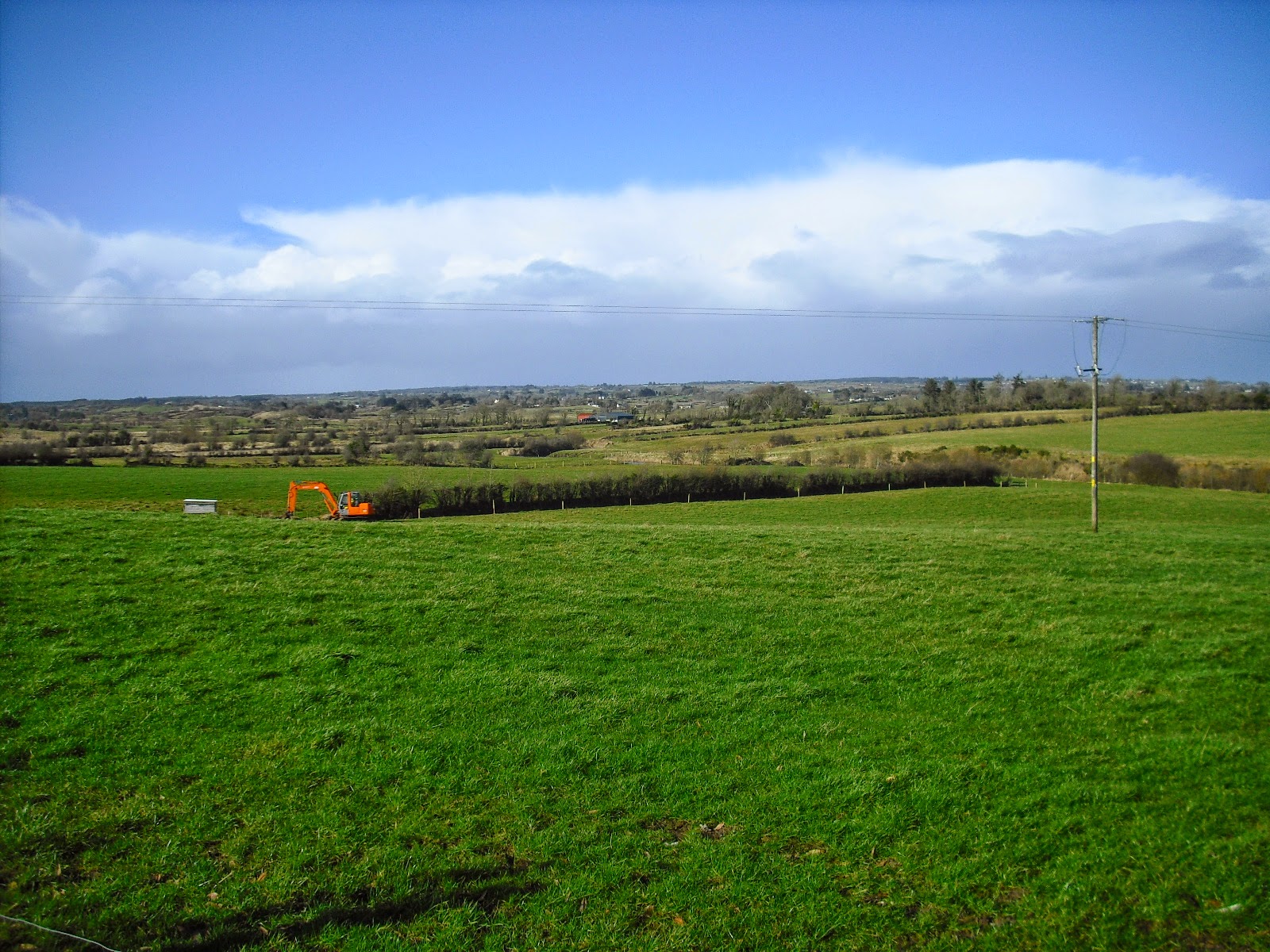
Promoting Ireland: A view inland from Keel Strand, Achill Island, Co. Mayo, Ireland.
Ireland's practically ever-present cloud. It does let up every now and again, though. Really, it does.
You see there's a good reason it's dubbed 'The Emerald Isle'. There are plenty of, picturesque, rolling green hills that give it a sparkling look, especially when viewed from above. That's if you could actually see the land beneath the practically perpetual, thick, grey rain clouds that smother the place.

Therein lies the Irish problem; the dull, wet weather. If it was pulled a thousand miles further south, you could be talking about one of the world's greatest tourist spots. But then again, there's the risk it'd lose a bit of that greenness; the land that is anyway, whatever about the people (well, we'd get a little redder for one).

Blue skies in Creevy, Lisacul, Co Roscommon.
Irish weather: Four seasons in one day (more or less) ...
Plus, an Ireland with nicer weather might tone down that fine Irish cynicism; what a terrible shame that would be for the world.

Now, needless to say, it's not always raining here (I write from ‘home’, in case you’re wondering). The odd few visitors get lucky with the sun coming out to play. Predicting when that's going to happen, though, is anyone's guess.

Winter wonderland, in spring: Creevy, Lisacul, Co Roscommon.
... from green to white, and back to green again.
As an Irish expat living in Colombia, I do, on occasions, try and talk up Ireland as a go-to destination. With a rising middle class (so it goes anyway) more Colombians are taking foreign holidays. Although you’d have to say that promoting other locations when in Colombia seems a little pointless considering the extent of its own natural beauty.

It more or less has everything in one neat package, save for violent storms. These can be good to experience every now and again, from a safe perch of course. Do note we’re talking weather-related ones, not the human emotional variety you regularly get from some Latinas.

Yet, even if my talking up of Ireland raises the interest of a visit from Colombians, as it sometimes does, the practicalities of doing so make the reality of it happening less likely.

We're talking visa issues here. The hassle of having to go through the process of applying for a separate one, separate from other European countries and the UK that is, pretty much extinguishes any enthusiasm to make Ireland part of a European holiday.

OK, with a UK visa they can visit the north-eastern part of the island, the part that is not the Republic of Ireland that is. And they could risk a run across the fluid border and more than likely get away with it. But why potentially jeopardise future travel by doing that?

A fine, creamy pint of Guinness at Gieltys Bar, Achill Island, Co. Mayo, Ireland.
If the weather fails, there's always Guinness ...
Now, the powers that be in London and Dublin have changed the rules of engagement as regards a common tourist visa for the two states. However, this little arrangement is limited to the Chinese and Indians — lucky guys. That's a bit unfair, no?

Considering all European citizens who travel to Colombia for tourism don't need to get a visa in advance — up to 90 days is given on arrival, with the option of getting another 90 after that — shouldn't the same apply for Colombians who visit Europe? (As pointed out in Soft touch Colombia, it could be argued that authorities are a little too generous in some aspects.)

So come on Ireland, take the lead, give a little more genuine substance to the motto of being 'the land of a thousand welcomes' and allow the country's doors to be opened more easily by many more.

'Open it and they will come.' Weather permitting.