Showing posts with label Chile. Show all posts

Friday, 18 March 2022

'We can do better on visas for Colombians' — Irish Deputy Prime Minister Leo Varadkar

@wwaycorrigan

Ireland's Deputy Prime Minister (Tánaiste), Leo Varadkar, has said he wants to make the visa process easier for Colombians who want to study and work in the country.

Ireland's Deputy Prime Minister Leo Varadkar wants to make travel to the country easier for Colombians.
Leo Varadkar at the Irish ambassador's residence in Bogotá, with Colombia's Vice President Marta Lucía Ramírez (top left).
Speaking at a St Patrick's Day reception at the Irish ambassador's residence in Bogotá, the Tánaiste stated that he would 'love to see more Colombian students coming to Ireland to study in our universities, to learn English, to work if they want to.'

However, he acknowledged that the current visa regulations are rather restrictive for Colombians compared to those from other South American countries such as Argentina and Brazil.

Following the signing of a Memorandum of Understanding with Colombia's Ministry for Education aimed at greater collaboration in higher education, Varadkar admitted that Ireland 'can do better' on visas but it is something he intends to address. 'Colombians need a visa to come to Ireland, (they) have to pay for that visa, that's not the case from a lot of other countries in Latin America, so that's something I'll try and improve or change and I've been in contact with Minister McEntee (Ireland's Minister for Justice) about that already.'

The Tánaiste, who also serves as Ireland's Minister for Enterprise, Trade and Employment, said that while trade between the two countries is small, 'there is scope for expansion'.

Deputy Prime Minister Varadkar officially opened Ireland's embassy in Bogotá this week, an office that began operating in 2019, the same year that Colombia opened an embassy in Dublin.

Before visiting Colombia, Varadkar was in Chile where Ireland also has a new embassy. During his stay in Santiago, he attended the inauguration of the country's new president, the leftist Gabriel Boric. 'Potentially, he represents a new generation of left-wing leaders in South America. Even though he comes from the student protests, the radical left, he has been very clear on Venezuela and Nicaragua. To a certain extent that gives me some encouragement,' Varadkar said of the Chilean president.

Click on the following link, https://youtu.be/3XgauTqKJOw (or see video below), to listen to the full interview with Leo Varadkar where he also speaks about Russia's war in Ukraine and the cocaine trade.
 _______________________________________________________________
Listen to Wrong Way's Colombia Cast podcast here.

Facebook: Wrong Way Corrigan — The Blog & IQuiz "The Bogotá Pub Quiz".


Sunday, 2 April 2017

Colombia's Venezuelans

In a similar fashion to our Bogotá 'bull' report a few weeks back, the following is the original script of our latest report for RTÉ's World Report, this time on the growing number of Venezuelans entering and staying in Colombia. You can listen to the report here (from 20' 55'', edited for time reasons) and follow the script below:
Colombia's Venezuelans: Puente internacional Simón Bolívar, Colombia-Venezuela.
Most of the traffic is coming into Colombia these days, not the other way around.

'We don't have to go too far back in history to find a time when some Colombians found refuge in neighbouring Venezuela, to escape the terrible bloodshed and uncertainty back home. 

Politically speaking, before Hugo Chávez's Socialism for the 21st century took hold in Venezuela, the two countries were quite similar. The difference was Colombia was seen as a violent backwater best avoided, while Venezuela, from a Western, capitalist perspective in any case, was a model for the rest of Latin America to follow.

It's not stretching it to say that now we have the reverse situation: Colombia's external image seems to get brighter by the day while Venezuela's plummets.

In Venezuela's pre-socialist days, so it is said, 'la Colombiana' was the one who came to clean the house of the well-off, the one who worked in the bakeries and bars, the work many locals felt was beneath them. 

Now it's the Venezuelans — men, women and children — who are crossing the border in their thousands to work in whatever they can find in Colombia. Chronic food and medical shortages, hyper-inflation and safety concerns, alongside a seemingly incompetent government to deal with these issues are what have them leaving in droves.

How many have actually relocated here is difficult to measure exactly. This is simply because on a daily basis the toing and froing of Venezuelans into Colombia, and vice versa, all along the over 2000 kilometre-long land border has been constant and not tightly regulated. [This is when the border hasn't been closed by order of Venezuelan president Nicolás Maduro that is, as has happened on occasions over the last couple of years.]

The United Nations Refugee Agency in Bogotá does state that there has been "a notable increase of Venezuelan nationals coming to and remaining in Colombia." 

From an official viewpoint, however, it acknowledges the figures it works off from Colombian immigration are not terribly accurate and more than likely underestimate the volume.

Alongside the informal, unregistered crossings, the agency points to the lack of data on Venezuelan nationals remaining in Colombia as well as the fact that official asylum claims are quite low as this process in Colombia is somewhat cumbersome.

Notwithstanding the difficulties of getting an accurate figure, Daniel Pages of the Association of Venezuelans in Colombia estimates that between legals and illegals there are over 1.2 million of his countrymen currently in Colombia. 

The association itself, set up five years ago to provide assistance for Venezuelans looking to live and work legally in Colombia, has now over 15,000 people on its books.

Alongside the estimated numbers, Colombians themselves are quick to tell you that the Venezuelan accent is being heard much more of late than had been the case just a couple of years ago. And we're not talking here about illegal border intrusions into Colombia by Venezuelan military personnel, which caused a stir recently, damaging further official relations between the two republics.

No, this isn't just temporary border-hopping; Venezuelans are travelling as far into Colombia as Bogotá to set up shop.

A visit to any of the capital's bog-standard bread shops or restaurants and it's a safe bet that there'll be at least one Venezuelan working there.

The problem, as some locals see it, is that these unregistered foreign workers are taking potential jobs from the many hard-pressed Colombians in need of employment. 

As store owner Laura Lancheros puts it: "Many of these unregistered Venezuelans coming here are willing to work for anything, so for some employers they're a good option because there's no real paperwork involved in hiring them."

Indeed, in Bogotá for one, there appears to be little sympathy for the plight of their neighbours. A lot of this stems from the Venezuelan government's decision to remove thousands of Colombian nationals from the country a couple of years back, the deported accused of being involved in paramilitary activities and other illegalities. 

President Maduro's almost daily jibes at Colombia also don't help, where he regularly accuses it as the source of many of his own country's problems.

Be that as it may, for the Venezuelans now living and working in Colombia, many are quick to distance themselves from what their government says and does.

What’s more, as 25-year-old Bogotá bread shop employee Angie Salcedo, who arrived here from her native eastern Venezuela earlier this year, points out: "Some Colombians would do well to remember the past. Venezuela was always welcoming to foreigners, but now that we're in trouble, we're not getting the same treatment from others. Not everybody is received with open arms."

A young, university-educated woman, Angie's story is typical of the Venezuelans flocking to Colombia: here illegally, engaged in unskilled work for barely the minimum wage.

Angie's co-worker, 22-year-old Yorkely Casanova, sees Colombia as just a temporary stopover. Like other Venezuelans, she has her eyes set on Chile as the process to become a legal worker there is shorter, more straightforward and less expensive than Colombia.

For the moment she, along with her husband, are working 12-hour plus days for no more than 10 US dollars a day to save money for that journey further south.

It's far from ideal, but as Yorkely sadly notes, it's better than being in Venezuela right now.'
_______________________________________
Facebook: Wrong Way Corrigan - The Blog & IQuiz "The Bogotá Pub Quiz".

Thursday, 26 May 2016

Crazy Copa América

It's fair enough to assume that most of us like at least a little stability in our lives. The comfort of knowing, barring absolute disasters, that you can rely on certain things.

Crazy Copa América: The stars expected to light up Copa América Centenario USA 2016 ...
Copa América: Embracing its unpredictability. (Image from Facebook.)
Even in the world of sport where stability, nay predictability, might not be what we always want, we do have certain bankers. 

You know, like in rugby where the All Blacks always win and in football where you can never write off the Germans. Sticking with the round-ball game — but something that is pretty much true of most sport — you also have the regularity of its main tournaments. The World Cup comes every four years, the same with the European Championships, on the even-numbered years between the global contest, as in this year.

Yet, as tends to be the wont in South America for many things, the Copa América arrives at any old time. It doesn't appear, or at least hasn't heretofore, to follow any plan. Well, if it does, it's not a straightforward one. (Maybe they're right on this one?)

Fair enough, this year's renewal, hot on the heels of Chile 2015, is marking the competition's centenary. Yet, it's not even being played on South American soil. No, it's taking place in the grand old US of A. 

At least it means that none of the Conmebol teams will have home advantage; but the USA will. It wouldn't exactly be the best of etiquette to throw a party in somebody else's gaff without inviting them, now would it?

Indeed, the venue choice has raised eyebrows among some of the participants, with Uruguay manager Óscar Washington Tabárez questioning the United States' suitability on this occasion, especially as games are going to be played all over the vast nation. His side, for example, will be travelling from west (Glendale) to east (Philadelphia) and back west (Santa Clara) again for their three group matches.

Whatever about the merits of this edition — the inclusion of six invitees, namely Costa Rica, Haiti, Jamaica, Mexico, Panama and hosts US, could be seen as weakening its credibility further — there is still a 'copa' to be won.

Looking at it from adopted-Colombian eyes, the competition gives José Pékerman's selection the opportunity to continue their unbeaten ways in competitive matches, having won two on the bounce in the World Cup qualifiers. It also represents a chance to erase the memories of a rather mediocre showing 12 months ago.

La Selección Colombia: How far can they go at Copa América Centenario USA 2016?
How far can Colombia go in the Copa this year? (Picture from Facebook.)
Their game with the United States on 03 June gets the tournament under way. Home advantage is usually a big help in the Copa América, but considering it is not the States' 'baby' so to speak, Colombia might be just that little more up for it (although the bookmakers, perhaps tellingly, see it differently).

A result in that one could set them up for a bit of a run, as Paraguay should be dispatched and Costa Rica, as one of the invited nations, mightn't be overly pushed. Yet making positive predictions about Colombia, as last year showed, is risky business.

That aside, it's likely the winner will come from one of South America's heavyweights. Take your pick from Argentina, Brazil, Chile or Uruguay (yep, we're going all out there). We'll be, um, 'patriotic' and include Colombia as well, but with a semi-final against Argentina, Chile or Uruguay on the cards should they get that far, making the decider might be just beyond them.

But hey, whatever the outcome, at least the Colombian team will have a few weeks in what is a second home for most of their fellow countrymen. Plus, there's always another Copa not too far away.
_________________________________________
Facebook: Wrong Way Corrigan - The Blog & IQuiz "The Bogotá Pub Quiz".

Tuesday, 9 June 2015

Colombia's Copa?

With the club season, both domestically in Colombia and abroad, put to bed, attention on this side of the world turns to the Copa América.

Chile provides what will be, um, the chilly venue for this year's renewal. The winter weather apart, there are solid reasons for Colombian football followers to feel warm inside ahead of the tournament. Indeed, it could be argued that things have never been better for La Selección.

Radamel Falcao scores his latest national goal against Costa Rica, ahead of the start of Copa América 2015.
Falcao: The Colombian captain has been at his best in the national jersey. (Photo: Facebook.)
Last year, they had their best-ever run at a World Cup, unluckily and controversially losing out to hosts Brazil at the quarter-final stage. The painful manner of that defeat aside, the second-half performance together with the previous four games did prove that Colombia can go toe to toe with the global superpowers. This is reflected in the Fifa (don't snigger) world rankings, where the side remains in fourth spot, with third-placed Argentina the only South American side above them.

Plus, with the proven quality players they have at their disposal, José Pékerman's side have the potential to go far. You also have the Radamel Falcao factor, who will be keen to put a disappointing loan spell at Manchester United behind him; there's a belief in some quarters that back in the comfort of the national set-up, El Tigre will be a far more potent animal than what we saw in England.

Even if he's not, his presence around the squad is only beneficial for what is already a confident, tight-knit group. (For the record, he did score the only goal in Colombia's recent friendly win over Costa Rica and looked relatively sharp.)

To keep that confidence high, a good start will be key. Yet the opener, a tussle with Venezuela, is far from straightforward. Remember, Colombia only took one point from six off their neighbours during their last meetings in the South American World Cup 2014 qualifiers. But the fact that Colombia made it to the finals while Venezuela watched from the sidelines should mean that the former is a much stronger proposition this time around.

A mouthwatering 'revenge' clash with Brazil also awaits in the group stages. However, it could be said that Colombia missed the boat 12 months ago to get one over the five-time World Cup winners. It's unlikely Dunga's men will be as fragile this time around.

Winners alright! The 2001 Colombian side that won the Copa América on home soil ...
Is Colombia's 2015 edition good enough to replicate the 2001 heroes? (Photo Facebook.)
Peru completes the group and while nothing can be taken for granted, Colombia should be taking three points from that game.

In any case, the way the draw is, finishing second in the group may not be such a bad thing as the likes of tournament favourites Argentina and perennial winners Uruguay could be avoided until the final, if Colombia were to get that far. On the flip side, a potential semi-final battle with hosts Chile would be no gimme, to say the least. But if you want to be the best you've got to beat the best and all that.

It certainly promises to be an intriguing three weeks of football, with at least five teams that can be considered as genuine contenders to lift the trophy on 4th July.

Whether Colombia can emerge as South America's top dog, we'll have to wait and see. It's time to let the football do the talking.

Tuesday, 14 April 2015

With O'Leary in Bogotá

It’s pretty much well known that the Irish are migrants. Coming from a small island, yet at the same time close to a host of the world’s old superpowers, it was pretty much inevitable that we’d wander outside our shores to see ‘what’s out there’.

With O'Leary in Bogotá: General Daniel Florence O'Leary's bust in Bogotá D.C., flanked by guys from Roscommon and Louth.
The Irish-Colombians: O'Leary still stands the tallest though.
Indeed, in the early days of Ireland’s human history, its inhabitants took on the role of travellers with gusto, regularly raiding the neighbouring island of Britain. 

Subsequent generations would pay a hefty price for such daring. But before total British interference, in our early Christian days, our brightest and best traversed the European continent in what you might call an Irish-Christian educational enlightenment.

Subjugation to our English neighbours didn’t change that; the only difference was that emigration wasn’t seen as a choice for many, but more of a necessity. 

It meant the masses went on the move, rather than just the privileged few. And for most of those early movers to the 'New World', leaving the homeland didn't guarantee any great improvement in conditions. It would be a few generations down the line before those of Irish descent started being treated as equals with their superiors.

However, some of those who left did find instant success, or at least had a big influence in their new abodes.

In South America, that tended to manifest itself in the military sphere. For one, you had Admiral William Brown, the County Mayo man regarded as the father of the Argentinian navy. 

On the other side of the Andes there was Bernardo O'Higgins, Chile's founding father and the bastard child of a County Sligo man. The signs of that Irish interaction, and others, can be seen today in street names and the like across Argentina and Chile.

Yet, one place where the Gaels didn't seem, at least I had thought, to leave a mark was in the north of South America. OK, a few Irish lads had a recent, less than positive run in with Colombian officialdom in the early part of this century, but that was about the height of links between Ireland and the land that is now called the Republic of Colombia I'd known about.

General Daniel Florence O'Leary: Somewhat of a trailblazer for the Irish in Colombia?
Irish charm: A dapper, young O'Leary. (Image from wikimedia.)
'There's always one', though, and that more positive association comes in the face of a Mr Daniel Florence O'Leary. The County Cork-born general was an aide-de-camp under the great liberator (that's a loaded title) from Spanish rule of these parts, Simón Bolívar.

In his later years, as a historian and diplomat, he wrote important memoirs documenting what was a landmark period in South American history. He also played a part in securing Venezuelan independence from what had been Gran Colombia.

In between all that, he found the time to father nine children; that might help to explain the odd few ginger-haired Colombians knocking about.* (Now, while this writer hopes to leave a positive mark on Colombia, replicating the reproductive exploits of O'Leary isn't part of that; not right now anyway.)

It's fair to say that he doesn't get the same recognition in Colombia as his aforementioned contemporaries in Argentina and Chile — perhaps for valid reasons — but there is, at least, a bust honouring him in a Bogotá city park. He did, after all, breathe his last breaths here, as well as leaving a decent gene legacy. (For the record, his remains lie in Venezuela’s National Pantheon.)

That’s something the rest of us Irish in Colombia, 127 at the last official count, will do well to emulate. Perhaps in time, though, a bust of ‘Wrong Way’ will be erected in La Perseverancia?
__________________________________
*If anyone knows of living descendants of Daniel O’Leary, it would be much appreciated if you could let us know here.

A special thanks to the staff at Bogotá's Instituto Distrital de Patrimonio Cultural for providing me with valuable information.

Friday, 9 August 2013

San Gil: Taming Suárez

Our first visit, over two years ago, to what's seen as Colombia's adventure capital, San Gil, was very much a relaxed affair. On that occasion we had a thoroughly enjoyable time wandering about the rolling Santander countryside, which included taking in the quaint, period village of Barichara.
San Gil: Taming Suárez. San Gil, Santander, Colombia from the hilltops
San Gil from the hilltops.
This time around, with the help of a good Dutch mate, we cranked up the adrenaline levels a few notches and sampled some of the reasons why the place is renowned for its extreme side. 

This started with an afternoon of getting a brief taste of varied activities including canopying and rappel, amongst others. For the price we paid (45,000 COP, roughly €20), it wasn't a bad deal.

The main event, however, was a rafting 'sojourn' down the famed Río Suárez; rated by many as second only in South America to Chile’s Río Futaleufú for its wild rapids. 

We had been forewarned not to over-estimate our talents mastering this waterway and that perhaps the gentler Río Fonce would be safer, less taxing and thus more enjoyable for all concerned. 

We’d also been told that those selling the excursion mightn’t be too bothered about our abilities, or lack thereof, in such an activity – Suárez costs more to do, so why scare people off and miss out on more plata (cash that is)?

Added to this, the day we tackled Suárez coincided with it being, according to our guides, in one of its roughest moods so to speak.

Now, as oft mentioned here, our ability in water is about as good as a handicapped cat. Yet, this doesn’t translate into any big fear of doing various aqua sports, especially when we have the safety of a life-jacket tied tightly around us. 

So we approached this undertaking with relative calm. Throw in the fact that our four on-raft guides and accompanying canoeist where putting their minds/senses at ease with a particular substance before we even started – something they also did mid-way through and at the end – made us feel that this wasn’t anything to get too worked up about. Perhaps that was all part of their plan.
Getting ready to tackle Suárez; it looks easy from here
'This will be easy.'

We did, though, do some head-scratching when a luminous wristband containing an emergency services phone number was put around us before the off. We wager this was to be of help to some passerby in case they found our unconscious, battered body – ‘a one-step guide on what to do if you find human remains’, in a sense. 

It was, however, valid for just one day. Sure you can’t be bothering emergency services with cases more than a day old, can you?

That aside, after a brief dry-run through the various call instructions by our skipper, the real action got off to a steady start. Although, the lads’ persistent criticism of our rowing ability was a little annoying at times – they were lucky they didn’t get an oar in the head at a few stages.

In any case, a little further on we all had greater things to concern ourselves with than getting hit in the head by somebody, accidentally or on purpose. That’s because Suárez began to show its teeth. And that meant us taking a dip – well, it was more like being in a washing machine on its final spin, we imagine – on more than one occasion. 

It certainly got the heart racing – the key being just to go with the flow and hope you don’t smash your body on a rock.

Having gone over a number of times, it was with a little trepidation that we approached the infamous La Fantasma*, The Ghost, section of the river. 

This is a decent sized stretch with powerful rapids where if you were to fall out early on, you’d be waiting some time and would have encountered a few hefty rocks before you floated to calmer waters.
Working our way through 'La Fantasma'
Steady as she goes...

That our guides stopped to assess it before we went through and had the canoeist do a solo run also got us thinking: Should we pass on this one? 

We’d already had a good thrill, so why, quite literally, push the boat out further for something that looked like it could dangerously get the better of us? Heck, though, we’d gone this far, we might as well make the final push – get our money’s worth (you know how important that is to us).

If there was any doubt in our minds about how rough this part was, the sight of one of the guides blessing himself before we got going put it firmly into focus. His plea to the gods worked anyway. Well, maybe it was more a case of lots of luck mixed in with us working a bit better as a team that saw us through in one, whole piece.

So a few minor bumps and bruises apart and conveniently overlooking our earlier mishaps, we like to think we ‘tamed’ Suárez.

We certainly survived it anyway. Alas, there’s a lack of a T-shirt proudly proclaiming so.

_________________
*For a look of us in action on 'La Fantasma', see http://youtu.be/J6T_BDVucJk. And for one of our 'overboard' moments, see http://youtu.be/pTBK0qqCa_g.

**More information on rafting and other activities in San Gil can be found from ‘Adrenalina’ at www.adrenalinasangil.com or by emailing adrenalina.sangil@hotmail.com.

***One pleasant budget accommodation option in San Gil is Hostal Le Papillon, hostallepapillon@hotmail.com. They also organise tours and various adventure sports.

Sunday, 28 October 2012

'¿Por qué Colombia?'

One of the most popular questions we get thrown at us here by some of the locals when they realise we’ve been in the country for a bit is ¿Por qué Colombia?, ‘Why Colombia?’ 

Many are quick to suggest an answer themselves with ‘a girlfriend’. But no, that’s not the reason for us. 

In this land of ‘beautiful and plenty’ on the ladies' front – granted that many of them fall firmly into the crazy category even more so than the average woman (see ‘Colombia’s Locas’ http://bit.ly/XzHltA, amongst others) – we’ve yet to be overly enthused to commit to just one. A lot of that is really down to our honesty – and frugality – to be honest. 

For if we were to play it the Colombian men’s way we’d commit to a number of women at the same time – indeed, most of the girls here expect as much (you could, in a sense, equate this kind of behaviour as taking the "best bits" out of the Muslim and Christian religions). 

However, we’re just not in the commitment mood at this moment in time, full stop.
'¿Por qué Colombia?': A dull, overcast day in Bogotá
Bogotá has its charms. The weather, though, isn't usually one of them!

So then, why indeed Colombia? Well, sticking with the reasons why we didn’t come here, making sack-loads of money is one of them. There are plenty of other countries across the globe we could hit for – we think, anyway – where we could make and save much more money doing more or less the same thing. 

In terms of Bogotá specifically, our home for the best part of a year, we’re not here for the glorious weather and/or laid-back coastal lifestyle. The fact that we’re in a gas-guzzling construction-site of a city, with a population of about eight million, perched well inland at an altitude of over 2,600 metres accounts for that.

It would certainly be untrue to say, though, that we’re here against our will or wholly by accident. 

What is a fact, though, is what we’ve termed our second coming to South America, in June 2011, was aimed more at Chile than here. 

That was because we wanted to give ourselves a more concrete reason to return to this continent than just willy-nilly travelling and we found the grounds for that in signing up as a volunteer for an English media group in Santiago. 

Yet, tellingly enough, perhaps, we firstly spent two weeks in Bogotá and its surrounds before hitting overland for Chile. Now, that wasn’t just because it was far cheaper to fly here compared to Santiago – the chance to catch up with some friends from our first visit to Colombia (February 2009) was a much greater reason.

Cheap flights back to Ireland were, though, the biggest factor in our brief return to Colombia in October last year – a visit that was a more sobering experience of the country than previous ones, a few days in the company of a good friend in Cartagena excepted. 

That ‘sobering experience’ was our first taste of how crazy Colombian women can turn for no apparent reason – what we thought was a good friend aggressively blanking us from her life.
A quite stunning view from 'The Rock' Guatapé, a couple of hours' drive from Colombia's second city, Medellín
Landscape-wise, Colombia is up there with the best of them.
However, after a necessary four-week stop in the home country, back we came, like suckers for punishment in a see-what-happens approach. 

An initial spell of wandering around to less-visited spots in this physically stunning country with its amazing and diverse wildlife helped us get over that aforementioned ‘defriending’ by someone who had been a strong initial reason in tempting us back in the first place (she is part of our life once more, however – we can be quite forgiving and lenient at times).

It was always likely that we’d return to Bogotá – Colombia’s ‘city of opportunity’, the best place for a local or expat to find work. It wasn’t that we were really stuck and needed money but we figured we’d give living here a go for a bit. 

So after a slow, admittedly reluctant start, we did manage to find ourselves some steady, semi-profitable English teaching work (for more on this see ‘The Money Tongue’ http://bit.ly/V8ELH4). Not forgetting the odd bit of relatively enjoyable TV extras work – something different anyway (see ‘Giving just a little bit ‘Extra’’ http://bit.ly/NrbPc3) – a change being as good as a break.

After a while, though, like in any place, city living can become quite stale – even here in Bogotá. A lot of this is probably more to do with our own itchy-feet nature, especially when we have very few serious ties to a place and are relatively free. 

The return of a very good local friend to this city after a 12-month absence coupled with our already existing good friends here is making it harder for us to take flight once more. 

The Colombian authorities have also played their part – they make it pretty easy to stay on a mid- to long-term basis. If we had to put more effort and cost into staying here we might reconsider.
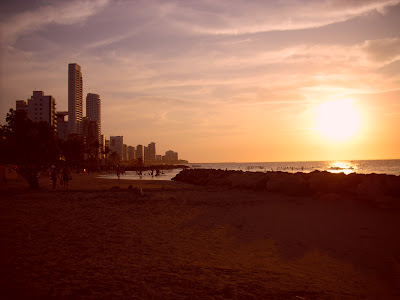
Sunset in the city of Cartagena, on Colombia's Caribbean coast
Is the sun setting on our time in Colombia?
There is, of course, much more to Colombia than Bogotá and while we have seen a fair bit of the country there are still many other places worth discovering. With the seasonal slow-down in teaching work upcoming that may give us the opportunity to get moving.

After that, perhaps our subconscious reasons for staying will abate somewhat and we’ll have less of a reluctance to leave? 

One thing is for sure, at this remove anyway, the Colombian tourist board's slogan of ‘the only risk is wanting to stay’ – be that subconsciously or not – is certainly ringing true. We just don’t really know why that is.

Sunday, 22 July 2012

Whose land is it anyway?

Independence Day celebrations are novel events for us here at Wrong Way. The fact that the freedom of our own island from colonial rule has never been achieved to the majority of our past liberators’ wishes means independence is an awkward subject for us Irish. 

So instead of a national day commemorating a political foundation, we celebrate our submission to Christianity – or what is commonly referred to as St Patrick’s Day. 

In the past year, though, we’ve been able to witness at first hand a couple of nations getting all patriotic and merry to mark their birth as free countries – Chile last 18 September and more recently Colombia on 20 July. 
Whose land is it anyway? Uniformed personnel engaged in military celebrations commemorating Colombia's independence
Independence Day celebrations in Bogotá, Colombia.
Both national days celebrate the defeat of the Spanish colonisers by, um, the previous Spanish colonisers. The kids grow up so fast, don’t they? The initial Spanish conquest was so successful that the indigenous populations they encountered were quite literally blown away by their new masters. 

These natives – well, those who remained – were reduced to mere silent and powerless spectators as the Old World invaders divvied up as their own what is Mother Nature’s earth. 

OK, there was some interbreeding between old natives and new settlers but for the indigenous that meant surrendering to the Spanish way of life – the opposite seldom occurred. Of course, this isn’t a unique story, the same happened in North America and in many colonised lands.

A Kogi Indian of Northern Colombia trekking through his territory in typical dress
The lesser-spotted Kogi Indians of Colombia.

Hence, we can only imagine that these Independence Day celebrations are met with, at the very least, indifference among the indigenous. It must be like having a party in your own house that not only you do not want but the organisers didn’t even invite you or ask for your permission to hold it. And then you’re left to clean up the mess. 

For some of the old natives – particularly the tribal indigenous – the country and its borders that is Colombia or Venezuela or wherever doesn’t even exist. They live in a world – or at least tried to – without man-made borders. (For a previous article related to this topic, see Phantom Freedom at: http://bit.ly/SOQUl0.)

This whole indigenous versus Latino question is very topical in Colombia at the moment. In the country’s south-western department of Cauca, where both the indigenous populations and the outlawed Farc are at their strongest, the old natives have taken it upon themselves to defend what they see as theirs. 

They claim that the presence of the Colombian military in the area – to "pacify" the region as far as the Government’s official line goes – only attracts more Farc attacks, which have been numerous in recent times. Their lack of confidence in the state’s security to adequately protect them is deeply rooted in history. 

Meanwhile, for many Spanish Colombians living in the big cities, their belief is that the indigenous are in the pocket of the Farc – the removal of the army will only serve to strengthen the rebels, no more, no less. There could, certainly, be some truth to that. But it’s quite arrogantly dismissive of the indigenous’ own, unique concerns. 

An aerial view of Machu Picchu - the famed Inca site in Peru's Cusco region
Life before the Spaniards — the Incas Machu Picchu in Peru.
Of course, any group of people that feels it is being mistreated is quick to point to the rights it believes it is entitled to. The indigenous in these parts have a strong case going back hundreds of years in this regard. But as we all should know, with rights come responsibilities. 

Too often, different minorities are quick to demand the former, yet fail to face up to the latter. For one, if you claim you don’t recognise a certain authority or state and thus will not be bound by its rules, it’s a little bit rich to be asking for benefits and assistance from said authority or state. 

In an Irish context, the IRA and Sinn Féin know all about that. Sometimes you just have to face up to the reality of a situation, no matter how disagreeable it may be for you.

As ever in such conflicts, and as alluded to above, the lack of trust in the motives of the other side is at the heart of the problem here. 

The gun, however, has rarely provided a long-term, satisfactory, solution. These Independence Day celebrations could be seen as proof of that.

Sunday, 6 May 2012

'Wrong Way' begins

We’re taking a bit of a step back in time this week. Below is a reproduction of an article we put together after returning from our first bout of travelling in 2009, when we were a little less cynical compared to now.

And while much has happened since it was penned, both personally and universally, you should find that the majority of what is expressed still holds true today. You could, in a sense, call it 'The Making of Wrong Way'.

“Our doubts are traitors and make us lose the good we often might win, by fearing to attempt.”

While I can't take credit for the above quotation, the plaudits there must go to the late American Nobel Peace Prize winner and activist Jane Addams, they are words, however, that have a deep resonance with me.

It was just over a year ago when I plucked up the courage and finally decided to 'take flight', leaving what was my comfort zone of this island.

It wasn't a decision that I took lightly, indeed I was procrastination personified before I eventually called Trailfinders and got the ball rolling so to speak. But once that was done, I purposely gave myself as little time as possible before R-Day (that’s 'Rio de Janeiro' day, in case you're wondering, my first port of call), so there could be little room for u-turns. Three weeks in fact was the time between booking my flights and hitting off.

'Wrong Way' begins: An aerial shot of Rio de Janeiro
Rio from a high - not a bad town.
It was enough time, nonetheless, to read a very apt article in The Sunday Times Magazine which opined that the hardest part about heading off on one's long-term travels — to clarify 'long term', what I mean here is an unspecified/indefinite period of travelling, as mine was — is closing the front door of your own house and hitting for that first airport.

Never truer words written, although I must admit it was my mother who closed the front door because it's not really my house, though it is home. Anyway, looking back at it now, I was a very nervous individual the morning I was escorted to Dublin airport. The fear of the unknown I suppose.

It was a deliberate choice, though, to go to a continent where I don't speak the language — well, not when I first arrived anyway. The destination of choice for most Irish people around my age is Australia, or at least it has been, but despite my fears about leaving Ireland on my own I was looking for somewhere slightly different for the first stage of my global adventure. 

(Although I must qualify this and say that if you're looking for a place free of fellow Irish people, from my experience, your best bet is the Moon or Mars because we certainly get around. Plans for 'Murphy's authentic Irish lunar pub experience' have hit a stumbling block for now, thankfully. Where's developer Sean Dunne when you need him? What? Bankrupt!)

Anyway, where were we? Ah yes, the trepidation of the unknown. Another part of the fear of leaving is, paradoxically, the fear of coming back — this oddity being, it appears, a particularly male phenomenon.

It's that bravado thing, when you tell your mates in the pub that 'I'm sick of this feckin' country of ours and I'm off, possibly never to return and ye're all stupid for staying around', while in the back of your mind you're wondering what are you doing leaving and how stupid you'll look when you return home after three weeks, if you last that long.

I did temper the possibility of that happening to me by telling friends and family that I could be back in three weeks, three months or three years. I didn't put any minimum count on how long I'd be gone for. Doing so could have come back to haunt me on my return to "the local". Anyway, I'm above such trivial stuff, am I not? That's why I only devoted a few lines to it, see.
An aerial shot of Peru's Machu Picchu.
Picture perfect - Machu Picchu.
That leaving fear, to move on, did just that, leaving me almost the minute I said goodbye to my sister and was left in Dublin airport to fend for myself.

However, I must admit I do have a fetish for the whole airport rough and tumble. I've just always liked the buzz of the place for some reason. Even by the time I reached Heathrow to get my flight to Rio, I was already walking with a swagger, enjoying my new-found freedom.

And while I say now, after the event, that had Baghdad been the first stop I would have loved it because anywhere was going to seem better than Ireland in November in a recession, the setting and the amazing people — both locals and not-so locals — that I met in Rio where I spent my first ten days set the tone for what was — with no exaggeration — a life-changing experience.

We won't go into details here, but suffice to say that what was initially meant to be a ten-week sojourn in South America before departing for New Zealand and Australia turned into over four months and would have been more if it hadn't kept on costing me to put back my flights.

From the scantily-clad ladies on the Copacabana in Rio, the amazing Iguazú Falls and magnificent Machu Picchu to the warmth and beauty of both the people and land of Colombia and the breathtaking sights of Chile, South America has a lot going for it. I suppose the mark of a place is your willingness to return to it and, in that respect, since I left 'América del Sur', I've been planning my return (it only took about 18 months to get back).

A small section of the stunning Iguazo Falls on the Argentina-Brazil border. No visit to South America is complete without seeing these natural wonders.
The Iguazú Falls - simply stunning.
That's not to say that the remainder of my travels in New Zealand, Australia and South East Asia were not as noteworthy.

On the contrary, all those places are amazing in their own right and I have much good to say about all of them, some more so than others, naturally. However, it was South America that laid down the marker and gave me that first glimpse of the world "out there" for an extended period of time, and for that I am eternally grateful.

So as the Irish economy gets worse by the day, with the relatively young — well, those remaining — asking the question, 'Should I stay or should I go?', we can take comfort in the following: Even with just a few euros in the back pocket, there are numerous countries on this planet where we can make those last much longer than they would at home — that's the benefit of being, ahem (no sniggering down the back there), a First World country.

Also, there are flights leaving this country every day to far flung places and, what's more, there are always ones coming back.

So, if you're thinking of your next move, my advice, for what it is worth, is to go and discover the world and in the process yourself. As for everything in this life, don't let the doubts hold you to ransom. Don't fear to attempt.

Monday, 16 April 2012

South American solutions to Irish problems

Let’s face it. The Irish Government’s job plan isn’t exactly a roaring success. Well, unless part of this "plan" is to maintain the steady flow of emigration, while at the same time ensuring that those many jobless people who can’t leave the country have no other option but to draw the dole. We’ll give our knowledgeable politicians the benefit of the doubt on that one. 

We can, though, offer a few suggestions on how they could get the numerous unemployed back to work – or at least feel like they’re working for their social welfare. It’s a back-to-basics formula, loosely based on things we’ve witnessed here in South America and elsewhere.
South American solutions to Irish problems: A Bogotá collectivo driver with his children in-tow. It helps keep childcare costs down anyway.
Why pay for childcare? Just bring the kids with you to work.
Firstly, we’ll take a look at public transport. All mechanised methods of paying when you board a city bus should be dismantled and replaced with an actual person to collect the money, distinct from the bus driver. Such a system works swimmingly in many developing countries and is an instant job creator. 

Although we can’t mention the above without saluting the growing number of Colombian city bus drivers who double-job on this one. 

They somehow manage to keep their vehicle on the road (more or less) while at the same time collect and dish out the correct change to the never-ending stream of passengers, as well as looking after their offspring from time to time. It certainly brings into question the widely held belief that men can’t concentrate on two things at once. 

That aside, for job creation and considering the Irish authorities' love of all things health-and-safety related the two-person approach is the way to go.

Sticking with public transport, another potential growth area is the hiring of a number of "bus spies". This is essentially the placing of personnel in various parts of cities and towns to make sure bus drivers are sticking to their allotted route – not spinning off doing a few nixers. Something Irish bus drivers are renowned for, right?

In terms of traffic control – it used to be a problem in Ireland anyway – we should have either Gardaí or civilians directing flow at every major junction on a constant basis, regardless if there are traffic lights present or not. So instead of many of our police officers being pen-pushers, they can be out on the streets being "whistle-blowers" instead. Much healthier for them, that.

Efficient use of resources - a group of Bogotá's Transport Police manning a junction that already has a barrier erected. It gets them out of the office anyway
Hard at it: Bogotá's transport police.
Now, did you ever think how straightforward it is in Ireland to pop into a pharmacist and buy some toothpaste or deodorant? Almost too easy, isn’t it? We need to follow Chile’s three-pronged approach on this one, creating meaningful jobs to boot. 

Here’s how it works: 

First, you approach one member of staff to tell them what you want. 

This person will give you an invoice for your product at which point you proceed to the cash register personnel. Here you pay for your goods, after which you’ll be handed two copies of a receipt of payment. 

Finally, you make your way to another counter where you hand in a store copy of your receipt and promptly collect your purchase. 

Why do something in one small, swift step when you can prolong the experience? As the saying goes, ‘it's not about the product, it’s about the journey getting it.' Or something along those lines.

Another area worth looking at back home is how we operate our pubs/bars. Before we explain, we must concede that we’re not totally behind this measure as it takes away one of our favourite ‘spots’, but if it can create a few extra jobs, then we’ll grudgingly accede for the greater good. 

So, what you do is remove all bar stools and force patrons to sit away from the point of sale. You also prohibit people to purchase drinks directly at the bar. Instead, you hire runners to do all your table service. 

These people have small amounts of cash on hand for minor transactions but are not allowed direct access to the till, this being reserved for the owner or somebody of similar standing. Outside of the additional employment this would create, you’d also take away potential flashpoints at the bar. 

Of course, one of the many problems with implementing this in Ireland right now is that there’s hardly anyone in the pubs to serve. See our ‘An Irish Lament’ (http://bit.ly/MmS5bm) post from a few weeks back for more on that.

Vultures tucking into some left-overs in San Gil, Colombia. They shouldn't be confused with members of the Fianna Fáil party
Delegates gathering for the Fianna Fáil Ard Fheis.
A further measure would be for Irish officials to turn a blind eye to corruption. 

For example, following Bogotá’s lead, government ministers could award lucrative public contracts to friends as opposed to those who are best equipped to do the job. That way work on essential infrastructure projects will more than likely go on longer than they should, thus prolonging tradesmen’s employment. 

It might cost the state more in the long term, but considering it’s Europe and the IMF that are actually paying most of our bills right now while our elected administration continues to flog the less well-off, it’s worth a try. 

Oh, wait, what’s that, we’ve been doing the corruption thing for years? Really, Bertie and Fianna Fáil? Heck, maybe we should consider bringing them back so?

Well, whatever the case, these are just a few simple ideas on how we can get Ireland working again. We won’t have it said that we’re just a cynical bunch here, always criticising but never coming up with worthwhile solutions. 

Enda, you know where to find us if you need help getting any of these off the ground. Always here to lend a hand.