Sunday, 27 January 2013

Buenaventura's dirty delights

It shouldn’t come as a major surprise to regular readers that we’re not averse to squalid settings every now and again. It’s just as well, of course, for as beautiful as Colombia is in a natural sense, many — but not all it must be said — of its urban dwellings make European rubbish tips seem idyllic. 

Last year we had the pleasure of checking out two such ‘dirty towns’, Turbo (see 'Turbo Living' http://bit.ly/SVtkWW) and Maicao (see 'Dirty Old Town' http://bit.ly/VG94Ho). You could also throw a large portion of Bogotá – our home, on and off, for the last 15 months – onto this list.*
Buenaventura's dirty delights: Sea, sun and rubbish — a typical Buenaventura scene.
Adding a bit of colour to the natural environment.
It’s not that we enjoy the dirt or take some sort of perverted satisfaction from seeing it strewn about the place, far from it. But scrape back a bit of the material waste and in most of these places — less so, perhaps, in the sprawling metropolis of Bogotá — you’ll find extremely friendly, laid-back people (laid-back to the point that collecting rubbish is seen as a waste of time — ‘Sure won’t Mother Nature break it down after a while?’) with what appears to be a generally healthy attitude to life.

So sticking to type, this is pretty much what we found in Colombia’s Pacific coast city of Buenaventura. 

Now, it was for reasons of transport that we had to pass through the place, our final destination being Bahía Solano, a tranquil little coastal town further north, reachable only — unless, that is, you fancy a wild trek through inhospitable jungle (next time) — by boat or plane (we took the former option, hence the stop in Buenaventura).

In fairness, and as is the case with Turbo and Maicao, the fact that most of the respected travel books on Colombia suggest giving the city a wide berth or if you have to stay for some reason then just make it brief, we were always tempted to check it out on its own merits. Not just using it as a transport hub that is.

Indeed, it does still see a fair number of visitors. And mirroring Colombia as a whole this number is increasing all the time, although many of these are just passing through, visiting some of the beaches that are short speedboat rides away (our destination of Bahía Solano, on the other hand, is a much longer trip – more on that in the coming weeks). 

The fact that it is also the most important port city on the country’s Pacific coast means that it gets plenty of sailors coming and going, too. So foreign faces are not uncommon.
A not very accurate message about Buenaventura.
Well, at least there's a positive outlook as regards the rubbish.
It is, though, home to a large number of Afro-Colombians, so the whiter your skin, the more you stand out. This can be both a good and bad thing. Good in so far as people like to talk with you, from a single-male perspective that can be very positive. Bad in the sense that, as happens in many places across the globe, some people here equate white skin with lots of money. If only they knew. 
 
Thankfully, such negative attention wasn’t very prevalent during our short stay there. In fact, our previous view that Afro-Colombians are the least friendly of the ethnic groups that live in the country was pleasantly altered. They can still be, however, a little disobliging when it comes to bus journeys. We all have our flaws.

It has been said that the city is the capital of arguably one of Colombia’s strongest underground exports — prostitutes.** From what we witnessed, it’s hard to disagree (wait a second, is that why the women were so friendly?). There were many of them ‘playing the game’ in any case. Throw in the fact that one of the semi-respectable hotels we stayed in seemed to double up as a brothel and you begin to see the importance of the industry to the place. 

Mentioning hotels, we must give a plug to ‘Hospedaje Bahia Mar’. At the equivalent of about US$8 a night, it’s one of the best value-for-money spots we’ve stayed at in Colombia. And sticking with the sex-tourism theme, it’s the only hotel/hostel we’ve been in that has a porn channel free to watch on your bedroom TV. How thoughtful.

What’s more, the first guy we befriended, a very helpful lad at that, seemed to be some sort of a pimp. Each to their own and all that. 

On a broader scale, this is the place where many of these ladies of the night learn their trade before hitting for the traditionally economically stronger Latin American countries. Chances are if you meet a Colombian prostitute in the likes of Brazil or Chile, she more than likely hails from Buenaventura or its surrounds.
A view of the little port from next to the seaside park.
The seaside park is relatively nice.
Outside of all that, in terms of what to do in the city itself, well there’s not an awful lot. Granted, our stay was limited to the centre, the part nearest the sea/port (the city is divided into two parts, joined by a bridge).

But from what we saw in passing of the outer part of the city, much of it resembles a shanty town and didn’t look that appealing. At least in the centre there’s a seaside park and accompanying views of the ocean. 

If you can find a half-clean park bench to sit on it’s a relatively nice place to read a book and watch boats sail in and out in the muggy afternoon heat. 

There’s also Zona Franca, the city’s duty-free zone in a sense, where you can do some bargain hunting for all sorts of goods if that’s your thing. For us, the cheap eats and drinks that can be found in the place were very satisfying, along, of course, with the aforementioned friendly locals.

As for the dirt, sure no place is perfect.

* For more on Bogotá's rubbish, see 'Petrograd - Colombia's new capital?' http://bit.ly/U4ViiJ & 'Small steps to a cleaner, greener Bogotá?' http://bit.ly/WFOPsW

** For related articles on prostitutes in Colombia, see "Bienvenidos a Medellin - 'Bangkok Light'" http://bit.ly/N83NbB & 'What a mother hooker!' http://bit.ly/XEAefP

Wednesday, 16 January 2013

A qualified, uneducated elite

OK, perhaps we’re guilty of being a little naive. Maybe this happens all over the place, not just here in Colombia. But we weren’t aware of it. Well, we never really asked questions about it to be honest.

A qualified, uneducated elite: One of the Los Andes university buildings in Bogotá
'How much is a master's?' 'How much have you got?'

Apparently, though, a host of the country’s brightest and best obtain degrees and masters in a less than equitable way – or at least in a way that just doesn’t seem proper. 

It’s not a case of ‘what you know’ or even ‘who you know’; it’s more to do with ‘who you are and where you come from’.

You see, we have it on good authority that a number of students in Colombia’s highest-rated university – Los Andes – are ‘too big to fail’, in a sense. That is, if their exam performances would see them fall short going by the standard marking procedure, that procedure is adjusted to see them right.

We’ve been told by a very trusted professional source inside the college that if he was to grade his students by the international norm – and this is in a subject area where there should be very little room for divergence – he’d be hard pressed to pass any of them. 

Indeed, it’s got to the point now where our insider doesn’t mark the exams he sets – they’re passed on to a third party who is more willing to mark in a ‘superficial and positive way’, as it was explained to us.

This sort of practice isn’t just limited to Los Andes. In another of Bogotá’s reputable universities, we heard of a more personal case which gives an idea of the questionable standards of grading that are practised in the capital, if not Colombia in general.

A famous Einstein quote
Indeed.

A female student who had barely attended any of her lectures all semester turned up to sit her final exam. When handing it in at the end, she also presented a doctor’s cert saying she had been ill for the last week – just a week now, not the whole semester. 

She demanded that her expat professor grade her leniently because of this. When she was told her week of sickness was no grounds for preferential marking – especially considering she barely turned up all term – she went berserk.

The professor, though, didn’t shirk – not until, that is, he was told by his department head that the girl should be marked favourably i.e. that she shouldn’t fail, even though she should have. Lunacy. Yet such occurrences here are not as unusual as you would like to see according to those we’ve spoken to who work in this area.

It certainly lends more credence to one of our favourite sayings: ‘Qualification is a result, education a process’. 

These people – and considering their backgrounds and schooling many of them will be Colombia’s future "leading lights" – can rather easily get their qualification, their little piece of paper saying that they are knowledgeable in a certain field, yet many perhaps are far from properly educated. 

Now, this isn't to say that their professors or lecturers are not fit for purpose – on the contrary, you can find some of the finest educators around working here. It’s more about the demands put on the system by these students and their parents, coupled with the significant influence they have.

Degree results
Important but worthless?

Of course, even without the shocking practices highlighted above, the previous paragraph could be aimed at many people who have degrees or masters. 

In one way getting your qualification is a bit like a placebo effect – it can make you feel that bit better about yourself but does it really better you? It can make some people more arrogant anyway.

Yes, a degree or a master’s is needed to open many doors or even just to be considered for numerous positions – a necessary evil in many ways. But like most things, practice makes perfect. It’s usually the case that you learn much more by getting down and dirty in whatever area you have your qualification in – if you have one – than what you learnt in schooling.

Bearing all that in mind, it would seem prudent for many companies, as some of the more progressive are now doing, to review what sort of qualifications they look for when hiring. 

Ruling out somebody straight away just because he/she doesn’t have a degree or a master’s could be foolish, in the same way that it may be unwise to include people just because they are well "qualified" in terms of letters after their name and pieces of paper on their walls.

After all, in the long run, it may be better to be mastered by a fool than to be fooled by an apparent master.

Tuesday, 8 January 2013

Forever friends

‘Better the devil you know than the one you don’t.’ 

When it comes to women, perhaps the majority of the time it’s better no devil at all. But we all have needs to satisfy – can’t live with them, can’t live without them and all that. 

We have, though, become a little bit tired of meeting new women and building from scratch in terms of friendships and/or relationships. Perhaps the country we’re in with its blasé attitude in a number of quarters towards those lesser-spotted friendships/relationships is playing its part in our less than enthusiastic desire to go in search of new ones (see ‘Colombia’s False Friends’ http://bit.ly/LbcE9V). 

Also, while being close to your family is generally something to be encouraged, sometimes in these parts that proximity can be a little bit claustrophobic in a sense, making it difficult to build outside friendships.
Forever friends: Michael and Fredo Corleone - not the best of buddies
Family as friends - not always a good mix.
In terms of both sexes, we do, of course, have some very good Colombian friends here to bolster our expat buddies but our policy now resembles at times a-what-we-have-we-hold strategy. That may seem like quite an unsociable approach but, as a rule, it takes us time to build good, trustworthy friendships. 

We have a lot of acquaintances and people whose company we enjoy from time to time – but those who make it onto the "true friends list" are few. Now, there’s nothing startling in this, it’s human nature really. 

What’s more, generally speaking, men tend to be able to build a larger base of loose friends compared to women but can very often be quite solitary when it comes to having tighter bonds.

Building genuine, trusting friendships can last a lifetime. Therefore, as a race we tend to gravitate towards familiar, similar characters – people we feel we can relate to better. This is not to say that these kinds of individuals will become true friends but there is perhaps a higher chance that they will.
Forever friends: A portrait of the writer - Oscar Wilde.
Wilde knows best.
This brings us on to what exactly the definition of a true friend is. For us, it’s somebody who is honest and trustworthy, somebody who you can confide in and vice versa. 

Obviously, it has to be somebody whose company you enjoy, but this does not mean that you have to be in agreement with him/her all the time. Indeed, as the Greek writer Plutarch put it, ‘I don’t need a friend who changes when I change and nods when I nod; my shadow does that much better.’ 

Sometimes a person being honest with you is not always nice but in the majority of occasions it’s usually for the better. To further hammer home the point, ‘true friends stab you in the front’, as Oscar Wilde mused. They shouldn’t always be attacking you, though, needless to state.

Friendships should also be able to survive over distance and time. A good sign of being a true friend with someone is when you don’t see them for an extended period yet when you do eventually meet it’s like you had never been apart.
Forever friends: A couple of dead and gutted birds
A similar fate awaits some false friends.
Now, it shouldn’t have to be said that being a true friend with somebody must be reciprocal in order for it to really work. It’s a two-way street where there is giving and taking throughout.

In a similar way, if a business person has a loyal customer, he/she should show signs of appreciating that loyalty in a tangible way. Alas, this doesn’t always happen (see ‘Doing Business in SA’ http://bit.ly/LVpK8p and ‘Bogotá’s simple pleasures’ http://bit.ly/Uzc3lk for more).

In our lives, we inevitably encounter characters who we wish we didn’t have to – be it at work, social events or whatever. You need to be able to park those kinds of people, though; to leave them in your mental outhouse so to speak. Don’t dwell on them or let them occupy you – this is easier written than realised, of course, but it can be done. Cut the deadwood and the negative influences from your life.

So as 2013 gets up and running, we’re going to continue to strive to surround ourselves with people we can trust. 

We are aware, however, that not everybody who is willing to stab us in the front is a true friend. It’s good to keep that in mind.

Monday, 31 December 2012

Six of the best in 2012 (well, kind of)

Despite the irrational and subsequently unfounded fear in some quarters that the world would end on 21 December just gone (remember all the hullabaloo?) because of a Mayan prediction, we’re still here, same as always, more or less. 

Of course, ‘officially’ the Mayans weren’t predicting the end of the world at all; it was just the end of their twelfth calendar and the beginning of number thirteen.

In any case, a large number of us use the Gregorian calendar these days, which sees us entering a new year. So, in keeping with our exceptional originality here, we’re going to look back at some of the things that we’ve derived most pleasure from in 2012. 

Well, at least we’re being outwardly positive for a change. And as you’ll see — in no particular order and far from exhaustive, by the way — there have been plenty of things that brought a smile to our face in the past year:

Six of the best in 2012 (well, kind of): A shot from the Miraflores Locks at the Panama Canal.
The Panama Canal.


Seeing more of the world

Considering it’s travelling that has us in Colombia in the first place, we’ll start off on this one. 2012 saw us add four more countries to our imaginary visited list — but far from done list (don’t get us started on that one. A very irritating turn of phrase used by far too many backpackers). 

Firstly, there were the ‘delights’ of Venezuela – it’s true, time is a great healer (for what we thought of the country at the time, see http://bit.ly/OLR2Ev).*

Then there was the very beautiful — if a little bit pricey for our modest and declining earnings — Barbados. That necessary trip to see a very good friend get married included a brief stop in Trinidad, enough, though, to take in a bit of Port-of-Spain, with its almost unbearable heat and quite friendly locals from what we encountered. 

We finished off our brief little Caribbean adventure with a longer return to Panama – we had actually walked into that country earlier in the year from bordering Capurganá in Colombia. This time around we actually got to stay a few nights; and it was well worth it.

On top of all this, we did take in more of the wonderful country that is Colombia itself, but there is still plenty more we want to see here. Time to get moving again pretty soon we reckon.

‘La Grande’ arrives

This may shock some of you, but we like a beer every now and again – the bigger (and cheaper) the better. 

For some unknown reason, though, since we first visited Colombia in 2009, all you could purchase in the majority of bars/tiendas were the small 330ml bottles. In most of the other South American countries 750 ml or litre bottles are the norm.

Thankfully this year saw Colombia get up to standard with both Aguila and Poker introducing the 750 ml bottles. Linked to this is the ‘discovery’ of cheap and cheerful tiendas with appreciative staff (are you listening Doña Ceci et al?) to consume said bottles. 

We thought we were doing well with $3,000 COP a bottle (roughly €1.20), but that’s been trumped by a lovely little place in Bogotá’s Belén district for $2,500 COP a bottle. It’s the little-big things in life that count. 

For a related article, which also details our perhaps dangerously addictive liking for value-for-money coffee and biscuits, see “Bogotá’s simple pleasures” http://bit.ly/Uzc3lk.
Six of the best in 2012 (well, kind of): A 'grande' poker - why would you go for the smaller one?
Game-changer.

A star is born

OK, not quite. But we did get a glimpse inside the telenovela (that’s utterly cheesy Latino soap operas) world with our work as an extra from time to time. Heck, we’re even due to appear prominently in some made-for-TV US movie, Left to Die, which is already out apparently. 

Although, we can’t help but think that we’ve already had our, precisely speaking, ’30 seconds’ of fame from this type of work. That came during our appearance in Colombia Tiene Talento (Colombia’s Got Talent), where we had to wave a flag all dressed in white for one of the acts. 

Such was the quality of our performance it made waves across the globe, with The Irish Daily Star giving us a spread in its pages. 

Alas, we failed to get the expected flag-bearer gig at the Olympics for either Team Ireland or Team Colombia. There’s always Rio in 2016... For more on this see Giving just a little bit ‘extra’ http://bit.ly/NrbPc3 and for our flag-waving extraordinaire see, http://bit.ly/TZsutM, from 2' 30".
'Wrong Way' in the Irish Daily Star
'Flagtastic'. indeed.

Teaching English

There are times when we wouldn’t feel like putting this down as a positive, but on the whole we’ve found it quite enjoyable. 

It’s helped us meet some very interesting, decent people, both in terms of the companies we’ve worked for (firstly Instituto Nordico, now BSR Idiomas and indeed our private classes) and the students we’ve taught. 

We’ve even managed to make a little bit of money out of the whole gig — just a little, mind you. For a more thorough look at this world, see our earlier piece, The ‘Money’ Tongue http://bit.ly/V8ELH4. 

Best Man for an old-time friend

As mentioned above, the reason we went to Barbados. It was a privilege and an honour to be at the side of one of our oldest (in length of time we've been mates that is, not age, lest we insult anyone) and best friends. 

Second time to be a best man, the chances of our own tying of the knot are a long, long way off, however. We’re happy to watch from the sidelines at this moment in time; horses for courses and all that.
A shot of the 'altar' for our friend's wedding in Barbados
Picturesque.

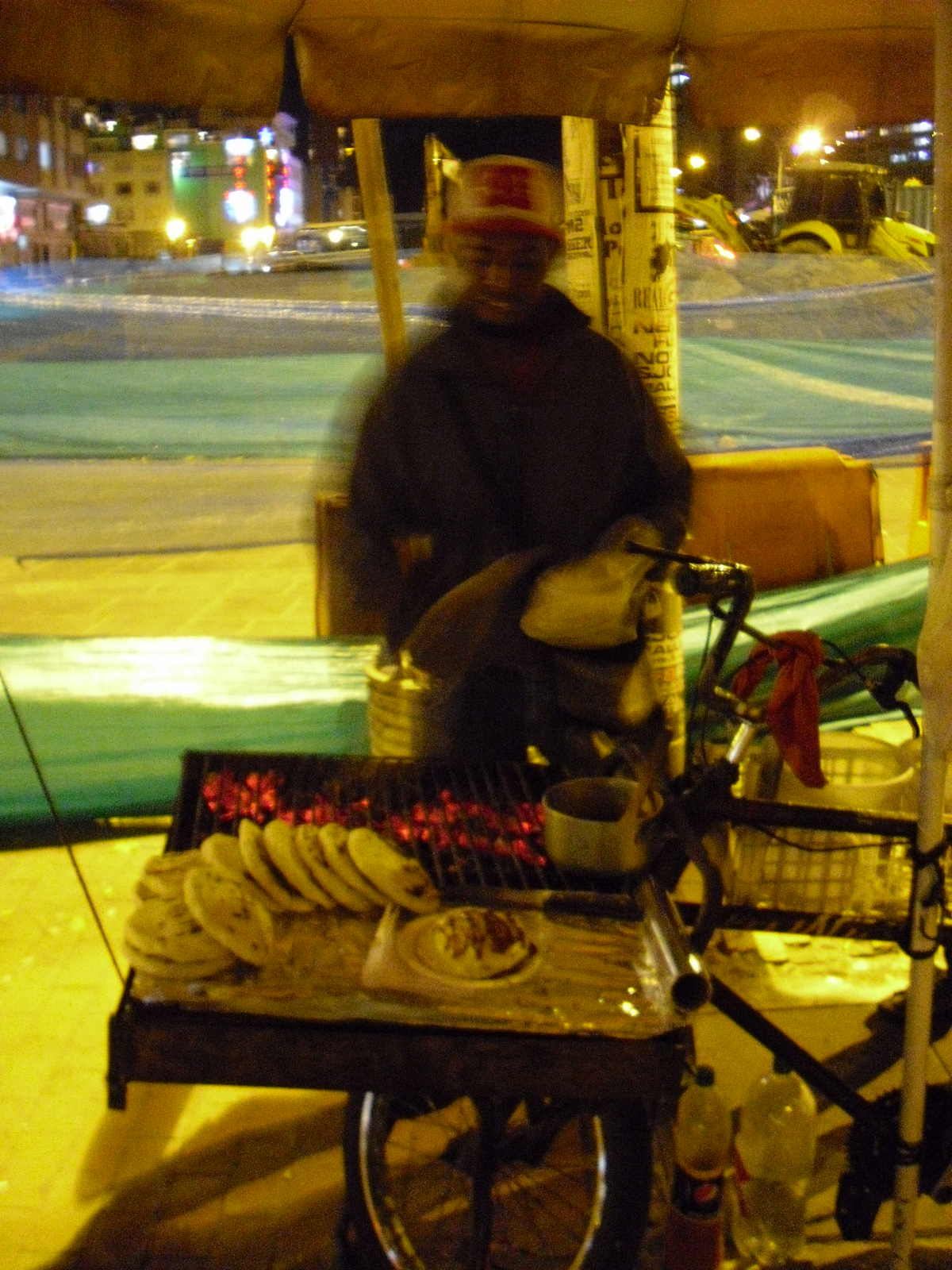
Street arepas

OK, we knew about these round corn-based delights before the start of 2012, but it was in this year that we really got to enjoy them; simple yet wonderful pleasures. 

The perfect hunger-buster on a chilly Bogotá evening, our preference has been the ‘carne con queso’ (that’s meat with cheese with a bit of BBQ sauce to boot) for a very agreeable $2,200 COP (roughly €1). 

For those of you who know the Colombian capital, our favourite place to consume these is from the vendor that operates outside the Colombo-Americano, Calle 19 with Carrera 3. We’ve missed them over the Christmas break — come back soon.
Street arepas - quite delicious
Quality grub.
So that's some of our highlights from 2012. All that's left for us to say for now is, Happy New Year to all; onwards and upwards in 2013.

 ________________________ 
*Please note, for an updated, more positive piece on Venezuela, see (for starters) see Venezuela: A necessary reappraisal.
 

Monday, 24 December 2012

"Dar papaya" — letting the guard down

A common occurrence for immigrants after spending some time in their adopted place is that they begin to feel more comfortable, at ease with their new surroundings. Not a bad thing in most scenarios, that. 

Indeed, it’s what most of us want to happen when we decide to rock up in a location that may be outside our comfort zone in some respects.
"Dar papaya" — letting the guard down: 'Wrong Way' masquerading as a Miami cop.
It's best to take all necessary precautions on a night out in Bogotá.
However – and this tends to be place-dependent – there are times when you can get to a level of comfort that slips into complacency. This is when things can get dangerous, something we’ve found out to our cost on a number of occasions here in Bogotá. 

Before we look at those incidents, it must be stated that even taking the best precautions out there is not going to guarantee your safety. That’s something that in reality can never be met, anywhere. Yes, some places are worse than others, but nowhere is completely trouble-free.

No matter where you are, though, there are certain things you can do to at least lessen the chances of, what Colombians call, "dando papaya", literally "giving papaya" (think low-hanging fruit). This phrase basically means leaving yourself exposed – not just physically, but mentally too – to be taken advantage of. Letting the guard down so to speak.

Our cautionary, lesson-must-be-learned experiences involve two of the things that we like to do best – socialising and the feeling that we’re getting value for money. 

The two stories we’re going to recount here were, as most of these sorts of incidents tend to be, completely avoidable. But when you can walk away from such events relatively unharmed, you should be all the stronger and wiser for them – that’s the theory anyway.

The first ‘eye-opener’ (or ‘skin-opener’ to be more precise, considering what happened) occurred in the flashy Zona T area of Bogotá – a place we usually feel ill at ease in any case but that’s usually to do with the arrogant types who frequent it, not for feelings of insecurity. 

As you tend to pay ridiculous prices around that part of the city for anything, we took it upon ourselves to purchase a bottle of aguardiente (Colombia’s ‘famed’ spirit) and knock it back in a quiet, dimly lit public park – we were unsure about the legalities of drinking on the street – before meeting another friend in an upmarket (and therefore outlandishly expensive) club.
The papaya fruit; lends its name to the Colombian warning phrase 'dar papaya'
Nice fruit, but keep it to yourself.
While ‘warming ourselves up’ in this park, three lads walked past us – something our more shrewd German companion apparently noticed, not liking their vibe, but he decided to hold his counsel. 

He should have trusted his instincts; for back came our ‘friends’, replete with knives and intent to harm. 

Two of them managed to pin down our German mate, not before managing to inflict a minor stab wound on our little finger. Seeing red, quite literally, and a little bit unsure as to what was happening, we confronted the third member of the group. 

Within seconds, though, the low-lives fled, once they had taken a little bit of a bounty from our friend – but in relative terms not that much. They took nothing material from us, but they did, of course, manage to split open our finger.

The lesson learned from this? Don’t nonchalantly go drinking in quiet parks at night time in Bogotá. OK, a no-brainer perhaps, but complacency very much set in for us on this occasion.

This brings us to the next ‘what were you thinking (or not as the case may be)’ cautionary tale. The context here is our dislike for taking taxis, especially when we know there’s a cheaper alternative. And with buses running more or less through the night in Bogotá, we generally find this a much more agreeable option to get home. 

Many locals, though, tend not to speak too highly of these late-night/early-morning buses. We’ve never had a problem with them, however – that is when we take them when we’re "with it", or at least close to being so.

This night, however, we don’t even remember getting on the bus to get home – in fact, we’re only guessing that this is what we did, but we can’t be fully sure. It seems, though, the most logical course of events to explain how we ended up in very dodgy territory in the not-very-safe south of the city, miles from where we were meant to be. 

Due to a significant blackout, our memory of events goes from being in a pub in the north of the city with friends and colleagues to lying on the ground in this inhospitable location in the far south with two men standing over us, emptying our pockets. 

Keys to the house, cash, mobile phone, ID – everything material they could take, they duly did. To paraphrase Ann Robinson from the BBC’s Weakest Link, ‘we were left with nothing’.

Christmas lights on Carrera Septima in Bogotá - a bit blurry like our memory
The exact details of our second 'incident' are a little blurry.
Thankfully, and most importantly, though, no physical injuries were inflicted. Considering how exposed we left ourselves, we were lucky on that front. 

Once we came round, we managed to bum a third of a bus fare from a guy on the street, with the bus driver seemingly taking pity on us, allowing us to board. Needless to say, we couldn't get out of the place quick enough.

As mentioned earlier, when you can walk away from such incidents pretty much in one piece, you have to be grateful. The most important thing is to learn from them and amend your practices accordingly. Not to do so is just plain stupid. 

For if you dar papaya around these parts, there are plenty of people willing to feed off you.
______________________
*For related stories on Colombia's 'dangers' (or not!) see: 'Dangerous' Colombia Part III http://bit.ly/12KWiux and associated posts.

**All the 'team' here at 'Wrong Way' would like to wish all our loyal readers a Happy Christmas/Feliz Navidad! No, we're not using the 'PC' 'Happy Holidays' - here's why http://bit.ly/NNg2E8

Sunday, 16 December 2012

Small steps to a cleaner, greener Bogotá?

OK, credit where credit is – perhaps – due. If we came across as being a little harsh on Bogotá Mayor Gustavo Petro in our last post (see ‘Petrograd – Colombia’s new capital?’) we must compliment him and his administration now. Cautiously that is, as it is early days and this is Colombia.

Small steps to a cleaner, greener Bogotá? A standard household bin in a Bogotá house - everything lumped in together.
No more mixing & matching of waste - in theory anyway.
However, with the scene now seemingly set for the introduction of a new ‘unified’ waste collection service in Bogotá in a matter of days, more details have – not before time, you might say – emerged as to what it will entail.

One of the more standout, welcome measures as far as we are concerned is the introduction of two separate household bins, a black one for organic matter and a white one for inorganic/recyclable material. For if there’s one thing we’ve missed in our time here, it’s a systematic approach to recycling domestic waste. It heretofore just hasn’t existed.

To say Bogotanos – or most Colombians for that matter – lack such a culture of ‘reduce, reuse, recycle’ is putting it mildly. 

Of course, this is a trend across developing world (we reluctantly use that description) countries – thinking ‘green’ often tends to be the last part of a state’s development plan. It just doesn’t seem as attractive – hedonistic, if you will – as the more planetary harmful, wasteful ways of doing business. Or at least it hasn’t up until very recently.

Small steps to a cleaner, greener Bogotá? A popular homeless people's haunt near the railway line in Bogotá. Not the most pleasing place on the eye.
We're not sure if the locals here will be separating their rubbish.
Now nobody, not even Mayor Petro, is expecting overnight success with the new waste measures. Considering the fact that there will be no punishment – financial or otherwise – for domestic users who don’t ‘play by the rules’, it’s a safe bet to assume that getting the city’s residents to change their habits is not going to be easy.

Indeed, having two bins for different types of rubbish might be a tad mind-blowing for some, especially those who find it difficult to move away from the doors of the Transmilenio transport system, both at the station and on-board, when they are neither getting on nor getting off (for more on this see ‘Bogotá’s transport truths’). 

Sometimes it appears people here just don’t know what might be good, not just for others, but for themselves, too. When you don’t see an obvious ‘carrot’, a ‘stick’ is often needed to lead you down the correct path.

Let’s not be overly pessimistic, though. It certainly seems to be a step in the right direction to get the city’s inhabitants to think more smartly about how they dispose of their waste and, in the process, it should help give the place a badly needed ‘freshening-up’.

Sticking with the green theme, it has also been announced that in the next few months Bogotá’s streets will become home to fifty electric-powered taxis. 

A tiny number this may be compared to the thousands of gas-guzzling cars on the capital’s streets but, as above, it’s a small sign that the city’s authorities are finally trying to clean up the place.

Small steps to a cleaner, greener Bogotá? A typically dirty Bogotá street near the tourist hotspot of La Candelaría in the old centre
Is a bright, cleaner future ahead for Bogotá?
Plans are also afoot – again, though, don’t hold your breath as to when these will be realised – to pedestrianise a large part of the Las Aguas area of the city near the historic centre. 

Coupled with the already partial pedestrianisation of Carrera Septima (Seventh Street – something we touched on in Dulling down Bogotá’), downtown Bogotá could become a much more pleasant place to amble about in the next few years.

Of course, as is the case with many environmentally ‘friendly’ measures, the argument can be made that the energy expended to introduce and maintain such methods can be just as much as the old ‘harmful’ ways of doing business. 

For example, in the case of electric-powered cars, often the electricity used to run them is produced from highly pollutant power plants. In one sense, it could be said that the point of pollution is just being moved to a more concentrated location – out of sight, out of mind so to speak.

This shouldn’t, however, be used as an excuse not to at least attempt to clean up our act. Yes, all countries must try harder to produce less planetary harmful core energy on a large scale, but we should all try to do our bit at a micro level, too.

In this regard, these may be small steps being taken in Bogotá but they're better than nothing. And for that, we must be thankful.

Sunday, 9 December 2012

Petrograd — Colombia's new capital?

There is a joke going around Bogotá — although for many it has a modicum of truth — that the Colombian capital is going to be renamed ‘Petrograd’. 

It’s all to do with the city’s mayor, Gustavo Petro and is a reference to the many Russian cities that were renamed after political leaders during the USSR communist era.
Petrograd — Colombia's new capital? Mayor of Bogotá wearing his trademark Cuban style flat-cap
Mayor Gustavo Petro with trademark flat cap. (Pic. from Mayor's website.)

For those of you in the dark, Petro is a former member of the far-left guerrilla group M-19. Indeed, he did time in the mid-1980s for the illegal possession of arms. 

Now, while those more radical days may be well behind him — his election as mayor perhaps a sign of that — it could be said that ‘you can take the man out of the leftist guerrillas, but you can’t take the leftist guerrilla out of the man.’ Or, the other way to look at it as we'll see is that he’s an opportunist, plain and simple — a wise way to be, perhaps.

You see, while his overall plan for the city, ‘Bogotá Humana’ (Humane Bogotá), may be full of merit, how he’s going about implementing it is a little bit more questionable. No doubt, especially considering his background, he is a visionary — or at least he has an idea of the type of Bogotá/Colombia he’d like to see emerge in the coming years. 

However, it would appear, as is the case with so many elected officials (see ‘Time for change’ http://bit.ly/TLNgLn for more on that point), that he’s now beginning to play the populist card as he positions himself to run, as he unsuccessfully did in 2010, for the country’s presidency in 2014.

Petrograd — Colombia's new capital? Two typically empty SITP buses
Nice buses. But where are all the passengers?
Let’s take the recent roll-out of the integrated public transport system, the Sitp. Despite our well-documented ‘love’ for the more chaotic older system of buses currently doing the rounds (see ‘Dulling down Bogotá’ http://bit.ly/XdUg5U), there’s no doubt that, in theory, the integrated system, given proper support, should make commuting in Bogotá far more comfortable for everybody. 

On top of that, the introduction of a modern fleet of, hopefully, cleaner, greener buses coupled with the phasing out of the big old gas guzzlers should do the air quality (well, lack of quality at this moment in time) in the metropolis no end of good.

Now, while it is relatively early days in its introduction — this is, of course, Colombia/Latin America — all the Sitp seems to have achieved thus far is the addition of a few more buses to the already chock-a-block Bogotá streets. With those buses carrying very few passengers at that. 

You see it appears that the Petro administration is too fearful to take on the very many private buseta/colectivo operators in the city. They make up a powerful group with many of their employees the type of people the current mayor will be relying on for support in his very likely second presidential assault in less than two years.

For if the powers that be in the city want its inhabitants to start using the new blue/red buses of the currently loss-making Sitp, the quickest way to achieve this is to make it the only game in town. So that means taking the busetas/colectivos off the road. The political will to do this seems to be sorely lacking. 

The talk from officialdom is that Bogotanos must adapt and change their habits. But when you have an old system where the buses pick you up and drop you off wherever you want along the route  — i.e. there are no set stops — and you don’t always have to pay the full fare, then getting people to opt out of that without much of a carrot or stick is wishful thinking.

As much of a socialist as Petro may claim to be, the lack of meaningful support he has shown to a publicly run transport system because of a reluctance to upset private operators is a bit of a contradiction to state the least.

Petrograd — Colombia's new capital? Out with the old, in with the new. An Acueducto leaflet looking for workers sits on top of a rubbish bag from one of the current providers
Looking for work in Bogotá? Check out the bins.
He is, perhaps, staying closer to his roots on the waste collection issue — though the reasons for this may be far from ideological. 

Here, the four current private operators are facing the axe, with the service due to be passed on to one publicly run company, Acueducto, which is responsible for water in the city. 

For many locals, this is a jobs-for-the-boys style move from the Petro administration. The whole plan seems ill-thought-out and highly questionable. To this end, it has more than raised eyebrows at national level, with President Juan Manuel Santos’s administration at loggerheads with Petro over the issue. 

Indeed, the national government may yet pull the plug on the scheme, which is due to get up and running on 18 December. Such a public bloody nose for Mayor Petro could have its benefits, though, selling it to the masses as national interference in his goal to clean up Bogotá — a rallying cry to bolster support.

The new water charges are not without controversy either. Whatever about making those who earn more, pay more, to let a large, densely-populated area of the city off without any charges at all could be seen as populist. 

The richest three strata in the city will have to pay for water usage once it goes over a certain prescribed amount. For the remaining three strata, there will be no water consumption charges at all. 

The thought of having to fork out for excessive water use can be an important motivation to conserve, though. Education can go so far, but people tend to learn more quickly when it hits them in the pocket.

In Petrograd, however, it’s best to keep the masses onside. Perhaps that’s the best way to play it, for now.