Friday, 23 March 2018

The Disposable Republic of Colombia

It tends to be the case that going green is one of the last things countries concern themselves with on the route to development.

Environmental issues are usually an afterthought as states strive to boost their economies. This can be particularly damaging for countries rich in natural resources such as Colombia. 

In this regard, it's generally not the locals doing harm (largely down to the fact that indigenous industries don't have the capacity to exploit these resources to their maximum potential). It's usually powerful multinationals, with the connivance of officials and politicians on the ground, albeit.

The Disposable Republic of Colombia: Litter in Buenaventura, Valle del Cauca, Colombia.
Um, beautiful Buenaventura: Spot the disposables. 
However, in terms of day-to-day waste management and a desire to 'reduce, reuse, recycle', the practices of many Colombians leave a lot to be desired. This can't really be blamed on "evil" foreign companies. No, the problem lies with the locals on this one.

You see, across the board, there is a big love affair with using not-very-environmentally-friendly disposable plastic products for a whole range of things.

Take our beloved panaderías. While most of these establishments, even the most basic ones, have porcelain cups available for public use, the preference for a large number of sit-in customers seems to be a throwaway plastic one, accompanied with a little plastic straw for stirring.

One reason for this, so it goes anyway, is related to hygiene. The thought of using a cup that some stranger drank out of beforehand is repugnant to many. It doesn't matter if it's been washed. (When you consider the fear-of-the-hot-seat syndrome, this kind of thinking isn't all that surprising.)

In a similar fashion, you'll be hard-pressed to get an actual glass with your beer in a standard tienda. A plastic one is what you'll be given if you don't want to drink directly out of the bottle. In mitigation on this one, most people do seem to drink directly from the bottle, thankfully.

Of course, the big problem with most of these disposables, especially the favoured plastic ones here, is that recycling is not an option. Yet, having them neatly collected and stored at waste facilities would at least, in theory anyway, prevent them from clogging up drains and being a general eyesore.

However, a not-always-reliable waste-collection service coupled with a penchant for individuals to recklessly litter plays against this.

Things aren't much better when it comes to plastic bag use, nay the ridiculous overuse of them. In many stores, it's still the case to put almost every item you purchase into its own plastic bag.

Now, it must be said that with the coming of new discount supermarkets such as Ara, D1 and Justo & Bueno and their policy to charge for using plastic bags, this is slowly changing in some quarters. Many others could do with following suit.

This plastic-bag charge in the stores mentioned and the subsequent behavioural change from shoppers bringing their own reusable bags shows, as it does in almost every other sphere, that money talks.

So how about panaderías and the like charging people more for wanting their drinks or whatever in disposables? (In a similar fashion to our idea to charge people more if they want sugar with their drink.) 

It's likely there'd be a quick change. People would either use the in-shop china or bring their own reusable cups (if they're that pernickety about hygiene).

A bit of a carrot-and-stick approach to get people to clean up their act.
_____________________________________________
Facebook: Wrong Way Corrigan - The Blog & IQuiz "The Bogotá Pub Quiz".

Monday, 5 March 2018

A rewarding Vélez view

Regular readers of this blog (stop it, there are some) will know I'm generally happiest when on the move.

That tends to mean travelling, but it can also refer to feeling busy, having lots to do from a 'fulfilling' work point of view.
A rewarding Vélez view: A view of Vélez, Santander, Colombia.
Vélez from a high.
On that latter front, however, and not really by design, it has been quieter than usual. It's been a bit like the old Irish back-to-work scheme, Fás; one week on, one week off (although with less money coming in to the coffers in this case).

Nonetheless, after over six years of this come-day, go-day employment whilst looking for something more serious — it's Latin America, things move slowly here do remember — one learns to budget for the lean times, ensuring there's money available for the things that matter most.

In this regard, when there's no pressing need to be in Bogotá, that means getting out of the place. Plus, a little getaway from the capital doesn't have to cost an awful lot, doing it the 'Wrong Way' way, in any case. (Choosing locations that aren't on the main tourist trail usually means you'll find plenty of value, in terms of accommodation if nothing else.)

So following on from the recent trip to Guaviare, this time the town of Vélez — the unofficial bocadillo (guava jelly) capital of Colombia — in the Santander department was on the radar. The only reason I knew of it was because a rather crazy (aren't all Santandereanas that way?) ex-fling is from there.

That might be reason enough for some to stay away from the place, but that particular bridge has seen plenty of water pass under it. What's more, buses to Vélez go via Bogotá's northern terminal, a very convenient 15-minute walk from my current abode.

Being a four-hour drive or so away, it doesn't really fall into the backpacker favourite 'leave at night, arrive in the morning' category. Those journeys are great in terms of 'saving' on a night's accommodation for a traveller, but when you're already living in the country and paying monthly rent, the benefits of them are significantly reduced.

In any case, at 28,000 COP (about eight euros) one-way, the daytime trip doubles up as a sightseeing tour, without the regular stops. Some of the views along the way in this mountainous terrain, especially after the city of Tunja, are pretty impressive.

Vélez itself, or more precisely its setting, is impressive as well. The thing is, we're spoilt for choice in these parts as regards quaint, colonial-style towns in hilly surrounds, replete with stand-out cathedrals/churches. On top of this, other similar places might be more 'tourist ready', so to put it.

Notwithstanding that, I for one don't get tired of checking out a different location on a regular basis — a change and a break from Bogotá life all in one.

Indeed, Vélez isn't really a tourist hub for the very reason that it doesn't seem to be set up that way. For some, this can be a frustration. "Tell us what's there to do and see here, please."
Vélez, Santander, Colombia.
More impressive views.
From a personal point of view, if there are a few adjacent hills to wander up in peace and quiet, I'm happy out. Get the obligatory panoramic view of the place in question. On this score, Vélez came good.

Now, it wasn't clear if the trail I went on is meant for public use. It looked more trodden by cattle than trekkers and there are gates and fences to cross, but of the few people I encountered at the start, no one told me I shouldn't be doing it.

In fact, in general, the good folk of Vélez, Veleños as they're called, tend to leave you to your own devices. From what I experienced, they'll only engage if you do firstly; suits me down to the ground that.

Public trail or not, those hills to the south-west of Vélez offer some nice views over the town and surrounding countryside — if and when the clouds go away, that is. Plus, there is a statue of the Virgin Mary in the vicinity of where I walked, so I'm guessing it is an attraction of sorts.

The route I took, though, didn't appear to be the correct one to get to that; I approached the Virgin from, um, behind. In defence, when I got there, I couldn't find a clearer alternative approach, honestly.

Thankfully, the clouds largely cleared around midday and I found myself a nice little isolated spot to take in the sun and simply enjoy the scenery and tranquillity. Simple pleasures.

That probably best sums up Vélez: simple pleasures. Ignorance might have resulted in my missing out on a host of attractions around the place. Yet the whole idea of this mini-break from Bogotá was to do my own thing, annoyed by nobody. Vélez satisfied that want. Pity I can't say that about the ex from there.

*Hotel Agatá has comfortable en suite rooms with a TV & WiFi from 15,000 COP per night.
____________________________________
Facebook: Wrong Way Corrigan - The Blog & IQuiz "The Bogotá Pub Quiz".

Friday, 16 February 2018

Colombia, vote V.E. Blanco for real change

Oh, what exciting times we have in Colombia. Election fever is in the air. In early March we've the curtain-raiser, the congress 'deciders'. Then in May, the big one gets underway, the first round of the presidential contest. For the record, a second round won't be needed if one candidate takes more than 50 per cent of the vote, but that's unlikely.

As ever, wily Wrong Way has been keeping a close eye on proceedings. (Not to blow our own Trump-et here, but we did foresee Trump's victory, as well as signalling the strength of the 'no' vote in both the Colombian peace agreement plebiscite and Brexit.)

Colombia, vote V.E. Blanco for real change: Could Voto En Blanco win Colombia's 2018 presidential election?!
Voto En Blanco: Your only man!
A bit has changed since we looked at the early candidates in the running. Nonetheless, despite all the other movers and shakers, 'Poker Petro' and 'Pilsen Fajardo' are the ones to beat going by those never-again-to-be-trusted opinion polls.

Well, they lead the way if you discard a certain V.E. Blanco, Voto En Blanco. He — and rest assured it is a 'he', Colombia's not ready for a lady president just yet (sorry Marta Lucía) — is polling quite strongly, even topping some.

While many may be quick to dismiss him, thinking he's a bit of an enigma or worse still a fraud, there are solid reasons to get behind him (more so than the others we could say).
Here's why:

A president for all

Blanco ticks all the boxes you want him to. For those few Colombians in the loony left brigade, he is unashamedly 'Castrochavista'. There's no need for public denials as to the existence of this brand of socialism. Let's be honest, Venezuela is giving the left a bad name. Blanco's Colombia will make socialism sexy again. (It was sexy once, wasn't it?)

Conversely, Blanco can be as right-wing as they come, something that will please many Colombians. He can proudly wax lyrical about the great work the right-wing paramilitaries, paracos, have done and are doing, by any means possible, to ensure those aforementioned bearded lefties are kept down.

What's more, he won't have anyone snooping around asking awkward questions. 'Firm hand, big heart', or something along those lines.

A man you can trust

OK, trust and politics don't make easy bedfellows whatsoever, but Blanco breaks the mould here. We can rest assured that when we put our 'X' after his name (we're going to try and sneak a vote or two in), he won't break his 'campaign' pledges.

How so? Well, it's simple really. He doesn't make any promises. There's no, let's say 'miércoles', or horse manure if you will, with Blanco. The rest of the candidates would do well to follow suit. 

Cheaper than changua 

The Colombian president's salary currently stands at US$250,000. That's a whopping $711,560,441 Colombian pesos. A bog-standard worker here would do well to get more than $10,000,000 a year, seventy times less than the top dog. In comparison, the salary for the president of neighbouring Ecuador is a more modest US$75,000, while in Venezuela, officially anyway, it's at just under US$25,000.

Putting Blanco in Casa de Nariño, the presidential palace, would cost nothing. Blanco can live off Bogotá's, um, fresh air. In fact, we could open up the palace to Colombia's myriad of homeless. Even let them have a little go at running the country. They couldn't do much worse than what's gone before, could they? 

It's decided so. Voto En Blanco for president!
_____________________________________
Facebook: Wrong Way Corrigan - The Blog & IQuiz "The Bogotá Pub Quiz".

Monday, 12 February 2018

The independent traveller's guide (of sorts) to Guaviare

Broadly speaking, there are two types of travellers: Those who do some sort of planning, research if you will, before getting to their destination; and those who just rock up to a place, a kind of 'see what happens' approach.

These days, I tend to find myself more in the latter camp. It's part of the adventure really. If I've to plan for a break, something that's meant to be relaxing, it can almost take the fun out of it.

On top of this, I usually prefer travelling alone. I find it quite a release to hop on a bus companion-less, heading to some destination I know very little about and where I don't know anybody on arrival. A chance to get away from it all and lose myself in my own thoughts.

Ciudad Piedra, Guaviare department, Colombia.
The view from the top of one of the many large rocks at Ciudad Piedra.
Thus was the style of the recent visit to San José del Guaviare, the dusty small town and capital of Colombia's Guaviare department.

Up until recently, the place was generally regarded as being off limits to not just tourism but pretty much any unnecessary visits. It was a 'zona caliente', that is to say, a hotbed of violence in Colombia's internal conflict.

In Bogotá, across the stratum divide, this view still seems to hold for many. "Be careful going down there" was the refrain from most, as it is when one goes to many regional outposts. Now, by area, it is a big department, about the size of Croatia actually, and I only explored a small section of it around San José, so I can't speak for it all.

Yet, what I did experience was nothing but friendly folk in an environment that felt anything but threatening. Indeed, in terms of having personal belongings stolen, the chances of this happening in San José seem pretty remote. Alas, we can't say the same for the country's capital.

The biggest problem with the place — which in some ways is paradoxically a plus — from that independent, off-the-cuff traveller perspective, is that the tourism infrastructure isn't quite in place (yet). If you haven't signed up with a tour company, getting around to see the many wonderful sights can prove to be a bit of a headache.

Of the fledgling tour companies in operation, Geotours del Guaviare is one that I had the pleasure to chat with and get some useful information on my second day there, by accident as it was albeit. However, doing tours on your own with these can be pretty expensive (though, if you're coming with dollars or euros in your back pocket, it won't seem too much at all).

Los Pozos Naturales, Guaviare department, Colombia.
On our way to the refreshing natural wells with the help of Saúl ...
Nonetheless, where there's a will, there's a way and all that. So while I was given a chance to go on a group tour with one agency, sticking to my independent guns, from San José's main square I contracted a motorcycle taxi guy (cum guide, of sorts) to bring me to some of the sights of interest.

Considering the agency prices, Arnulfo's negotiable 80,000 COP for an 'all-day' (09:00 to 18:30 as it turned out on day one) trip seemed reasonable. (That's just over 22 euros. And yes, I did get it at a lower price; we are in straitened times.)* In fact, the motorbike ride in the hot sun was an attraction in itself, if a little bit testing on the posterior.

Although he wasn't the most informative, Arnulfo turned out to be good company all the same, although he was a little difficult to understand at times. We got over the small setback of his struggling to find the 'pozos naturales', natural wells, at the end of our first day. That I opted for a second day with him is proof of that.
Ancient rock paintings, Cerro Azul, Guaviare department, Colombia.
The ancient rock paintings at Cerro Azul ...
Alongside the natural wells that we eventually found (with thanks to a third party, Saúl!), on that first day we took in the rather mysterious, ancient indigenous rock paintings of Nuevo Tolima, followed by the impressive Ciudad de Piedra (Rock City) and then the rock tunnels. It's what the tour agencies call the 'rocoso', rocky trip, with all the attractions being within relatively easy reach of each other (with transport that is).

On day two with Arnulfo we went to Cerro Azul, or Blue Hill if you like, where there are more indigenous paintings to try to 'decode', a 'cool', in every sense of the word, bat-filled rock tunnel to traverse, as well as stunning views over the vast plains-cum-jungle.

A refreshing tienda pit stop came after that  — Arnulfo's call, honestly. In fairness to him, it's a sweaty trek up and down Cerro Azul in the energy-sapping sun, while the motorbike journey alone to get there from San José is a good 90 minutes, most of it on unpaved roads. He deserved a beer or five.

Once 'watered', we briefly took in Laguna Negra, the Black Lake. By that time, with the sun setting, the blood-sucking flying insects were out in force and I was left badly exposed. They were the biggest threat faced over the four-day visit.

Going to Guaviare in dry season means missing out on the chance to see majestically-coloured rivers, akin to the more renowned Caño Cristales (an advantage for the Guaviare versions is that they're far easier, and cheaper, to reach). The best time to see the rivers in bloom is between July and November.
An anteater in San José del Guaviare, Colombia.
This anteater caused a bit of excitement among the concerned locals in San José ...
Also, on the fauna side of things, Guaviare has much to offer. In this regard, I didn't see a lot on this occasion — an unexpected visit of a young anteater to the centre of San José that caused a bit of excitement was as exotic as it got.

In any case, it's just another reason to go back. We can call this a reconnaissance mission of sorts for the independent traveller. The contacts and groundwork have been laid for that return visit.

*Both Arnulfo (+573115678891) and his brother Antonio (+573115559047) offer moto-taxi services.
There are a host of hotels in San José del Guaviare, from basic to slightly more upmarket. Residencia Casanare, a block away from the main square, has rooms available for as little as 10,000 COP.
______________________________________
Facebook: Wrong Way Corrigan - The Blog & IQuiz "The Bogotá Pub Quiz".

Wednesday, 31 January 2018

Making Bogotá 'mejor para todos'

The last week in Bogotá saw a fair amount of uproar  —  and traffic disruption — following the decision by city authorities to ban motorcyclists from carrying male pillion passengers.

The measure, which applies to only certain sectors of the metropolis, is being introduced in a bid to curb (pun not really intended) street crime. You see, there is a chance in these parts that two men riding a motorbike are up to no good.

In Pablo Escobar's time, the wise move would have been to run for cover if you saw such a sight approaching. It mightn't be as dramatic these days, but there is a potential criminal risk all the same. Hence the move to outlaw them.
Making Bogotá 'mejor para todos': Baseball cap-wearing Venezuelan president Nicolás Maduro.
You just can't trust those who wear baseball caps ... (From Facebook.)
It's all part of Mayor Enrique Peñalosa's plans to build a Bogotá 'better for everyone' ('mejor para todos [y todas]', we mustn't leave out the ladies). These things take time.

To lend a helping hand in that pursuit (you can thank us later), here are another few brainwaves that should whip the city into line (she'll be a paradise in no time):

If the cap fits ...

Let's face it, anyone wearing a baseball cap is surely on the wrong side of the law. Well, except for the police officers who actually have them as part of their uniform. They are the law, of course.

Yet rounding up all others who wear them would no doubt result in a big reduction in crime.

It would also significantly reduce the number of people freely wandering about Bogotá. A win-win scenario if ever there was one.

Where would we keep all these captured young and not-so-young punks? We could send them to Venezuela. They'd feel right at home with President Nicolás Maduro and all the other crazy, baseball cap-clad politicians over there. Not only that, but it would help to provide a balance to the massive influx of Venezuelans to these parts, too. Let's get on it, post-haste.

Line out

Sticking with matters of the head (we're a thoughtful bunch), what about those lads with that James Rodríguez-style line in their hair? We have to question the motives of grown men who dare to care enough to do it. Line in the hair one day, up to lewd acts in public the next.

Out with them, we say. Or at least have them sent to the barbers to get the line shaved out.

Colombia's James Rodríguez sporting that hair-line look. We're not buying it ...
You're kidding nobody with that look, James ... (From Facebook.)

No-child policy 

Nobody said cleaning up Bogotá was going to be easy. Sometimes you have to be cruel to be kind.

What we're calling for here is abortions for any pregnant stratum one or two women. The same for unemployed stratum-three women.

That should lead to a fall in the number of delinquents in the future.

Those in the other strata are fine. Colombia's more well-to-do classes don't commit crimes you see. You don't have to when everything's set up in your favour.

Queue chaos

OK, this one might be more of a personal crusade and may not actually improve things unlike the fine measures above. We're allowed one indulgence, though, aren't we?

It also could be seen as both drastic and almost impossible to implement, but hey, such concerns haven't stopped Colombian authorities before.

Basically, anyone who jumps a queue is to be sent for some sort of intense corrective coaching, which may or may not involve mild torture. This would likewise apply to those who block the doors of the Transmilenio, a particular bugbear of ours.

If introduced along with the measures above it would result in practically every inhabitant of Bogotá having to face the law. So be it. A city's gotta do what a city's gotta do.

We could suggest another few areas to 'come down on', but let's see how we get on with these solid proposals for the moment. We don't want to run the risk of turning the place into a police state. Firm but fair is how we see it.
___________________________

Tuesday, 23 January 2018

Returning to a life more ordinary

It's safe to assume that most foreigners, especially those from the West, who come to Colombia on a whim don't arrive with the expectation to make money here. That is to say, those who come not having work already lined up with a decent paying school/university, NGO, big multinational or the like.

It's generally more a case of being here on an adventure. 'A see what happens' approach while making the most of this beautiful country and largely friendly people.

Returning to a life more ordinary: Nice views on the way to Choachi from Bogotá, Colombia.
Time for a change of direction?
Indeed, many sacrifice a more financially stable existence to 'give things a lash' in countries not quite as 'developed' as their homelands. Some come with a cash cushion, making things much more manageable. First World savings can go a long way in these parts.

Others, and we're pretty much in this boat, don't exactly have wads of a strong foreign currency to fall back on. It's more a case of 'where there's a will, there's a way' in order to find the resources to keep the adventure alive. That 'way', more often than not, is freelance teaching. It provides a somewhat steady income while also giving the freedom to explore the country when one wishes.

Then, as time passes, a root takes hold. What initially might have been planned as just a relatively brief stay turns into years. It becomes difficult to leave. Of course, for some there are strong, solid reasons for that; a long-term relationship, an improved employment situation, a child.

For others, and again this is where we're at, it's simply a question of time itself. There's no long-term relationship (none at all, actually), no improvement in earnings, no child (thankfully). We're here because we've become used to it. (There is also the small incentive of being only months away from being able to apply for a five-year residency.)

We could, perhaps even should seek out new pastures but we've become comfortable with the status quo, with mediocrity if you will. Returning to the ridiculously expensive Western world without any guarantees of finding decent, fulfilling work just seems madness.

Moving to another 'developing' country, starting from scratch again, seems more hassle than it's worth. (Visiting them still appeals greatly, though. What's more, no place could be ruled out if a job with appealing terms and conditions was forthcoming.)

Yet, sometimes, like a smartphone app, you have to hit 'force stop' and either reinstall or forget about it altogether.

With that in mind, it will be seven years this June since we made our return to South America. Moreover, what could be viewed as the 'birth' of Wrong Way has its tenth anniversary this coming November.

It was back in 2008 that the then reluctant traveller took flight from Ireland on a personal voyage of discovery. Things have never been quite the same again, for better and for worse. (The book recounting this 10-year, life-changing phase is in the making. Watch this space!)

We've had a good innings at it. There have been some unforgettable experiences, new friends for life made (we hope) from all walks of life.

However, without some significant modifications in the coming months it feels like this Colombian chapter is drawing to a close, for now at least.

Some of those on the outside looking in might think we'd be silly to end what they see as a sort of surreal, fantasy life when there's no real pressure to do so. 'Sure you're living a relatively carefree existence. Why rock the boat?'

There is merit to that viewpoint.

Yet the reality is that it can often feel more mundane than magical. More of a frustration than a fantasy, especially from a financial perspective.

It's not all about money of course. As The Beatles sang, it 'can't buy you love'. Fair enough, but as a tienda-socialising, non-dancing foreigner in these parts, without flaunting the cash, you might not get much 'action'.

A steady job and income, our own lodgings, a return to 'a life more ordinary' among our own, this kind of living is beginning to look more appealing. If only for a time.

The transition back to that, though, could prove quite a task. For one, finding that steady and hopefully fulfilling job is not going to be easy. There are also plenty of things we like about Colombia.

We must be careful what we wish for. Yet changes are required nonetheless.
________________________________________
Facebook: Wrong Way Corrigan - The Blog & IQuiz "The Bogotá Pub Quiz".

Tuesday, 16 January 2018

Cali on the fringes

'What?! You were in Cali for its famous end-of-year festival and you didn't go to it. Madness!'

That's pretty much how most view our (three like-minded Irishmen that is) non-attendance at any of the Cali festival events during our recent visit there.

This "shock" is understandable, of course. People flock from far and wide to check out what is viewed as one of Colombia's biggest and best festivals.

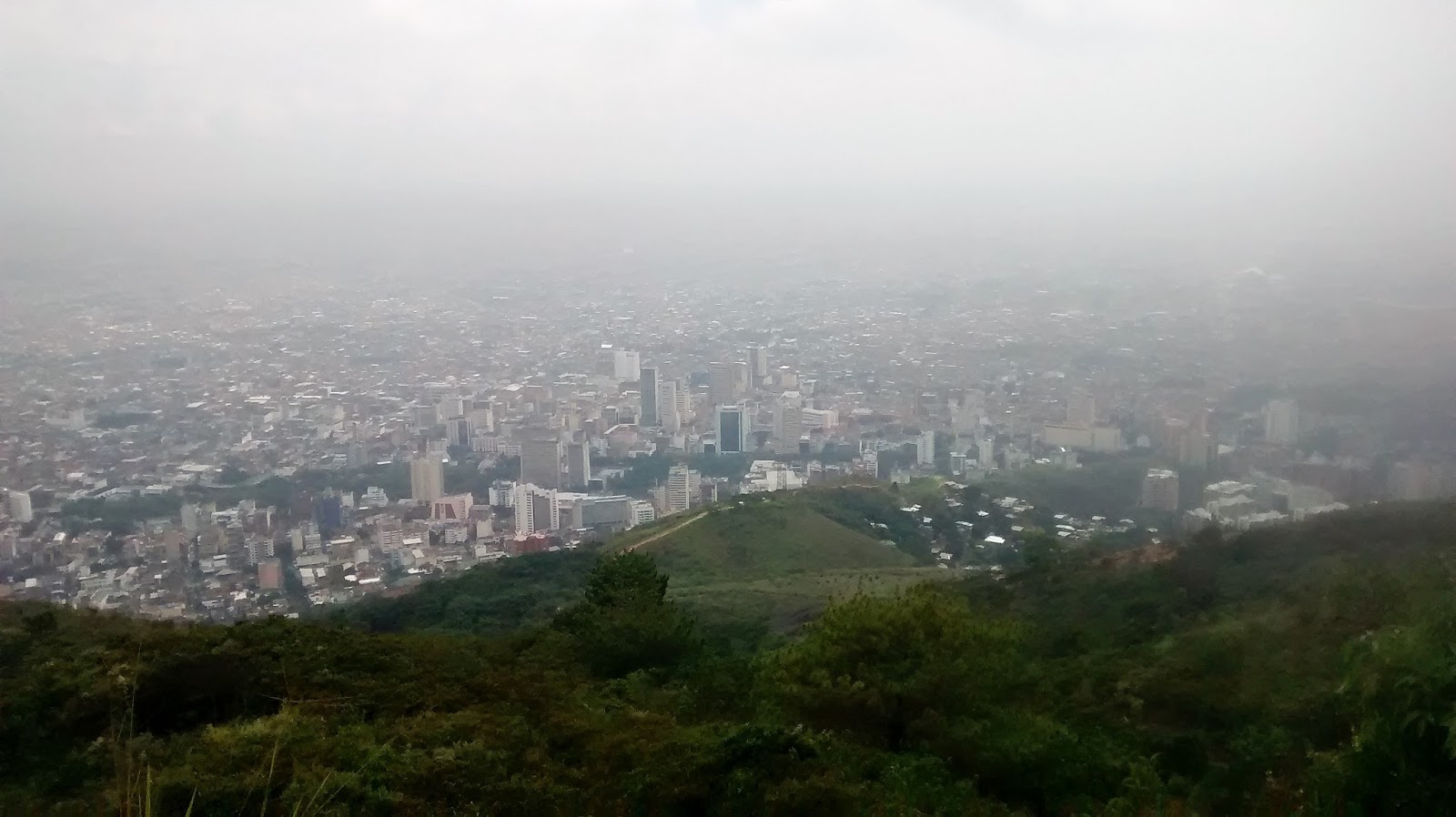
Cali on the fringes: A view of Cali, Colombia from Cerro de las Tres Cruces.
Cali from a high.
What better way to get into the salsa swing — Cali is regarded as the salsa capital — when much of the city is in party mood?

Truth is, we'd generally prefer to shovel stiff concrete on a hot day than awkwardly move to salsa. Sure, we've given it a go before, but we just don't enjoy it.

Anyway, there was/is more to the festival than salsa; well, we guess so. However, our choice of hotel left us quite removed from the festival vibe.

The rather industrial, rough-and-ready, Barrio Santander wouldn't be most visitors' choice of location to overnight it in Cali. Yet, at festival time prices unsurprisingly shoot up in the more popular locations, such as the tourist-heavy San Antonio.

So getting a private room for 20,000 COP a night was a bargain not to be turned down. Plus, the city centre was only a steady 30-minute walk away.

In any case, as our few regular readers may have guessed, hanging around and socialising in Colombia's working-class barrios isn't at all anathema to us.

You could say we were getting a truer reflection of how Cali rolls. Away from the crowds and the tourists that the festival attracts.

It's what we enjoy doing when in a new place. Get an idea of what it's like to live in, Wrong Way style. Thus, finding the value locations is one of the important things in this regard.

As the country's third biggest city, it's not exactly a relaxing escape from the normal mayhem of Bogotá. This was one reason why we weren't overly bothered that after over six years in the country we'd never visited the place.

Taking into account that it was the festive period, there was a nice feel to it nonetheless. A much warmer climate, but not overbearingly so, than that of Bogotá played its part in this.

Cali on the fringes: Barrio San Antonio, Cali, Valle del Cauca, Colombia.
The picturesque church in Barrio San Antonio.
Now, considering we had three, um, moderate-drinking Irishmen together at end-of-year holiday time, there wasn't much exploring done.

We did, however, find time to trek up Cerro de Las Tres Cruces (Hill of the Three Crosses). At an altitude of 1,480 metres, it's over 400 metres higher than the city itself. It's a nice little workout to get to the top, from where you get nice views of the metropolis. (Apparently the barrio at the start of the trek can be somewhat dangerous, but we didn't get any sense of that.)

You can also push yourself a bit more and pump some iron and concrete in the outdoor 'gym' at the summit. We gave it just a short test — one wouldn't want to overdo it.

Apart from that and a bit of wandering around the centre and Barrio San Antonio, that was pretty much our Cali experience. Some people might consider it a shameful act for where we were, but there wasn't a salsa dance in sight.

We won't get our legs in a tangle over that one, though.
___________________________________________
Facebook: Wrong Way Corrigan - The Blog & IQuiz "The Bogotá Pub Quiz".