Wednesday, 31 January 2018

Making Bogotá 'mejor para todos'

The last week in Bogotá saw a fair amount of uproar  —  and traffic disruption — following the decision by city authorities to ban motorcyclists from carrying male pillion passengers.

The measure, which applies to only certain sectors of the metropolis, is being introduced in a bid to curb (pun not really intended) street crime. You see, there is a chance in these parts that two men riding a motorbike are up to no good.

In Pablo Escobar's time, the wise move would have been to run for cover if you saw such a sight approaching. It mightn't be as dramatic these days, but there is a potential criminal risk all the same. Hence the move to outlaw them.
Making Bogotá 'mejor para todos': Baseball cap-wearing Venezuelan president Nicolás Maduro.
You just can't trust those who wear baseball caps ... (From Facebook.)
It's all part of Mayor Enrique Peñalosa's plans to build a Bogotá 'better for everyone' ('mejor para todos [y todas]', we mustn't leave out the ladies). These things take time.

To lend a helping hand in that pursuit (you can thank us later), here are another few brainwaves that should whip the city into line (she'll be a paradise in no time):

If the cap fits ...

Let's face it, anyone wearing a baseball cap is surely on the wrong side of the law. Well, except for the police officers who actually have them as part of their uniform. They are the law, of course.

Yet rounding up all others who wear them would no doubt result in a big reduction in crime.

It would also significantly reduce the number of people freely wandering about Bogotá. A win-win scenario if ever there was one.

Where would we keep all these captured young and not-so-young punks? We could send them to Venezuela. They'd feel right at home with President Nicolás Maduro and all the other crazy, baseball cap-clad politicians over there. Not only that, but it would help to provide a balance to the massive influx of Venezuelans to these parts, too. Let's get on it, post-haste.

Line out

Sticking with matters of the head (we're a thoughtful bunch), what about those lads with that James Rodríguez-style line in their hair? We have to question the motives of grown men who dare to care enough to do it. Line in the hair one day, up to lewd acts in public the next.

Out with them, we say. Or at least have them sent to the barbers to get the line shaved out.

Colombia's James Rodríguez sporting that hair-line look. We're not buying it ...
You're kidding nobody with that look, James ... (From Facebook.)

No-child policy 

Nobody said cleaning up Bogotá was going to be easy. Sometimes you have to be cruel to be kind.

What we're calling for here is abortions for any pregnant stratum one or two women. The same for unemployed stratum-three women.

That should lead to a fall in the number of delinquents in the future.

Those in the other strata are fine. Colombia's more well-to-do classes don't commit crimes you see. You don't have to when everything's set up in your favour.

Queue chaos

OK, this one might be more of a personal crusade and may not actually improve things unlike the fine measures above. We're allowed one indulgence, though, aren't we?

It also could be seen as both drastic and almost impossible to implement, but hey, such concerns haven't stopped Colombian authorities before.

Basically, anyone who jumps a queue is to be sent for some sort of intense corrective coaching, which may or may not involve mild torture. This would likewise apply to those who block the doors of the Transmilenio, a particular bugbear of ours.

If introduced along with the measures above it would result in practically every inhabitant of Bogotá having to face the law. So be it. A city's gotta do what a city's gotta do.

We could suggest another few areas to 'come down on', but let's see how we get on with these solid proposals for the moment. We don't want to run the risk of turning the place into a police state. Firm but fair is how we see it.
___________________________

Tuesday, 23 January 2018

Returning to a life more ordinary

It's safe to assume that most foreigners, especially those from the West, who come to Colombia on a whim don't arrive with the expectation to make money here. That is to say, those who come not having work already lined up with a decent paying school/university, NGO, big multinational or the like.

It's generally more a case of being here on an adventure. 'A see what happens' approach while making the most of this beautiful country and largely friendly people.

Returning to a life more ordinary: Nice views on the way to Choachi from Bogotá, Colombia.
Time for a change of direction?
Indeed, many sacrifice a more financially stable existence to 'give things a lash' in countries not quite as 'developed' as their homelands. Some come with a cash cushion, making things much more manageable. First World savings can go a long way in these parts.

Others, and we're pretty much in this boat, don't exactly have wads of a strong foreign currency to fall back on. It's more a case of 'where there's a will, there's a way' in order to find the resources to keep the adventure alive. That 'way', more often than not, is freelance teaching. It provides a somewhat steady income while also giving the freedom to explore the country when one wishes.

Then, as time passes, a root takes hold. What initially might have been planned as just a relatively brief stay turns into years. It becomes difficult to leave. Of course, for some there are strong, solid reasons for that; a long-term relationship, an improved employment situation, a child.

For others, and again this is where we're at, it's simply a question of time itself. There's no long-term relationship (none at all, actually), no improvement in earnings, no child (thankfully). We're here because we've become used to it. (There is also the small incentive of being only months away from being able to apply for a five-year residency.)

We could, perhaps even should seek out new pastures but we've become comfortable with the status quo, with mediocrity if you will. Returning to the ridiculously expensive Western world without any guarantees of finding decent, fulfilling work just seems madness.

Moving to another 'developing' country, starting from scratch again, seems more hassle than it's worth. (Visiting them still appeals greatly, though. What's more, no place could be ruled out if a job with appealing terms and conditions was forthcoming.)

Yet, sometimes, like a smartphone app, you have to hit 'force stop' and either reinstall or forget about it altogether.

With that in mind, it will be seven years this June since we made our return to South America. Moreover, what could be viewed as the 'birth' of Wrong Way has its tenth anniversary this coming November.

It was back in 2008 that the then reluctant traveller took flight from Ireland on a personal voyage of discovery. Things have never been quite the same again, for better and for worse. (The book recounting this 10-year, life-changing phase is in the making. Watch this space!)

We've had a good innings at it. There have been some unforgettable experiences, new friends for life made (we hope) from all walks of life.

However, without some significant modifications in the coming months it feels like this Colombian chapter is drawing to a close, for now at least.

Some of those on the outside looking in might think we'd be silly to end what they see as a sort of surreal, fantasy life when there's no real pressure to do so. 'Sure you're living a relatively carefree existence. Why rock the boat?'

There is merit to that viewpoint.

Yet the reality is that it can often feel more mundane than magical. More of a frustration than a fantasy, especially from a financial perspective.

It's not all about money of course. As The Beatles sang, it 'can't buy you love'. Fair enough, but as a tienda-socialising, non-dancing foreigner in these parts, without flaunting the cash, you might not get much 'action'.

A steady job and income, our own lodgings, a return to 'a life more ordinary' among our own, this kind of living is beginning to look more appealing. If only for a time.

The transition back to that, though, could prove quite a task. For one, finding that steady and hopefully fulfilling job is not going to be easy. There are also plenty of things we like about Colombia.

We must be careful what we wish for. Yet changes are required nonetheless.
________________________________________
Facebook: Wrong Way Corrigan - The Blog & IQuiz "The Bogotá Pub Quiz".

Tuesday, 16 January 2018

Cali on the fringes

'What?! You were in Cali for its famous end-of-year festival and you didn't go to it. Madness!'

That's pretty much how most view our (three like-minded Irishmen that is) non-attendance at any of the Cali festival events during our recent visit there.

This "shock" is understandable, of course. People flock from far and wide to check out what is viewed as one of Colombia's biggest and best festivals.

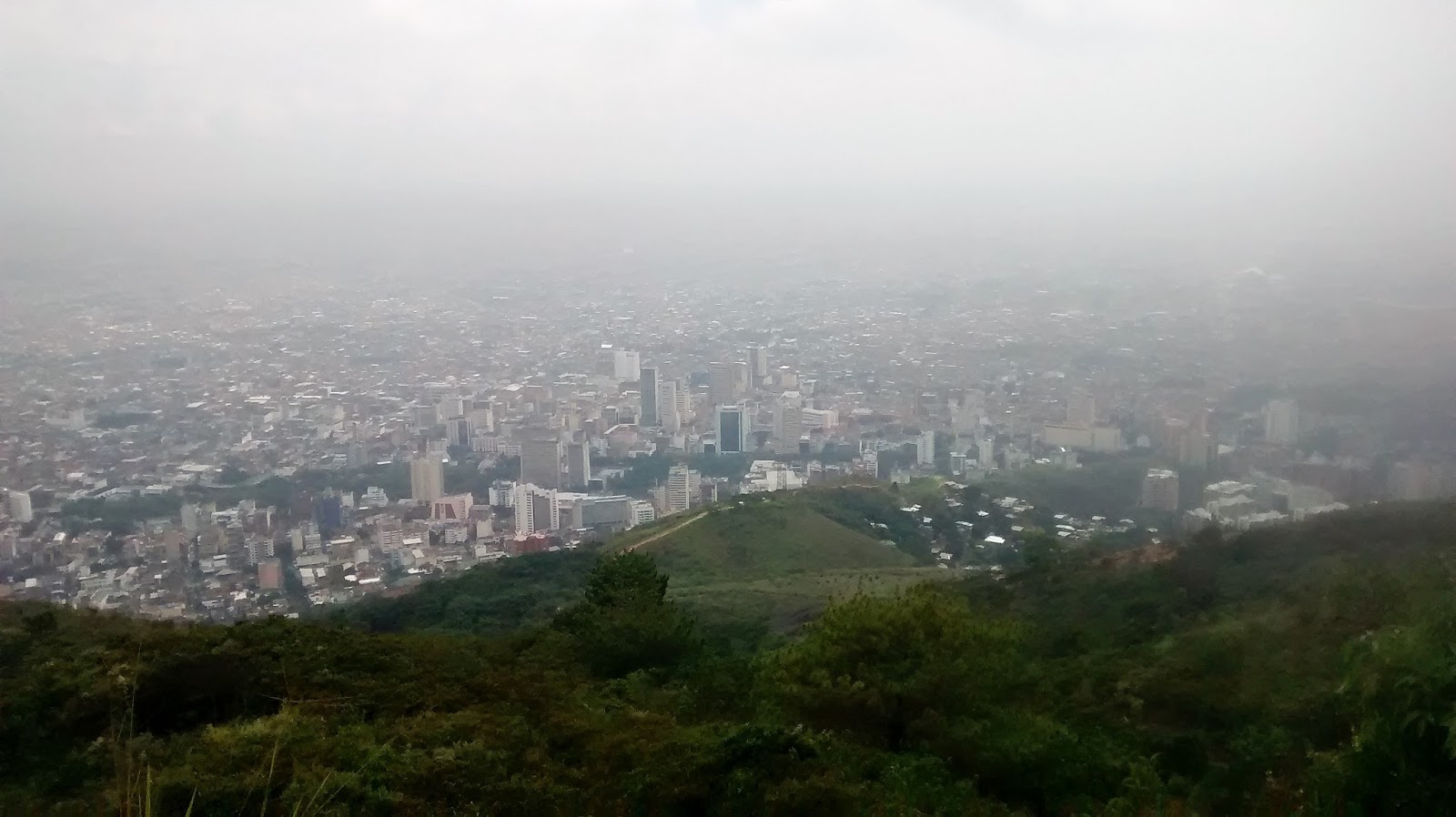
Cali on the fringes: A view of Cali, Colombia from Cerro de las Tres Cruces.
Cali from a high.
What better way to get into the salsa swing — Cali is regarded as the salsa capital — when much of the city is in party mood?

Truth is, we'd generally prefer to shovel stiff concrete on a hot day than awkwardly move to salsa. Sure, we've given it a go before, but we just don't enjoy it.

Anyway, there was/is more to the festival than salsa; well, we guess so. However, our choice of hotel left us quite removed from the festival vibe.

The rather industrial, rough-and-ready, Barrio Santander wouldn't be most visitors' choice of location to overnight it in Cali. Yet, at festival time prices unsurprisingly shoot up in the more popular locations, such as the tourist-heavy San Antonio.

So getting a private room for 20,000 COP a night was a bargain not to be turned down. Plus, the city centre was only a steady 30-minute walk away.

In any case, as our few regular readers may have guessed, hanging around and socialising in Colombia's working-class barrios isn't at all anathema to us.

You could say we were getting a truer reflection of how Cali rolls. Away from the crowds and the tourists that the festival attracts.

It's what we enjoy doing when in a new place. Get an idea of what it's like to live in, Wrong Way style. Thus, finding the value locations is one of the important things in this regard.

As the country's third biggest city, it's not exactly a relaxing escape from the normal mayhem of Bogotá. This was one reason why we weren't overly bothered that after over six years in the country we'd never visited the place.

Taking into account that it was the festive period, there was a nice feel to it nonetheless. A much warmer climate, but not overbearingly so, than that of Bogotá played its part in this.

Cali on the fringes: Barrio San Antonio, Cali, Valle del Cauca, Colombia.
The picturesque church in Barrio San Antonio.
Now, considering we had three, um, moderate-drinking Irishmen together at end-of-year holiday time, there wasn't much exploring done.

We did, however, find time to trek up Cerro de Las Tres Cruces (Hill of the Three Crosses). At an altitude of 1,480 metres, it's over 400 metres higher than the city itself. It's a nice little workout to get to the top, from where you get nice views of the metropolis. (Apparently the barrio at the start of the trek can be somewhat dangerous, but we didn't get any sense of that.)

You can also push yourself a bit more and pump some iron and concrete in the outdoor 'gym' at the summit. We gave it just a short test — one wouldn't want to overdo it.

Apart from that and a bit of wandering around the centre and Barrio San Antonio, that was pretty much our Cali experience. Some people might consider it a shameful act for where we were, but there wasn't a salsa dance in sight.

We won't get our legs in a tangle over that one, though.
___________________________________________
Facebook: Wrong Way Corrigan - The Blog & IQuiz "The Bogotá Pub Quiz".

Tuesday, 9 January 2018

Manizales: Bien pueda

'Manizales, el mejor vividero del país.' So runs the slogan on the city's tourist map. It basically means it's the best place to live in Colombia.

It's a bit of a statement to make in a land that has an abundance of natural beauty spots. What Manizales claims to have, however, is more than just the impressive, hilly, landscape it's set in.

Manizales: Bien pueda. Manizales, Caldas, Colombia.
Hilly setting.
As one of Colombia's more moderately-populated department capitals, getting around the place doesn't tend to be a headache. 

Indeed, it can be navigated easily enough on foot, if you don't mind the steep inclines and declines, that is. (On the commuting front, a city that has a cable car service incorporated into its public transport system is always a little special for us.)

Its location in the country's famed and relatively well-developed Coffee Region (Eje Cafetero) boosts further its quality-of-living index. It's not an isolated outpost. Word on the street is that there's money floating about the place, there are employment opportunities, framed in a limited Colombian context as they must be.

Another bonus is that many everyday things are cheaper here compared to Bogotá.

On top of all this, not only are many of the locals friendly — something which can be said about many places in Colombia — the city also has, for the most part, a safe feel to it. This can't be said about some of the other big urban centres here.

For those who feel more at home living the 'high life' in the hills than by the beach, as we do, at 2,200 metres above sea level, Manizales certainly ticks that box.

When the sun shines it can get up to a satisfying 24 degrees Celsius or even a little more. At night, the temperatures don't drop as low as they generally do in the slightly loftier Bogotá.

As well as being in the Eje Cafetero, Manizales is also in Paisa Country. The home of the Paisas, those recognised as Colombia's more business-minded and industrious types, is regarded as Medellín.

We had a bit of a love-hate relationship with the country's second city, so it could be said Manizales offers Paisa living without the Medellín drawbacks.

The musical Manizales accent is, as far as we're concerned anyway, another pull factor. It's rather enticing.

Manizales: Bien pueda. Manizales' main cathedral. Manizales, Caldas, Colombia.
City-centre cathedral. 
It could be said it has some sort of an Italian flavour to it. Whatever the case, it's certainly quite distinct from the plainer Bogotá tones.

On that Italian front, the fact that meatballs — albóndigas in the local tongue — are a staple cuisine here, might suggest some sort of previous connection. (A tenuous link it may be, but the Manizales and Italian flags use the same colours, albeit in a different order and direction. The city's football team, Once de Caldas, however, displays the green, white and red on its crest in the same way as Italy.)

Granted our week-long visit was over the Christmas holiday period, the city still seemed quite busy, yet with a relaxed vibe to it. We were assured this is how the place typically rolls.

Indeed, if one was considering a move out of the mayhem of Bogotá, Manizales doesn't seem like a bad option at all.

As the locals would say themselves to such an idea, 'bien pueda'. 'Well you can', indeed. 
_____________________________________

Tuesday, 5 December 2017

Replacing religion's false comforts

It wasn't quite billed as a clash of titans, religion versus science, but with the Rocky walk-on music, it hinted that we might be in for something special.

In the end, what we got was a rather tame affair — shadow-boxing if you will. There were a few reasons for that. For one, the format certainly didn't help.

After opening statements, each man was given separate, alternate questions to answer. So it made it difficult for a robust, heated encounter to develop. A time limit on those answers would have done no harm either.
Replacing religion's false comforts: Richard Dawkins debates Colombian Jesuit priest Father Gerardo Remolina at Bogotá's Javeriana University.
Clash of the heavyweights - well, not quite ...

Another reason why sparks weren't exactly flying is that the opposing sides weren't actually that much opposed to each other — at least that's how it appeared.

We're referring to Javeriana University Bogotá's "debate" titled 'Is God an illusion?' (¿Es Dios una ilusión?). 

The protagonists were Colombian Jesuit priest and author Father Gerardo Remolina and the British evolutionary biologist, author and atheist Professor Richard Dawkins.

We more or less knew what we were going to get from Dawkins.

It was Fr Remolina who surprised us somewhat. He basically came across as a man of reason and some science who just happened to have made a good living from something he doesn't entirely believe in. Or if he does fully believe in it, he's not very convincing.

He effectively reduced all the core tenets of Catholicism to symbols. 'Is God an illusion?' 'Well, what is God?' 'Eh, you tell us, Father.' 'Does heaven exist?' 'Well, what is heaven exactly?' OK, we're using a bit of poetic licence here but many of his answers to questions that are at the core of Christianity were abstract, to say the least.

This aspect to proceedings did not surprise us. He had a fair idea of the gallery he was playing to. (In one way, at the risk of being facetious, it was like the 'That would be an ecumenical matter' scene from the Irish sitcom Father Ted.)

It would have been much more entertaining to have a fundamentalist Christian from Bible Belt USA on stage. A creationist to the core. Their phoney arguments are much more engrossing. 

It's not for nothing that the influence of the traditional Christian churches is on the wane. These new guys on the block have a far sexier story to sell. And selling it they certainly are. There's money in that crucifix, you know. (They definitely would have felt at home with the Rocky entrance music anyway.)

Of course, religion's greatest strength in the face of rigorous scientific enquiry is the comfort it provides. It's a release from the trials and tribulations of this mortal world we toil in.

It tells us that there is something more than our present existence, something greater. It can give hope in the midst of despair. Who cares if the evidence suggests otherwise? Remember, 'happy are those who have not seen yet still believe.'

Stony-faced science, in contrast, can leave us cold. Take Dawkins' rebuttal to that comforting aspect of religion, quoting the Canadian cognitive psychologist Steven Pinker: 'If you're being chased by a tiger it may comfort you to believe it's a rabbit. But it's a tiger and it's going to eat you.' Doesn't tend to leave one all that chirpy, does it?

Yet, science isn't in the game of emotions. It's about truth-seeking. Fantasy and fiction, on the other hand, by definition operate without the inconveniences of having to prove themselves. In this regard, a fantastical story of everlasting life is generally going to appeal more than the theory that when we die, that's it.

Religions across the world, despite the many glaring holes and contradictions in their stories (it's not called 'having faith' for nothing), still trump atheism.

Thus, when asked if he felt we were coming near the end of religion, Dawkins said he can only hope that that's the case. The reality, however, suggests we're still some way off that juncture at this stage in our development as a species.

Some people might ask, 'So what? What's the big deal?' As we wrote about before, getting personal comfort, strength even, from belief in a higher power is one thing — what you do in private is your own business after all. Forming whole societies based on religious doctrine that doesn't stand to reason is quite another thing.

We're not going to take up space here disputing the argument that a religion-free world would be some sort of immoral, violent backwater.

Coming back to comfort, it's not like an atheist is devoid of it. Science can provide it. And it's arguably a more reassuring one than what religions offer because it comes more from fact.

Take an individual's very existence. It's a remarkable achievement in itself when we consider all the things that had to happen by chance to actually get us on this planet. Isn't that something worth celebrating and living for? Not to mention making the most of it for the short period we are here.

What's more, it could be argued that parents have a lesser need for religion than childless, singletons (even if, in reality, the opposite seems to be the case). Who needs a god or organised religion when you have your children and later, perhaps, grandchildren to get behind, your raison d'être?

So a world without religion doesn't have to be a gloomy, hopeless, meaningless place. 

Remember, it's only in recent years that the more established religions, from a Christian perspective in any case, 'jazzed up' their message to the masses. In the not-too-distant past, the stick was preferred to the carrot. 'It's God's will or it's eternal damnation.'

Atheism can be appealing, too, liberating even. Don't dismiss it right out of hand.
________________________________________
Facebook: Wrong Way Corrigan - The Blog & IQuiz "The Bogotá Pub Quiz".

Tuesday, 28 November 2017

Colombian universities' English at all costs

Colombia's powers that be place a fair amount of importance, in theory anyway, on improving the level of English here. There was even a ridiculously ambitious plan from the government to have the country bilingual by 2019. Still on track with that, guys?

There's aiming high and then there's the pie in the sky. Keep it attainable, people. (If only the Brits had colonised the place instead of those plundering Spanish, eh?)

Colombian universities' English at all costs: In order to graduate from university, many Colombian students are forced into trying to learn English.
'This would have been much easier if I'd started at a younger age.' (Picture from web.)

Essential English 

Nonetheless, as the global language (for now) in an unprecedentedly interconnected world, there's no doubt having English up to a workable level is, or at least could be, an advantage.

Thus, convincing the masses to warm to it is a noble pursuit.

Like most things, but perhaps even more so with languages, this leads to better results by getting them when they're young. However, Colombia's track record in this regard, especially in public schools, leaves a lot to be desired.

This being the case, the fact that in many university courses you can't graduate without attaining a certain, usually relatively high level of English could be viewed as being a bit harsh.

Of course, if you're studying international relations or the like where English is usually a core element and prerequisite for the course, fair enough.

Yet for degrees where English is not essential per se, why make obtaining a good grade in it a qualification requirement?

If the student has shown to be competent and worthy of his or her degree in the chief area of study, let them at it we say.

OK, as mentioned above, having a decent grasp of English may open more doors in the workplace. So the universities in question could be seen as forcing a good deed on students who have paid hefty enrolment fees. How thoughtful of them.

Now, as you know it's far from cynical we are here, but those of that disposition could be forgiven for thinking that the English requirement is just a money-making racket. 'Aw, hard luck, you failed English. Not to worry. Pay for a course to get your level up to scratch, pay for an additional semester and hopefully you'll be good to graduate in a few months.' Come on guys, these universities would never be so self-centred.

As tough as it may seem on those who struggle with English, as ever in these parts some centres of learning "allow" a way around it. From what we can gather, in some places the English test doesn't have to be taken supervised, on campus. There's an unsupervised, on-line option.

We recently had the friend of an acquaintance ask us to assist her while she took this on-line test. Of course, we objected strictly on moral grounds -- it had nothing to do with the fact that it wasn't financially worth it for us.

This practice, where it happens, obviously makes a mockery of the whole English requirement. (For the record, this was Universidad Central.)

An Ielts or Toefl exam would soon find out those who profess to have a high level of English (to a point anyway; some people who do have good English don't always perform well in such tests).

Outside of that, coming back to the practice of having an English test requirement for degrees where it's not essential, isn't it best to just let potential employers deal with that?

A Spanish-speaking civil engineering firm searching for prospective employees would probably list English as merely an advantage, not an actual requirement.

Forcing the language on people at a later stage in their development isn't the way to achieve bilingual status.

Needless to say, it starts at a much younger age.

If English is a priority for Colombian officialdom, the place to get serious about it is in primary-level education.

Alas, from a public school perspective anyway, it's more a case of the blind leading the blind in this regard.
_________________________________________
Facebook: Wrong Way Corrigan - The Blog & IQuiz "The Bogotá Pub Quiz".

Tuesday, 14 November 2017

The Bogotá bubbles

In a Colombian context, especially in relation to employment, Bogotá is where it's at for the most part. 

As the capital and most populated city, it's the place that attracts the most job seekers, both from within and outside the country.

In many employment sectors, such as education and finance to name just two, it's where the best money can be made. Yet, as we've oft mentioned on these pages before, it's a very unequal city.

The Bogotá bubbles: Colombia's capital is a very unequal city.
Bogotá: It looks fairly equal from this viewpoint ...
Colombia's inequality is, arguably, most apparent here. In simplistic terms, financially speaking, it's broken into three groups: 'The have lots', 'The have a littles' and 'The have nots'. 

For our time in the country, putting aside our First World background that, in theory anyway, puts us on a higher plain in this regard, we're firmly in that second group. 

We share this space with perhaps about 60 to 70 per cent of those who currently call Bogotá home. (In actual monetary terms, we're talking about an average monthly wage of roughly 350 to 450 euros at current conversion rates.)

That is to say, if we operate within certain circles of the city, a working-to-lower-middle class bubble so to put it, we can live within our means. 

Indeed, with a not-overly frugal existence, those of us in this middle group can even put some money aside on a monthly basis.

Nonetheless, from a socialising perspective, the likes of the city's exclusive Zona G, Zona T and Parque 93 are largely off limits, save for on very rare occasions.

Not only that, but on the seldom times that we do go out in those places, we tend to be quite uncomfortable. Paying multiples of the price for the exact same product, or something very similar, that we can get, with a smile, in the barrios doesn't sit well with us at all. 

OK, there are some places, although not too many in our experience, that offer both good quality and decent service — this being a particular rarity in these parts — at reasonable enough prices.

The thing is, after six years of having Bogotá as the base, remaining in that more modest income bracket, even if we were to see a significant upswing in terms of take home pay (while we're always striving to improve our lot here personally and professionally in the pursuit of a happier existence, money's not the chief motivation), it's unlikely that our socialising habits would change that much.

We now have a very clear idea of what the price of things should be. So when we're asked to pay significantly more than that for no real strong reason, we don't like to. 

For many of the more well-to-do Colombians, not only do they not have many major issues paying above the odds for things, it's actually a status symbol to do so. 

Going out in the fancier establishments is a true sign that you've made it; style, questionable as it is, but with little substance. It's also a good way to help ensure the riff-raff are kept at arm's length.

Of course, the quest for a life without these socio-economic divisions, or bubbles as we'll call them, is idealistic in the extreme. The best we can hope for is to see a fusion of some of the bubbles, a levelling out of living standards. The likes of Colombia has a long way to go in this regard, but there's always hope.

From a global perspective, it's also worth bearing in mind the following, which we read in an official UN source a few years back: If the poorest 80 per cent on the planet were to live like the richest 20 per cent, at current consumption levels we would need four planet earths to sustain us.

Thus, it's not just a case of improving the lot for our most unfortunate. The richer amongst us need to learn the art of modesty in living. We all can't over indulge in the man-made finer things in life.
_________________________________________
Facebook: Wrong Way Corrigan - The Blog & IQuiz "The Bogotá Pub Quiz".